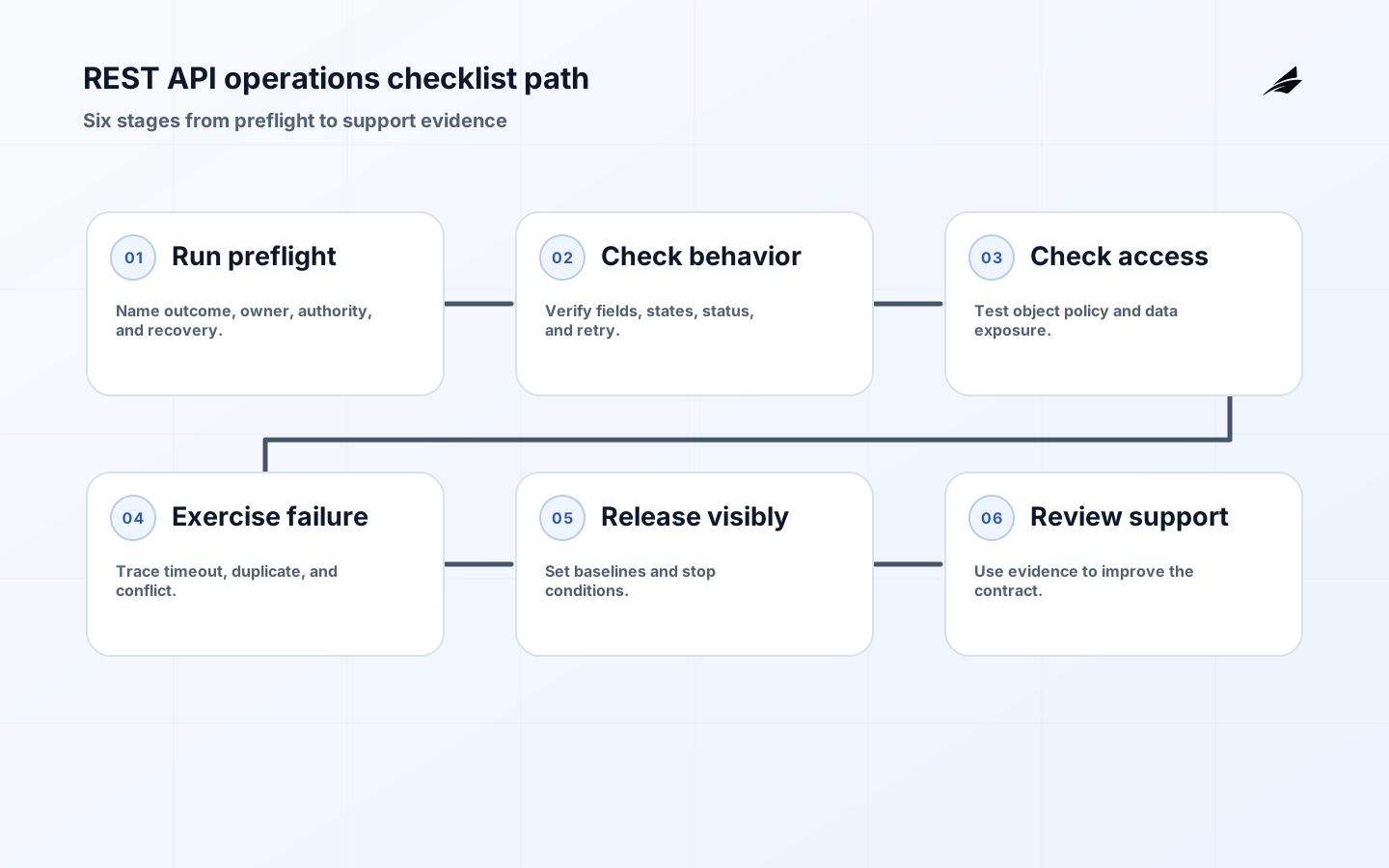
A REST API contracts checklist is most useful when it helps an operator decide what to do under pressure. A list of routes and fields can show what a service claims to accept, but it does not say whether a request completed, whether a retry is safe, whether a caller may see an object, or how a dependency failure reaches the user. This operational version starts with the outcome and walks through the evidence needed before and after release. It uses OpenAPI 3.1 for the machine-readable interface, HTTP Semantics for protocol meaning, and secure delivery guidance to keep the checklist attached to production reality.
Run the contract preflight
Write the request journey in one paragraph before checking syntax. Identify the actor, resource, action, source of truth, dependencies, completion condition, and user-visible recovery. Confirm the owner for the contract, the implementation, support, security, and rollback. Then check that the path and operation names reflect the resource rather than an internal function. Make the first success example concrete, but reserve time for invalid, unauthorized, duplicate, delayed, and unavailable cases. A preflight is complete when another person can explain what the service promises without opening the code.
| Checklist item | Pass condition | Artifact |
|---|---|---|
| Outcome | Caller knows what completed means | Journey and state example |
| Authority | Resource owner and access rule are named | Role or policy reference |
| Contract | Request, response, error, and side effect are explicit | OpenAPI entry and examples |
| Recovery | Timeout, retry, and support path are defined | Runbook and correlation rule |
| Change | Owner knows what may break and how to stop | Impact note and rollout condition |
Check request and response behavior
Verify required fields, formats, limits, pagination, ordering, time zones, numeric precision, and state transitions. For every response, ask whether it means completed, accepted, pending, empty, or rejected. Define how clients should handle unknown fields and whether an omitted field differs from an explicit null. Use HTTP methods and statuses according to their meaning; an operation that queues work should not look identical to one that committed the business result. If a request can be repeated, state its idempotency key, deduplication window, and final reconciliation behavior.
Check access and exposure at the object boundary
Confirm authentication, object-level authorization, field visibility, tenant isolation, and administrative actions. Test an authorized caller against another user's identifier, a permitted role against a forbidden action, and a response containing sensitive fields. The OWASP API Security Project is a useful authoritative cross-check for broken object authorization, excessive data exposure, resource consumption, and inventory. Do not treat a route hidden from documentation as protected. The checklist should name the policy owner, the deny response, the audit record, and the way support can resolve a legitimate access problem without asking engineers to bypass the rule.
| Failure or risk | Contract check | Operational response |
|---|---|---|
| Invalid input | Field-level error and no unsafe side effect | Correct input; do not retry unchanged |
| Forbidden object | Consistent deny without data leakage | Request approved access or show a safe state |
| Duplicate request | Idempotency or explicit duplicate outcome | Reconcile once and preserve the original result |
| Slow dependency | Timeout and pending or temporary error | Back off, preserve intent, alert owner |
| Resource abuse | Rate, size, and concurrency limits | Throttle with visible reason and review demand |
Design the failed request as a supported state
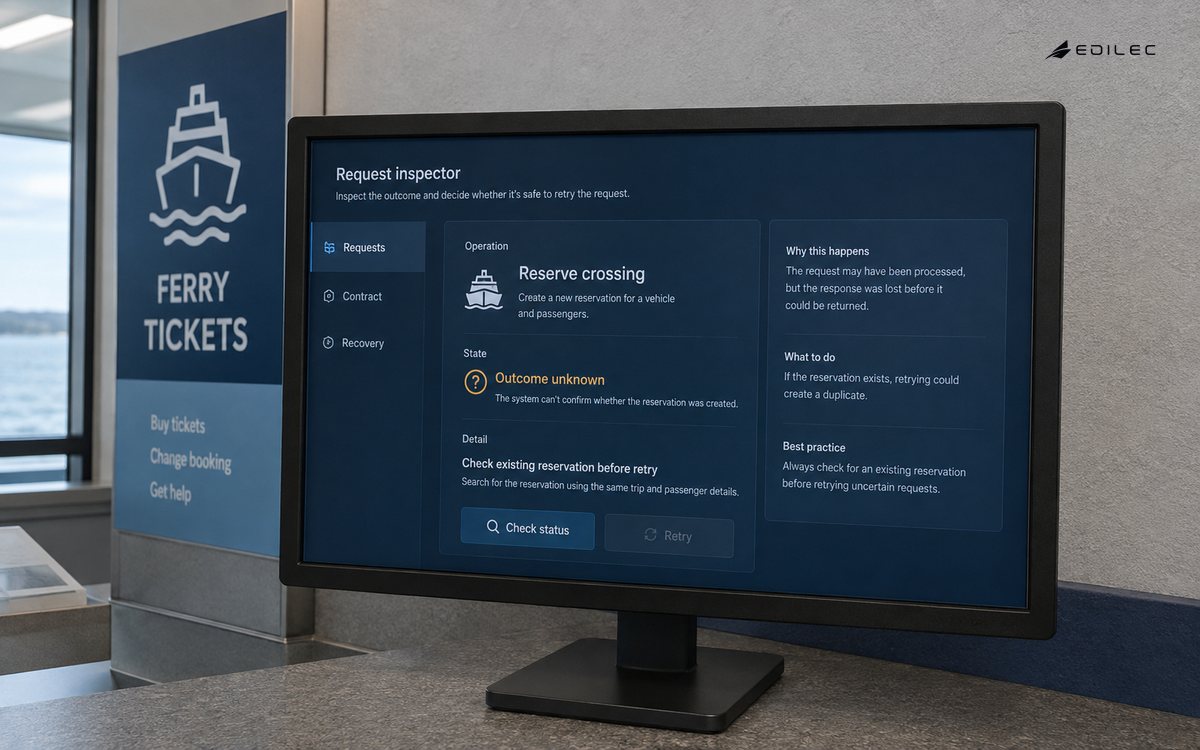
A failure contract is more than a status code. Give the client a stable category, safe detail, a correlation identifier, and a next action where one exists. Distinguish a user correction from a retryable outage and a conflict that needs fresh state. RFC 9457 Problem Details is a useful reference for the structured shape, but the local contract still decides which types and details are safe. Keep internal stack traces and credentials out of responses, but retain enough server-side context for investigation. Test when the client loses the response after the server commits; this is where idempotency and reconciliation earn their place. The related error handling checklist can extend the review into escalation and recovery.
Run contract tests at two seams
Provider tests check that the server implements the documented response, status, and side-effect rules. Consumer tests check that a real caller handles permitted variation, error categories, and pending states. Add a contract fixture for every high-impact operation and run it against representative data shapes, not only an empty database. Include unauthorized, stale, duplicate, and dependency-failure cases. Keep the contract revision and fixture version in test output so a failure after release can be linked to the change that introduced it. A schema validation pass without behavior coverage is not enough.
Roll out with a visible stop condition
Choose a narrow audience or operation for the first release. Define the baseline for latency, error category, validation failures, duplicate effects, and customer support demand. Add release annotations to telemetry and identify the person who can pause traffic or revert the implementation. If a compatibility adapter is involved, measure adapter use and set a removal condition. The NIST Secure Software Development Framework is a useful wider reference for secure design and verification; this checklist translates that discipline into the actual API change and its evidence.
Observe contract health after launch
Track operation, version or contract revision, caller class, authorization result, validation category, latency, response size, retry, and dependency outcome. Segment by tenant or partner where a global average could hide a failure. Review error samples with sensitive data removed and connect correlation identifiers to user-visible support cases. Look for signals that the contract is ambiguous: clients retrying successful requests, polling too aggressively, treating pending as complete, or using undocumented fields. Turn those observations into examples, tests, or a changed contract instead of a dashboard-only warning.
Close the checklist with a human review
Before marking the change ready, ask an engineer, operator, and product or support owner to trace one normal result and one difficult result. Can they identify the authoritative record, explain the error, locate the evidence, and name the next action? If not, the contract is not ready even if automation is green. Keep a short decision record with assumptions, accepted limitations, owner, rollout window, and reconsideration date. Related authentication flow checks matter when identity or session behavior is part of the route, and test strategy checks help verify the seam cases.
Turn the checklist into a release runbook
A checklist becomes operational when each item names a verifier and an observable result. Put the contract artifact, examples, test command, deployment step, dashboard, alert, rollback or traffic-control action, and support contact in one runbook. For a change that affects a stateful workflow, add the query or report that proves the final business result. The runbook should describe what to do if the request succeeds but the response is lost, if a dependency becomes slow, or if a consumer sends an old representation. Those cases determine whether the system is recoverable, not just whether it is reachable.
Let support rehearse the difficult case
Ask a support or operations teammate to use the documented correlation identifier to answer a customer who says an action is stuck. They should be able to tell whether the request is pending, rejected, duplicated, or completed; identify the authoritative record; and choose a safe next action without asking a developer to inspect private logs. If the answer is not clear, improve the response contract, telemetry, or runbook. Support language is part of the API promise because the customer experiences the result through both the client and the people who explain it.
Close the rehearsal by recording what the customer should do next and what the team should not do. A manual retry may be safe for a read and unsafe for a charge; a support agent may need to offer a status lookup rather than ask the customer to submit again. Preserve that distinction in the runbook and the response examples. Revisit it whenever an endpoint gains a new side effect or dependency so the checklist continues to describe the actual risk.
| Runbook step | Expected result | Owner |
|---|---|---|
| Preflight | Contract and examples match the intended workflow | API owner |
| Release | Version, revision, and change marker are observable | Delivery owner |
| Failure test | Timeout, duplicate, and access cases have safe outcomes | Engineering and security |
| Customer trace | Support can find status and next action | Operations or support |
| Review | Baseline and post-release evidence are compared | Product and API owner |
Keep the runbook versioned with the contract and remove steps that no longer describe the system. A stale checklist creates false confidence just as a missing one creates uncertainty. The goal is a small, repeatable release conversation that makes the contract observable to people outside the implementation team.
REST API contracts checklist takeaways
- Start with a user-visible outcome, owner, authority, completion state, and recovery route.
- Check semantics, validation, idempotency, pagination, and status behavior—not just schema shape.
- Test object authorization and sensitive-data exposure with negative examples.
- Treat failure as a supported state with a safe message, correlation, and next action.
- Release with baselines and stop conditions, then use production behavior to improve the contract.
REST API contracts checklist FAQ
What should be kept in OpenAPI?
Keep paths, parameters, schemas, responses, security requirements, examples, and documented constraints that tools and consumers need. Link to the deeper decision record for business completion, retry, support, and operational details that cannot be captured clearly in the schema alone.
How do we decide whether a client may retry?
Classify the method and side effect, define idempotency or deduplication, state timeout behavior, and test the case where the response is lost after the server acts. A generic instruction to retry temporary errors is unsafe for a non-idempotent operation.
Who maintains the checklist?
The API owner should keep the contract and lifecycle current, but the checklist is strongest when an operator, security reviewer, and consumer owner contribute evidence for their parts. Change ownership when the service or client changes hands.
Conclusion: use the contract to run the service
A REST API contract is reliable when it guides implementation, testing, rollout, support, and recovery with the same vocabulary. Run the preflight, make behavior and access explicit, exercise failure, observe real clients, and close the loop with an owner. The checklist then becomes a practical operating instrument rather than a document that describes only the route a request took on a good day.