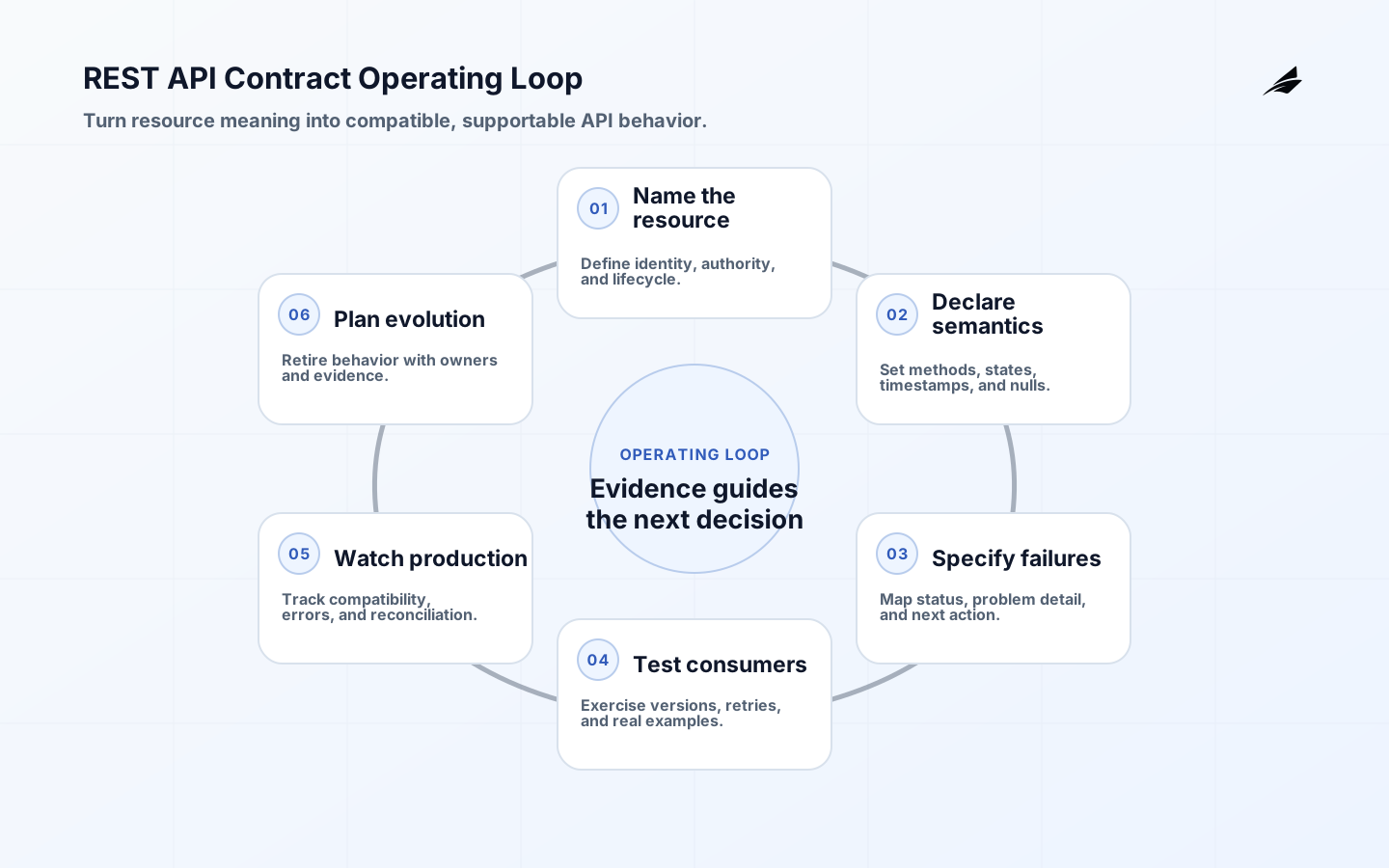
REST API contracts matter when an operations system consumes a vendor endpoint whose undocumented field changes turn a routine status update into an overnight reconciliation exercise. This guide is for operations leaders who need to treat REST API contracts as operating agreements with clear resource meaning, change rules, and recovery behavior. The planning unit is a resource interaction defined by its consumer, authority, representation, validation rules, error cases, and change policy. That framing keeps the work tied to a decision people can inspect, rather than to a tool purchase or a collection of isolated tickets.
Define the on-call contract before the endpoint
REST API contracts are operational agreements because an API turns one team’s record into another team’s action. A route is not enough. Define the resource in business language, its stable identifier, the system that owns each fact, and the time at which a value becomes authoritative. An operations leader should be able to ask, “If this delivery status changes, who may change it, what evidence supports it, and which downstream process will act?”

| Question | Working rule | Evidence to collect |
|---|---|---|
| Outcome | Name the decision or task that must improve. | an operations system consumes a vendor endpoint whose undocumented field changes turn a routine status update into an overnight reconciliation exercise |
| Authority | Identify who owns the fact and who may change it. | a resource interaction defined by its consumer, authority, representation, validation rules, error cases, and change policy |
| Risk | Describe the costly failure before selecting technology. | publishing endpoint names without agreeing what a status, identifier, timestamp, or error means to the people running the process |
| Measure | Choose a signal that can change the next investment decision. | integration failures after releases, contract-test results, undocumented-field use, client upgrade lead time, reconciliation defects, and error recovery time |
Trace callers, resources, and recovery owners
HTTP already supplies a vocabulary for request and response semantics. Use it accurately instead of creating private conventions that every client must rediscover. RFC 9110 distinguishes safe and idempotent methods, conditional requests, and response status meanings. The contract must still document application semantics: a PATCH may be syntactically accepted but rejected by a business rule, and a 202 may mean work has been accepted rather than completed.
For REST API operations, map the path from request to outcome with the people who operate it. For REST API operations, include entry points, systems of record, permissions, dependencies, handoffs, and the place where a person can correct an exception. For adjacent implementation concerns, read What Changes When API Versioning Moves into Production, What Changes When Error Handling Moves into Production, and What Changes When Background Jobs Moves into Production. For REST API operations, these related guides help distinguish a local implementation choice from the wider delivery practices that keep a service understandable.
| Boundary | Decision to make | Operational check |
|---|---|---|
| Input | Define identity, required fields, and validation responsibility. | Can an invalid REST API contracts request be rejected with a useful reason? |
| Authority | State the source of truth and who can override it. | Can a reviewer explain which record or rule produced the REST API contracts result? |
| Change | Version behavior that clients, users, or operators rely on. | Can the team deploy a compatible change and observe its effect? |
| Recovery | Give failures an owner, reference, and safe next action. | Can support resolve a disputed case without an unsafe workaround? |
Instrument one incident-ready API path
Representations need to make time and absence clear. State whether timestamps are creation, effective, observation, or update times; state the timezone and precision; distinguish an omitted field from a known null; and give identifiers a lifespan. These decisions matter during reconciliation. A customer service tool cannot correctly explain a dispute if it cannot tell which version of a resource a partner saw or whether an upstream correction arrived after the local action.
An OpenAPI description can make a contract reviewable, generate clients, and focus testing, but it is not proof that the system behaves as described. Pair the description with examples from real cases, consumer-driven or integration tests, and a named change owner. Test pagination, filtering, authorization, partial failure, rate limiting, and long-running jobs. Those are the areas where a tidy schema often gives way to operational ambiguity.
- Write one REST API contracts decision record with owner, boundary, and success condition.
- Collect ordinary, invalid, delayed, and contradictory examples before estimating broad scope.
- Assign an accountable operator for exceptions and a named escalation path.
- For REST API operations, add correlation references that connect the user-visible outcome to supporting records.
- Test the recovery path as deliberately as the successful path.
- Review integration failures after releases, contract-test results, undocumented-field use, client upgrade lead time, reconciliation defects, and error recovery time after the first release before expanding the design.
Gate dangerous changes with reversible checks
Design errors for recovery. A client needs to know whether it should correct input, wait, retry with the same request key, or escalate a business exception. RFC 9457 provides a common envelope for problem details; define stable type URIs and an instance reference that support can use. Do not leak stack traces or infrastructure identifiers merely to make an error feel detailed.
Turn HTTP standards into local runbook rules
For REST API operations, the design choices above should be checked against primary guidance and then tested against local constraints. Useful references include RFC 9110: HTTP Semantics, RFC 9457: Problem Details for HTTP APIs, OpenAPI Specification, OWASP API Security Top 10. For REST API operations, these sources explain standards and supported behavior; they do not replace the organization’s own decision about owners, legal obligations, service targets, and user impact. In this REST API contracts context, turn the guidance into concrete configuration, review evidence, and runbooks that a team can use during a release or incident.
Measure caller impact and operator workload
Change management must respect consumers that do not deploy on your schedule. Additive fields can still create trouble when clients assume a closed shape; changed meanings are usually more dangerous than changed syntax. Announce deprecations with a timeline, measure actual consumer use before removal, and offer a migration path with comparison examples. Versioning is a policy for preserving meaning, not simply a segment in a URL.
Operate contract health as a shared measure. Track errors by consumer and operation, failed schema checks, payload-validation rejections, and reconciliation exceptions. Review a sample of integration incidents with the team that owns the process, not only with the team that owns the gateway. The highest-value fix may be a clearer field definition, a better problem response, or a documented state transition rather than another endpoint.
Make the contract usable at 2 a.m.
Operations leaders experience an API contract through queues, dashboards, runbooks, vendor escalations, and the records that must be reconciled after a partial outage. A document is useful only when it answers operational questions: which request created this record, what does “accepted” mean, how long may a response be delayed, can the action be repeated, and who can correct an ambiguous outcome? Put those answers beside the formal schema instead of hiding them in tribal knowledge.
Use a resource example to separate representation from workflow. A shipment resource might expose status as “labelcreated”, “intransit”, or “delivered”, while a separate command requests a reroute. Treating status as a free-form string or allowing clients to mutate it directly makes ownership unclear. Define who may cause each transition, which precondition is required, and what event or audit record proves the change.
A contract review should include a consumer-facing failure rehearsal. Send a stale version, missing field, invalid state transition, expired credential, throttled request, and delayed dependency response. The review is complete when the client can distinguish a correction from a retry, support can locate the authoritative record, and the owner can explain whether the request was received. This is the difference between a schema check and an operating contract.
Keep compatibility policy proportional to dependency reality. A private service with one coordinated consumer may use a short migration window; a partner API with unknown clients needs explicit deprecation, telemetry, and a support path. Record the evidence used to choose the policy: consumer inventory, request volume, release cadence, and the cost of a bad interpretation. That record protects future teams from treating a local convention as a universal rule.
Key takeaways
- REST API contracts should begin with a real operational decision, not an abstract technology preference.
- Use a resource interaction defined by its consumer, authority, representation, validation rules, error cases, and change policy as the unit of planning and review.
- Make authority, change behavior, and recovery visible before scaling a design.
- For REST API operations, use authoritative guidance as an input, then validate the result with representative local cases.
- Let integration failures after releases, contract-test results, undocumented-field use, client upgrade lead time, reconciliation defects, and error recovery time determine whether the next increment is justified.
REST API contracts become a durable advantage when the team designs the decision, authority, evidence, and recovery path together. Begin with the vendor endpoint whose undocumented field changes turn a routine status update into an overnight reconciliation exercise, keep the first change narrow enough to observe, and use real operating signals to guide the next investment. For REST API operations, that is how a technical choice becomes a service people can trust.
Frequently asked questions
What belongs in a REST API contract?
Resource meaning, representations, allowed transitions, authentication and authorization expectations, status and problem responses, idempotency rules, limits, compatibility policy, and ownership for recovery.
Who should approve an operational API change?
The API owner, a representative consumer or operations owner, and security or privacy reviewers when data or authority changes. The approval should point to tests and a migration or rollback plan.
Is an OpenAPI file enough?
No. OpenAPI can describe many interface details, but it does not by itself define business authority, reconciliation, support ownership, or the meaning of an ambiguous outcome. Pair it with examples, scenarios, and a runbook.
Conclusion
A dependable REST API contracts decision is visible in resource meaning, operating promises, ownership, and evidence. Start with one complete workflow, rehearse the uncomfortable response, and expand only when callers and operators can recover it without private context.