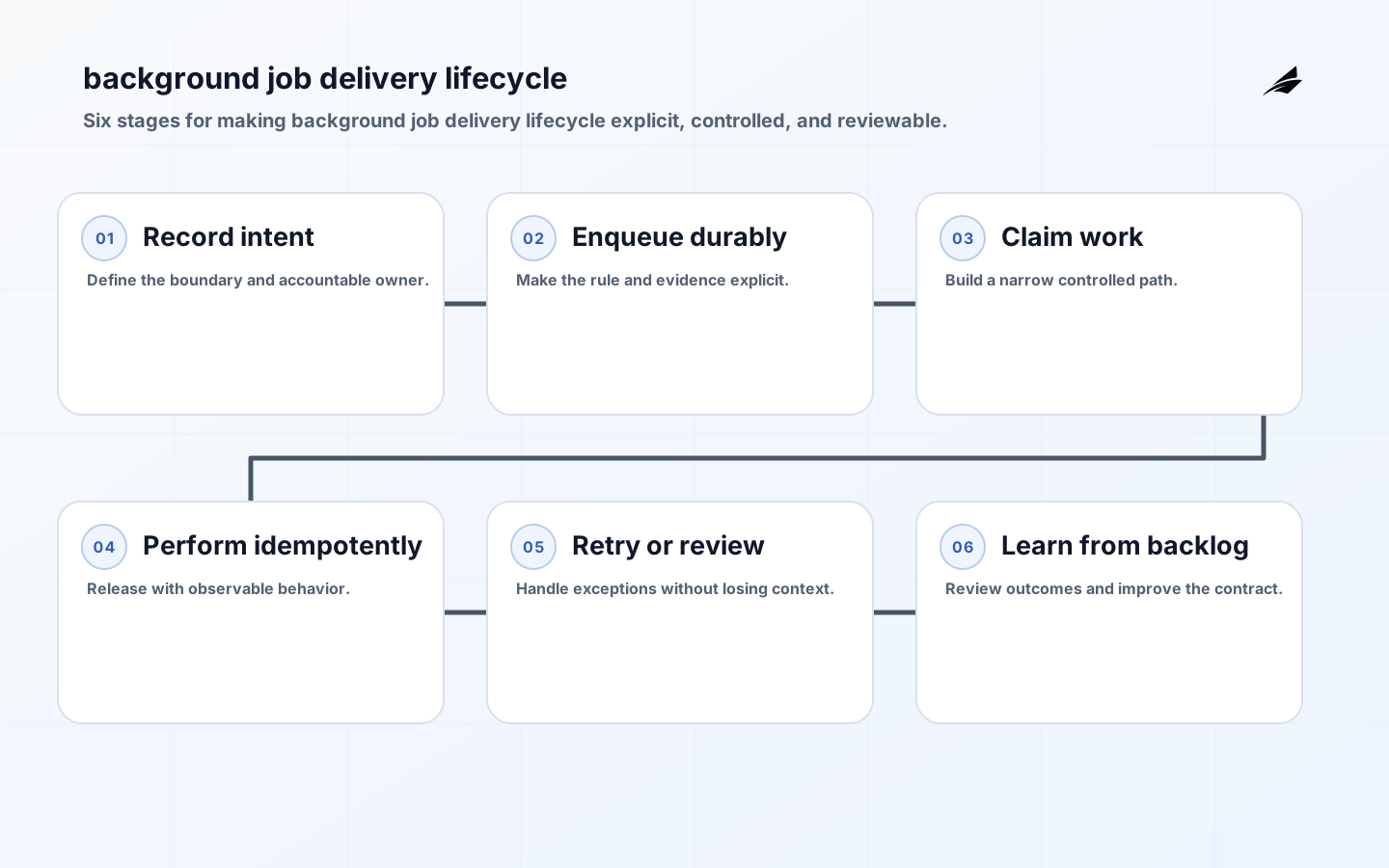
Background jobs is a decision system, not a framework setting. It matters when application, queue, and support owners need a shared answer about durable intent, job identity, idempotent effect, retry class, deadline, and final state. The practical test is whether an action can be performed, explained, and corrected using evidence the team can trust. The first failure often appears when duplicate delivery or an invisible poison job creates repeated work or lost outcomes. Start with a request accepts work that must survive process and dependency failure. That scope is concrete enough to expose dependencies, ownership, and exception handling before a team builds an overly broad platform around assumptions that cannot be tested.
Model the background jobs decision
Write the decision in ordinary language. For background jobs, the durable facts are durable intent, job identity, idempotent effect, retry class, deadline, and final state. Each fact needs a source, a lifecycle rule, and an owner when it changes. A browser state, old cache entry, or support note can be useful context, but it should not silently become the authority for a consequential result. Model both the normal path and the disputed path so a reviewer can reconstruct inputs, applied rule, and defensible outcome.
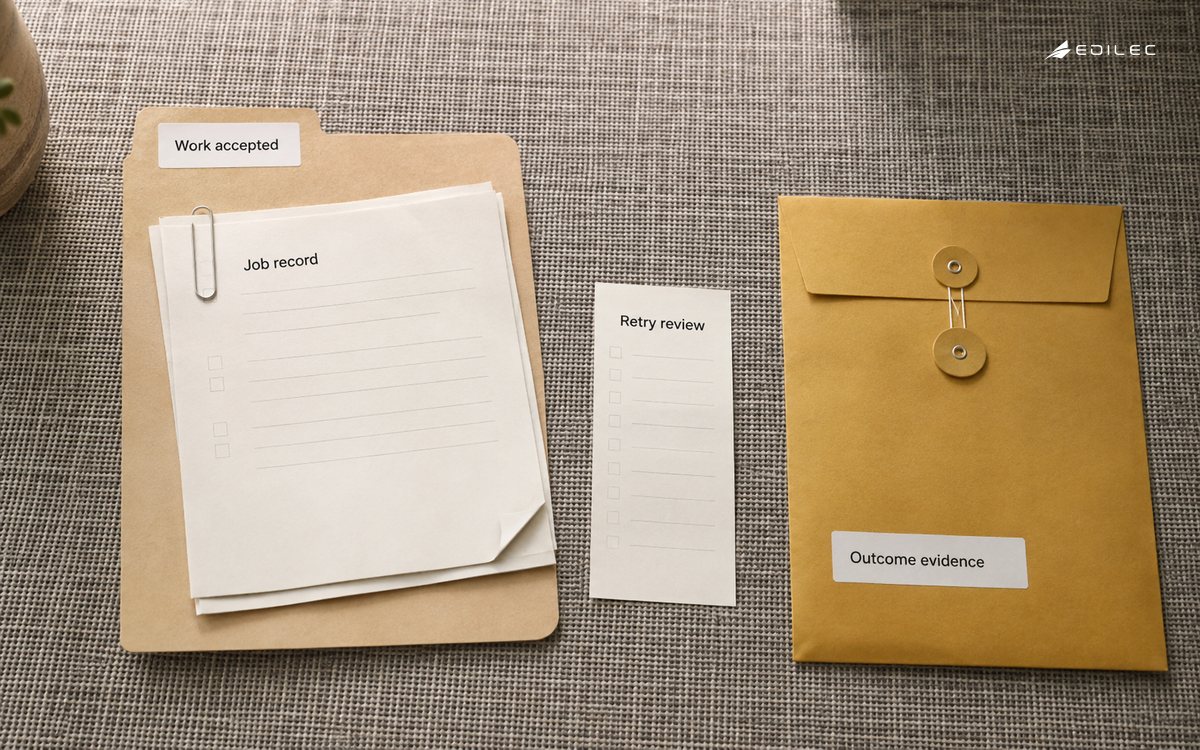
This model also prevents teams from confusing a component boundary with a business boundary. The same background jobs decision can cross a user interface, service, worker, and vendor dependency. Give each layer a narrow responsibility, then preserve the evidence needed for the next layer. When inputs disagree, the system should choose a documented safe state and surface the disagreement. That is more reliable than allowing timing or implementation detail to decide the customer outcome.
| Decision | What to define | Evidence |
|---|---|---|
| Boundary | durable intent, job identity, idempotent effect, retry class, deadline, and final state | Named owner and written example. |
| Failure | duplicate delivery or an invisible poison job creates repeated work or lost outcomes | Negative-path test and customer response. |
| Control | durable handoff, idempotency key, bounded retries, dead-letter review, and operator controls | Release check with accountable reviewer. |
| Observation | queue age, attempt count, backlog, failure class, next run, and final outcome | Trace or report that supports diagnosis. |
Design the boundary before choosing tools
The boundary for background jobs is where a local implementation detail becomes a dependency for another person, service, or release. Define allowed inputs, expected results, identity or tenancy context, and behavior when a dependency is late or incomplete. Keep the first contract narrow: one comprehensible decision is more valuable than a broad surface that relies on undocumented assumptions. Record which changes are additive, which need a migration, and which must wait for an accountable policy decision.
For founders working on background jobs, this operating decision should connect interface contracts, state changes, dependency behavior, authorization, and recovery to evidence an accountable owner can inspect. Design reviews should ask what a customer sees when the rule cannot be evaluated, not only what happens when it succeeds. The answer may be a retryable state, an explicit refusal, queued work, or a route to support; it should never be accidental. The team also needs a versioning rule for the evidence itself. If a field, policy, or state meaning changes, preserve enough context to explain past outcomes without pretending historical records follow a new rule. In this field review, move beyond the operating decision only after the owner can show the accepted result, the exception path, and the signal for another review.
Build one controlled path
Build controls that match the risk: durable handoff, idempotency key, bounded retries, dead-letter review, and operator controls. Exercise negative behavior while implementing the normal path: missing input, stale state, duplicate work, delayed dependency, changed permissions, and a person who needs an explanation. Keep correction separate from ad hoc production edits. A controlled repair should enforce the same invariants and leave an event that can be reviewed later. This narrow path produces learning because failures remain linked to explicit assumptions.
In background jobs, founders should make the relationship between interface contracts, state changes, dependency behavior, authorization, and recovery explicit and reviewable. Add tests at the smallest boundary that can expose the relevant failure. That can mean a deterministic policy test, an integration fixture, a contract check, or a short end-to-end journey. Avoid relying on a happy-path demonstration. The release should include a way to observe the control under real conditions, a way to stop or roll back a harmful change, and a named person who can decide whether an exception is a defect, an expected edge case, or a policy question. This field review should close the operating decision only when the result, unresolved exception, and next review condition are recorded.
| Review question | Good answer | Warning sign |
|---|---|---|
| What is authoritative? | A named record and current owner. | Several systems silently disagree. |
| What happens on failure? | A bounded safe recovery action. | People improvise around the workflow. |
| How is change released? | A tested compatibility or migration path. | Every consumer must change at once. |
| What changes the decision? | A measured operating signal. | Success is inferred from anecdotes. |
Operate with evidence
Production evidence for background jobs should help a person reconstruct an outcome without storing secrets or raw customer payloads. Record queue age, attempt count, backlog, failure class, next run, and final outcome. Use an opaque correlation reference to connect a customer report, trace, and operational event. Review complete and exceptional cases with the people who own the workflow. Repeated manual intervention is evidence that the boundary is incomplete, not simply a cost to absorb.
A dependable background jobs design makes interface contracts, state changes, dependency behavior, authorization, and recovery visible to the owner responsible for this information boundary. An operating review benefits from reading a small sample of real journeys from beginning to end. Did the record match what the customer saw? Did the assigned owner have enough context? Did retries, overrides, or migrations preserve the intended rule? This practice finds gaps that a dashboard average can hide. It also creates a useful feedback loop between support, product, and engineering without granting broad access or relying on private knowledge. The next step in this field review is justified when the team can trace the accepted outcome, the fallback route, and the owner of follow-up.
Measure the result, not activity
Choose measures that could change a delivery decision. Inspect the rate and consequence of duplicate delivery or an invisible poison job creates repeated work or lost outcomes, the time needed to resolve a known exception, and whether the intended user can complete a request accepts work that must survive process and dependency failure. Segment by workflow or release rather than treating all traffic as equivalent. Counts of components, tests, cache hits, or deployments are context, not proof that the customer outcome is safe.
This operating signal for background jobs is strongest when interface contracts, state changes, dependency behavior, authorization, and recovery can be reviewed as one operating record. Pair quantitative signals with qualitative evidence. A falling error rate may reflect suppressed reporting; a rising completion rate may conceal people abandoning a difficult step. Review the measures with the owner who understands the user decision, then state what would trigger a pause, a rollback, a policy change, or further investment. The point of measurement is to improve the next decision rather than to decorate a status report. Acceptance in this field review requires a visible outcome, a bounded exception path, and a measurable reason to revisit the decision.
Use authoritative guidance
The following sources provide durable reference points for reviewing background jobs: HTTP Semantics, Problem Details for HTTP APIs, Secure Software Development Framework, OpenTelemetry Observability Primer. Apply them to the actual path rather than copying a checklist. Ask what behavior is promised, what input is trusted, what information is safe to reveal, and what recovery is possible after partial failure. Source material earns its place when it makes a local assumption visible and testable.
Validate background jobs through a complete operating case
Use this field guide to validate background jobs with one complete operating case before widening the scope. Founders should trace one representative user action across the interface, application service, persistence layer, background work, and visible customer result. Begin with the initiating request, identity and tenant context, accepted state transition, dependency response, and correlation record, cross each policy and dependency boundary, and finish in a durable state that a customer or operator can recognize. Record the expected state at every handoff, who may change it, and which evidence proves that the next step was justified. This walkthrough gives product, engineering, security, and support a shared acceptance case instead of allowing each team to assume that another layer owns the transition. Use representative roles, realistic timing, and the constraints that exist during an ordinary operating day.
The field guide should also test a second background jobs case that deliberately challenges the design. Include a repeated request, incompatible payload, delayed dependency, partial write, or authorization disagreement. The purpose is not to demonstrate that every dependency always succeeds; it is to prove that the service can stop safely, preserve useful evidence, and expose the next responsible action. Review contract version, state transition, status family, retry decision, trace identifier, and customer-visible result together so the team can distinguish a policy refusal from bad input, a software defect, a delayed dependency, or an operator decision. A useful result is specific enough for a support or incident owner to act without reconstructing the entire journey from unrelated logs and messages.
Turn both cases into release evidence for background jobs. Keep the input conditions, expected states, observed result, decision owner, and unresolved exceptions in one reviewable record. Define the recovery action in advance: restore a defensible business state, reconcile partial work, make the next owner visible, and verify the customer outcome. Re-run the same cases after a material policy, interface, data, model, infrastructure, or entitlement change so that improvements do not silently weaken an earlier control. For this field guide, readiness means that the normal path is usable, the failure path is understandable, and ownership remains visible after launch rather than ending when implementation work is declared complete.
- Choose one representative background jobs journey and state the customer or operator result in plain language.
- Capture the initiating request, identity and tenant context, accepted state transition, dependency response, and correlation record as evidence, with a named owner for each consequential handoff.
- Exercise a repeated request, incompatible payload, delayed dependency, partial write, or authorization disagreement before broader exposure and verify that the safe state is visible.
- Review contract version, state transition, status family, retry decision, trace identifier, and customer-visible result after release and assign every unresolved exception to a person and date.
Key takeaways
- Treat background jobs as an explicit product and operating contract.
- Name the authoritative record, boundary owner, and safe default for uncertainty.
- Release one narrow path with negative cases, evidence, and recovery.
- Use operating signals to change the contract deliberately rather than accumulating exceptions.
Frequently asked questions
Where should a growing team start with background jobs? Start with one consequential journey, such as a request accepts work that must survive process and dependency failure. Describe the initiating actor, authoritative record, expected result, and exception owner. That model is enough to select a first control, write meaningful tests, and decide what must be visible to support before the topic spreads through every service or screen.
Founders can keep background jobs accountable by recording how interface contracts, state changes, dependency behavior, authorization, and recovery shape this operating decision. How much process is enough? Use controls proportionate to the consequence. A small release does not need a large platform, but it does need a named owner, testable behavior, safe handling of uncertainty, and evidence that support can use. Add complexity only when the workflow demonstrates a real missing control, risk, or customer need. For this field review, the responsible owner should be able to explain what passed, what remains exceptional, and which signal reopens review.
Conclusion
Strong background jobs practice makes change easier without making behavior mysterious. Keep the promise narrow, test it at the relevant boundary, and make recovery visible to people affected by a failure. For adjacent engineering decisions, see A Field Guide to Caching Strategy for Growing Teams, A Field Guide to Test Strategy for Growing Teams, Background Jobs in Production: Delivery, Retries, and Recovery. These connected guides keep delivery, operations, and customer outcomes in the same conversation.