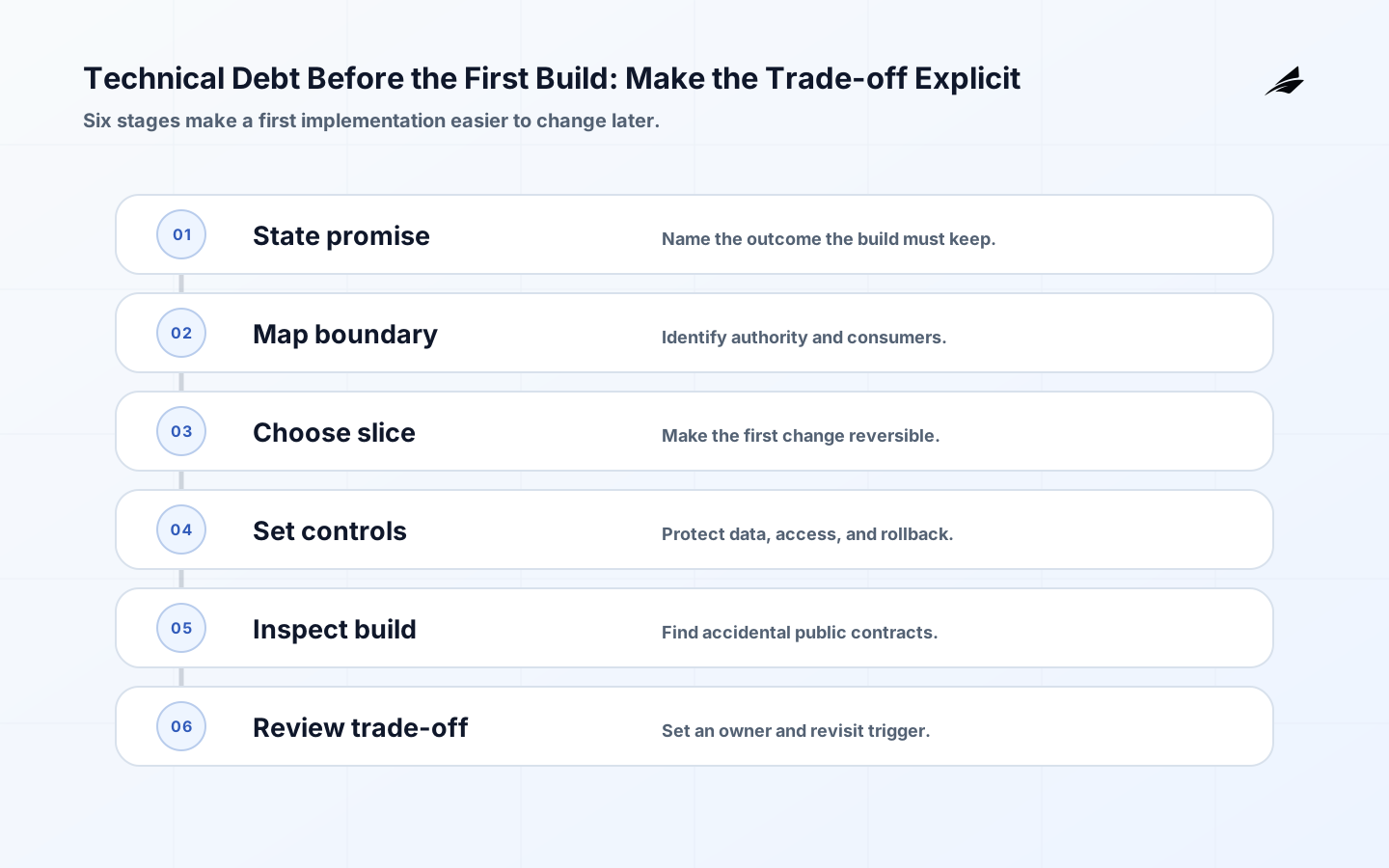
Technical debt starts before code exists when a team accepts a shortcut without recording what it protects, what it makes harder, or when it should be revisited. A first build can create a durable dependency on a shared database, an unowned API, a provider-specific identity claim, an implicit module import, or a manual release step. None of those choices is automatically wrong. The risk is that the team calls them temporary while designing no evidence, owner, or exit condition that would make them temporary in practice.
Use a short decision record before implementation: desired user or operational outcome, authoritative data, trust boundaries, accepted constraints, alternatives considered, owner, evidence required, and a review trigger. The software modernization decision guide helps when the new capability must coexist with an older estate. The code review systems guide shows why review is part of the design control, not merely the last step before merge.
State the promise that the first build must keep
The first build should be framed by a business or operational promise rather than a technology selection. Say who initiates the work, what result they need, how quickly or accurately it must arrive, which records cannot disagree, and what happens when a dependency is unavailable. This makes trade-offs visible. A team may accept a manual approval for a pilot, but it should not accidentally accept lost audit history, unbounded access, or a migration that cannot be reversed. A promise gives reviewers a way to distinguish an intentional simplification from an unsafe omission.
Record the parts that are deliberately not being solved. A small internal tool may defer multi-region recovery while retaining backups and a restore test. A first API may support one representation while documenting an additive change policy. A prototype may use a provider-hosted identity flow while keeping local authorization independent. Writing the boundary prevents the first implementation from becoming a silent claim that the deferred problem does not exist. It also gives product and operations a chance to accept a limitation before customers encounter it.
| Early decision | Example | Debt trigger |
|---|---|---|
| Data authority | Orders remain authoritative in the existing service. | New writes need two records to agree. |
| Access model | The pilot has one admin role with audit logging. | More roles or external users arrive. |
| Provider use | A managed identity service handles sign-in. | Provider claims become local authorization. |
| Release path | A manual approval gates the first deployment. | Release frequency or risk increases. |
| Compatibility | One client consumes the initial API shape. | A second client or public consumer appears. |
Map boundaries before choosing implementation shortcuts
Draw the real journey in enough detail to expose authority and failure. Identify the actor, input, decision point, storage, integration, asynchronous work, notification, and recovery path. Mark where data crosses a trust boundary or where one team becomes dependent on another team’s private implementation. OWASP’s API Security project emphasizes risks such as broken object or function authorization, unrestricted resource consumption, improper inventory, and unsafe consumption. These risks are easier to prevent when the first design names the resource and action rather than relying on a generic authenticated route.
For code boundaries, choose a module or package structure that matches change and ownership. Bazel’s dependency guidance shows why explicit direct dependencies and minimized visibility help teams remove accidental edges as the repository grows. The first build need not use Bazel, but it should avoid importing a sibling’s private folder or hiding a runtime dependency behind a root alias. A narrow boundary is a form of debt insurance: it keeps a local shortcut from becoming a public contract before the team has tested whether the contract deserves to exist.
- Name the resource and action at every protected API boundary.
- Identify the system of record and the conditions for safe disagreement.
- Declare which package, team, or service owns each decision.
- Record external provider limits, version policies, and failure behavior.
- Keep private implementation paths out of reusable contracts.
Choose a first slice that can teach the team
A reversible slice is more valuable than a complete first architecture that has not met a real user. Choose one journey with a bounded record set, a clear owner, and a safe fallback. Keep the old path available when the new path is not yet trustworthy, but define when the fallback may be used and how it will be retired. Avoid building a general platform before the product has shown which concepts are stable. A slice should produce evidence about throughput, data shape, workflow exceptions, support questions, and the cost of change.
Make the slice observable from the start. Record the accepted request, state transitions, decision reason, and outcome. Add a test or probe that would fail if the boundary were bypassed. If an operator must run a manual step, time it and write the exact preconditions. The manual step is not automatically bad; it becomes debt when the team cannot tell whether it is still appropriate or who will automate it when volume or risk changes. A first build earns the right to generalize by showing which assumptions survive contact with use.
Set controls that make the shortcut safe
Every accepted shortcut needs a control that limits its downside. If the first release uses one administrator role, log every privilege-changing action and keep an owner for adding roles. If a third-party API is called directly, set a timeout, rate limit, response classification, and provider reference. If a migration is manual, produce a dry-run report and a rollback or restore procedure. If an endpoint is private, enforce network and identity boundaries at the server rather than trusting an interface not to expose it. NIST’s Secure Software Development Framework is a useful checklist for integrating security practices rather than adding them after a defect.
Keep controls proportionate and testable. A dozen policies nobody can verify is weaker than a few checks that run on every change. Google’s code review guidance asks reviewers to consider design, functionality, complexity, tests, naming, documentation, and style. Use those questions to expose debt early: will another engineer understand the boundary, can a test demonstrate the failure behavior, and does the owner know what must change when the constraint expires? Review comments should produce decisions, not only preferences.
| Shortcut | Control | Review trigger |
|---|---|---|
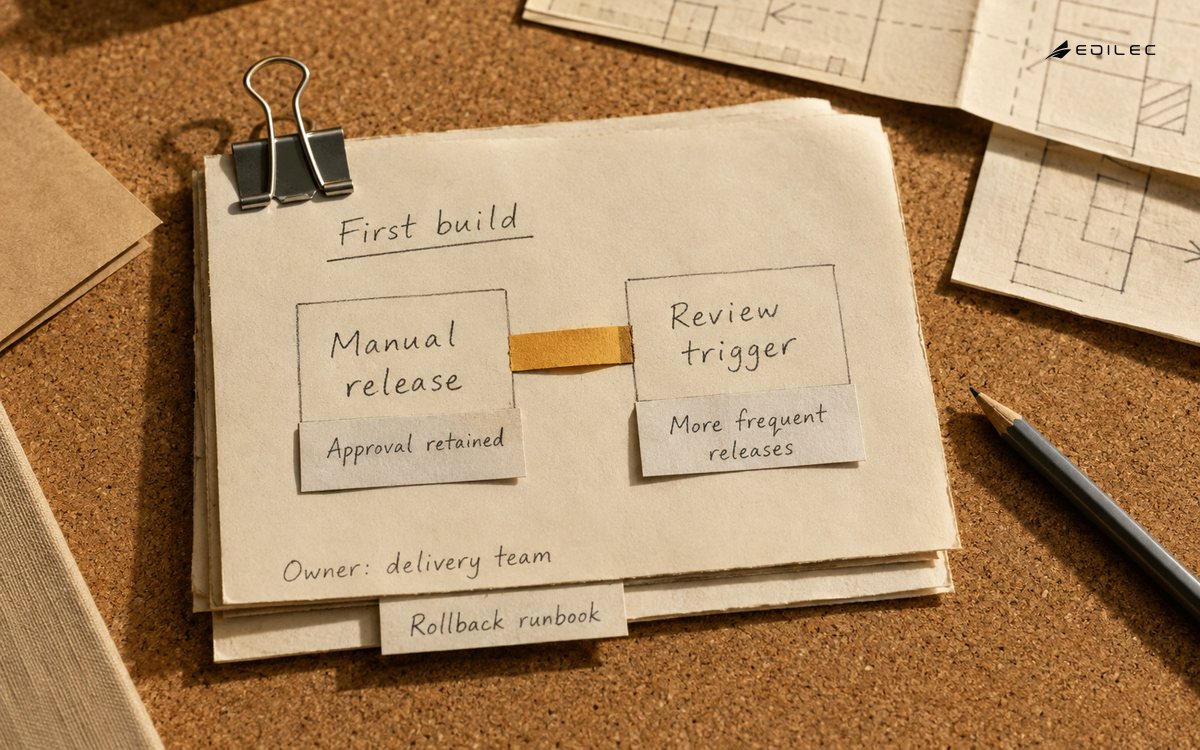
| Manual deployment | Approval, artifact digest, and rollback runbook. | More frequent or higher-impact releases. |
| Shared table | Access policy, owner, and migration compatibility tests. | Second writer or new data sensitivity. |
| Provider dependency | Timeout, rate limit, error class, and fallback. | Volume, outage, or provider contract change. |
| Single role | Audit log and explicit deny for other actions. | More users, tenants, or privileges. |
| Path alias | Runtime resolution test and package export plan. | Package reuse or published artifact. |
Inspect the build for accidental contracts
Before a first build reaches production, look for behavior that became public without a decision. Check response fields, error codes, database columns, event names, package exports, log formats, provider identifiers, and admin actions. A consumer can depend on any of these even if the team calls them internal. Write a compatibility rule for each surface that may persist. Add a deprecation path for fields or modules that are likely to change. The cost of a small record now is lower than explaining an accidental contract to a customer six months later.
Review the code with someone who did not write the original assumption. The best reviewer may be a domain owner, operator, security partner, or future consumer, depending on the risk. Use a small change set so the important design choice is visible. If the review reveals that the boundary cannot be explained without opening five unrelated modules, stop and narrow the slice. A fast merge that makes the next change harder is a debt decision; make it consciously or change the design before it spreads.
Give the decision an owner and a review date
Debt becomes invisible when it lives only in a meeting or a founder’s memory. Put the decision record near the implementation and link it to the tests, runbook, issue, and provider contract that support it. Name the person or team who can decide whether the shortcut still fits. Set a date or event for review: the next customer cohort, the next release volume, a security change, or the arrival of a second consumer. A review date is not a promise to rewrite; it is a promise to look at evidence before the constraint becomes expensive.
Use signals that reflect the original promise. Track change lead time, manual intervention, failure recovery, access exceptions, support questions, build duration, or migration effort as appropriate. Do not create a universal debt score. If the first implementation continues to meet the promise and the shortcut creates little interest, leave it alone and record why. If the signal worsens, choose the smallest repair that changes the cost. The API versioning guide illustrates this principle: compatibility policy should follow real consumers and change risk, not a template.
Choose the next improvement from evidence
At the review point, decide among four paths: keep the design with a documented control, add a narrow boundary, migrate a data or dependency surface, or start a larger program. Explain what evidence changed the decision. If the team chooses to keep the shortcut, note the next trigger. If it chooses repayment, define the slice, compatibility window, owner, and completion proof. This practice prevents both reckless rewrites and indefinite acceptance. The goal is not a debt-free system; it is a system where the cost of change is visible and governable.
Make the first build teach the organization how to decide. Product should see which promise is protected, engineering should see which boundary is stable, security should see which control reduces exposure, and operations should see how to restore or explain the path. When those perspectives meet before the first build, technical debt becomes an intentional trade-off with a repayment option rather than an accusation discovered after the system succeeds.
- State the promise, constraints, and deliberately deferred work.
- Map data, identity, package, API, and operational boundaries.
- Select a reversible slice that produces useful production evidence.
- Add controls for every shortcut with a meaningful downside.
- Inspect accidental contracts before consumers depend on them.
- Review signals and choose the next improvement deliberately.
The recommendations here are grounded in inspected primary guidance: Secure Software Development Framework, Google Engineering Practices: Code Review, OWASP API Security Risks, Bazel Dependency Management, About Code Owners. These sources establish early security, review, dependency, and ownership controls; this guide uses them to make first-build trade-offs explicit.
Takeaways for technical debt before the first build
- Frame the first build around a promise and an explicit scope boundary.
- Map authority, package, API, data, and provider edges before implementation.
- Choose a slice that can be observed, supported, and safely reversed.
- Pair every accepted shortcut with a control and review trigger.
- Inspect accidental contracts before they reach more consumers.
- Use production evidence to decide whether to keep, control, or repay the debt.
Questions about technical debt before coding begins
Can a prototype create technical debt?
Yes, if its interfaces, data, deployment path, or provider assumptions are reused without being examined. A prototype can be valuable learning, but record which behavior is experimental and prevent it from becoming a silent public contract.
How much architecture should be decided before the first build?
Decide the boundaries that protect user outcomes, authority, data integrity, security, and reversibility. Leave details that depend on real usage open, but add a way to observe them. The right amount is enough to make the first slice safe and informative.
Who should own an early technical debt decision?
The team accountable for the capability should own the decision, with product, security, and operations involved when their risks are affected. Ownership should include the review trigger and the authority to accept, control, or repay the shortcut.
Conclusion: make the first build easier to change
Technical debt is easiest to manage before a shortcut becomes a dependency. State the promise, map the boundaries, choose a reversible slice, add controls, inspect accidental contracts, and review the evidence. That discipline lets a team move quickly while keeping future choices open and the cost of change explainable.