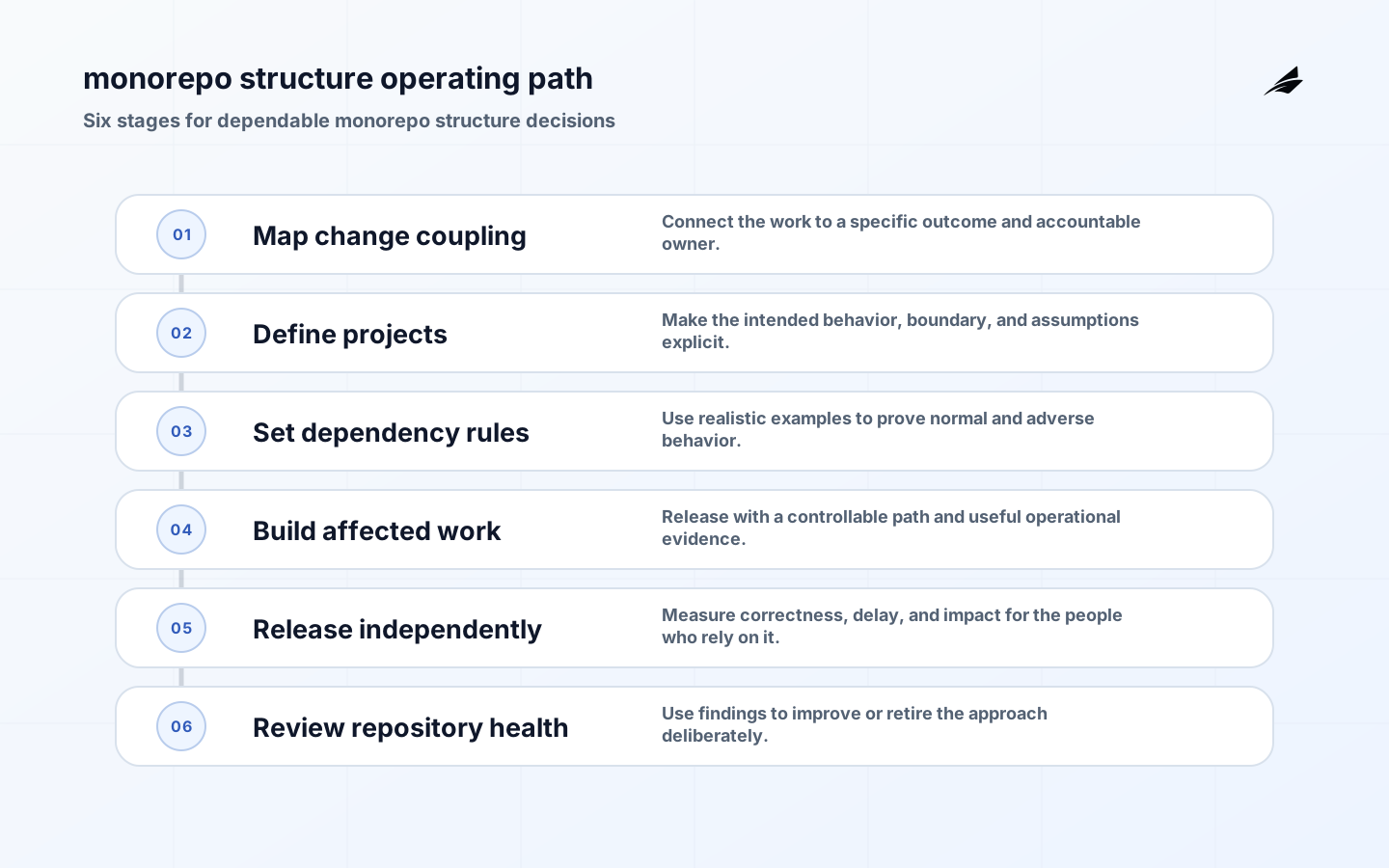
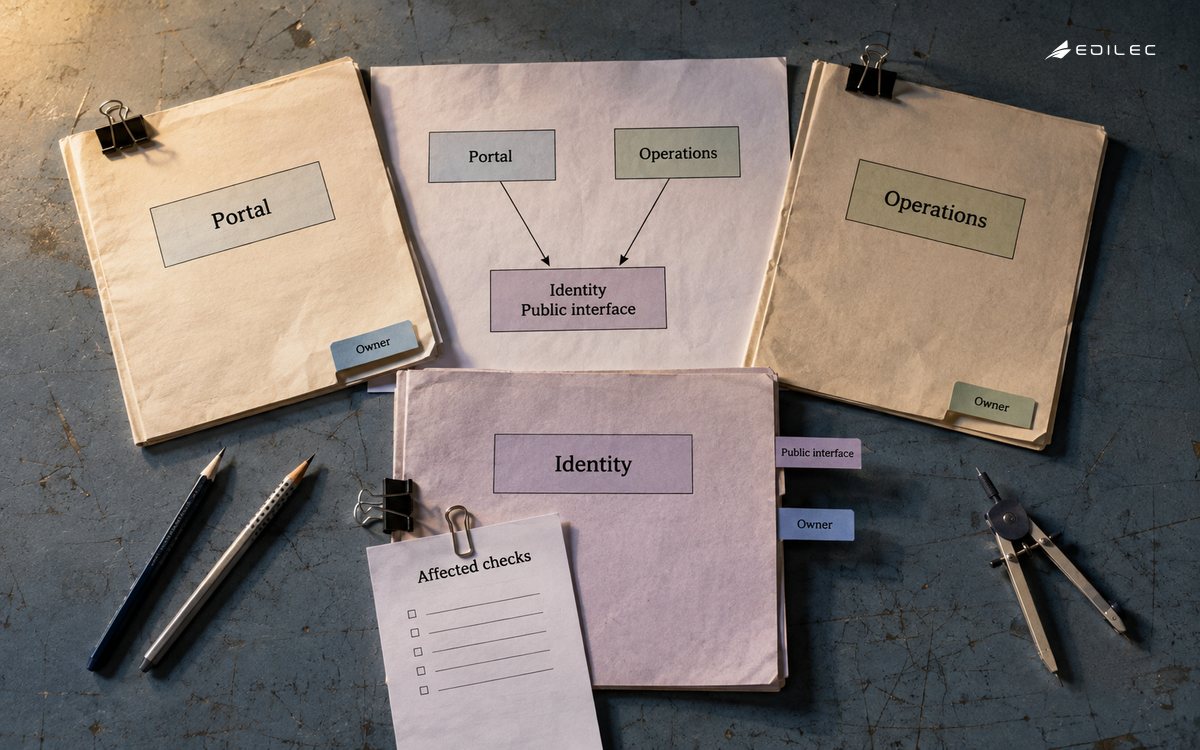
Monorepo structure is an operating decision, not a technology label. A customer portal, an internal operations tool, and a shared identity package evolve together, yet each deploys on its own schedule. Separate repositories can make a cross-cutting change difficult to discover; one large repository can make every developer pay for irrelevant builds and unclear ownership. The question is not whether one repository is fashionable. It is whether the code that must change together can be understood and verified together. This guide helps IT managers turn monorepo structure into a clear promise, a delivery path, and a reviewable operating practice. The aim is not to remove every trade-off. It is to make the trade-off explicit enough that a team can change the system without guessing who depends on it or how failure should be handled.
Start monorepo structure with an outcome and a boundary
Begin with the user or operational outcome that monorepo structure must improve. Name the decision-maker, the data or behavior that is authoritative, the expected time boundary, and the consequence of a wrong result. A sound monorepo structure defines projects, their public interfaces, allowed dependency directions, owners, and the commands that prove a change is safe. Directory placement alone is not an architectural boundary. TypeScript project references can partition builds and improve build times when projects are configured as composites, but they do not prevent an application from reaching into another package's internals. Pair build structure with import rules and code review ownership. The useful test is whether a new engineer and a support owner can explain what the system promises without reading implementation details.
| Decision area | Question to settle | Evidence to retain |
|---|---|---|
| Outcome | Which user or business result must improve? | A concrete scenario and success measure. |
| Boundary | What belongs inside this capability and what remains external? | Owner, interface, and dependency map. |
| Failure | What can safely retry, wait, or require review? | Recovery rule and escalation route. |
| Change | Who approves a behavior change and how is impact checked? | Decision record, test evidence, and rollout plan. |
Define the monorepo structure promise
A promise turns a broad engineering intention into behavior a team can verify. State the inputs, permitted transitions, output, permissions, timing, and recovery rule in language that product, support, and engineering can all use. Avoid a promise such as “reliable” or “scalable” without a context. Instead, say what happens when data is delayed, a caller retries, a worker is unavailable, or an operator needs to correct a record. This is also where monorepo architecture becomes concrete rather than decorative.
- What real decision or workflow makes monorepo structure worth maintaining?
- Which actor owns the authoritative change, and which actors only observe it?
- What invalid, delayed, duplicate, or denied case must the design handle?
- Which contract, state, or dependency can a reasonable consumer rely on?
- What evidence will show that the intended outcome occurred?
- Who can pause, repair, or roll back the behavior during an incident?
Build monorepo structure in small, testable slices
Do not begin by standardising every adjacent system. Map the existing deployment units and repeated libraries, then begin with a small workspace rather than moving every repository at once. Give each package a clear name, tested entry points, and a single responsibility. npm workspaces can manage local packages; use the package manager as a mechanism, not as the policy. Build affected projects in continuous integration, cache only trustworthy outputs, and make a change to shared configuration visible to the right owners. Keep the first slice narrow enough that its normal and failure paths can be exercised before its assumptions spread. test strategy provides useful adjacent context when the work crosses an existing service or workflow boundary.
Use examples as design material: one ordinary case, one boundary case, one invalid request or state, one delayed dependency, and one correction. Review the examples with the people who will operate the result. A technically valid implementation can still be wrong if it leaves a support owner unable to explain a disputed outcome or a user unable to recover from a predictable interruption. For Monorepo Structure: A Practical Guide for IT Managers, make those examples part of the review record so later changes preserve the same decision.
| Stage | Practical choice | Check before progressing |
|---|---|---|
| Discover | Map users, owners, data, and dependencies. | The team agrees on the problem and scope. |
| Design | Write behavior and recovery examples. | Important states and permissions are explicit. |
| Deliver | Release one bounded path with instrumentation. | Normal and adverse cases have been tested. |
| Operate | Review outcome and exception signals. | An owner can diagnose and improve the path. |
Operate monorepo structure with evidence
Measure queue time, affected-build duration, flaky checks, dependency violations, release coordination, and time spent finding a code owner. A monorepo does not require one release train, nor does it eliminate independent deploys. It should make dependency evidence cheaper to obtain. Bazel's concepts illustrate why declared dependencies and reproducible targets matter when a repository grows. Use a small set of measures that connects implementation behavior to the intended workflow. For example, separate a technical signal such as timeout rate from a business signal such as completed corrections. Review the measures at a regular cadence and include the people who handle exceptions; they often see the first mismatch between a documented promise and an actual customer journey.
Avoid common monorepo structure failure modes
A frequent failure is centralising code without a boundary model: shared becomes a drawer for unrelated helpers, and every application imports whatever it finds. Another is forcing every check on every pull request. Both make the repository feel slow and opaque. Treat the migration as a product change with owners, dependency rules, and an escape hatch for genuinely independent systems. Treat these as design signals, not reasons to abandon the approach. The corrective move is usually modest: name the owner, constrain the interface, add one realistic test, preserve a correlation record, or delay retirement until the relevant users have moved. code review systems is a useful companion when the issue is a broader change or reliability concern.
- No one can name the consumer, owner, or support route for a behavior.
- A successful technical response is mistaken for a completed business outcome.
- Recovery depends on an undocumented manual step or a single person’s memory.
- Metrics show volume but not correctness, delay, or user impact.
- A migration or shared abstraction has no retirement condition.
- Production evidence contradicts a design assumption but the documentation is unchanged.
Use a monorepo structure implementation checklist
Use this checklist as a conversation before release, not as a ceremonial sign-off. Each answer should point to a test, a visible behavior, an owner, or an operational record. For deeper delivery confidence, pair the work with TypeScript architecture and revisit the plan when the first production evidence arrives. In this KM-SW-0036 implementation, the checklist should be reviewed by the people accountable for monorepo structure.
- Write the monorepo structure outcome, owner, boundary, and failure consequences in plain language.
- Capture normal, boundary, denied, delayed, duplicate, and correction examples.
- Define an interface or state model that makes the permitted behavior inspectable.
- Protect access and sensitive data at the service boundary, not only in the user interface.
- Release behind a controllable rollout or cohort when the blast radius warrants it.
- Instrument technical health and the business outcome separately.
- Document a bounded recovery, rollback, or repair action before dependency failure forces an invention.
- Set a review date and a criterion for expanding, changing, or retiring the first slice.
Key takeaways
- Monorepo structure should begin with a valuable outcome and a named operational boundary.
- A clear promise includes failure, recovery, ownership, and evidence, not only happy-path behavior.
- Small releases with realistic examples reveal risk earlier than broad standardisation.
- Operational measures must distinguish a healthy component from a completed user outcome.
- A documented retirement or improvement decision keeps temporary work from becoming permanent uncertainty.
Frequently asked questions
When should a team invest in monorepo structure? Invest when a recurring workflow, reliability risk, or delivery constraint has a clear cost and a team can name the behavior it needs to improve. How much design is enough? Enough to describe ownership, ordinary and adverse cases, access, recovery, and a measurable outcome before the first release. Should every related system use the same pattern? No. Share a pattern when it preserves a genuine contract or reduces meaningful risk; keep an exception when its constraints differ and record why. What is the first operational metric to add? Add the signal that tells an owner whether the intended user or business result happened, then pair it with the technical signal most likely to explain a failure.
Conclusion
Well-run monorepo structure gives a team a way to make change legible. Start with an outcome, make the promise testable, release one controllable slice, and learn from production evidence. The authoritative references used here, including TypeScript Project References and Nx Monorepo Concepts, are useful for the underlying standards and platform details. Apply them to the actual workflow, people, and recovery decisions in front of the team; that is where an engineering practice earns its value. Over the next month, document two packages that often change together, their allowed imports, and the affected checks for a shared modification. Time the resulting build and ask the maintainers whether ownership is clearer. That small experiment gives better evidence for monorepo structure than a repository-wide migration proposal built on general preference.