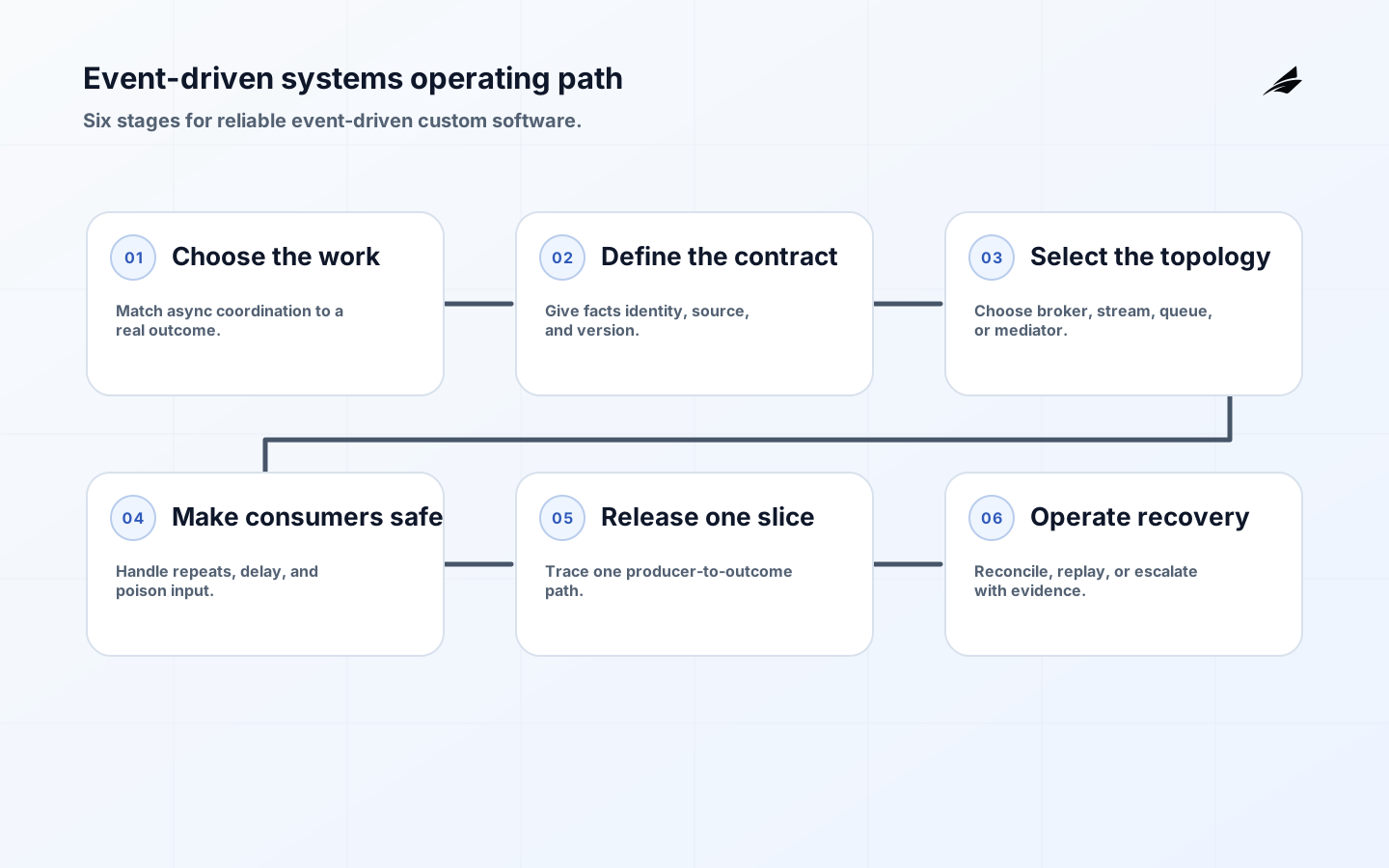
Event-driven systems are useful when one meaningful fact should trigger work in several places without forcing the original request to know every consumer. They are also easy to overuse. Turning every method call into a message can make a simple transaction slower, harder to debug, and less consistent without creating a real product benefit. A good design begins with the business outcome: a payment accepted, a document uploaded, a shipment dispatched, or a customer preference changed. Then it decides whether an event, command, queue, or synchronous response is the clearest boundary. This guide explains how custom software teams can choose the pattern, define the contract, manage retries and ordering, and operate the result when a consumer is late or wrong.
Choose work that benefits from event-driven coordination
An event is a record that something happened; a command asks a named actor to do something. Keep that distinction visible. A PaymentAccepted event can be consumed by billing, receipt, and analytics capabilities without the payment service knowing their deployment details. A CapturePayment command has one intended handler and should carry the authority and idempotency rules for that action. The Azure event-driven architecture guidance describes producers, channels, and consumers as decoupled parts, while also noting the cost of asynchronous coordination and eventual consistency. Use the style when fan-out, independent scaling, replay, or latency hiding matters; keep a direct request when the user needs one immediate, strongly consistent answer and the extra broker would only add distance.

| Work shape | Useful boundary | Question to answer |
|---|---|---|
| One immediate decision | Synchronous request and response. | What must the caller know before continuing? |
| Many independent reactions | Event with durable identity and subscriptions. | Which consumers may arrive later? |
| One action with a specific owner | Command or queue message. | Which handler is accountable for completion? |
| Long-running process | Workflow or saga with explicit state. | Who compensates when a step fails? |
Define an event contract that consumers can trust
A useful event contract says what happened, when it happened, which entity it concerns, who produced it, and how a consumer can identify a repeated delivery. Include a stable event identifier, type, subject, source, time, schema version, correlation or causation identifier, and the minimum business data needed to react safely. CloudEvents provides a common vocabulary for event metadata; it does not decide whether a field is authoritative or whether a consumer may act on it. Write the local rule in examples: an order status event is a fact, not a request to set a different status; an event with an old version must be rejected or translated in a named way; and sensitive fields should not be emitted merely because a consumer might someday want them.
Keep authority, ordering, and consistency explicit
Distributed consumers will not observe a single global present. Decide which system owns each fact, which ordering matters, and how a consumer detects that its view is stale. If a shipment can move from packed to dispatched but never backward, a consumer can reject an older transition or apply it only when its version is newer. If two events are independent, do not impose a global order that reduces throughput for no user benefit. If the user must see a current balance before approving a payment, do not hide a strong consistency requirement behind an asynchronous event. Make the accepted delay, stale state, and reconciliation action part of the contract.
Select broker, stream, or mediator behavior deliberately
A broker topology is attractive when producers publish facts and multiple consumers can decide independently whether to react. A mediator topology is more suitable when a central process needs to manage a multi-step business flow, timeouts, and compensating actions. A stream is useful when consumers need durable history, replay, or ordered partitions; a queue is often clearer when one worker should claim a unit of work. The choice affects ownership and recovery. A stream consumer has to manage its position and reprocessing behavior. A queue consumer has to make retries and dead-letter handling visible. A mediator has to remain available and must not become an unreviewed source of business truth.
| Choice | Strength | Cost to operate |
|---|---|---|
| Publish-subscribe broker | Independent fan-out and loose producer-consumer coupling. | Subscription drift, duplicate delivery, and harder end-to-end tracing. |
| Durable event stream | Replay, partition ordering, and a history for new consumers. | Consumer offsets, retention, schema evolution, and reprocessing safety. |
| Work queue | Clear ownership for one piece of asynchronous work. | Visibility timeout, retry policy, poison messages, and dead letters. |
| Mediator workflow | Centralized state, timeout, and compensation decisions. | More coupling and a coordinator that must be highly reliable. |
Build consumers for repetition, delay, and poison messages
At-least-once delivery is often the practical starting point, which means a consumer may see the same event more than once. Make the handler idempotent with a stable event or business identifier, a durable record of applied work, and a clear distinction between a retryable failure and a permanent rejection. Do not use an in-memory set as the only duplicate guard. The Kafka delivery semantics documentation explains why delivery and processing guarantees depend on the whole pipeline, not just on the broker setting. If a consumer sends email, charges money, or updates an external system, pair the message identity with an outbox, idempotency key, or reconciliation record appropriate to that side effect.
Retry timing is a business decision as well as a technical one. A short database outage may deserve bounded backoff; a validation error should move to a visible rejection path; a poison message should not block unrelated work indefinitely. Preserve the original event, failure category, attempt count, last attempt time, and next owner. Make dead-letter queues searchable by business reference, not only by internal message identifier. A support operator should be able to answer whether the consumer never received the event, received it and rejected it, or applied it but failed while recording the result.
- Store an idempotency or business reference before performing a consequential side effect.
- Separate transient dependency failures from permanent validation or authorization failures.
- Bound retry count and delay, then route exhausted work to a visible owner rather than retrying forever.
- Keep enough event and consumer evidence to replay safely or reconcile against the authoritative record.
Avoid the dual-write gap with an intentional publication path
The most common reliability gap appears when a service commits a database change and then publishes an event in a separate step. A crash between those actions leaves the database correct but downstream consumers unaware. A transactional outbox stores the business change and the pending event in the same local transaction; a separate publisher then delivers the event and records progress. The AWS transactional outbox pattern is a useful reference for the shape and tradeoffs. It does not remove the need for idempotent consumers, retention, or monitoring. Choose the pattern when losing the notification would materially change the business outcome, and keep a simpler synchronous path when it would not.
Release one evidence-bearing slice before building a platform
Start with one event, one producer, and one consumer whose outcome can be measured. Pick a journey such as order acceptance to inventory reservation, and define the acceptable delay, duplicate behavior, consumer owner, and recovery action before introducing a dozen topics. Test ordinary input, missing fields, old schema versions, duplicate delivery, out-of-order delivery, dependency timeout, and operator replay. The goal is not to prove that the system never fails; it is to prove that the team can see and correct a failure without losing the business record. Link the slice to Event-Driven Systems: A Practical Guide for Product Teams, Background Jobs: Decisions That Matter Before the First Build, and What Changes When API Versioning Moves into Production when the boundary touches product queues or user-visible work.
Instrument the full path with a correlation identifier. Record publish latency, broker age, consumer lag, processing duration, retry count, dead-letter age, duplicate rate, and time from original event to durable business outcome. OpenTelemetry messaging conventions can help keep spans, metrics, and logs comparable across message technologies. Avoid a dashboard that only reports broker health; the user cares whether the inventory was reserved, the receipt was sent, or the case was routed. Technical activity is evidence only when it connects to that outcome.
Give operators a safe way to inspect and recover
Every event-driven path needs a small operating kit: event and schema lookup, consumer status, retry and dead-letter search, replay or re-drive rules, a reconciliation query, and an escalation owner. Define which actions are safe to automate and which require approval. Replaying an event that sends a notification may be harmless if the side effect is idempotent, but replaying one that creates a payment or changes entitlement may need a compensating workflow. Keep the original payload and applied version, but minimize sensitive data retention and restrict access. A runbook should tell an operator how to identify the authoritative state before choosing to replay.
Review the design when a new consumer, data class, region, or privilege appears. A consumer that only builds analytics today may later trigger a customer-facing action; the contract and approval boundary should change before that happens. If the system accumulates topics no team can explain, subscriptions no one owns, or retry queues that are treated as permanent storage, stop expanding and simplify. Event-driven systems are healthy when their decoupling creates useful independence without making authority and recovery invisible.
Event-driven systems takeaways
- Use events for durable facts and independent reactions; use commands or synchronous calls when one actor and one immediate result are clearer.
- Give every event a stable identity, version, source, subject, timestamp, and business contract that consumers can test.
- Choose broker, stream, queue, or mediator behavior based on ordering, replay, consistency, and recovery needs.
- Assume repetition and delay, then make consumers idempotent and exhausted work visible.
- Release one measurable slice with end-to-end tracing and an operator recovery path before building a broad event platform.
Event-driven systems FAQ
When should a team avoid event-driven systems?
Avoid the pattern when the workflow is small, synchronous, and requires an immediate strongly consistent answer that one service can provide directly. It is also a poor first choice when the team has no capacity to operate retries, consumer lag, schema changes, and reconciliation. Start with an event only when fan-out, independent scaling, replay, or latency hiding creates a meaningful benefit that pays for the added operational surface.
Do event-driven systems require exactly-once delivery?
Not usually. Exactly-once claims are limited by the full path from producer through broker, consumer, and external side effect. Many systems use at-least-once delivery plus idempotent handlers, stable business identifiers, and reconciliation. Choose stronger guarantees when the business consequence justifies the complexity, and document which part of the path is actually covered.
Is a transactional outbox always necessary?
Use an outbox when a local database change and its notification must not diverge. It is less important when the event is advisory, the change can be polled or rebuilt safely, or a synchronous response is the actual source of truth. The decision should name the failure consequence and the recovery option rather than following a pattern by habit.
Conclusion: make event-driven systems dependable, not merely decoupled
Event-driven systems are a way to place useful distance between producers and consumers, not a reason to hide business ownership. Choose the work that benefits from asynchronous coordination, describe facts and commands clearly, protect the dual-write boundary, and design for duplicate and delayed delivery. Then give operators evidence and a safe correction path. A small event-driven slice that can explain its outcome is more valuable than a large broker topology that no one can confidently recover.