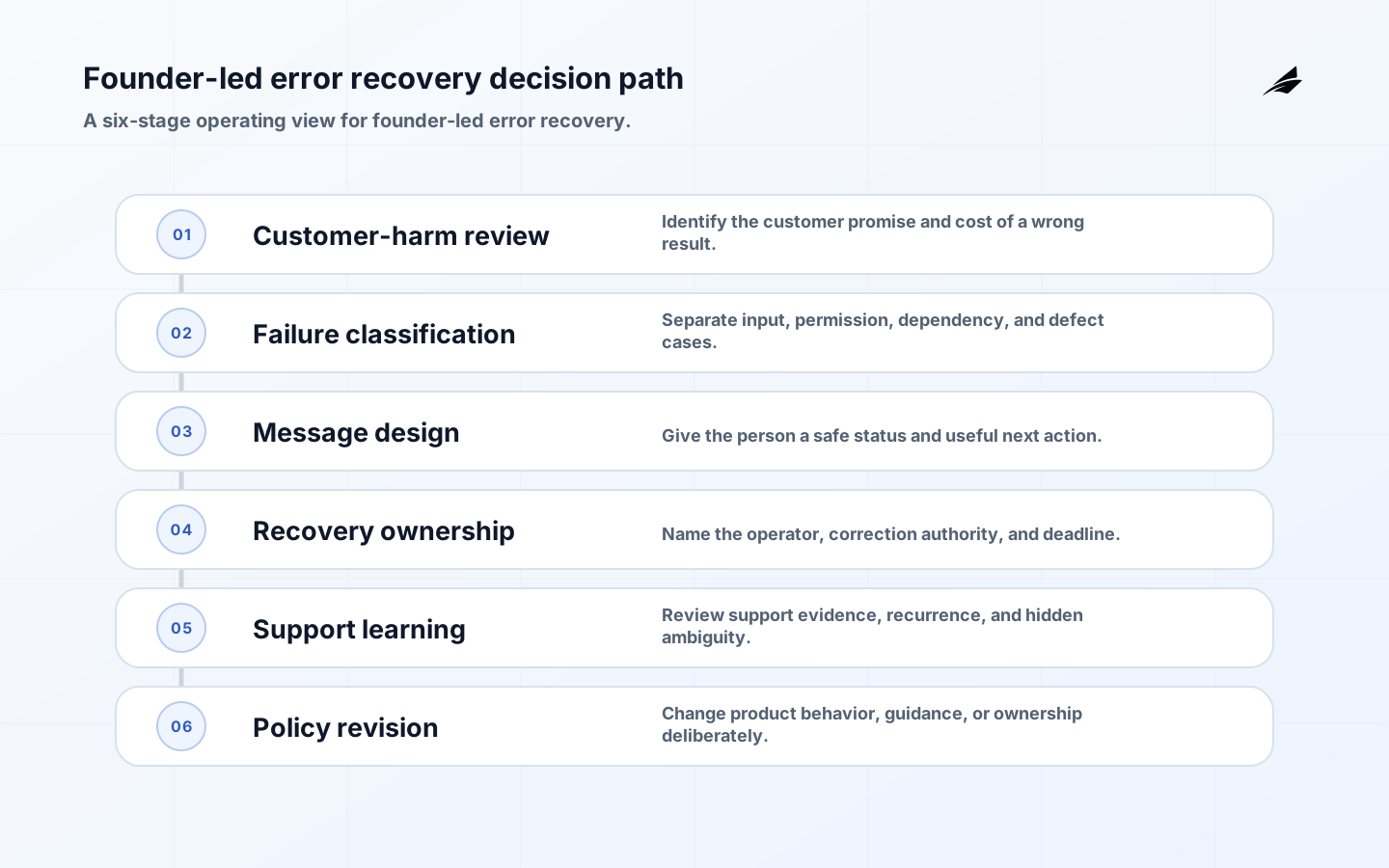
For a founder, error handling is a product and operating decision, not a final polish pass. Customers need a safe next step, support needs enough context to help, and engineers need signals that distinguish bad input from an unavailable dependency. This guide turns those needs into a small, testable error contract that can mature with the company.
Error handling is not a tool choice made in isolation. During customer-harm review for founder-led error recovery, it is a way to make a business outcome dependable when normal work meets delay, ambiguity, change, or failure. For founders, the central decision is whether to make every failure safe for the user, useful to support, and bounded for the system that failed. That decision should be visible before implementation begins: name the user or system that starts the work, the accountable owner of the outcome, the evidence that proves success, and the boundary where a person must intervene. The useful result is not a more elaborate diagram. It is a service people can explain, support, and improve under ordinary pressure.
Make the error handling decision explicit for founder-led product recovery
Write the decision as a short operational statement, then test it against real examples from payment attempts, account changes, imports, and third-party integrations. In this case, the team should make every failure safe for the user, useful to support, and bounded for the system that failed. The unit of work is a failure; its trigger is a violated precondition, unavailable dependency, invalid request, or unexpected fault; and its meaningful states are detected, classified, reported, retried, compensated, or resolved. This removes a recurring source of expensive debate: engineers, operators, and product owners can distinguish a requested action from a completed outcome. It also gives support staff a practical answer when they need to explain what happened, why it happened, and what will happen next.
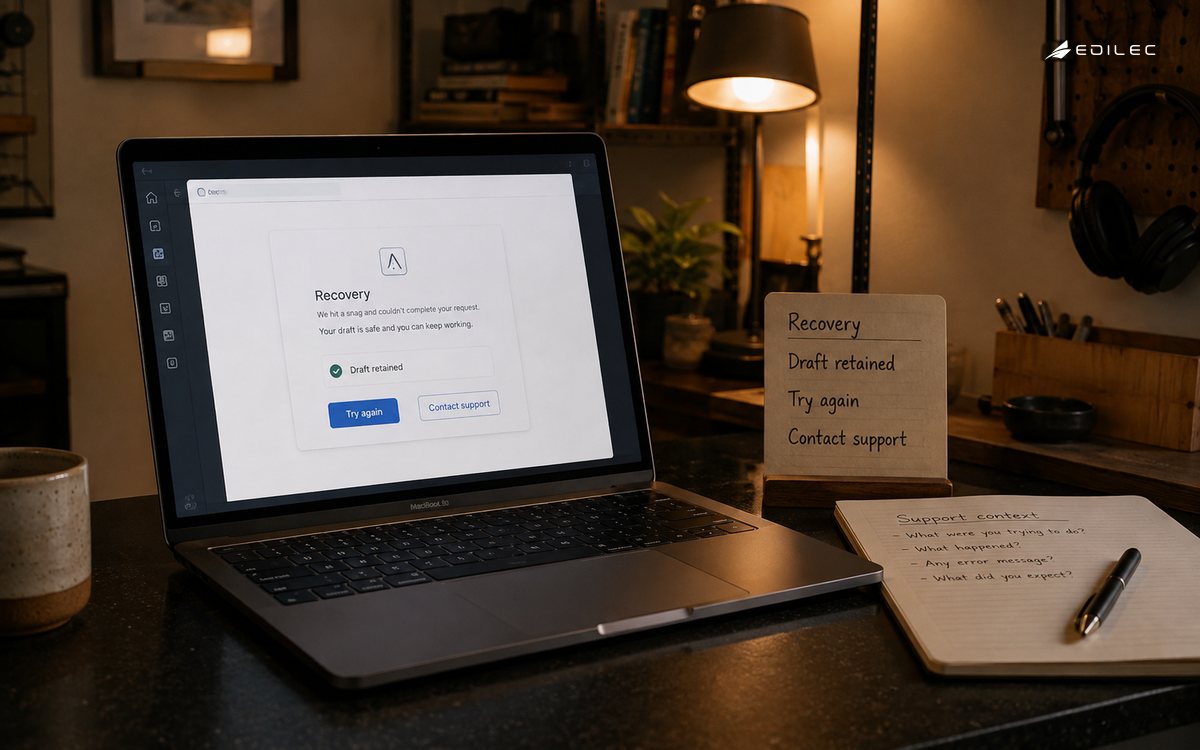
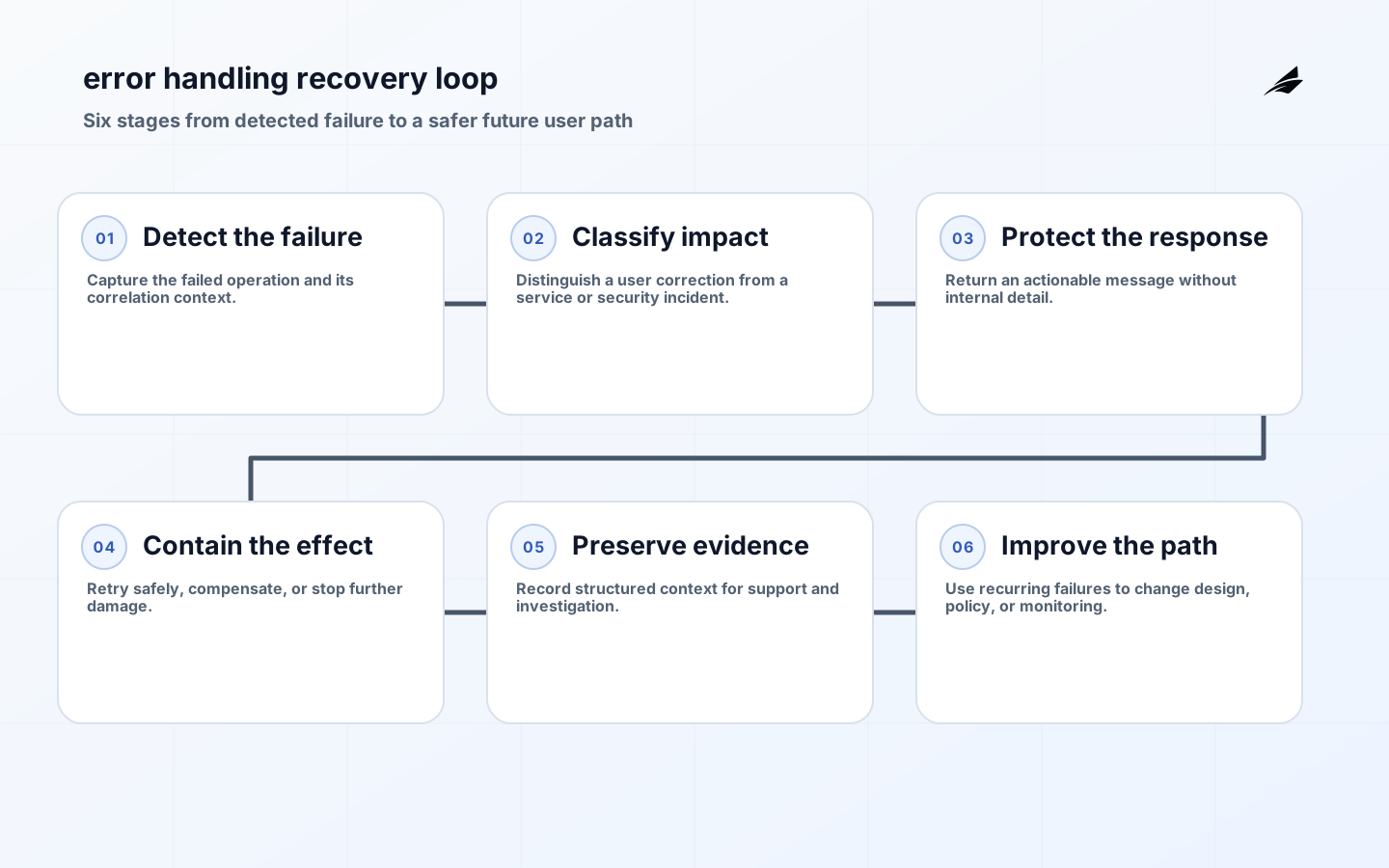
The non-negotiable rule is that a user receives an actionable outcome without seeing secrets or implementation details. Treat that as a product rule, an implementation constraint, and an operational check. RFC 9457: Problem Details for HTTP APIs and OWASP Error Handling Cheat Sheet are useful references because they describe concrete delivery or interface guarantees rather than vague aspirations. Their lesson is not to copy a platform pattern wholesale. During customer-harm review for founder-led error recovery, it is to make the guarantee your own system gives explicit, including what it does when the happy path is interrupted.
| Decision element | Question to settle | Evidence to keep |
|---|---|---|
| Outcome | What does a successful failure mean to the business? | Named owner, completion condition, and user-visible result |
| Boundary | When is a failure accepted, changed, or refused? | Input validation, authorization rule, and state transition |
| Failure | How will the team handle returning a generic success-like response or leaking a stack trace during an incident? | Classification, recovery action, and escalation owner |
| Observation | Which signal will show healthy operation? | error rate by journey, recovery success, unresolved incident age, and support contact rate |
Model state, ownership, and change for founder-led product recovery
Model the failure as something with history, not as a mutable line on a dashboard. The state sequence detected, classified, reported, retried, compensated, or resolved should have allowed transitions, an effective time, and a responsible actor or service. A transition should record the relevant input, the rule or contract version used, and a correlation identifier that links it to adjacent work. This is deliberately modest: it does not require an event-sourcing rewrite or a new control plane. It does require the team to preserve enough context to reconstruct a consequential decision without relying on memory, chat messages, or an unsearchable log stream.
Ownership must survive organizational boundaries. During customer-harm review for founder-led error recovery, product owns the intended user and business behavior; engineering owns the implementation and technical safeguards; operations owns the alert and recovery procedure; the service owner decides which trade-offs are acceptable. NIST SP 800-92: Log Management reinforces the value of explicit structure or repeatable checks, while OpenTelemetry traces supports carrying useful context across system boundaries. When these responsibilities are implicit, a change can appear harmless in one component while creating an unowned obligation somewhere else.
| Model concern | Practical design choice | Review question |
|---|---|---|
| Identity | During customer-harm review for founder-led error recovery, use a durable identifier for the ${c.unit} and its related business record. | Can a support person find the same case across systems? |
| State | Make legal transitions explicit and reject or park ambiguous inputs. | Does each state tell the user and operator what comes next? |
| Authority | Bind approval and access checks to the requested action. | Who may change this state, and who may correct it later? |
| History | Retain actor, time, reason, and correlation context. | Could the team explain this outcome six weeks later? |
Operate for normal failure, not heroic recovery for founder-led product recovery
A reliable error handling capability assumes that returning a generic success-like response or leaking a stack trace during an incident will occur. Design the response before a customer, operator, or downstream service depends on it. Classify failures into correctable input, policy refusal, transient dependency trouble, and unexpected faults; the classification determines whether the next move is to retry, request correction, compensate, or escalate. Automated retries need a ceiling and a reason. Manual recovery needs a narrow permission, a visible queue, and a record of the corrective decision. Otherwise a fast workaround becomes an invisible second workflow.
During customer-harm review for founder-led error recovery, start with the operating signals that answer a decision, not every metric available from a framework. Error rate by journey, recovery success, unresolved incident age, and support contact rate should be reviewed alongside a small sample of completed and failed cases. A rising retry rate can indicate a dependency regression; a growing oldest-item age can indicate missing capacity or a poisoned input; an unusually quick completion can reveal a skipped control. Pair quantitative signals with a runbook that says who acknowledges, how they investigate, when they pause the path, and how they communicate an affected outcome. This is where error handling becomes a managed service rather than a launch artifact.
Deliver in small, observable increments for founder-led product recovery
The first release should prove one high-value path in payment attempts, account changes, imports, and third-party integrations, including its unhappy path. Define a small error taxonomy that separates validation, authorization, conflict, transient dependency, and unexpected failures. Keep the interface, policy, and supporting instrumentation close enough that one team can learn from the same production evidence. A broad platform promise often hides the highest-risk decision behind a later phase; a focused release makes assumptions testable and creates a usable recovery route before volume rises.
Use change review to ask four questions: what business behavior is changing, which failure states or contracts are affected, how will the team observe the new behavior, and how will it reverse or compensate if wrong? Connect this work to the related operating guide when its concern overlaps, but keep the contracts separate. During customer-harm review for founder-led error recovery, record the answer alongside the delivery change so it remains useful after the original implementers move on.
Error handling takeaways
- Start with the outcome: make every failure safe for the user, useful to support, and bounded for the system that failed.
- Treat a user receives an actionable outcome without seeing secrets or implementation details as a checkable service rule.
- Model failure state and ownership before adding automation or interface detail.
- Design recovery for returning a generic success-like response or leaking a stack trace during an incident; do not rely on an informal workaround.
- Review Error rate by journey, recovery success, unresolved incident age, and support contact rate with real cases, not in isolation.
- Expand only after one path can be observed, supported, and corrected.
During customer-harm review for founder-led error recovery, include one valuable workflow, its state model, the responsible owner, a way to detect an incorrect outcome, and a controlled correction path. The first release does not need every future variation. It needs enough real usage to test the decision rule and enough evidence to show whether the workflow is helping. The practical companion is this related engineering article, which covers an adjacent concern without diluting the scope of the first release.
For error handling, readiness means users receive a safe next step, support can locate the correlated failure, and operators know whether to retry, compensate, or escalate. Increase automation only after a representative unexpected error has been exercised without exposing sensitive implementation detail.
Good error handling work is disciplined decision-making. During customer-harm review for founder-led error recovery, make the promised outcome, ownership, state transitions, and recovery path concrete; test them with ordinary and uncomfortable cases; then use production evidence to improve the next release. That approach gives founders a system that can change without becoming mysterious. For a further perspective on sustainment, see the related practical guide.
Practical decisions for founder-led error recovery
Choose failure behavior with the business. A payment retry can duplicate a charge, a report retry may be harmless, and an invitation may be recoverable but visible. Write those distinctions beside the workflow, give support a lookup key, and make the customer message match the actual state. For an early release, cover invalid input, authentication, authorization, missing records, dependency timeout, duplicate submission, and unexpected faults. Each category needs a safe response, a test, an owner, and a review point after incidents.
Related reading for founder-led error recovery
Compare this guide with How CTOs Should Think About API Versioning, How CTOs Should Think About Software Modernization, Design Systems for Custom Software: a Practical Guide. During customer-harm review for founder-led error recovery, these adjacent articles help connect the implementation choice to ownership, delivery, and operations.
Error Handling for Founders: A Practical Operating Guide FAQ
What error should a founder prioritize first?
Prioritize the failure that can damage a high-value customer promise and that the team cannot currently explain or recover without improvisation.
What is the practical starting point?
Choose one customer-critical failure, define the safe next action, and give support, product, and engineering the same case reference.
When should the team scale the approach?
Scale the practice after recurring failures have stable categories, assigned recovery owners, and evidence that the new handling reduces customer effort.
Conclusion: founder-led error recovery
Founder-led error handling is a product operating discipline, not a collection of apologetic messages. Rank harm, classify causes, assign recovery authority, and review real cases so each incident improves the promise the company makes next.