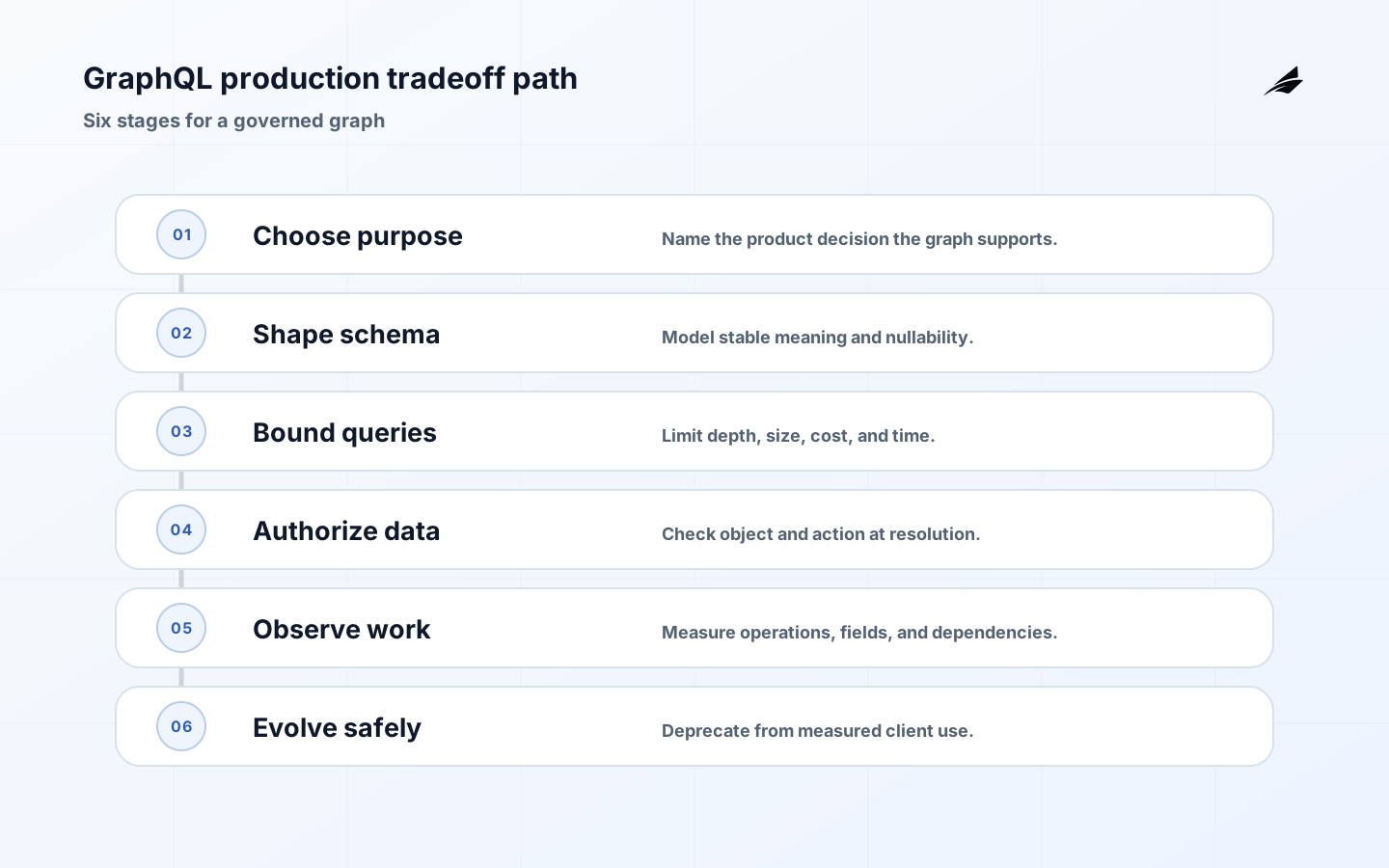
GraphQL tradeoffs look different once a real product, not a demo client, is sending queries. The schema can let a product team request the shape it needs, but that flexibility shifts responsibility into schema design, resolver behavior, query cost, authorization, caching, and observability. The GraphQL schema design guidance helps make schema meaning and evolution explicit; Serving over HTTP describes transport expectations. Neither document chooses the right limits for a particular product. This guide uses production situations—slow nested queries, partial errors, changing permissions, and multiple client releases—to make the tradeoffs concrete.
Choose the GraphQL boundary
Start with the product decision the graph should support. A customer dashboard may need account, subscription, and usage data in one view; an internal workflow may need a mutation that changes an approval state and returns the next task. Map the source systems, ownership, authorization rule, freshness expectation, and failure behavior for each field or mutation. Keep the graph from becoming a second uncontrolled database. A resolver should know which source owns the fact and how to describe a stale, missing, or forbidden result. Decide whether the graph is a read composition layer, a command surface, or both, because each role creates different operational obligations.
| Decision | Useful question | Production evidence |
|---|---|---|
| Schema purpose | Which user or workflow decision does this type support? | Owner, source of truth, and success case |
| Resolver | Where does the field come from and what does it cost? | Dependency, budget, cache, and latency record |
| Authorization | Who may read or change this object and field? | Policy test across roles and tenants |
| Failure | Can the result be partial, stale, or unavailable? | Documented error and user recovery behavior |
| Evolution | How can a field or mutation change safely? | Deprecation, consumer inventory, and migration example |
Design a schema around stable meaning
A field name is a promise about meaning, not just a convenient mapping to a database column. Define nullability from business reality: a missing value can mean not applicable, not permitted, not yet calculated, or failed. Those meanings should not be collapsed into one silent null. Use input types to express the minimum command needed, return a result that makes state and next action clear, and avoid exposing internal identifiers or relationships merely because they are easy to resolve. The schema should remain understandable when a new client asks for a different slice of the same business fact.
Keep resolver work bounded
Nested selection is powerful because it can compose data, but it can also multiply calls. Group or batch compatible lookups, bound collection sizes, and set a budget for depth, complexity, or execution time that matches the service's capacity. A request that is valid by schema can still be operationally unsafe. Make expensive fields explicit in documentation and metrics. If a resolver calls a payment provider, search service, or customer database, record the dependency and define whether one failure should fail the whole operation or produce a partial result the client can safely explain.
Control query cost before it controls you
Set limits for the queries your clients may execute and make the rejection behavior useful. Consider maximum depth or complexity, collection size, timeout, concurrency, persisted operations, and rate or resource budgets. GraphQL Best Practices discusses performance and security concerns that become more important as the graph grows. The OWASP GraphQL Cheat Sheet is a valuable security cross-check for depth, batching, introspection, and denial-of-service defenses. Return a reason that helps the client reduce the request or use an approved operation; do not leave operators to infer that a timeout was a query-shape problem.
| Risk | Guardrail | Signal to review |
|---|---|---|
| Deep nesting | Depth or complexity ceiling | Rejected queries and execution cost |
| Large collection | Page size and server-side cap | Items requested versus returned |
| Resolver fan-out | Batching, budgets, and bounded dependencies | Downstream calls per operation |
| Expensive mutation | Idempotency, authorization, and timeout | Duplicate effects and partial failures |
| Untrusted operation | Persisted or approved operations where appropriate | Unknown operation rate and abuse pattern |
Apply authorization at the data boundary
A graph can make authorization subtle because one request may traverse several objects, tenants, and field-level decisions. Authenticate at the transport boundary, then authorize the actor against each object and action as data is resolved. Do not assume that hiding a field in the schema prevents access through a relationship or mutation. Test cross-tenant identifiers, nested objects, aliases, fragments, bulk selections, and changes in role during a long-running operation. A partial result should not disclose a protected object's existence unless that is an intentional product decision. Keep authorization failures distinguishable to the client without revealing whether a sensitive record exists.
Make partial errors understandable
GraphQL responses can include data and errors together, which is useful for a dashboard but dangerous if clients treat any data as success. Document which fields can be absent, how error paths map to a user-visible component, and which mutations are all-or-nothing. Include a correlation identifier in extensions or an adjacent safe channel, and keep sensitive internal messages out of the response. Define retry behavior for dependency failures; a client that retries a mutation without an idempotency rule can duplicate a business action. The related error handling checklist helps make this recovery behavior explicit.
Evolve the graph with a client lifecycle
Additive schema changes are usually easier to adopt than removing or changing the meaning of a field, but they still need ownership and usage evidence. Mark a field for deprecation with a replacement and a date, measure which operations use it, and give client teams a migration example. Treat resolver behavior and authorization changes as possible breaking changes even when the schema is unchanged. Review generated types, persisted operations, mobile release cadence, and fragments before removing anything. A graph without a version prefix still has versions in practice: the set of fields, permissions, and meanings that a client expects at a point in time.
Observe operations, not just endpoint latency
Record operation name, selected fields or an approved operation identifier, caller class, query cost, resolver latency, dependency outcome, error path, and response size. Redact arguments that contain secrets or personal data. Segment by client and tenant so a healthy global p95 does not hide one expensive partner query. Review the most costly operations with both product and platform owners: a faster resolver may be the wrong decision if it returns stale or incomplete data. Keep a release annotation for schema, resolver, policy, and limit changes so a spike has an interpretable timeline.
Use a customer dashboard as the rehearsal
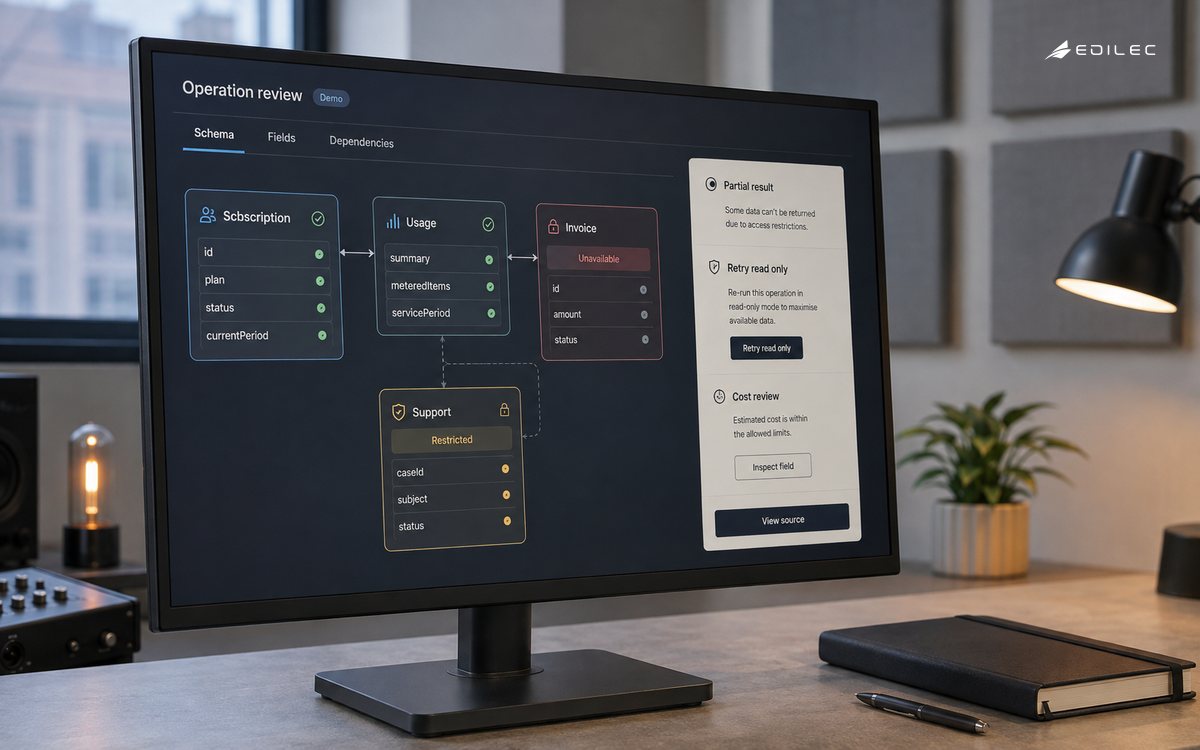
Take a dashboard that joins a subscription, usage, invoice, and support status. Trace a normal query, a missing invoice, a forbidden support note, a slow billing dependency, a large usage range, and a retry after a partial result. Decide which cards can show stale data, which must be hidden, how the user knows to retry, and how support finds the operation. Compare the graph's direct composition with the simpler REST API contracts path before committing to more schema surface. The exercise exposes whether the graph is reducing client coordination or only moving complexity into resolvers.
Make freshness and caching a field decision
GraphQL does not make every field equally cacheable. A product profile may tolerate a short-lived cache, an account balance may need current data, and a permission-sensitive support note may not be safe to reuse across users. Define freshness, authority, authorization scope, and invalidation for expensive or frequently requested fields. If the graph composes several sources, document which source wins when values disagree. A cache hit should not bypass the object-level policy or turn a stale permission into access. Treat cache behavior as part of the field's contract and observe it by operation and caller class.
Use operation ownership to control growth
As the graph grows, operation names and persisted documents become useful ownership boundaries. Assign an owner to costly or privileged operations, review their selected fields, and set a retirement path when a client stops using them. An operation registry can make query-cost changes safer because the team sees which clients will be affected before changing a limit. Keep an escape path for legitimate exploratory work, but require stronger limits and logging for it. The related design systems production guide is a useful reminder that shared flexibility also needs ownership and versioned usage.
| Graph decision | Question | Evidence |
|---|---|---|
| Freshness | How old may this field be? | Timestamp and user-visible stale state |
| Cache scope | Which user, tenant, or role may reuse it? | Key design and authorization test |
| Cost | What is the resolver budget? | Operation cost and dependency calls |
| Ownership | Who reviews the operation and replacement? | Named team and last-use record |
This approach keeps GraphQL tradeoffs visible as the product changes. A cache policy, query limit, or resolver optimization should be reviewed against the business meaning it serves. If a change improves latency while making freshness or access harder to explain, the team has exchanged one operational problem for another and should make that tradeoff explicit.
GraphQL tradeoffs takeaways
- Choose the business decision the graph supports and keep source ownership explicit.
- Treat valid query shape as separate from safe query cost.
- Authorize objects, fields, and mutations at the data boundary, not only at the transport edge.
- Make partial data, error paths, retries, and idempotency understandable to clients.
- Evolve schema and resolver behavior from measured client use, not from a deprecation annotation alone.
GraphQL tradeoffs FAQ
When is GraphQL a poor fit?
It may be a poor fit when resources have simple stable representations, clients do not need composition, query cost is difficult to bound, or the team cannot support schema and resolver ownership. A straightforward REST API can be clearer and easier to operate for those paths.
Does GraphQL make caching impossible?
No, but it changes the caching problem. Teams can use persisted operations, client or resolver caches, and carefully selected HTTP behavior. Cache keys, authorization, freshness, and mutation invalidation still need an explicit design; a generic response cache can leak or serve stale data.
Should every field error be exposed to users?
Expose enough information for the client to render a safe next step and for support to trace the event. Keep internal stack details, sensitive identifiers, and dependency secrets server-side. The client should know whether to retry, correct input, request access, or contact support.
Conclusion: make the graph accountable
GraphQL is valuable when its flexible shape shortens a real product path without hiding cost or authority. Define the schema around stable meaning, bound resolver work, authorize at the data boundary, explain partial errors, and measure the operations clients actually run. Those controls let a graph grow with the product while keeping its tradeoffs visible to the people who must support it.