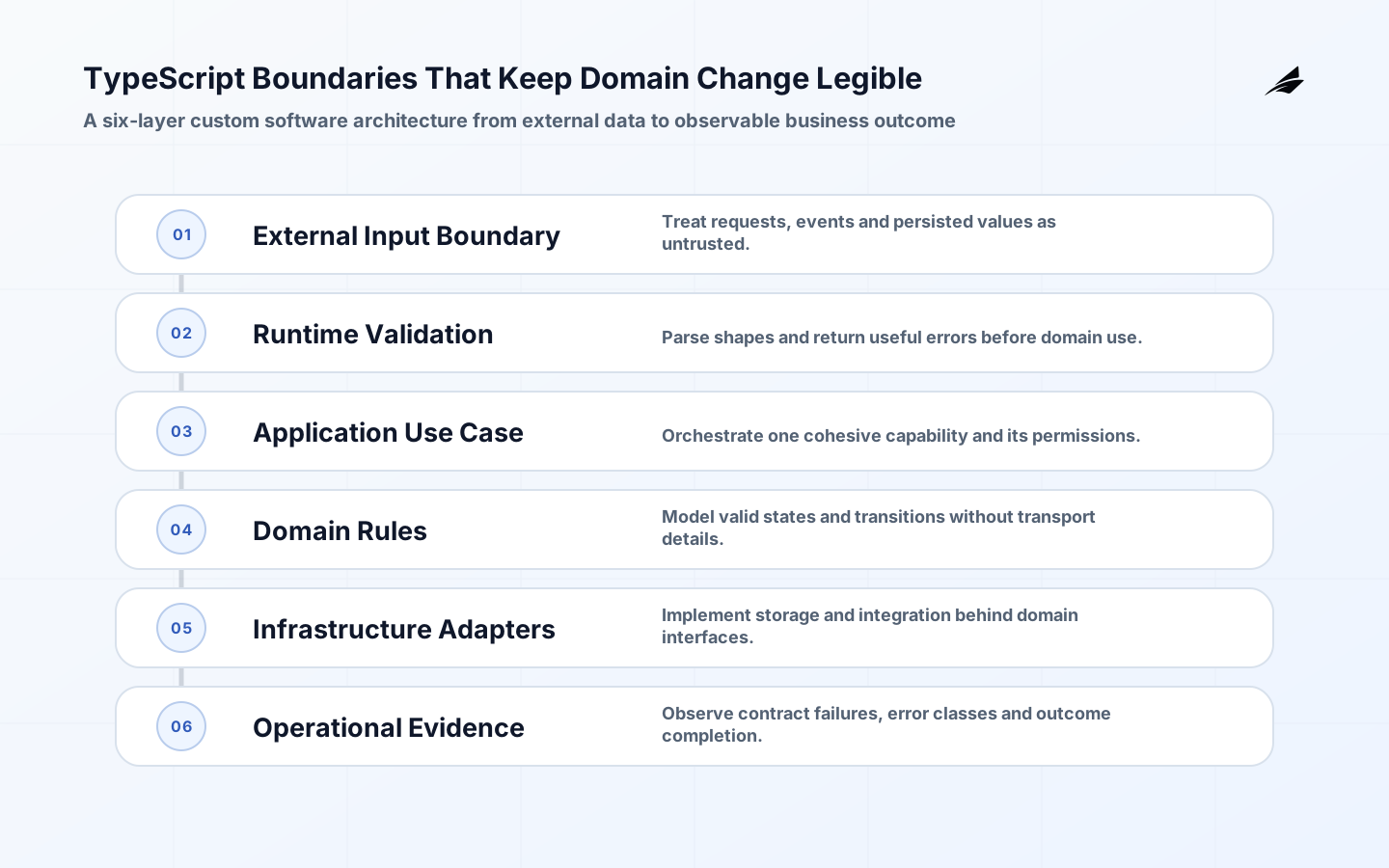
TypeScript architecture is an operating decision, not a technology label. A service receives a payment status from a partner, stores it, and exposes it to a React screen. If each layer treats the value as an arbitrary string, a new partner status can reach a user as a seemingly valid but unsupported state. Types can make the intended states visible, but only when they reflect a real domain rule and are checked at the boundary where untrusted data enters. This guide helps custom software teams turn typescript architecture into a clear promise, a delivery path, and a reviewable operating practice. The aim is not to remove every trade-off. It is to make the trade-off explicit enough that a team can change the system without guessing who depends on it or how failure should be handled.
Start typescript architecture with an outcome and a boundary
Begin with the user or operational outcome that typescript architecture must improve. Name the decision-maker, the data or behavior that is authoritative, the expected time boundary, and the consequence of a wrong result. TypeScript architecture separates domain rules, application orchestration, infrastructure adapters, and user-facing representations without pretending that types exist at runtime. Use narrow public interfaces and discriminated unions for states that demand different handling. The TypeScript handbook on narrowing explains how control flow refines types; it does not validate a JSON payload from a browser, queue, or third-party API. Validate there, then convert into trusted domain values. The useful test is whether a new engineer and a support owner can explain what the system promises without reading implementation details.
| Decision area | Question to settle | Evidence to retain |
|---|---|---|
| Outcome | Which user or business result must improve? | A concrete scenario and success measure. |
| Boundary | What belongs inside this capability and what remains external? | Owner, interface, and dependency map. |
| Failure | What can safely retry, wait, or require review? | Recovery rule and escalation route. |
| Change | Who approves a behavior change and how is impact checked? | Decision record, test evidence, and rollout plan. |
Define the typescript architecture promise
A promise turns a broad engineering intention into behavior a team can verify. State the inputs, permitted transitions, output, permissions, timing, and recovery rule in language that product, support, and engineering can all use. Avoid a promise such as “reliable” or “scalable” without a context. Instead, say what happens when data is delayed, a caller retries, a worker is unavailable, or an operator needs to correct a record. This is also where TypeScript design becomes concrete rather than decorative.

- What real decision or workflow makes typescript architecture worth maintaining?
- Which actor owns the authoritative change, and which actors only observe it?
- What invalid, delayed, duplicate, or denied case must the design handle?
- Which contract, state, or dependency can a reasonable consumer rely on?
- What evidence will show that the intended outcome occurred?
- Who can pause, repair, or roll back the behavior during an incident?
Build typescript architecture in small, testable slices
Do not begin by standardising every adjacent system. Organize code around cohesive capabilities, not a generic collection of utils. Keep transport and persistence details at the edges, and let use cases depend on domain interfaces. Enable strict settings deliberately, fix the resulting ambiguity rather than suppressing it, and isolate any necessary escape hatch. Project references help large repositories partition builds and dependencies when each project has a clear public surface. Keep the first slice narrow enough that its normal and failure paths can be exercised before its assumptions spread. monorepo structure provides useful adjacent context when the work crosses an existing service or workflow boundary.
Use examples as design material: one ordinary case, one boundary case, one invalid request or state, one delayed dependency, and one correction. Review the examples with the people who will operate the result. A technically valid implementation can still be wrong if it leaves a support owner unable to explain a disputed outcome or a user unable to recover from a predictable interruption. For TypeScript Architecture for Custom Software: A Practical Guide, make those examples part of the review record so later changes preserve the same decision.
| Stage | Practical choice | Check before progressing |
|---|---|---|
| Discover | Map users, owners, data, and dependencies. | The team agrees on the problem and scope. |
| Design | Write behavior and recovery examples. | Important states and permissions are explicit. |
| Deliver | Release one bounded path with instrumentation. | Normal and adverse cases have been tested. |
| Operate | Review outcome and exception signals. | An owner can diagnose and improve the path. |
Operate typescript architecture with evidence
Treat compiler success as one layer of evidence. Track runtime validation failures, contract mismatches, error categories, build time, and migration progress when a shared type changes. Generate or share types only when the source of truth and compatibility policy are clear. For server-side TypeScript, Node.js guidance is a useful reminder that native type stripping and full type checking are distinct concerns. Use a small set of measures that connects implementation behavior to the intended workflow. For example, separate a technical signal such as timeout rate from a business signal such as completed corrections. Review the measures at a regular cadence and include the people who handle exceptions; they often see the first mismatch between a documented promise and an actual customer journey.
Avoid common typescript architecture failure modes
The usual failure is using any or broad casts at every difficult boundary until type safety becomes cosmetic. Another is placing domain meaning in frontend-only types while the API accepts arbitrary combinations. Make invalid combinations unrepresentable where practical, but keep error messages and validation paths useful for the caller who supplied bad input. Treat these as design signals, not reasons to abandon the approach. The corrective move is usually modest: name the owner, constrain the interface, add one realistic test, preserve a correlation record, or delay retirement until the relevant users have moved. React state design is a useful companion when the issue is a broader change or reliability concern.
- No one can name the consumer, owner, or support route for a behavior.
- A successful technical response is mistaken for a completed business outcome.
- Recovery depends on an undocumented manual step or a single person’s memory.
- Metrics show volume but not correctness, delay, or user impact.
- A migration or shared abstraction has no retirement condition.
- Production evidence contradicts a design assumption but the documentation is unchanged.
Use a typescript architecture implementation checklist
Use this checklist as a conversation before release, not as a ceremonial sign-off. Each answer should point to a test, a visible behavior, an owner, or an operational record. For deeper delivery confidence, pair the work with Node.js APIs and revisit the plan when the first production evidence arrives. In this KM-SW-0041 implementation, the checklist should be reviewed by the people accountable for typescript architecture.
- Write the typescript architecture outcome, owner, boundary, and failure consequences in plain language.
- Capture normal, boundary, denied, delayed, duplicate, and correction examples.
- Define an interface or state model that makes the permitted behavior inspectable.
- Protect access and sensitive data at the service boundary, not only in the user interface.
- Release behind a controllable rollout or cohort when the blast radius warrants it.
- Instrument technical health and the business outcome separately.
- Document a bounded recovery, rollback, or repair action before dependency failure forces an invention.
- Set a review date and a criterion for expanding, changing, or retiring the first slice.
Key takeaways
- TypeScript architecture should begin with a valuable outcome and a named operational boundary.
- A clear promise includes failure, recovery, ownership, and evidence, not only happy-path behavior.
- Small releases with realistic examples reveal risk earlier than broad standardisation.
- Operational measures must distinguish a healthy component from a completed user outcome.
- A documented retirement or improvement decision keeps temporary work from becoming permanent uncertainty.
Frequently asked questions
When should a team invest in typescript architecture? Invest when a recurring workflow, reliability risk, or delivery constraint has a clear cost and a team can name the behavior it needs to improve. How much design is enough? Enough to describe ownership, ordinary and adverse cases, access, recovery, and a measurable outcome before the first release. Should every related system use the same pattern? No. Share a pattern when it preserves a genuine contract or reduces meaningful risk; keep an exception when its constraints differ and record why. What is the first operational metric to add? Add the signal that tells an owner whether the intended user or business result happened, then pair it with the technical signal most likely to explain a failure.
Conclusion
Well-run typescript architecture gives a team a way to make change legible. Start with an outcome, make the promise testable, release one controllable slice, and learn from production evidence. The authoritative references used here, including TypeScript Handbook: Narrowing and Node.js: Running TypeScript, are useful for the underlying standards and platform details. Apply them to the actual workflow, people, and recovery decisions in front of the team; that is where an engineering practice earns its value. Over the next month, choose one untrusted boundary and replace a broad cast with runtime validation plus a narrow domain type. Test malformed and newly introduced input values, then inspect the operational error. That focused change demonstrates how TypeScript architecture can improve real behavior without claiming that compile-time types alone secure an application. Keep the validation error observable and safely actionable; a good type boundary makes unexpected input easier to correct rather than turning it into an opaque exception that is silently discarded.