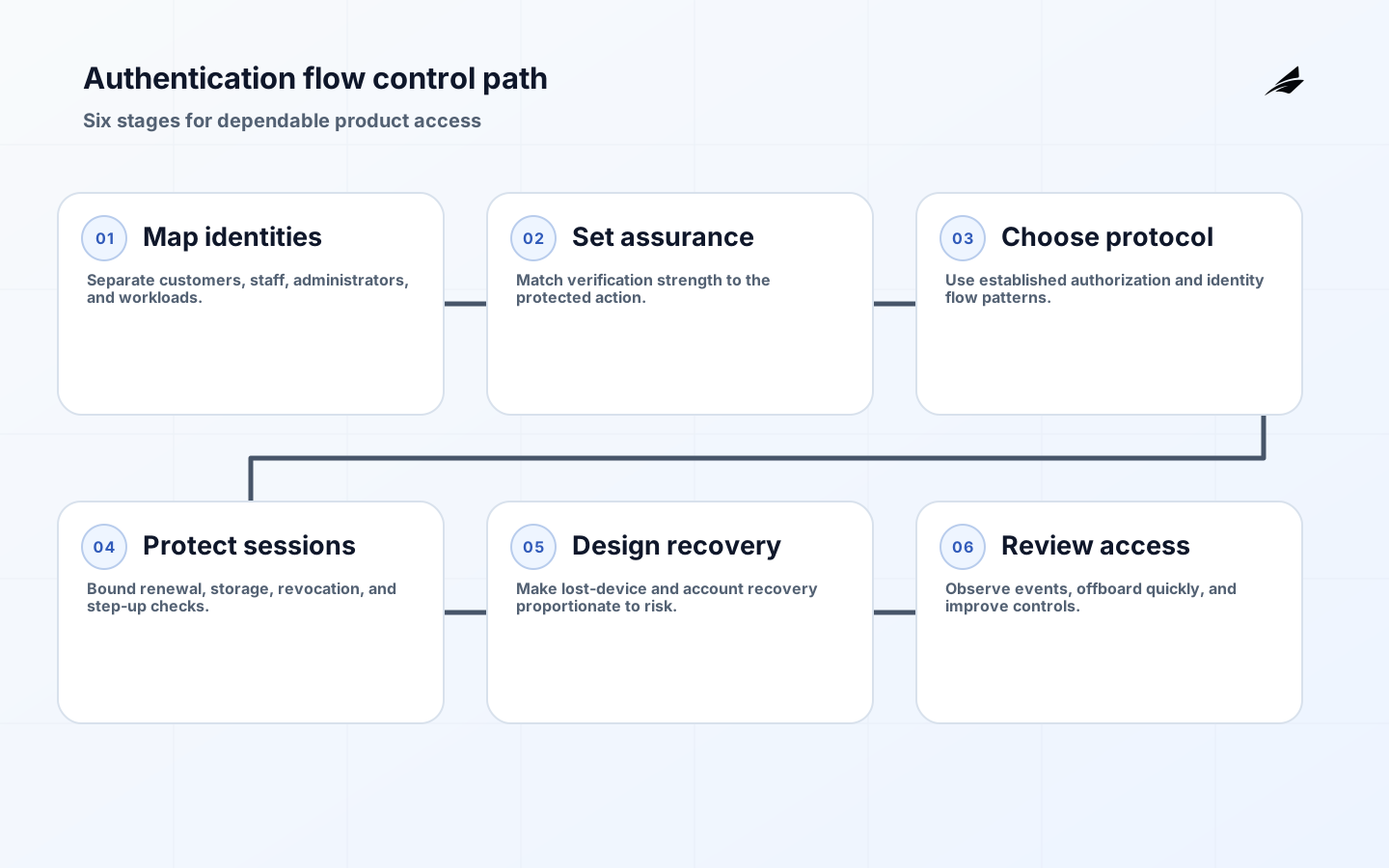
Authentication flows decide how a product recognizes a person or workload before granting access. They are easy to underestimate because the happy path looks like a login form and a redirect. In production, the flow has to handle a new device, lost authenticator, expired session, enterprise identity provider, suspicious sign-in, service account, and customer who cannot complete a recovery step. CTOs should frame identity as a risk and experience boundary: who is asking, what assurance is needed for this action, what permission is being granted, and how can the decision be reviewed later?
Start with identities and journeys
Inventory the actors before selecting a protocol. Employees may use company single sign-on; customers may need passkeys or email recovery; services need non-human credentials with narrow scope. Separate authentication, which establishes an identity, from authorization, which decides what that identity may do. Then map the high-consequence journeys: initial enrollment, normal sign-in, sensitive action, administrator access, recovery, and offboarding. The OpenID Connect Core specification defines the identity layer built on OAuth 2.0, but implementation choices should follow the product's users and harm model.

| Actor | Typical need | Control to design |
|---|---|---|
| Customer | Low-friction recurring access | Session expiry, recovery, and device protection |
| Administrator | High-impact configuration changes | Stronger factor and step-up verification |
| Employee | Managed workforce access | Federation and prompt offboarding |
| Service | Machine-to-machine calls | Short-lived, scoped credentials and rotation |
Choose protocol patterns deliberately
For browser and native applications that use an authorization server, authorization code flow with PKCE is generally the defensible starting point. PKCE binds the authorization request to the code exchange and reduces interception risk; its mechanics are specified in RFC 7636. Do not place long-lived secrets in a browser or treat an access token as a generic user session. Use issuer, audience, redirect URI, nonce, state, expiry, and signature validation according to the applicable protocol. Keep the first implementation small enough that every callback and token handoff can be tested.
- What identity assurance does each protected action actually require?
- Which application validates which token and for which audience?
- Where are session tokens stored, refreshed, and revoked?
- How does account recovery avoid becoming an easier attack path?
- What event alerts a human or blocks a risky action?
- How will terminated users and rotated service credentials lose access quickly?
Protect sessions and recovery as first-class features
A strong login can be undone by a weak recovery page or an indefinite session. Set reasonable session lifetime, renewal, device, and reauthentication rules based on the action's risk. Protect cookies with appropriate secure, HttpOnly, and same-site settings; prevent token leakage in URLs and logs. Recovery should require evidence proportionate to the account's value and should notify the account through an independent channel where possible. The OWASP Authentication Cheat Sheet provides concrete checks for credential handling, generic failure messages, and account protection.
| Weak point | Better pattern | Evidence to monitor |
|---|---|---|
| Password reset | Rate limits, time-bound token, and post-reset notice | Reset attempts and completed recovery |
| Privileged action | Fresh verification or step-up factor | Step-up failures and overrides |
| Long-lived browser session | Rotation and bounded expiration | Session age and unusual device changes |
| Shared service key | Scoped short-lived workload identity | Credential use outside expected audience |
Run identity as an operation
Identity control is not finished at launch. Maintain an event record for sign-in success and failure, enrollment, permission changes, recovery, factor changes, and administrative overrides, without logging credentials or sensitive token material. Set ownership for incident response, identity-provider outages, and access reviews. Measure normal login completion separately from suspicious activity so a security change does not quietly exclude legitimate users. NIST guidance in SP 800-63B helps teams reason about authentication assurance and lifecycle rather than treating every account the same.
Document the final identity decision in terms a product leader can revisit: which actors use which method, which actions require step-up verification, how long sessions live, how recovery is handled, where authorization is enforced, and what events are reviewed. Reassess it after a new enterprise customer, privileged feature, regional requirement, or material incident. Identity systems become brittle when their original assumptions remain invisible while the product around them changes. A compact decision record keeps security work connected to the users and workflows it exists to protect.
Make authorization testable
Authentication identifies a principal; business authorization still needs policy tests at the service boundary. A finance administrator may authenticate correctly but should not approve their own payout, and a support employee may view a case without changing a customer's legal profile. Express these decisions in policies or service rules that can be exercised with realistic identities. The API contract work in the REST API contracts guide is relevant here because scopes, denied responses, and audit events are promises consumers must understand.
Run a schema design review
A useful schema review is a short working session around examples, not a visual inspection of an entity diagram. Bring one normal transaction, one correction, one concurrent update, one imported record, and one report or support question. Walk through where each fact is written, what prevents an invalid state, and how a later reader learns its meaning. Ask whether a different service can write the same fact and, if so, how conflicts are resolved. These examples force the model to confront time, ownership, and failure instead of only neat relationships.
Keep schema migrations in the same delivery conversation as application code. A reviewer should see the expansion step, data backfill method, compatibility window, read switch, monitoring query, and cleanup condition. Estimate table size and lock behavior before production, particularly for indexes, type changes, and default values on busy tables. Where a backfill is long-running, throttle it, record progress, and make it restartable. Treat counts and samples as evidence, but also check the business effect: a populated column can still contain the wrong interpretation of a historical value.
Documentation need not be ornate to be useful. Record the entity meaning, identifier rule, important constraints, owner, source boundary, and the reason for non-obvious denormalization. Keep this close to migrations or the data model so it changes with the system. When a production incident reveals an unclear fact, update the model or its notes rather than leaving the learning in a ticket. A maintained explanation is part of what allows new engineers to add a feature without accidentally converting an implicit assumption into corrupted data.
| Review checkpoint | Question | Evidence to retain |
|---|---|---|
| Vocabulary | Do teams mean the same thing by this entity? | Glossary and example records |
| Invariant | Which impossible states must be blocked? | Constraint and invalid-write test |
| Ownership | Which service may change this fact? | Write boundary and reconciliation rule |
| Migration | Can old and new code run together? | Expand-backfill-contract plan |
| Operations | Can an operator explain a disputed record? | History, timestamps, and source context |
| Performance | Does the model support the expected access path? | Representative query plan and index rationale |
Resist the urge to solve uncertain future requirements by making every relationship optional and every value generic. Flexibility that erases meaning merely postpones design work until the data is difficult to repair. Use an explicit extension or event record when the business genuinely has variable facts, and preserve the context that explains those facts. A schema earns its durability by being precise about what is known today while giving tomorrow's change a safe migration path.
Use an authentication flow implementation checklist
- Verify issuer, audience, redirect URI, signature, expiry, nonce, and state validation for every token-bearing callback.
- Use PKCE for public clients and confirm that no browser bundle or mobile package contains a reusable client secret.
- Test normal sign-in, new-device sign-in, expired session, logout, provider outage, recovery, and high-risk action with realistic roles.
- Confirm that session cookies and storage choices prevent accidental exposure through URLs, logs, browser scripts, or cross-site requests.
- Set reauthentication and step-up rules for actions that change payment, identity, permissions, or sensitive records.
- Review recovery tokens, notification behavior, rate limits, and support escalation as carefully as the primary password or passkey journey.
- Make authorization tests prove that authenticated users cannot read or change records outside their organization, role, or approval boundary.
- Record sign-in, recovery, factor, permission, and override events with retention and access rules that do not retain credentials.
- Exercise fast offboarding for a workforce account and rotation for a workload credential before relying on either during an incident.
- Name owners for identity-provider configuration, incident response, access reviews, and emergency decisions when a provider becomes unavailable.
Key takeaways
- Model people, machines, high-risk actions, recovery, and offboarding before choosing a login screen.
- Use well-understood OAuth and OpenID Connect patterns rather than inventing token flows.
- Keep session protection and recovery proportional to account risk.
- Log security-relevant decisions without recording secrets.
- Test authorization rules independently from successful authentication.
Frequently asked questions
Is OAuth the same as authentication? OAuth primarily delegates authorization; OpenID Connect adds an identity layer for authentication. Do all users need multifactor authentication? The appropriate assurance depends on risk, but privileged and high-impact actions commonly deserve stronger verification. Can a frontend enforce permissions? It can improve experience, but the backend must enforce the decision. What should happen when an identity provider is unavailable? Define the expected user message, support path, and any tightly constrained emergency procedure before the outage.
Conclusion
A dependable authentication flow makes the right access easy enough for legitimate users and meaningfully harder for an attacker or a stale account. Build it from actual identities and actions, use proven protocol patterns, and keep recovery, sessions, authorization, and operational review in scope. That produces an identity system that can grow with the product instead of becoming its least understood dependency.