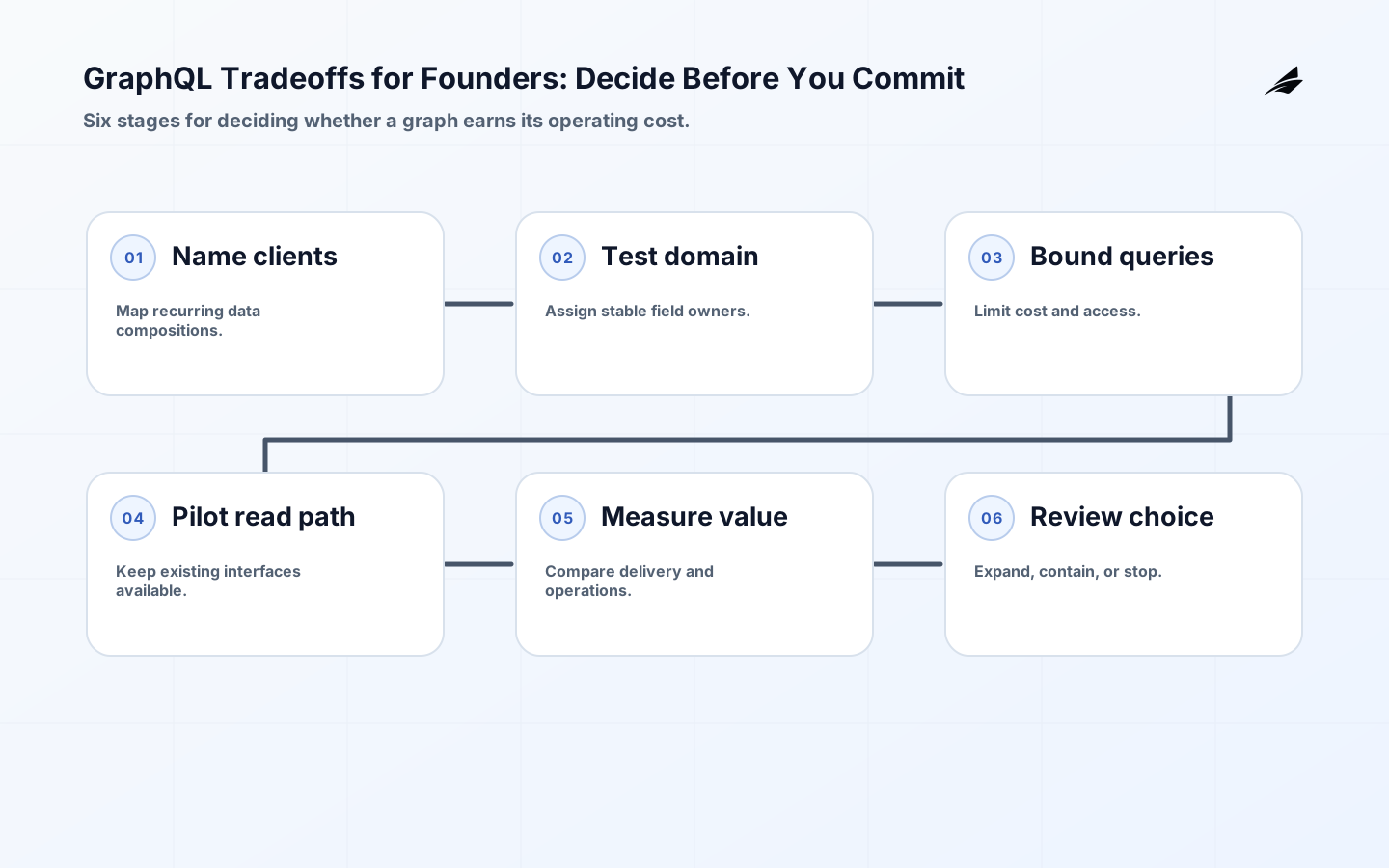
GraphQL tradeoffs are easiest to understand when a founder starts with the product surface rather than the fashionable API shape. A web dashboard, mobile application, partner portal, and internal tool may all need the same customer, order, inventory, and entitlement facts in different combinations. A typed graph can reduce repeated coordination between those clients and the services behind them. It can also move cost into schema stewardship, resolver performance, authorization, caching, and incident diagnosis. The right question is not whether GraphQL is modern. It is whether the recurring composition problem is expensive enough, stable enough, and owned well enough to justify another production boundary.
Read the GraphQL decision through product economics

A founder should be able to name the user journey that becomes easier if clients can select their own fields. Consider a sales workspace that combines account status, open orders, renewal dates, and support signals. If three clients need different subsets of that view and each new field currently requires coordinated endpoint changes, GraphQL may earn its complexity. If one server-rendered page consumes one stable representation, the graph may simply relocate complexity from endpoints to resolvers. The GraphQL Queries guidance describes typed selection sets and client-specified fields; it does not prescribe the business case or the team structure needed to run them.
| Question | A promising GraphQL signal | A warning signal |
|---|---|---|
| Client variation | Several approved surfaces compose related facts differently. | One consumer needs one stable representation. |
| Domain stability | Business concepts and relationships have durable owners. | Names and ownership change every sprint. |
| Delivery friction | Frontend coordination repeats across many journeys. | The current API is not the real delivery bottleneck. |
| Operating capacity | Someone can own schema review, access, cost, and incidents. | No team can investigate resolver behavior end to end. |
| Migration shape | A read slice can run beside existing interfaces. | A rewrite is the only proposed adoption path. |
Distinguish a credible fit from an expensive detour
A credible fit has a repeated composition problem and a bounded answer. For example, a subscription product may have a customer overview that joins identity, plan, usage, invoices, and current support status. A mobile client can request a compact view while an operations console requests additional fields, with both relying on the same named domain concepts. A weak fit is a small administrative service whose only consumer already has a well-designed endpoint. Introducing a graph there adds schema publication, query validation, access review, and monitoring without removing meaningful coordination.
Founders should also separate the need for a graph from the need for a shared backend model. If the underlying records have unclear authority, GraphQL will not resolve that ambiguity. A field can make an unstable service dependency look friendly to a client while leaving the team with a hidden cross-service contract. Resolve the ownership question first, then decide whether the client-facing graph is the right boundary. A plain REST resource, a read model, or a direct service call can remain the better choice for a capability that has one consumer or a strict transactional contract.
Treat schema ownership as a leadership decision
A schema becomes a product surface once clients depend on its names, nullability, pagination, errors, and performance. Do not build it by copying database tables. Model the business terms a client needs, document why a field exists, and give its meaning to the domain team that can keep it correct. A platform team may provide conventions and tooling, but a central group cannot invent the freshness or authorization semantics of every field. The official Schema Design guidance is useful here because it frames the schema as a model of the domain rather than a mirror of storage.
- Who owns the meaning and data quality of each type and field?
- What does null mean: missing, denied, not applicable, or temporarily unavailable?
- Which collection fields have a maximum page size and a defined traversal model?
- What is the deprecation notice, replacement, and observed-use threshold for a field?
- Which user roles may request the combination of fields, not just each field alone?
- How will the client learn that an outcome is partial, stale, or awaiting another service?
This ownership model affects hiring and planning. A team that can ship frontend features but cannot maintain cross-service contracts will experience GraphQL as a platform tax. Conversely, a team already investing in domain boundaries, automated contract checks, and observable read models may find a graph a natural composition layer. The decision should be recorded as an operating commitment: named owners, review cadence, supported clients, and a plan for removing fields that no longer earn their cost.
Budget query cost and security from day one
Client-selected shape is powerful because it is flexible, and that flexibility is also the main operational risk. A nested query can fan out into many backend calls, return more rows than a screen can use, or combine fields that reveal sensitive context. The GraphQL Security guidance recommends treating malicious or expensive operations as a first-class concern. Apply authentication before execution, enforce authorization in the business logic, and make query depth, complexity, pagination, timeout, and rate limits part of the product boundary.
| Risk | Design decision | Evidence to review |
|---|---|---|
| Resolver fan-out | Batch related loads and cap expensive nesting. | Backend calls and latency by operation. |
| Sensitive combination | Authorize the requested business action at the resolver boundary. | Denied-field tests for each relevant role. |
| Large collection | Use a consistent pagination model and maximum page size. | Rejected or truncated query rate. |
| Untrusted operation | Use persisted or trusted documents where the threat model requires them. | Allow-list changes and rejected-operation logs. |
| Schema drift | Deprecate deliberately and observe field use before removal. | Client inventory and deprecation age. |
The cost conversation should include money and attention, not only milliseconds. A resolver that calls five services on every dashboard load can increase dependency charges, on-call noise, and incident blast radius. A query that returns a partial response may be useful for a read-only view but dangerous if the client uses it to authorize a financial decision. Define which operations are informational, which are mutating, and which must read authoritative data synchronously. The official Authorization guidance supports keeping access rules in the business layer so a rule is not bypassed by a second client or resolver.
Choose an adoption path that preserves options
Use a first slice that exposes learning rather than commitment. Pick one read-heavy journey, write its operation examples, name the backing systems, and keep the current API available while the graph is measured. Record field latency, downstream calls, authorization denials, rejected queries, cache behavior, and the user outcome that motivated the change. If the slice does not reduce coordination or improve the journey, stop without having to unwind the whole product.
Do not force mutations into the first release just to make the graph look complete. Writes carry idempotency, concurrency, validation, and error semantics that deserve their own design. A read slice can still reveal whether the domain model is coherent. Pair it with the REST API contracts guide when an existing resource boundary remains the clearer contract, with the background jobs guide when a graph field would otherwise hide asynchronous work, and with the test strategy guide when the first slice needs explicit contract and authorization evidence.
Measure whether flexibility paid for itself
A high query count is not proof of value. Compare the first graph journey with its previous path: time to add a field, number of coordinated releases, duplicate aggregation code, page latency, origin load, support incidents, and the rate at which clients receive a useful result. Review slow operations by name and owner. A graph that makes one client faster while increasing every downstream failure surface may be the wrong trade.
Founders should ask for a quarterly answer to three questions. Which client journeys now ship with less coordination? Which fields or resolvers create disproportionate operational cost? Which parts of the graph should remain stable, be redesigned, or be retired? The Pagination guidance is a practical reminder that list behavior is part of the client promise. A graph remains healthy when its flexibility is bounded by clear contracts rather than by undocumented team memory.
Key takeaways
- Choose GraphQL for recurring composition across approved clients, not as a default replacement for every API.
- Treat schema ownership, field meaning, and deprecation as leadership responsibilities.
- Set authorization, pagination, query-cost, and timeout controls before broad exposure.
- Prove one read journey beside existing interfaces and measure the user and operating outcome.
- Keep simpler boundaries where they make authority, cost, and failure behavior easier to explain.
Frequently asked questions
Is GraphQL a good default for a young product?
Not automatically. It is a reasonable early choice when the product already has several clients, repeated data composition, and people who can own schema and resolver behavior. If the product is still changing its core domain language or has one predictable consumer, a smaller API boundary may preserve speed and clarity.
Does GraphQL replace REST?
It can coexist with REST, events, and direct service calls. Use the boundary that makes each capability easiest to secure, observe, cache, and evolve. A graph is valuable when it makes approved compositions easier; it is not valuable merely because it reduces the visible number of endpoints.
What is a sensible first GraphQL release?
Pick one read-heavy journey with measurable coordination pain. Define the fields and access rules, cap depth and page size, instrument resolver cost, retain the existing route, and agree in advance on the evidence that will expand or stop the experiment.
Conclusion: make the GraphQL choice accountable
GraphQL tradeoffs are ultimately tradeoffs between client flexibility and operating responsibility. Founders can make the choice durable by tying it to a real product journey, assigning ownership to the schema, protecting data and compute, and measuring whether the graph lowers coordination. A narrow first slice keeps the decision reversible while the team learns what the product actually needs.