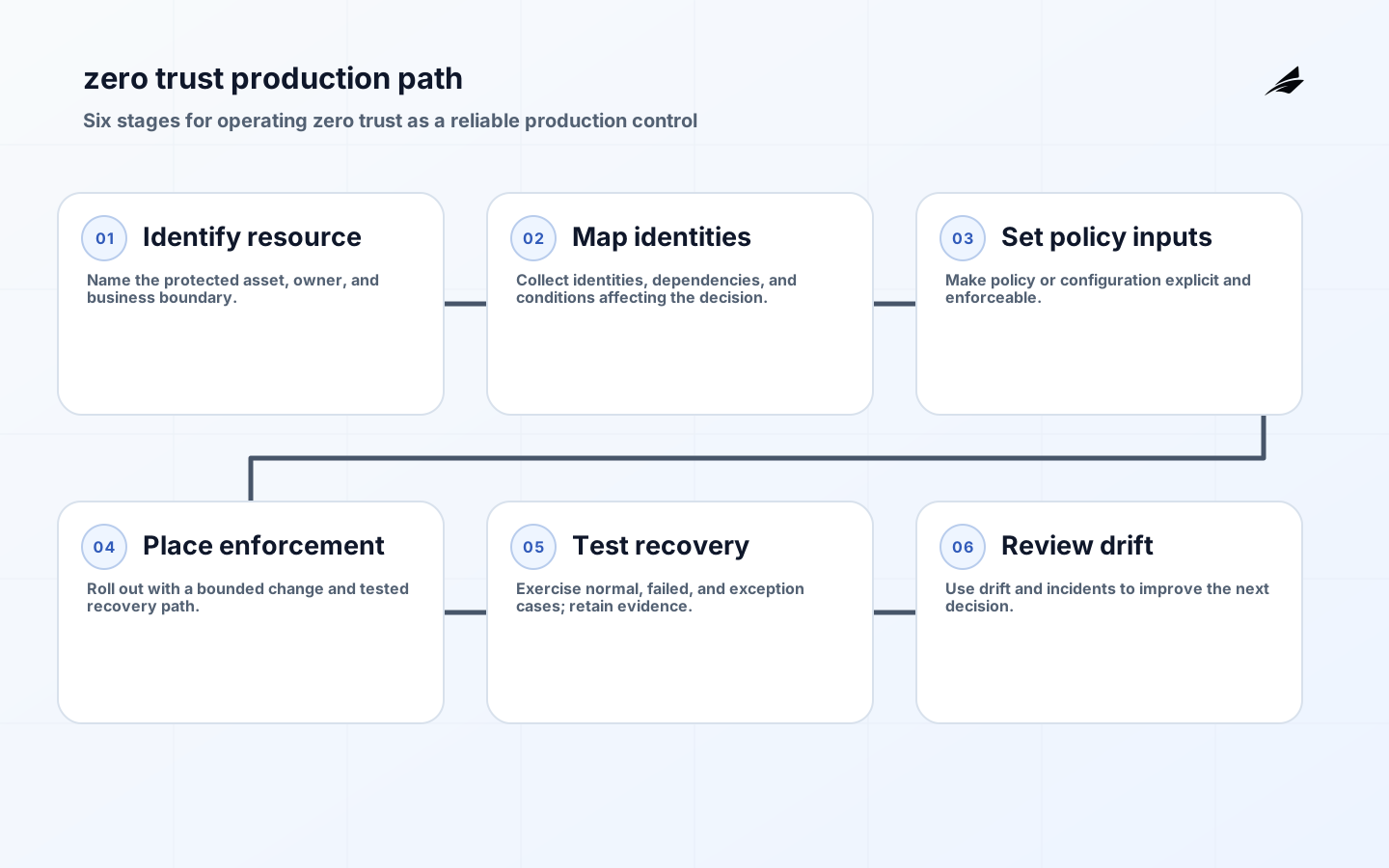
Zero trust changes character in production. It is no longer a diagram, a setting, or a procurement line; it becomes decisions made under real traffic, real people, and real failures. The central question is whether a team can evaluate each request from current identity, device, workload, and context signals instead of granting durable trust based on network location. That takes more than selecting a product. It takes an owner for the protected outcome, a precise boundary, and evidence that the control works when a dependency, administrator, or client behaves unexpectedly. This guide treats zero trust as an operating practice: scope it, make the design testable, release it in a bounded way, and improve it from evidence. For this operating step, name the accountable owner, supporting evidence, exception route, and next measurable check.
What zero trust changes in production
The useful outcome is not more security in the abstract. It is a decision made at the right point in a system, with enough context to defend later. For zero trust, the team must evaluate each request from current identity, device, workload, and context signals instead of granting durable trust based on network location. Start with a valuable workflow rather than every system. Name the action or data at stake, identities that initiate it, enforcement systems, and the person who can approve an exception. That narrow start exposes hidden dependencies while leaving room to learn before enforcement reaches a wider audience. Within this operating step, name the accountable owner, supporting evidence, exception route, and next measurable check.

| Production question | Operational answer | Evidence |
|---|---|---|
| What is protected? | Name a concrete action, data set, or service. | Asset owner, classification, boundary diagram. |
| Who decides? | Assign policy ownership and escalation before enforcement. | Approved policy, review date, exception owner. |
| How does it fail? | Define deny, fallback, and recovery behavior. | Test result, alert route, rollback record. |
| How is it reviewed? | Use measured signals, not an annual assertion. | Decision logs, change history, recertification. |
Design the zero trust boundary
A boundary is where an untrusted or changed condition can alter a decision. For zero trust, include the user or workload, authenticating identity, protected resource, policy decision, enforcement point, and telemetry. Draw the normal path and the uncomfortable path: a stale record, duplicate identity, unavailable dependency, privileged support request, or automated client retrying at the worst moment. The boundary need not be a vast enterprise diagram. A small, versioned representation that developers, operators, and reviewers understand is more useful than a picture nobody consults during change review. When implementing this decision boundary, name the accountable owner, supporting evidence, exception route, and next measurable check.
- State the protected action and acceptable failure mode for zero trust.
- Name each identity, data source, and dependency that influences the decision.
- Mark where a request crosses a trust boundary or changes authority.
- Give every exception an approver, expiry, and review trigger.
- Keep routine access distinct from emergency or elevated access.
- Decide what users, clients, and operators see when access is denied.
Build and roll out zero trust safely
Pilot one high-value application. Inventory human and workload identities, require strong authentication, put enforcement near the resource, and time-box legacy paths. Before releasing this design choice, name the accountable owner, supporting evidence, exception route, and next measurable check.
For delivery teams working on zero trust, this operating decision should connect identity, assets, policy enforcement, security evidence, exceptions, and recovery to evidence an accountable owner can inspect. Rollout discipline matters because a technically correct control can still cause an outage or an unmanaged bypass. Establish a baseline of normal behavior, release first to a small population or route, and collect the signals that distinguish legitimate friction from policy failure. Use a named change owner and a short rollback window. A rollback is not proof that the control was pointless; it is proof that the team can correct a harmful decision before people create their own uncontrolled workaround. In this production review, move beyond the operating decision only after the owner can show the accepted result, the exception path, and the signal for another review.
| Rollout step | Decision | Practical test |
|---|---|---|
| Baseline | Which legitimate paths must keep working? | Replay a normal request and capture dependencies. |
| Pilot | Which small population reveals friction safely? | Run with monitored enforcement. |
| Enforcement | What changes from observe to block or require? | Verify expected allow and deny cases. |
| Recovery | Who can reverse a bad change safely? | Practice rollback and record approval. |
Failure modes to test before enforcement
A VPN replacement that leaves shared administrator accounts, broad reachability, and unaudited service identities untouched. Treat these as design inputs, not embarrassing edge cases. A production-ready control has a deliberate answer when a required signal is missing, an identity record is delayed, or an operator needs urgent access. Fail open and fail closed are not universal slogans: choose behavior according to the protected action, safety impact of downtime, compensating controls, and ability to detect degraded mode. Document the choice where the people on call can find it. When changing this evaluation, name the accountable owner, supporting evidence, exception route, and next measurable check.
Evidence that makes zero trust governable
In zero trust, delivery teams should make the relationship between identity, assets, policy enforcement, security evidence, exceptions, and recovery explicit and reviewable. A control that cannot be explained after an incident is hard to improve. Retain the policy or configuration version, principal or client category, requested action, outcome, and exception approver. Keep enough context to investigate without retaining credentials, raw tokens, or unnecessary sensitive data. Evidence should answer what happened, why, who changed configuration, and whether the decision matched an approved rule. Set retention and access rules for the evidence itself, then rehearse a focused investigation using records actually available to an operator. This production review should close the information boundary only when the result, unresolved exception, and next review condition are recorded.
A dependable zero trust design makes identity, assets, policy enforcement, security evidence, exceptions, and recovery visible to the owner responsible for this information boundary. Ownership turns evidence into a dependable habit. Decide who reviews unusually high denial or bypass rates, who receives failed-control alerts, and who is authorized to retire stale exceptions. Connect change records to the responsible service or policy owner, rather than to a generic queue. During an incident, this makes it possible to distinguish a deliberate, documented exception from an accidental weakening of the boundary. It also gives leadership a concrete way to see whether risk is shrinking or simply being moved elsewhere. The next step in this production review is justified when the team can trace the accepted outcome, the fallback route, and the owner of follow-up.
- Version policies and configurations so events match the rule in force.
- Record exception approval, expiry, and removal, not only the request.
- Alert on control failure and unusual denied or bypassed decisions.
- Review authority-broadening changes with a second pair of eyes.
- Use sampled tests and incident learning to update the control.
- Track resource enforcement coverage, dormant privileged identities, exception age, and revocation time in the operating review.
Operating signals that deserve attention
Metrics matter only when they lead to a decision. For zero trust, watch resource enforcement coverage, dormant privileged identities, exception age, and revocation time. A spike does not automatically prove attack or misconfiguration, but it prompts comparison with deployments, customer activity, identity changes, and dependency health. Set an owner and cadence for each signal. The point is an early warning that says whether the protection boundary is becoming weaker, noisier, or harder for legitimate users to navigate. Keep the review close to engineering and operational work so a finding results in a test, a policy revision, or a properly approved exception. To govern this part of the system, name the accountable owner, supporting evidence, exception route, and next measurable check.
A practical zero trust control review
A useful zero trust review connects a policy statement to observed behavior. Sample a normal request, a denied request, an exception, and a recovery event. Compare what happened with the intended rule, owner, evidence record, and user-facing outcome. When the result differs, decide whether the configuration, dependency, documentation, or business rule needs to change. This keeps governance close to the work and prevents a quarterly review from becoming a detached compliance ritual. When explaining this control, name the accountable owner, supporting evidence, exception route, and next measurable check.
Key takeaways
- Zero trust is dependable only when its decision is tied to a named asset, action, and owner.
- Pilot on a bounded workflow, then test denial, rollback, and exceptions before wider enforcement.
- Keep policy, configuration, and evidence versioned so decisions remain explainable.
- Treat recovery and privileged access as first-class design work.
- Use least privilege for cybersecurity a practical guide, session security for cybersecurity a practical guide, and identity and access management practical guide for business teams to strengthen the same boundary.
Frequently asked questions
What should the first zero trust release include?
This release decision for zero trust is strongest when identity, assets, policy enforcement, security evidence, exceptions, and recovery can be reviewed as one operating record. Start with one valuable workflow, the people or workloads using it, a written boundary, enforceable decision, tested recovery path, and evidence explaining outcomes and exceptions. A smaller release with real evidence is more useful than broad coverage nobody can operate. For this operating step, test one expected case, one ambiguous case, and one failure with a documented recovery action. Acceptance in this production review requires a visible outcome, a bounded exception path, and a measurable reason to revisit the decision.
How often should zero trust be reviewed?
Delivery teams can keep zero trust accountable by recording how identity, assets, policy enforcement, security evidence, exceptions, and recovery shape this operating decision. Review on an operating cadence and whenever the boundary changes. A new integration, identity source, administrator function, data class, or deployment model can invalidate assumptions. Also review after material incidents, repeated exceptions, or signals that legitimate requests are blocked or bypassed. Within this part of the system, test one expected case, one ambiguous case, and one failure with a documented recovery action. For this production review, the responsible owner should be able to explain what passed, what remains exceptional, and which signal reopens review.
Conclusion
Moving zero trust into production means making a durable promise: the right decision is made for the right resource, exceptions are bounded, and the team can show how it knows. Begin with the boundary whose failure matters most, make its behavior visible, and build from evidence. That is how a security practice becomes dependable without turning daily work into a maze. When implementing this part of the system, test one expected case, one ambiguous case, and one failure with a documented recovery action.