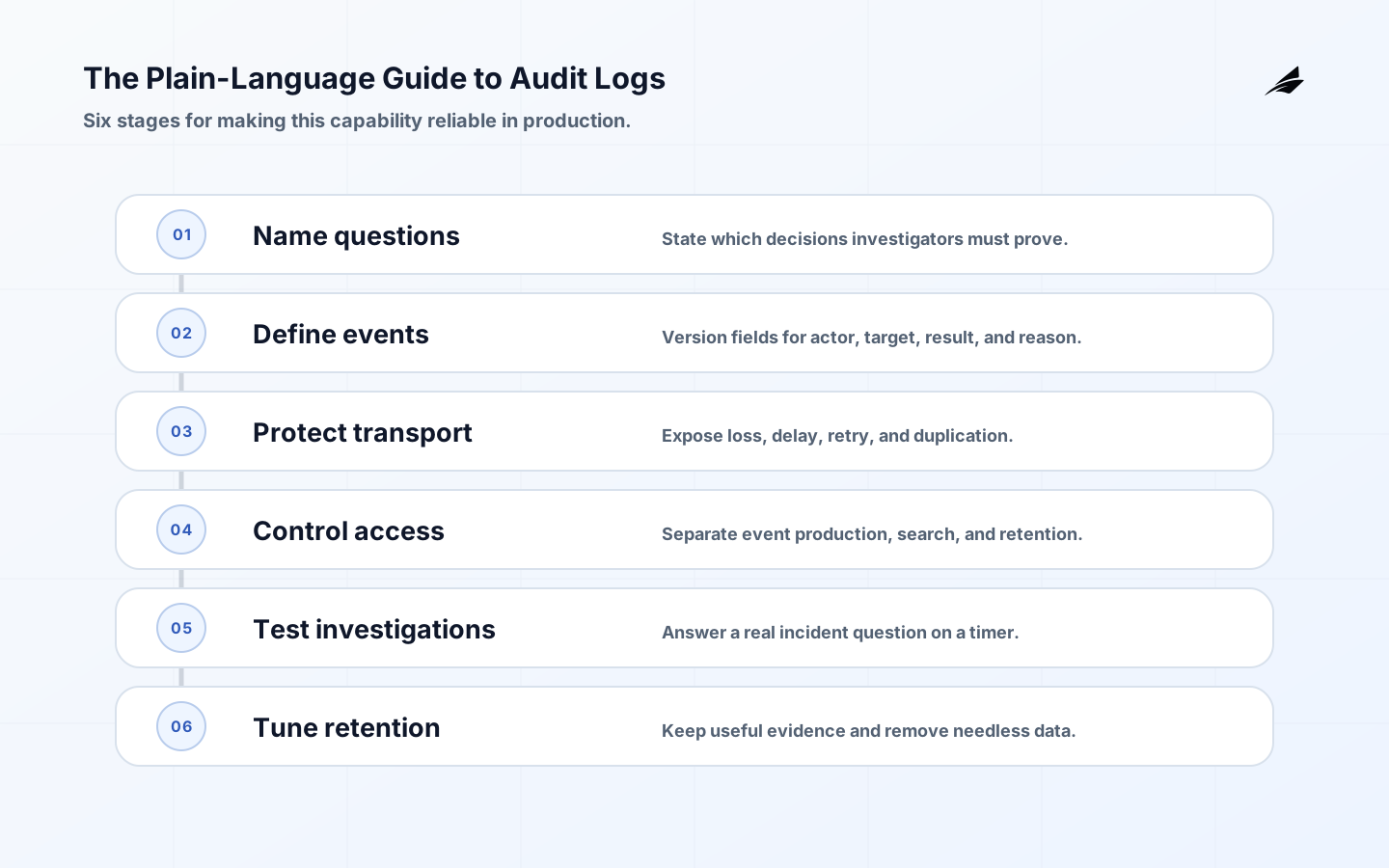
AuditPractice: audit logs are security evidence: a durable account of who attempted or performed a sensitive action, against what target, under which authorization and result. AuditPractice: they are different from broad application diagnostics. AuditPractice: a log that cannot reconstruct a privileged change or distinguish a denied request from a successful one may be noisy, but it is not doing the core audit job.
Define the questions audit logs must answer — audit log practice
AuditPractice: start with questions that matter during review and investigation: who granted an administrator role, who exported a customer record, which policy permitted an action, which credential changed configuration, and when was a secret revoked? AuditPractice: the OWASP Logging Cheat Sheet recommends security-relevant event logging while warning against storing secrets and sensitive information unnecessarily. AuditPractice: capture the action and its context, not indiscriminate payloads.
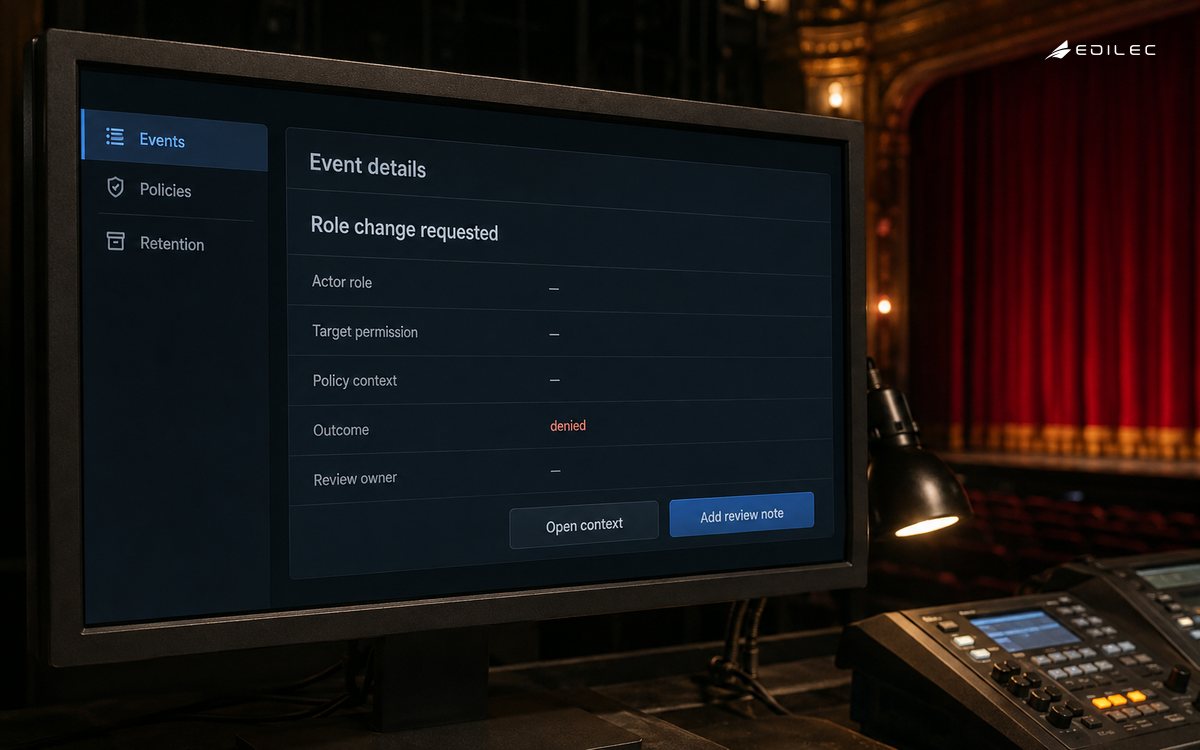
AuditPractice: a useful event commonly includes a stable event name, time, actor or service identity, target, correlation identifier, source context, outcome, authorization or policy version, and reason for denial where it can be safely shown. AuditPractice: normalize vocabulary across services so analysts can join events. AuditPractice: synchronize time and preserve original event timestamps separately from collection timestamps when data crosses systems.
| AuditPractice: design decision | AuditPractice: question to answer | AuditPractice: evidence |
|---|---|---|
| AuditPractice: event | AuditPractice: minimum context | AuditPractice: avoid |
| AuditPractice: privileged role grant | AuditPractice: actor, target, approver, old and new state | AuditPractice: credential or session token |
| AuditPractice: data export | AuditPractice: actor, tenant, scope, result, volume band | AuditPractice: full exported content |
| AuditPractice: denied authorization | AuditPractice: actor, target type, policy version, reason class | AuditPractice: sensitive policy attributes |
Capture events with useful context — audit log practice
AuditPractice: protect logs against the very actors they record. AuditPractice: restrict read access, separate administration of the application from deletion or alteration rights, encrypt collection paths, and detect modification or loss. AuditPractice: oWASP notes the value of tamper detection and recording access to logs; NIST SP 800-92 provides broader guidance for log management. AuditPractice: backups, search indexes, and exported reports need the same access and retention decisions as the primary store.
- AuditPractice: avoid: Logging sensitive tokens, passwords, or full personal records in the name of investigation.
- AuditPractice: test for: Allowing the same administrator to change a system and silently delete its history.
- AuditPractice: do not accept: Collecting events without stable names, clocks, correlation, or an alert owner.
Protect integrity, access, and retention — audit log practice
AuditPractice: the practical standard for security audit evidence is not a perfect diagram or a successful demonstration. AuditPractice: it is whether the control still makes the intended decision when data is incomplete, a dependency is slow, an operator is rushed, or an attacker chooses the least protected path. AuditPractice: use focused tests for denial, stale state, unusual volume, and recovery. AuditPractice: keep the result with the change record so later reviewers can see what was expected and what was actually verified.
| AuditPractice: operating signal | AuditPractice: what it may reveal | AuditPractice: first investigation |
|---|---|---|
| AuditPractice: control | AuditPractice: purpose | AuditPractice: test |
| AuditPractice: append or tamper detection | AuditPractice: expose alteration or deletion | AuditPractice: attempt controlled modification |
| AuditPractice: restricted log access | AuditPractice: limit secondary disclosure | AuditPractice: review readers and exports |
| AuditPractice: retention rule | AuditPractice: balance evidence and data exposure | AuditPractice: verify disposal across copies |
Make review and response operational — audit log practice
AuditPractice: logging becomes a control only when someone can use it. AuditPractice: define alert thresholds for exceptional events such as administrator creation, mass export, policy bypass, and repeated denied access, then attach a response owner. AuditPractice: test an investigation using a realistic case. AuditPractice: review retention against legal, contractual, privacy, and operational needs. AuditPractice: keeping every event forever can create a sensitive archive with no ability to explain or protect it.
AuditPractice: use a short review cadence for the parts of security audit evidence that can cause material harm: privileged access, exception paths, high-value data, and emergency changes. AuditPractice: the NIST Cybersecurity Framework 2.0 is helpful as an organizing model because it links governance, protection, detection, response, and recovery. AuditPractice: the goal is a control that a named owner can explain, test, and improve rather than a setting no one revisits.
Implementation Details That Matter — audit log practice
AuditPractice: event schemas are contracts. AuditPractice: give event names a stable namespace, define required fields, version additions carefully, and publish examples for service teams. AuditPractice: a consumer should be able to tell the difference between an authentication failure, an authorization denial, a resource-not-found response, and an application error without parsing prose. AuditPractice: include a correlation identifier that links a user action across services, but avoid using a mutable display name as the only actor identifier. AuditPractice: this makes investigations faster and makes automated detection less brittle as products evolve.
AuditPractice: delivery reliability matters because missing evidence can be as harmful as misleading evidence. AuditPractice: decide whether a service should buffer, retry, locally spool, or fail a sensitive action when the audit collector is unavailable. AuditPractice: the answer can vary by consequence, but it should be explicit and tested. AuditPractice: monitor gaps, clock skew, parsing failures, and backlog age. AuditPractice: a central platform may be healthy while one service has silently stopped emitting its most important events because a schema change or network rule broke the path.
AuditPractice: access to logs is an authorization surface of its own. AuditPractice: support staff, developers, incident responders, compliance reviewers, and vendors may have different legitimate needs. AuditPractice: use scoped queries, time-bounded elevated access, and recorded exports for sensitive audit data. AuditPractice: redaction policies should preserve enough context to investigate without revealing credentials or personal content. AuditPractice: test whether a user with application administration can alter retention, disable collection, or read logs that would reveal data they are otherwise not allowed to access.
AuditPractice: close the evidence loop after incidents and routine reviews. AuditPractice: ask which events actually answered the investigation questions, which were missing, and which added noise without decision value. AuditPractice: add a targeted event or improve an existing field rather than multiplying unstructured debug logs. AuditPractice: review alerts for precision and ownership, and test the response path for high-impact events. AuditPractice: an audit program matures when its records help a person make a defensible decision under time pressure, not merely when storage volume grows.
Use audit logs as evidence, not exhaust — audit log practice
AuditPractice: event transport and retention should also be read against RFC 5424 and RFC 5425, which clarify syslog structure and protected transport assumptions relevant to an evidence pipeline.
AuditPractice: an application log tells an operator what code printed; an audit log explains a security- or business-relevant decision. AuditPractice: capture actor, service, target, tenant, action, outcome, reason, authorization context, correlation ID, and schema version. AuditPractice: synchronize clocks and avoid passwords, bearer tokens, payment details, and unnecessary personal data. AuditPractice: the OWASP Logging Cheat Sheet covers event content while NIST SP 800-92 covers management and review. AuditPractice: include negative paths: denials, validation failures, policy mismatches, and attempted privilege changes. AuditPractice: if the sink is unavailable, buffer, stop a high-impact action, or create a durable alert; an unrecorded event leaves the resulting conclusions unreliable. AuditPractice: use least privilege, separate retention administration, and append-oriented handling for high-value events, but test retrieval and deletion obligations. AuditPractice: run an exercise where someone outside the service team answers a real question on a target time. AuditPractice: the NIST Cybersecurity Framework, OWASP ASVS, OAuth Guide, and Incident Evidence connect the signal.
Practical Takeaways
- AuditPractice: tie audit logs decisions to a bounded action and a named owner.
- AuditPractice: make enforcement happen in a trusted service or policy boundary, not in a browser or a document.
- AuditPractice: treat exceptions, recovery, and observability as part of the design from the start.
- AuditPractice: use representative negative tests and review evidence after changes, not only before launch.
Audit logs FAQ
AuditPractice: is audit logs a one-time implementation? AuditPractice: no. AuditPractice: the initial design establishes a baseline, but systems, identities, dependencies, and risks change. AuditPractice: review it whenever a high-impact workflow changes and use incidents or recurring exceptions as evidence that the operating model needs adjustment.
AuditPractice: what should be measured first for audit logs? AuditPractice: start with the decision it protects, then measure successful and denied actions, exception volume, corrective work, and the time required to establish what happened. AuditPractice: those signals reveal whether audit logs are supporting the intended workflow or simply moving risk to a less visible path.
AuditPractice: how should a small team start with audit logs? AuditPractice: choose one high-consequence workflow, map its current inputs and failure states, assign an owner, add the smallest dependable control, and test both normal and adverse cases. AuditPractice: that bounded work creates evidence for the next audit logs decision without claiming the entire estate can be redesigned at once.
AuditPractice: audit log design should include a privacy review before collection expands. AuditPractice: event data can reveal user behavior, customer relationships, administrative decisions, or operational topology even when it contains no direct secret. AuditPractice: define the approved purposes, access roles, geographic or contractual restrictions, and retention periods for each event class. AuditPractice: ensure incident responders can obtain what they need without copying raw records into uncontrolled documents or chat. AuditPractice: when logs are shared with a vendor or analytics tool, document the transfer and verify its security boundary. AuditPractice: evidence has value only while its collection and use remain defensible; a well-governed log is both more trustworthy in an investigation and less likely to become a secondary source of harm.
AuditPractice: periodically sample a completed investigation and ask whether the audit record supported an independent reconstruction of the action. AuditPractice: if the answer requires a person’s memory or a private spreadsheet, improve the event design. AuditPractice: this is a practical quality test for audit logs because it measures the evidence against the reason it exists.
AuditPractice: plain language does not mean vague fields. AuditPractice: say “service account 42 changed role 7 for tenant 19; policy denied; reason separation-of-duties” rather than “authorization failed.” Keep the event understandable to an investigator who did not build the feature, while preserving stable identifiers for automation. AuditPractice: review readers as carefully as writers: an overly broad dashboard can turn a useful evidence trail into a new disclosure surface. AuditPractice: retention and deletion should be explainable to security, privacy, support, and legal owners.
For plain-language logs, test whether a support or incident responder can understand the record without access to source code. AuditPractice: readability is part of evidence quality. AuditPractice: use a named owner, a dated review, and a measurable stop condition. AuditPractice: check both the normal path and the adverse path, then record the evidence where the next operator can find it. AuditPractice: review dependencies, permissions, configuration, data handling, and recovery together because a locally correct component can still create an unsafe system when its assumptions do not match its neighbors. AuditPractice: keep the first release narrow enough to inspect. AuditPractice: when the evidence exposes a gap, change the control, test, alert, runbook, or ownership record explicitly; do not hide the gap in a broad exception. AuditPractice: a useful review ends with a decision, an owner, and the next verification date.
For adjacent practice, compare the evidence model with Audit Logs Architecture before changing retention or access rules.
Conclusion
For audit log practice, consult OWASP Logging Cheat Sheet, NIST SP 800-92: Guide to Computer Security Log Management, The Syslog Protocol, Transport Layer Security Protocol when checking the stated boundary, test, and operating evidence.
AuditPractice: related decisions for audit log practice: How AI Agents Work in Business Workflows: Architecture, Controls and Rollout, RAG for Company Knowledge and Support: Architecture, Controls and Rollout, Internal tools that scale with operations.
AuditPractice: audit logging is dependable when it maps to real work, uses authoritative inputs, makes a defensible decision at the point of action, and leaves an evidence trail for review. AuditPractice: start with one bounded workflow, make the recovery path real, and expand only after the team can explain what the control prevented, what it allowed, and who owns the next decision.