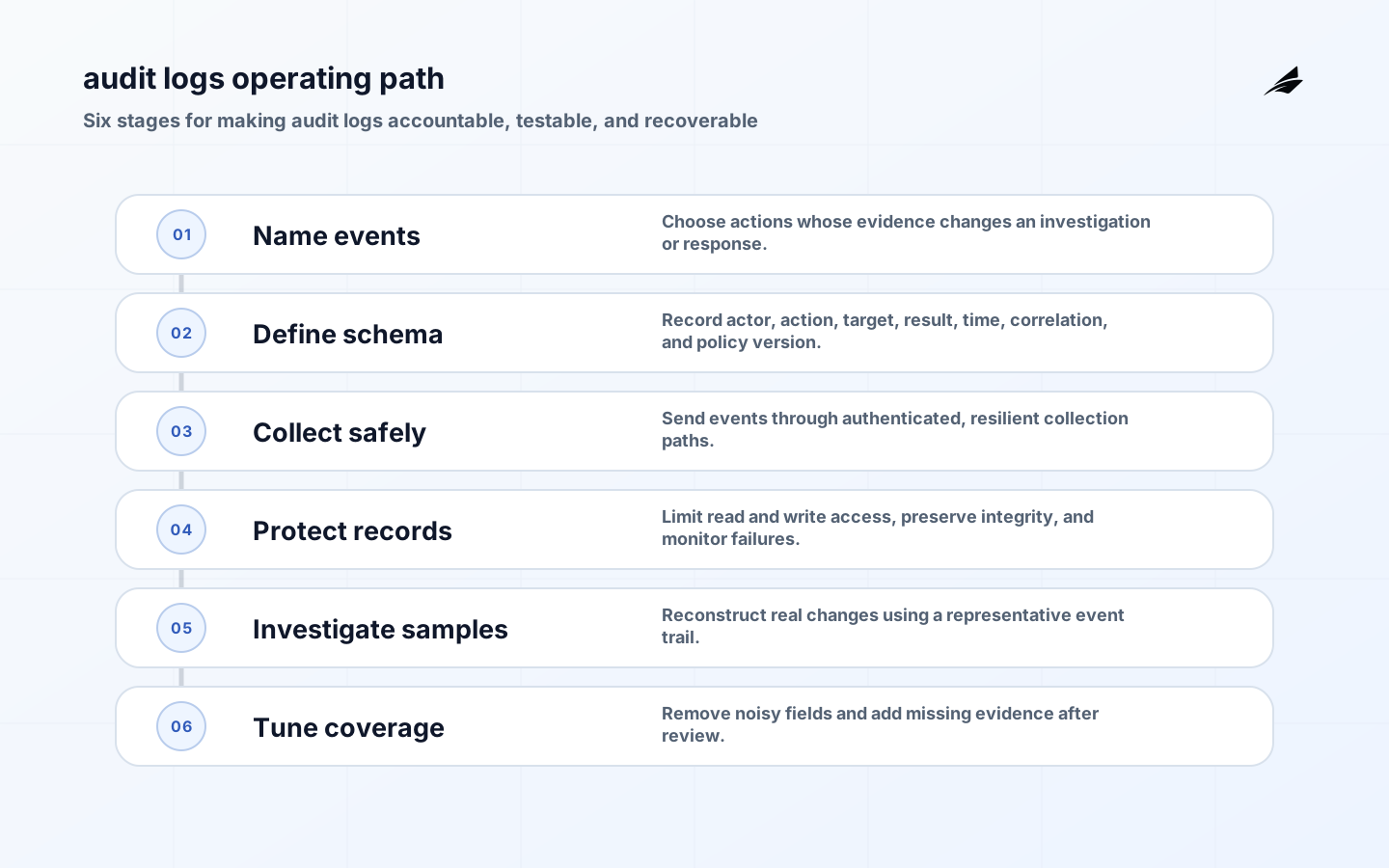
Audit Logs is an operational discipline, not a calendar reminder or a product purchase. For operations leaders, the useful starting point is security-relevant actions that change access, data, configuration, or money. The question is specific: whether an investigator can reconstruct a material event without relying on a person's memory. That framing turns a broad security aspiration into a system that can be owned, tested, and improved. OWASP Logging Cheat Sheet provides direct technical guidance for this topic, while NIST SP 800-53 Rev. 5: Security and Privacy Controls helps place the control alongside access, change, monitoring, and recovery work. A small team does not need a large program to begin; it needs a narrow boundary, honest evidence, and a way to stop or reverse a change when the evidence disagrees.
Set the audit logs boundary
Begin by naming the outcome, the systems included, and the person who can accept or reject risk. In this case, inventory authentication events, authorization outcomes, administrative changes, exports, and break-glass actions. Do not call an item covered merely because it appears in a spreadsheet. A useful inventory records its owner, environment, business dependency, technical location, change path, and the consequence of failure. It also calls out what is not yet known. That last field matters: uncertainty should narrow the first release, not disappear under an optimistic status label. The boundary is ready when an engineer can show a normal path, a failure path, and the evidence that distinguishes them.
| Boundary question | Decision to make | Evidence to retain |
|---|---|---|
| Protected outcome | What must audit logs permit, prevent, or prove? | Scope statement, accountable owner, and material consequence. |
| Authoritative record | Which source of truth governs authentication events, authorization outcomes, administrative changes, exports, and break-glass actions? | System name, steward, freshness expectation, and access path. |
| Exception | When may normal audit logs rules be bypassed? | Approver, compensating measure, expiry, and review date. |
| Recovery | How is safe operation restored? | Tested runbook, decision authority, and verification signal. |
Design audit logs around evidence and ownership
The design should make a decision traceable without exposing sensitive content. Use an event schema, protected collection path, clock discipline, access limits, and retention rules. Treat every handoff as a design choice: who changes the record, which identity is permitted to do it, how another system learns of the change, and what happens when that system is unavailable. NIST Cybersecurity Framework is especially relevant because it emphasizes that security controls need usable, protected evidence rather than a collection of unconnected signals. Good records make an ordinary operator more capable; they should not require privileged access or tribal knowledge simply to explain a result.
Separate policy from mechanism. Policy states the condition that must hold and the owner who approves an exception. Mechanism is the software, configuration, workflow, or review that applies it. When the two are mixed, a change in a vendor console can silently rewrite the rule. Keep configuration reviewable, versioned, and attributable. For each important decision, record the input, decision version, outcome, correlation identifier, and a reference to the source record. Exclude credentials, session values, or unnecessary personal data from that evidence. The aim is accountability without creating a second sensitive repository. For audit logs, state which events are mandatory, which fields are prohibited, and who can change schema or retention without weakening an investigation.
- Give each audit logs rule one accountable business or technical owner and a named operational backup.
- Make normal use, expected denial, dependency failure, and approved recovery explicit before wider rollout.
- Version configurations and retain enough context to compare a change with the behavior that followed.
- Time-box exceptions; an exception without an expiry is a policy change that avoided review.
Implement audit logs in bounded stages
Start with one valuable workflow rather than all systems at once. Capture a baseline before making a change: current state, known consumers, expected behavior, measurement window, and recovery action. Then apply one reversible step and observe it through a representative period. For audit logs, this means avoiding an untested bulk operation that could affect every customer or administrator at once. The implementation record should say precisely which cohort moved, which configuration or policy version applied, who watched the signals, and who could halt the rollout. That is not bureaucratic overhead; it is how a team distinguishes a real improvement from a quiet interval.

| Release check | Pass condition | What a miss means |
|---|---|---|
| Expected path | A legitimate audit logs workflow completes with attributable evidence. | The integration, policy, or inventory needs correction before expansion. |
| Adverse path | A deliberately invalid, expired, or unauthorized case is handled safely. | A bypass, missing control, or unsafe fallback may remain. |
| Recovery path | The designated owner restores approved operation using documented steps. | Responders may create an improvised and persistent exception. |
| Observation | The result can be tied to a version, owner, and time window. | The team cannot make a reliable keep, revise, or rollback decision. |
Operate audit logs with meaningful signals
Measure event completeness, ingestion delay, correlation coverage, query success, and protected-log access. Pair a direct control measure with an operational guardrail. A reduction in one count is not automatically success if it creates latency, support pressure, failed work, or blind spots elsewhere. Segment the data by the boundary that matters: application, environment, tenant, service, or change version. Review examples as well as totals. A small sample of successful and unsuccessful cases often exposes an ownership or context error that a dashboard average hides. OWASP Authorization Cheat Sheet supports this broader view: durable security work connects the technical control to risk management, not just to a one-time deployment.
Build review into existing operational rhythms. A weekly service review can handle fresh failures and exceptions; a monthly ownership review can find stale accounts, records, or dependencies; a post-change review can confirm that a material alteration behaved as planned. Each review should finish with one of four explicit decisions: keep, correct, widen, or reverse. Record why. This is how a growing team preserves knowledge when people change roles and prevents temporary emergency choices from becoming permanent architecture. For audit logs, schedule sampling of privileged events, delayed ingestion, and failed collectors so the team learns whether the record remains usable when its normal pipeline is degraded.
Failure modes to address before scale
The recurring failure is treating audit logs as a checkbox. A team may document a rule, turn on a feature, or generate a report, yet leave the actual decision unowned. Another failure is over-collection: storing every possible value makes investigation slower and raises the impact of a compromise. A third is optimistic fallback, where missing data, unavailable tooling, or deadline pressure quietly produces a broad allow, skipped check, or unreviewed exception. Counter these patterns with default-safe behavior appropriate to the service, a visibly owned emergency route, and a post-event review that tests whether the route should still exist.
Avoid using a severity label as a substitute for local judgment. The consequence of a control failure depends on the asset, exposure, actor, and available recovery. State those factors in the decision record. Then test the uncomfortable cases: a former owner, a partial outage, a delayed message, a dependency that reports stale data, an administrator acting in the wrong tenant, or an automation job using yesterday's configuration. The result should be understandable and safe, even when the ideal signal is missing. That is the standard that matters in real operations. For audit logs, test clock skew, duplicate delivery, and a writer outage; an investigator needs a coherent story even when telemetry arrives late or out of order.
Connect audit logs to adjacent practices
Audit Logs works best when its handoffs to related controls are deliberate. Useful companion reading includes KM-SEC-0092 guide, KM-SEC-0113 guide, KM-SEC-0119 guide. These guides help teams align identity, authorization, configuration, monitoring, and incident response rather than solving each in isolation. For example, an alert must lead to someone with authority to act; an access decision must apply at the protected resource; and a recovery step must not depend on the very dependency that failed. Shared ownership vocabulary and a small, current asset inventory do more for consistency than a sprawling policy document.
Audit Logs takeaways
- Scope audit logs around a concrete business or security outcome and a named accountable owner.
- Make decisions explainable through protected evidence, not personal recollection or dashboard color.
- Begin with a reversible workflow, then test normal, adverse, and recovery paths before widening it.
- Use time-bounded exceptions and review them before they quietly become a second operating model.
- Measure the control and its operational side effects together, then let evidence select the next change.
Audit Logs FAQ
Where should a small team start with audit logs? Choose one workflow where a failure would matter, name its owner, and write down the current state, desired state, and recovery action. How much documentation is enough? Keep a short decision record with scope, source records, rule or configuration version, owner, exception process, tests, and review date. What if the inventory is incomplete? Mark the uncertainty, reduce the rollout boundary, and fix the evidence path before making an irreversible change. How often should it be reviewed? Review after a material change or incident and on a cadence that is realistic for the consequence; stale access, records, and exceptions deserve more than an annual glance.
Conclusion: make audit logs operable
The durable form of audit logs is a promise the team can keep under pressure: what is protected, who decides, which evidence explains the result, and how normal operation is restored. Start small enough to observe the full path. Keep exceptions visible and temporary. Then expand only after the people responsible can explain a real event and correct it safely. That discipline produces security controls that are useful in daily work, not merely impressive in a review.