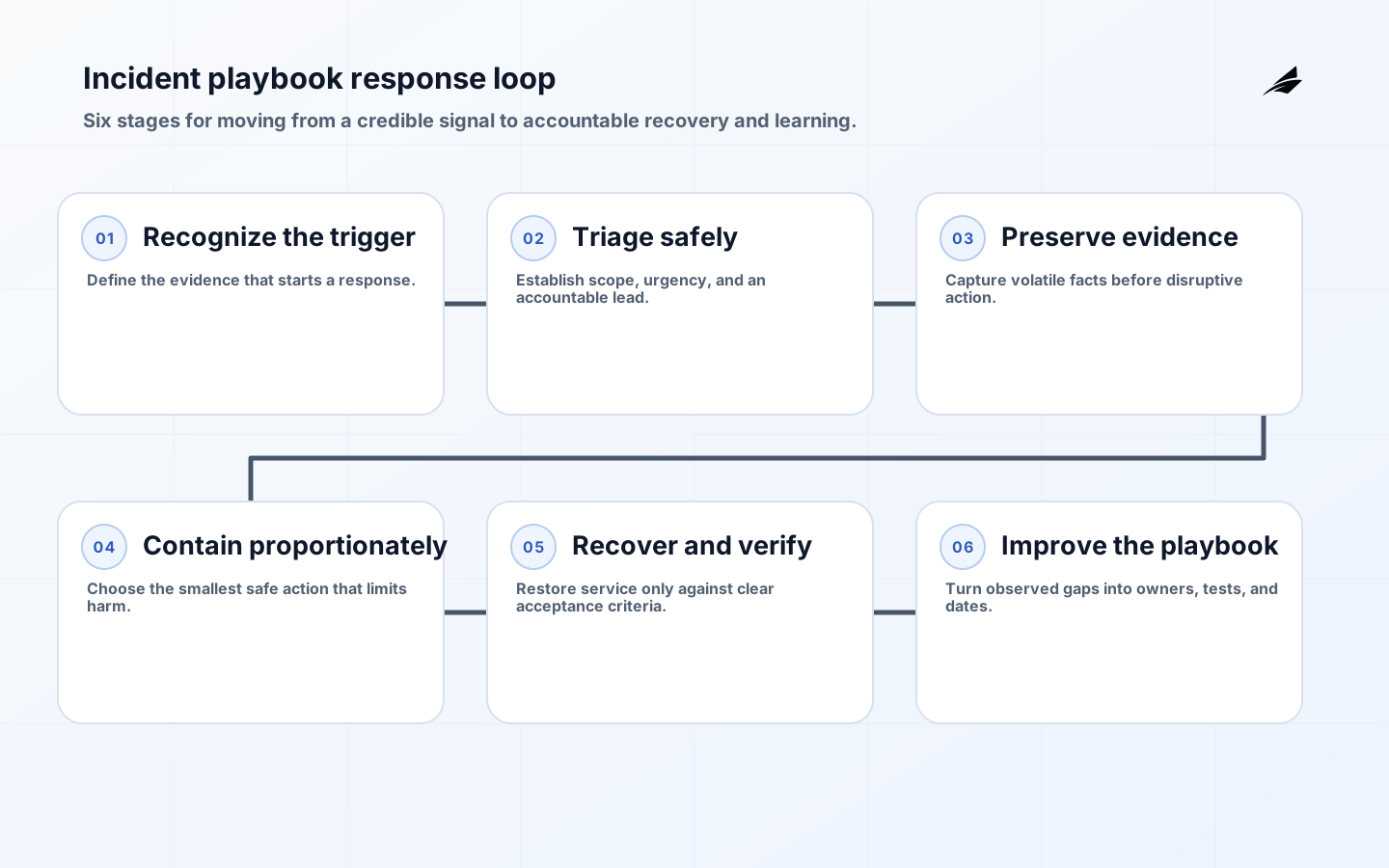
Incident playbooks are not a product label or a compliance checkbox. It is a set of decisions about pre-agreed, evidence-led instructions that help people recognize, contain, communicate about, and recover from a defined class of security incident. For engineering teams, the useful starting point is a concrete business journey: name the protected outcome, the identities that take part, the systems that make a decision, and the evidence needed when something goes wrong. The central question is what responders should verify first, who can authorize a disruptive action, and how to reduce harm without destroying evidence or creating a second outage. That question keeps a team from copying a default configuration without knowing what it protects. It also exposes trade-offs early, including usability, recovery time, supplier dependence, and the work required to operate the control after launch. This guide treats incident playbooks as an operating capability: a design must work during ordinary use, in a degraded state, and when an investigator needs to reconstruct a meaningful event.
Define the incident playbooks decision
Begin by writing the decision in plain language and identifying its owner. In this case, the decision is what responders should verify first, who can authorize a disruptive action, and how to reduce harm without destroying evidence or creating a second outage. The material risk is that an unpracticed response invites delay, contradictory decisions, unsafe containment, missed notification duties, and a loss of evidence needed to understand the event. A useful record captures the subject, protected resource, requested action, time, environment, policy or configuration version, and resulting decision. This is more valuable than a broad statement that a system is “secure.” It lets engineering, security, support, and the business test the same boundary. NIST SP 800-61 Rev. 3 is a strong reference point, but the organization still has to translate general guidance into its own resource inventory, user journeys, and risk appetite. The aim is not to remove all exceptions; it is to make every exception visible, owned, time-bound, and reviewable.
| Question | What a team should decide | Evidence that the decision holds |
|---|---|---|
| Purpose | State the protected outcome and the harm from a wrong incident playbooks decision. | A named owner, representative request, and acceptance test tied to the outcome. |
| Authority | Name who may create, change, approve, or override incident playbooks rules. | An accountable role, approval record, and change history that can be inspected. |
| Scope | Define the resources, identities, environments, and third parties inside the boundary. | An inventory that connects the rule to live systems and named dependencies. |
| Expiry | Choose when access, evidence, exceptions, or data must be renewed, removed, or reviewed. | A scheduled review and proof that stale conditions are detected and handled. |
Map the incident playbooks boundary
The boundary is the handoff among detection, triage, incident command, technical containment, business communication, legal or privacy review, recovery, and learning. Draw it as an actual request or release path, not as a vendor diagram. Mark where trust is established, where data or credentials cross a process boundary, which component enforces a rule, and which system remains authoritative when records disagree. Then trace the path under ordinary conditions and under a realistic failure: the team has a document but cannot identify the incident commander, safely isolate a service, or reach the people who decide customer communication. The comparison reveals dependencies that a happy-path review misses, such as a cache, redirect, build runner, backup copy, device, shared service account, or administrator console. A boundary is credible when the team can say what happens next if one of those components is unavailable, dishonest, delayed, or incorrectly configured.
Choose controls that fit the path instead of layering unrelated settings. Here, the practical control set includes clear severity definitions, an incident commander, preserved logs and artifacts, least-disruptive containment options, out-of-band communications, recovery criteria, and scheduled exercises. Each control needs a reason, an owner, a release method, and a way to observe whether it is functioning. Do not give a monitoring system more authority than the protected system, and do not make a dashboard the only record of a decision. The relevant operational evidence is alert context, timeline, affected identities and assets, commands or changes, approvals, containment results, recovery checks, and post-incident actions. For a companion view of the same problem, read incident playbooks planning guide. It is often more revealing to follow one sensitive request or release all the way through than to review a long policy document in isolation.
Build testable incident playbooks controls
| Control area | Implementation question | Failure-aware test |
|---|---|---|
| Identity and authority | Which identity can act, and how is that authority limited for incident playbooks? | Attempt the same action with an expired, over-scoped, or changed identity and record the result. |
| Change management | How are policy, configuration, dependency, or lifecycle changes reviewed and reversed? | Deploy a representative change, then prove the team can identify and safely undo it. |
| Observability | Which events make incident playbooks decisions explainable without exposing unnecessary secrets? | Trace one normal case and one denied or degraded case from trigger to resolution. |
| Recovery | Who can contain, restore, or escalate when the expected control is unavailable or bypassed? | Exercise the recovery decision with real owners, communications, and time limits. |
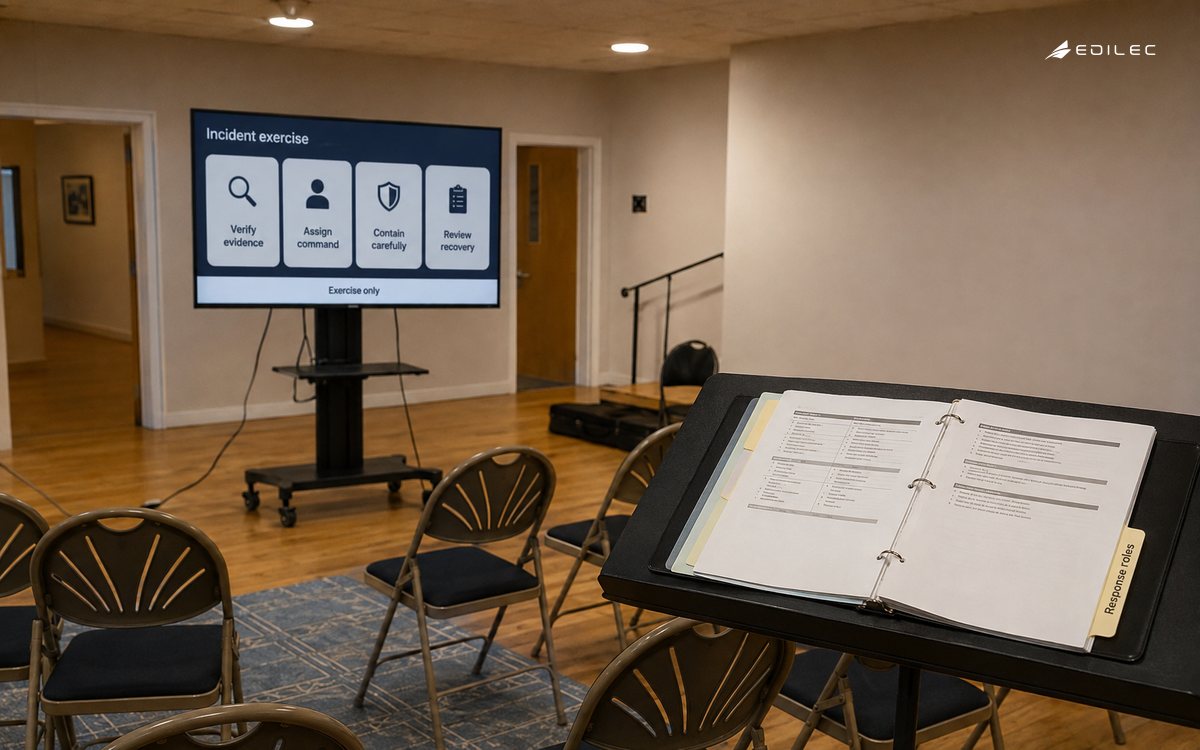
Testing should be designed around abuse cases and operational mistakes, not only the expected API or UI response. Start with a normal journey, then test an incorrect identifier, stale state, duplicate request, unavailable dependency, changed role, and delayed evidence. Confirm that the safe response is understandable to the person on call. Where a change could affect customers, use a limited rollout and a pre-decided stop condition. The test outcome should record the observed behavior, the expected behavior, the accountable owner, and the corrective action. That record becomes a reusable fixture for later changes. incident playbooks checklist can help convert the broad design into a short, repeatable review before a release or a material configuration change.
Operate incident playbooks from evidence
An operating metric is useful only if it leads to a decision. For incident playbooks, review whether the inventory is complete enough for the decision, whether exceptions are growing, whether protections are being bypassed, how long unsafe conditions persist, and whether failures are detected by the team rather than by a customer. Segment metrics by resource criticality and meaningful owner; a single aggregate percentage can hide the system that matters most. Review a small sample of successful and failed cases with the people who do the work. That discussion often reveals confusing ownership, unsupported workflow, or an approval that exists only on paper. Preserve the original evidence and the resulting decision, especially when a temporary workaround is approved.
Roll out incident playbooks deliberately
A staged rollout should include representative users, workloads, locations, integrations, and exception cases. Publish the success measure, the containment trigger, and the person empowered to pause the rollout. Review results with engineering and the people who experience the operational consequence. If their accounts disagree, preserve both observations and resolve the authority; do not smooth the difference away in a report. Changes to incident playbooks often alter support volume, latency, recovery, or partner behavior, so these effects belong in the review alongside security telemetry. The next iteration should update the policy, test fixtures, runbook, and ownership record together. A mature control is one that a new operator can understand and a support owner can handle without guessing.
Incident playbooks takeaways
- Start with the decision: what responders should verify first, who can authorize a disruptive action, and how to reduce harm without destroying evidence or creating a second outage.
- Treat the live boundary as the handoff among detection, triage, incident command, technical containment, business communication, legal or privacy review, recovery, and learning.
- Make controls observable through alert context, timeline, affected identities and assets, commands or changes, approvals, containment results, recovery checks, and post-incident actions.
- Plan explicitly for the failure case: the team has a document but cannot identify the incident commander, safely isolate a service, or reach the people who decide customer communication.
- Keep exceptions named, time-bound, and visible to the owner who accepts their risk.
Incident playbooks FAQ
What should be done first? Identify one high-consequence journey and write the decision, resource, accountable owner, enforcement point, evidence, and recovery action. This gives incident playbooks a measurable boundary. Starting with every application, every control, or every historic exception usually creates an inventory that nobody can act on. A narrow first journey should still include a realistic failure path and the people who must resolve it.
How should a team handle playbook exceptions? A responder may need to delay isolation, preserve a service, or use an alternate communication route. Record who authorized that deviation, what evidence supported it, the containment limit, and the next review. After the incident, turn a recurring deviation into a tested branch of the playbook instead of leaving it as oral tradition.
Authoritative guidance
- NIST SP 800-61 Rev. 3: Incident Response Recommendations
- CISA StopRansomware Guide
- NIST Cybersecurity Framework 2.0
- NIST SP 800-86: Integrating Forensic Techniques into Incident Response
Conclusion: make incident playbooks accountable
Incident playbooks become dependable when their decisions are narrow enough to explain, controls are strong enough to enforce, and evidence is complete enough to review. The objective is not an impressive control catalogue. It is a system that tells people what it can establish, identifies the owner of the next decision, and gives them a safe way to respond when conditions change. Keep the boundary current, practice the degraded path, and use the resulting evidence to improve the next release. That is how a security mechanism becomes part of reliable operations rather than a promise made at launch.