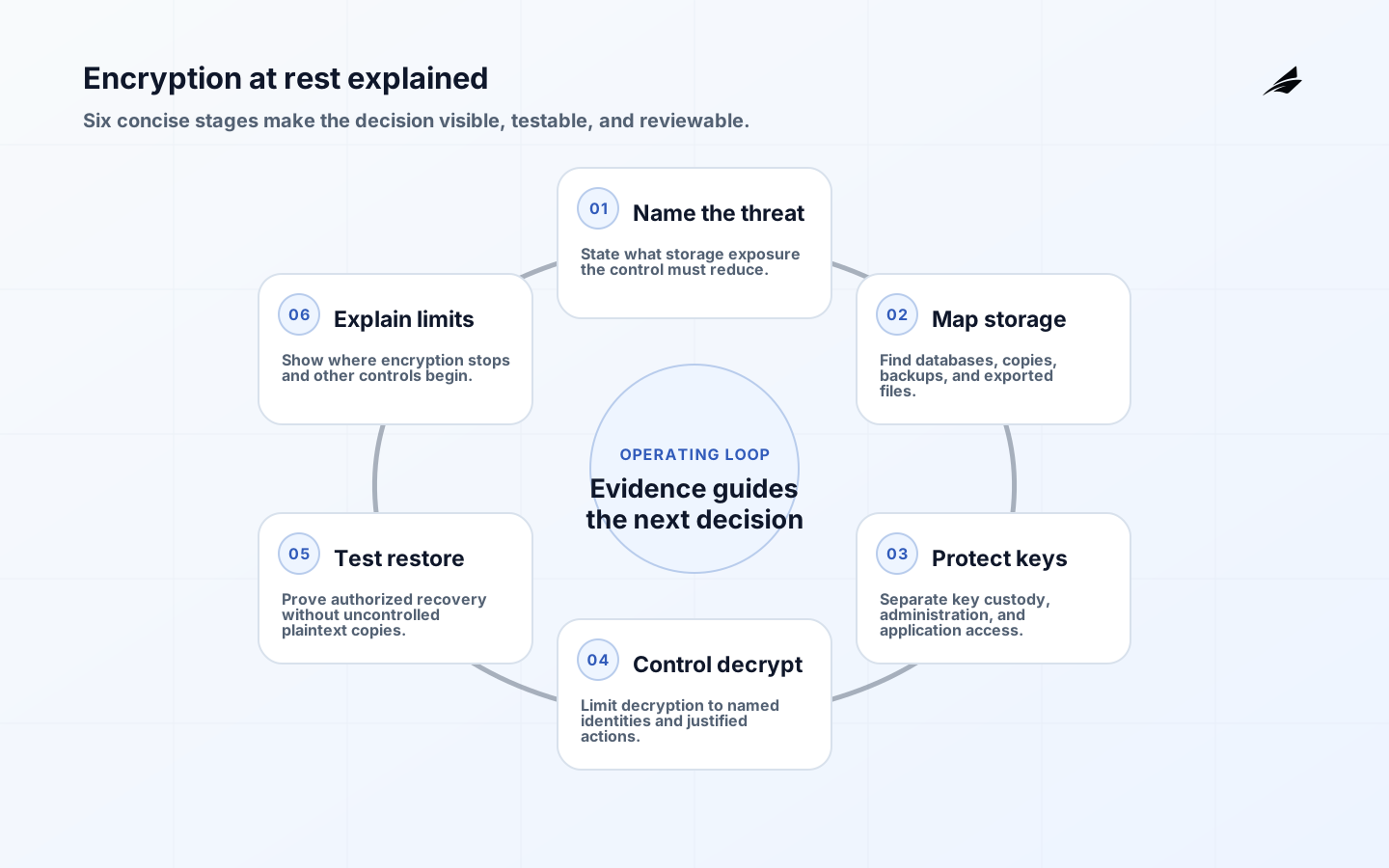
Encryption at rest is easiest to understand as a boundary question: who could obtain the storage medium, host, snapshot, backup, or exported file, and what should that person be unable to read? Encryption reduces exposure when protected data is copied or media is accessed, but it does not replace authorization or secure application design. For concrete provider boundaries, compare Amazon EBS encryption, Azure data-encryption practices, Google Cloud default encryption, and Kubernetes data-at-rest encryption. OWASP’s storage guidance starts with choosing an appropriate algorithm and protecting keys; the plain-language version is simple: protect the data and the thing that unlocks it.
Decide what encryption at rest must protect
Classify data and map every place it persists: primary databases, object storage, search indexes, logs, analytics copies, developer fixtures, queues, backups, and endpoint caches. The OWASP Cryptographic Storage Cheat Sheet makes an important distinction: the appropriate layer depends on the threat model. Disk encryption helps with physical media loss; application-level encryption can narrow who can decrypt a sensitive field.
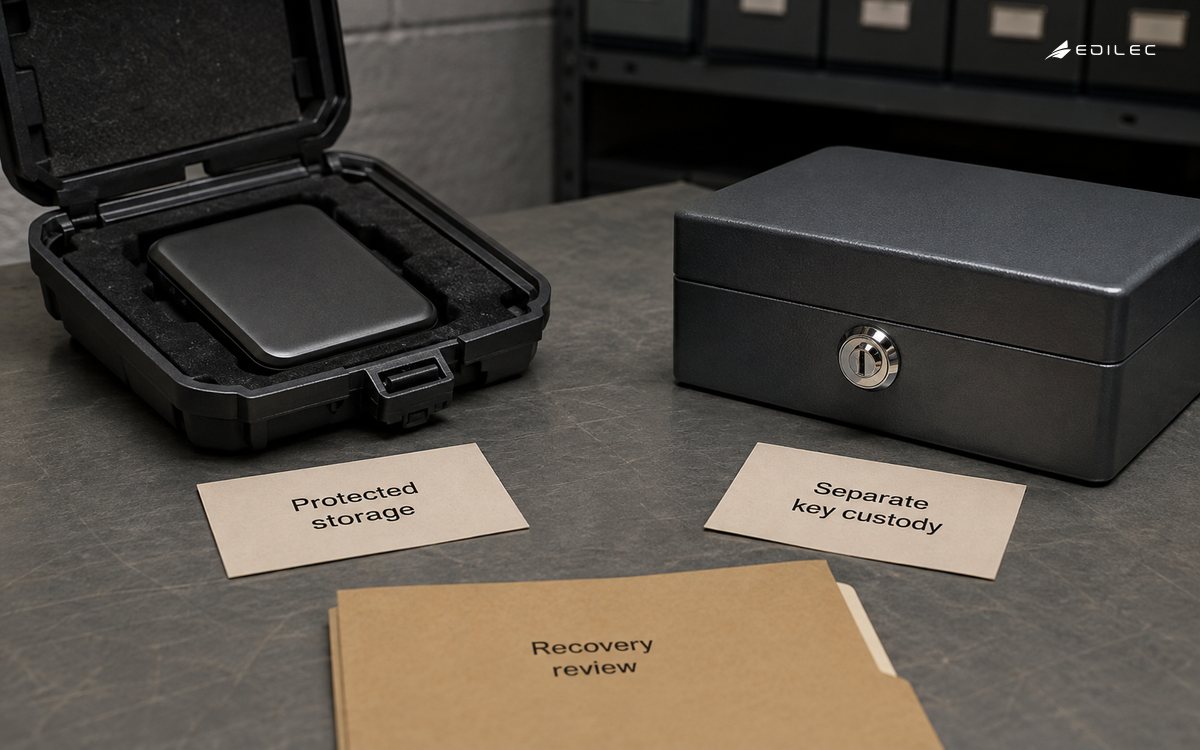
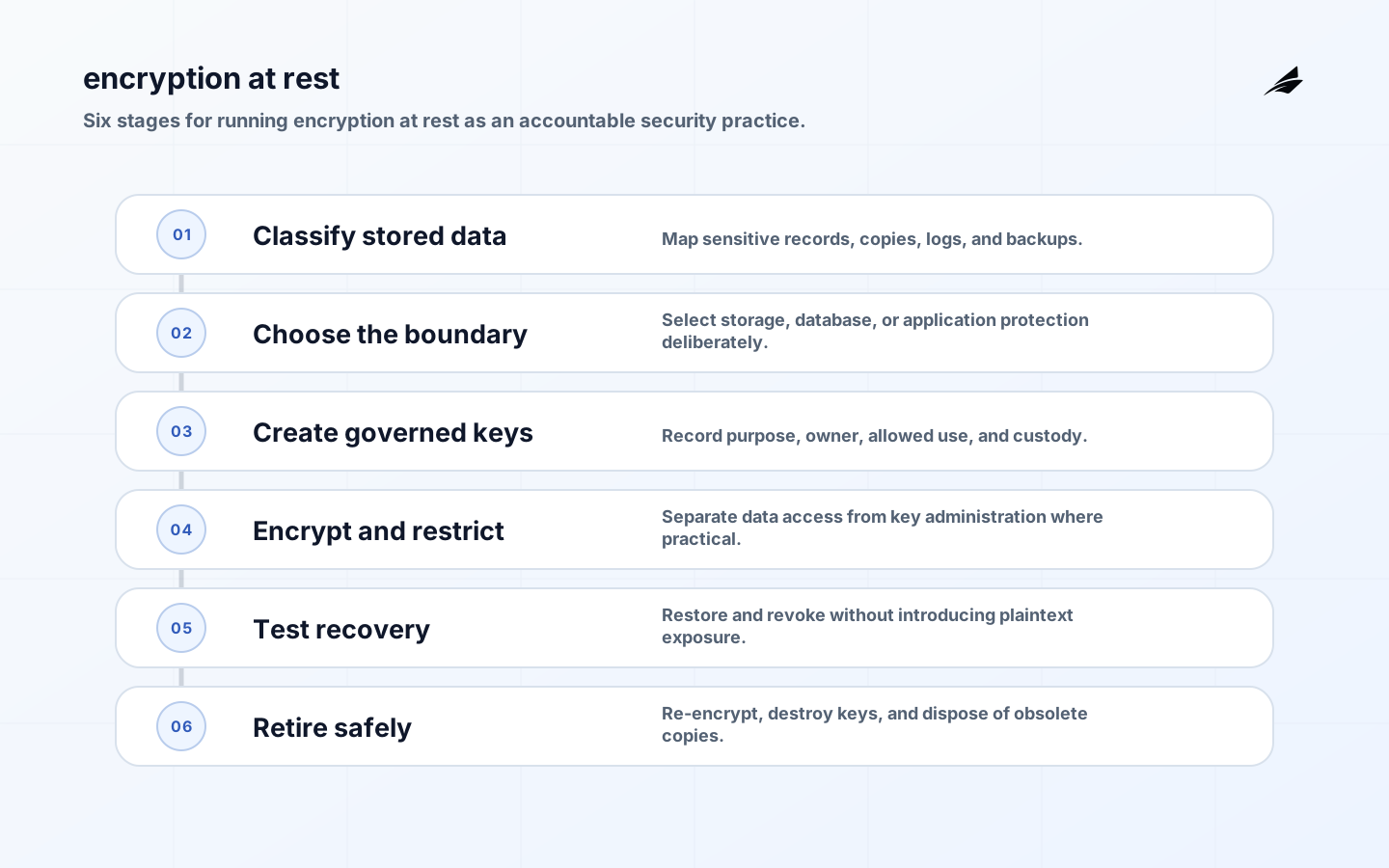
Choose a layer that matches the boundary. Database or storage-service encryption may reduce operational burden, while envelope or application-level encryption can separate access to ciphertext from access to key use. Do not describe either as universally stronger. Consider query needs, key separation, multi-tenant design, incident response, and the operational cost of re-encryption. Minimize collection first; the least risky sensitive record is one the service never stores.
| Design decision | Question to answer | Evidence |
|---|---|---|
| Layer | Protection boundary | Design trade-off |
| Storage or disk | Lost media and underlying storage exposure | Application access may still read plaintext |
| Database | Database files and backups | Key separation varies by service |
| Application field | Narrow sensitive values | More query and key-management complexity |
Choose the right encryption layer
Cryptography depends on keys, not just algorithms. NIST SP 800-57 covers the key lifecycle from generation through destruction. Maintain a key inventory with purpose, owner, allowed use, location, rotation or rekey plan, and recovery authority. Restrict key administration separately from ordinary data administration, log key-use decisions, and never place long-lived key material beside the data it protects.
- Avoid: Assuming disk encryption protects data from a compromised application identity.
- Test for: Encrypting the primary store while leaving backups, exports, or logs unprotected.
- Do not accept: Creating keys without an owner, inventory, revocation path, or recovery test.
Make key management an operating system
The practical standard for stored-data encryption is not a perfect diagram or a successful demonstration. It is whether the control still makes the intended decision when data is incomplete, a dependency is slow, an operator is rushed, or an attacker chooses the least protected path. Use focused tests for denial, stale state, unusual volume, and recovery. Keep the result with the change record so later reviewers can see what was expected and what was actually verified.
| Operating signal | What it may reveal | First investigation |
|---|---|---|
| Lifecycle event | Required evidence | Common miss |
| Key creation | Purpose, owner, permitted use | No inventory entry |
| Rotation | Old and new records remain readable as intended | Unplanned performance spike |
| Restore | Recovered data stays protected and access-controlled | Plaintext copied for troubleshooting |
Test backup, recovery, and retirement
Test the paths teams skip in demonstrations: restore a backup into an isolated environment, revoke a compromised application identity, rotate a key without corrupting old records, and decommission a tenant while retaining only defensible recovery material. Confirm encryption status for replicas and exports, not merely the production database toggle. A recovery procedure that requires copying plaintext to a broad shared location has quietly changed the threat model.
In the plain-language encryption context, use a short review cadence for the parts of stored-data encryption that can cause material harm: privileged access, exception paths, high-value data, and emergency changes. In the plain-language encryption context, the NIST Cybersecurity Framework 2.0 is helpful as an organizing model because it links governance, protection, detection, response, and recovery. In the plain-language encryption context, the goal is a control that a named owner can explain, test, and improve rather than a setting no one revisits.
Implementation Details That Matter
Key hierarchy is a design choice with real recovery implications. A common envelope pattern encrypts data with a data-encryption key and protects that key with a more tightly controlled key-encryption key. The pattern can reduce re-encryption work when a higher-level key rotates, but it does not remove the need to protect metadata, authorize key use, and understand which records each key can recover. Select a provider or component that supports the required audit, separation, availability, and regional requirements; do not add custom cryptography to solve an ownership problem.
Encryption metadata needs its own handling. Store the algorithm or service version, key reference, creation information, and any required context so authorized recovery is possible after an application update. Do not store plaintext keys in metadata, and avoid using predictable identifiers as the only security boundary. When encrypted records move across environments, make sure the destination is authorized to use the relevant key and that test environments do not quietly receive production ciphertext plus a broadly accessible decrypt capability.
Consider the effect of encryption on search, analytics, support, and deletion. Some designs require application-level access to decrypt before processing; others use platform features with different exposure boundaries. Document which jobs can decrypt, what they can emit, and whether derived data retains sensitive content. A data catalog should identify encrypted copies as well as the primary record. Otherwise a deletion or incident response may clean one store while a search index, support export, or old backup remains a more accessible source of the same information.
Cryptographic agility is preparedness, not a promise to rotate everything constantly. Track where algorithms and key references are used, avoid hard-coding obsolete choices into data formats, and make re-encryption a tested operation for the records that warrant it. When a vulnerability, provider change, or policy decision requires a migration, the team should know the order: issue new keys, update writers, migrate or rewrap records, verify reads, protect backups, then restrict the old keys. That evidence is more meaningful than a generic statement that data is encrypted.
Practical Takeaways
- Tie encryption at rest decisions to a bounded action and a named owner.
- Make enforcement happen in a trusted service or policy boundary, not in a browser or a document.
- Treat exceptions, recovery, and observability as part of the design from the start.
- Use representative negative tests and review evidence after changes, not only before launch.
Encryption at rest FAQ
Is encryption at rest a one-time implementation? No. The initial design establishes a baseline, but systems, identities, dependencies, and risks change. Review it whenever a high-impact workflow changes and use incidents or recurring exceptions as evidence that the operating model needs adjustment.
What should be measured first for encryption at rest? Start with the decision it protects, then measure successful and denied actions, exception volume, corrective work, and the time required to establish what happened. Those signals reveal whether encryption at rest is supporting the intended workflow or simply moving risk to a less visible path.
How should a small team start with encryption at rest? Choose one high-consequence workflow, map its current inputs and failure states, assign an owner, add the smallest dependable control, and test both normal and adverse cases. That bounded work creates evidence for the next encryption at rest decision without claiming the entire estate can be redesigned at once.
For encryption at rest, account for deletion and retention before choosing the mechanism. Some systems can remove a record while leaving encrypted copies in backup retention; others use per-tenant or per-object key strategies that can support cryptographic erasure when policy permits. Neither pattern eliminates legal, operational, or recovery obligations, so document what deletion means in each store and how long restoration remains possible. Test access after an account is disabled, after a key policy changes, and after a backup restore. The objective is not simply to prove that a cipher was invoked; it is to show that unauthorized actors cannot obtain usable plaintext through the storage, export, support, or recovery paths that the product actually operates.
Finally, verify access-control logging around key use. A key service may correctly encrypt data while an overly broad application identity can request decryption at scale. Alerts for unusual key use, policy denial, and administrative changes provide the evidence needed to tell a key-management incident from an ordinary application failure.
Plain-language encryption conclusion
Encryption at rest is dependable when it maps to real work, uses authoritative inputs, makes a defensible decision at the point of action, and leaves an evidence trail for review. Start with one bounded workflow, make the recovery path real, and expand only after the team can explain what the control prevented, what it allowed, and who owns the next decision.
Plain-language encryption: turn explanation into an operating decision
Plain-language encryption: test storage and restore
Begin with a small data story. Suppose an application stores identity documents. The database, image bucket, processing queue, backup vault, and support export each need a decision. Database encryption may protect tables and backups while object-storage encryption covers files. A worker still needs decrypt permission, and a support export may need approval and shorter retention. The common gap is not an absent cipher; it is a copy nobody included in the inventory.
Use envelope encryption when the access boundary justifies it. A data-encryption key protects a file or field while a key-encryption key in a managed service protects the data key. This supports scoped access and rotation, but adds metadata, errors, and recovery dependencies. NIST SP 800-57 recommends treating keys as managed objects with lifecycle states and controls. Decide how keys are generated, stored, backed up, rotated, disabled, recovered, and destroyed.
Communicate the limit honestly. If a running application is compromised, encryption at rest may not stop the application decrypting data for an attacker. Pair it with least-privilege service identities, access logging, network controls, secret management, and tested backup recovery. A good review explains the threat encryption addresses, threats that remain, and evidence that production and recovery paths are covered.
Plain-language encryption: connect keys to operations
In the plain-language encryption context, for a broader view, compare encryption at rest access and operations, evidence and review practice, and recovery planning. In the plain-language encryption context, these Edilec guides add the human and operational context around this article’s technical decision.
Plain-language encryption: preserve limits and ownership
A plain-language review should distinguish three questions that are often collapsed: is the data encrypted on the storage service, can the application decrypt it, and can an operator or attacker obtain the decryption authority? The answer may differ for a database, object store, backup, and export. Explain those differences to product and support owners because they determine what a restore, support request, or incident response can safely do. If users need search or partial display, document which fields remain available in searchable or masked form and why. This prevents a later feature request from silently bypassing the original boundary.
Do not use key rotation as a substitute for access review. Rotation changes cryptographic material; it does not remove an over-privileged service identity or an old support role. Pair rotation with a review of decrypt permissions, provider administrators, backup operators, and logs. Run a restore using the newly governed key path and prove that the old path is no longer required before retiring it.