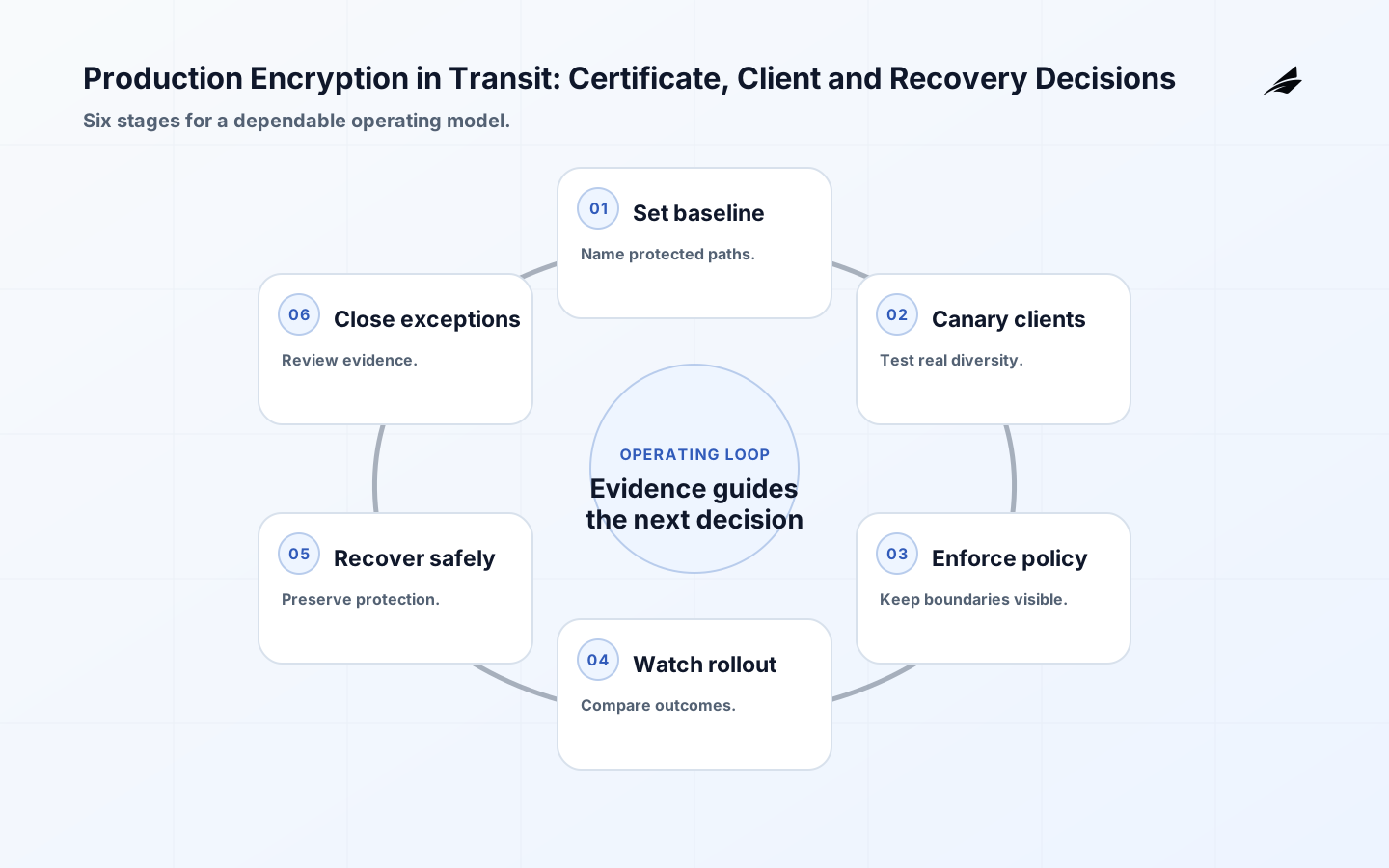
Encryption in transit changes in production because it must withstand ordinary operations, staff changes, dependency failures, and deliberate misuse. The goal is not to collect a control label; it is to make decisions about interception, downgrade, certificate misuse, service impersonation, and plaintext traffic on internal or administrative routes explicit and repeatable. Start from the people and systems that perform consequential work, then identify the evidence a responder would need after an unusual event. OWASP Transport Layer Security Cheat Sheet provides an authoritative baseline, while the local design must specify ownership, implementation boundaries, testing, and review. A useful first release protects one high-value workflow end to end instead of making a broad promise that no service owner can operate.
Define the protected work — production transport readiness
Map the workflow in concrete terms: who initiates it, what resource changes, which service makes the final decision, and what a safe failure looks like. For encryption in transit, the relevant facts include connection route, peer identity, certificate issuer, protocol version, cipher policy, expiry, and service ownership. Give each fact an issuer and determine whether it may be cached, must be refreshed, or requires a human decision. Document paths outside the normal interface, including APIs, scheduled jobs, support tools, imports, and recovery procedures. Those paths often carry the same authority but receive less scrutiny. A design is ready for implementation when an engineer can state the expected allow, deny, hold, and escalation result without interpreting a vague policy statement.
Use the standards as decision aids, not as a substitute for the model. NIST SP 800-57 Part 1: Key Management and OWASP Authentication Cheat Sheet support explicit, protected access decisions; the organization still has to choose its risk boundary. Interview the operator who performs the work and the person who investigates failures. Their uncomfortable examples expose missing conditions: a reassigned employee, an unavailable dependency, a customer with a special contract, a locked administrator account, or a request that must be rolled back. Capture those examples before writing configuration or code.
| Design decision | Question to settle | Release evidence |
|---|---|---|
| Scope | Which interception need protection first? | Named resource, action, and accountable owner |
| Trusted facts | Where do connection route and peer identity originate? | Issuer, freshness, and failure behavior |
| Enforcement | Which component can actually stop the operation? | Server-side decision and negative test |
| Exception | When may normal control be narrowed temporarily? | Approver, expiry, and post-use review |
Design the control — production transport readiness
Design encryption in transit so that the component closest to the protected action can reject an unsafe request. A browser, a spreadsheet, an API client, or an upstream gateway may help with user experience, but none is the final authority. NIST Zero Trust Architecture is useful for the operating principle: make the decision observable and avoid implicit trust. Express the required inputs, policy or rule version, expected outcome, and non-sensitive audit data. Keep privileges narrow enough that a compromised identity, stale record, or failed integration has a limited blast radius. Make an ordinary denial understandable to an authorized support team without disclosing confidential data to an unauthorized caller.
- Inventory interception, downgrade, certificate misuse, service impersonation, and plaintext traffic on internal or administrative routes before choosing a product setting or default policy.
- Assign an owner for each protected service and for every external fact that influences its decision.
- Define an explicit deny, hold, or escalation result when a required fact is missing, stale, or contradictory.
- Keep the final encryption in transit decision on the server or service that owns the sensitive operation.
- Store enough non-secret context to reconstruct a decision without placing credentials or raw personal data in logs.
- Give temporary access, policy overrides, and emergency operations a reason, scope, expiry, and later review.
Release with proof — production transport readiness
Release in a bounded workflow and prove both success and failure behavior. Test the intended path, a caller with insufficient authority, a wrong resource or tenant, a revoked condition, and the loss of a dependency. Include automation and administrative tooling; a control demonstrated only in a polished interface is not yet a production control. Run these cases in the deployment pipeline where possible, then repeat a small set against the live integration after change. The result should be an evidence set that tells an operator whether encryption in transit is protecting the real action rather than merely returning an attractive status.
| Test | Unsafe outcome prevented | Signal to monitor |
|---|---|---|
| Unauthorized request | A hidden or alternate path bypasses the control | Denied operations by action and caller |
| Boundary mismatch | A valid identity reaches the wrong resource | Cross-scope denials and investigation result |
| Dependency failure | Missing decision facts silently become allow | Failure mode, retry, and escalation volume |
| Change or revocation | Old state remains powerful after an update | Propagation time and stale decision count |
Operate and improve — production transport readiness
Production health comes from review, not from a launch checklist. Monitor expiring certificates, handshake failures, plaintext listeners, weak protocol use, and hostname mismatch, then distinguish attack signals from workflow defects. A surge in denials may indicate abuse, a broken source system, or a legitimate use case the policy did not capture; each needs a different response. Review changes with the service owner and the business owner of the workflow. Remove unused rules, permissions, credentials, or logging fields instead of treating accumulated complexity as maturity. Connect the work to a related practical guide so the control remains part of access, delivery, and incident operations rather than an isolated technical project.
Manage the certificate lifecycle
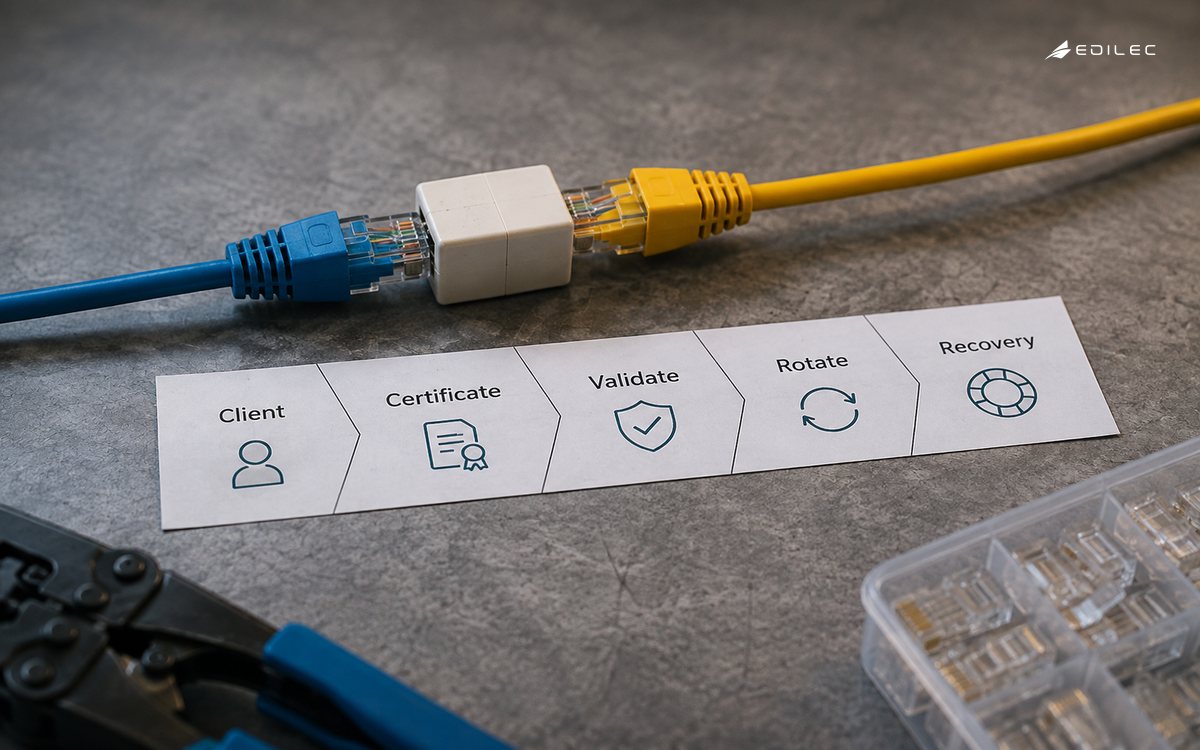
Transport encryption fails operationally when identity and renewal are treated as an afterthought. Inventory every listener and outbound client, its expected hostname, certificate issuer, renewal owner, and alert threshold. Validate hostname and certificate chains in clients; accepting any certificate to “fix” an integration turns a temporary outage into an impersonation risk. Test renewals and emergency replacement before an expiry window creates pressure. Internal routes deserve the same inventory as public endpoints, particularly administrative interfaces and service-to-service traffic that crosses network or organizational boundaries. Where mutual authentication is required, make certificate issuance and revocation part of the service lifecycle rather than a manual deployment secret.
- Alert early enough for ownership transfer and planned renewal, not on the final day.
- Reject obsolete protocol versions and insecure fallback modes deliberately.
- Test service identity validation when routing, load balancing, or certificates change.
- Inventory plaintext health checks, message queues, and administrative ports separately.
Review the evidence — production transport readiness
Create a regular evidence review for encryption in transit with the service owner, operational lead, and security reviewer. Select a recent allowed event, a recent denial or failure, and any exception that remains open. Confirm that the recorded context explains the outcome, the owner can identify the next action, and the monitoring signal would expose the same issue again. This small routine tests whether documentation, telemetry, and operational responsibility still agree after product and staffing changes. It also prevents a control from being declared complete simply because its original configuration has not been touched.
For production certificate work, consult ACME, Let’s Encrypt challenge types, Certificate Transparency, and OCSP. Use the secure API access guide, transport checklist, and transport operations playbook to connect certificate lifecycle evidence to rollout decisions.
Key takeaways
- Encryption in transit should protect a named business action, not an abstract compliance category.
- Trusted inputs need clear provenance, acceptable freshness, and a safe failure result.
- Enforcement belongs at the protected service, including APIs and background paths.
- Negative tests and live checks reveal gaps that a happy-path demonstration cannot.
- Exceptions need a narrow scope, owner, expiry, and review trail.
- Use operational signals to simplify controls and repair recurring friction without widening privilege.
Frequently asked questions
Where should a team start? Choose one workflow involving interception and document its action, owner, inputs, outcome, and evidence. How much logging is enough? Retain the actor, action, target, result, time, correlation information, and policy or configuration version, while excluding secrets and unnecessary sensitive payloads. When is an exception acceptable? When a legitimate operation cannot safely wait and the exception is approved, narrower than normal access, time-bounded, and reviewed after use. Repeated exceptions are not proof that the control is too strict; they are a prompt to understand the ordinary workflow better.
Conclusion
Encryption in transit becomes dependable when teams can explain the protected work, the facts that influence a decision, the component that enforces it, and the evidence available after failure. Start small, test uncomfortable cases, and put a person in charge of every exception and source of truth. That approach gives engineering teams something more durable than a checklist: a control that can be operated, investigated, and improved as the business changes.
Production transport readiness review
Production adds real clients, traffic, certificates, proxies, vendors, emergency access, and recovery pressure. Use a representative canary, test lifecycle failure, preserve exceptions, and define readiness as protected paths plus observable recovery. Record the decision with its owner, acceptance evidence, exception rule, and review date so another team can operate it without private context.
| Decision | Evidence before release | Review signal |
|---|---|---|
| Scope and owner | Named boundary, accountable role, and expected outcome | Unowned or ambiguous work |
| Failure path | Rehearsed fallback, retry, and escalation | Aged or repeated exceptions |
| Change control | Versioned policy and rollback condition | Unexpected outcome after change |
| Recovery | Test result and correction authority | Time to restore and unresolved impact |
For the technical baseline, read the encryption in transit checklist and the encryption in transit operations playbook. Production readiness depends on both path coverage and response capability.
A production change also needs a communication path for supported clients and partners. Publish the policy transition, identify clients that cannot negotiate the target behavior, and set an explicit end date for exceptions. During rollout, compare handshake errors and service outcomes with the release baseline. When the change is complete, retain the final inventory and the exception decisions. This is the evidence that makes the next certificate, proxy, or client change safer.
Keep the readiness decision reversible until the evidence is clear. A canary that passes only synthetic traffic should not authorize broad exposure, and a rollback that lowers transport protection should require explicit approval. The release record should state what was observed, what remains unknown, and who owns the next verification.
Make the final review a service decision, not only a security sign-off. Ask support whether clients can understand failures, ask operations whether renewal is observable, and ask architecture whether every hop remains in scope. The answers should be attached to the release record with the remaining exception owner. This closes the gap between a technically valid handshake and a production service that people can operate safely.
That final record should remain easy to find during the next incident or audit.
Frequently asked questions
What should be decided first? Set the production baseline and protected paths. Which failure deserves an early rehearsal? A real client or proxy that cannot negotiate the target policy. What proves readiness? Canary evidence, observable recovery, and explicit exception ownership.