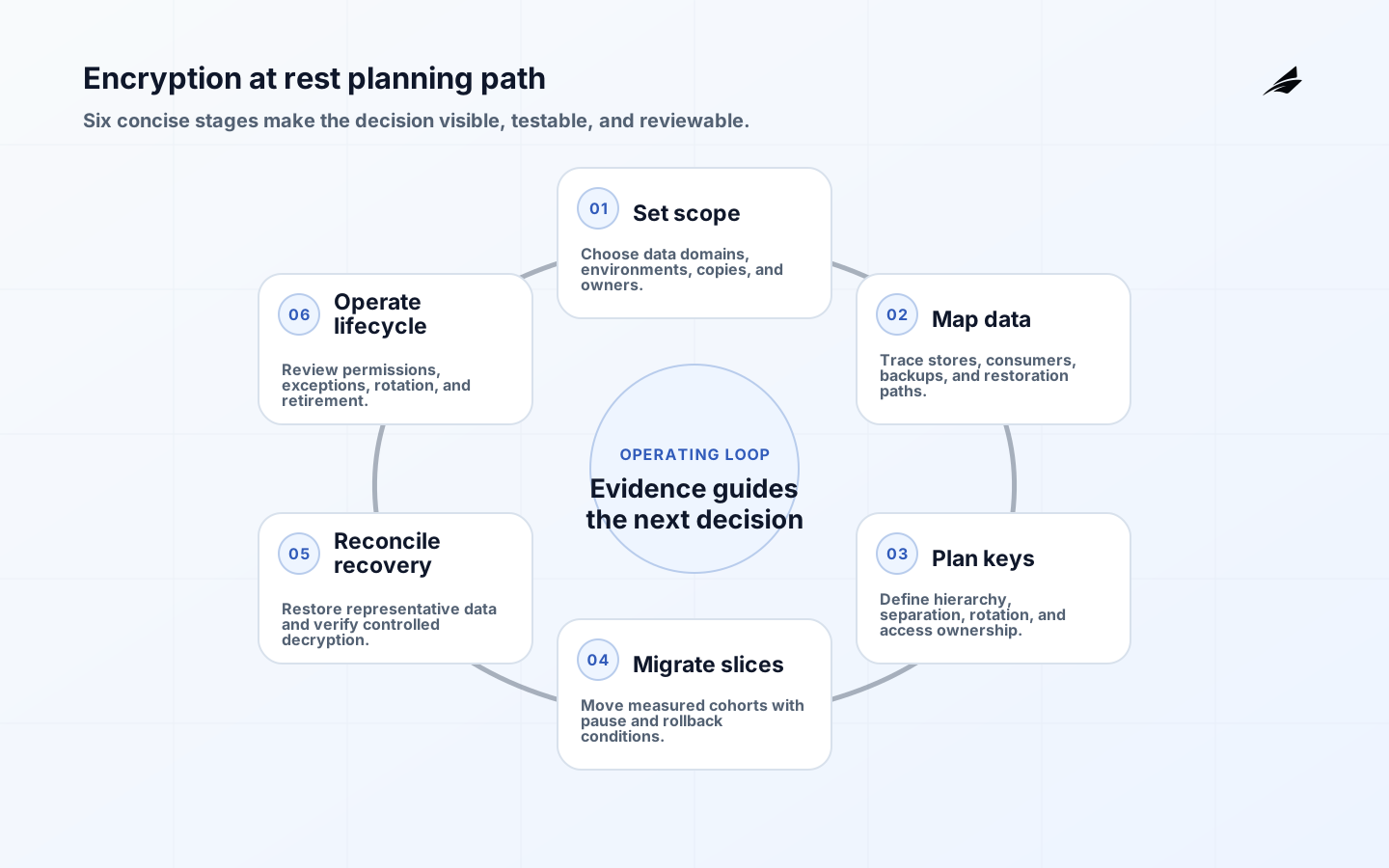
Planning encryption at rest as a delivery project begins with a cut line: which data, services, environments, and copies are in scope? List production and non-production separately, because sanitized test databases may still contain sensitive values and development exports may have weaker access. Capture classification, owner, storage locations, consumers, retention, deletion, and recovery expectations. The implementation choices can be compared through AWS KMS, Azure Key Vault, Google Cloud KMS, and HashiCorp Vault secrets engines. This turns a broad request into verifiable work packages.
Define the protected decision
Begin with the harm, not the tool. Make a short inventory of databases, object stores, backups, snapshots, analytics extracts, endpoint caches, and removable media containing sensitive records, then state the action, target, actor, and consequence of an incorrect result. For each item, decide whether the system should prevent, require an additional approval, allow with an auditable exception, or simply observe. This prevents policy language from becoming broad enough to mean anything. It also exposes awkward cases early: automation that acts for a person, a support engineer working across tenants, a scheduled process, or an emergency operation that cannot wait for the normal path.
NIST SP 800-57 emphasizes that cryptography depends on the protection and lifecycle management of keying material, not just selection of an algorithm. In practical terms, document data classification, encryption boundary, key hierarchy, key owner, service identity, backup location, restore procedure, and deletion requirement. A fact without a source owner or update expectation is a future incident waiting for a busy day. Be explicit about the default when a required fact is absent, delayed, disputed, or malformed. For high-consequence actions, a clear deny or hold-and-escalate path is usually safer than an optimistic decision based on stale context.
| Decision area | Question to settle | Evidence to retain |
|---|---|---|
| Scope | Which encryption at rest decisions can materially harm the business? | Named actions, targets, and accountable owner |
| Trusted context | Which facts are evaluated: data classification, encryption boundary, key hierarchy, key owner, service identity, backup location, restore procedure, and deletion requirement? | Source, freshness expectation, and missing-data behavior |
| Exception | When may a normal rule be bypassed? | Approver, duration, reason, and expiry |
| Verification | How will the team know the rule behaved as intended? | Test result, decision record, and review date |
Classify data and copy paths
The enforcement path must be as specific as the business decision. Put the evaluation close to the service that performs the sensitive action, rather than relying on a user interface convention or a single gateway rule. Pass only the context the decision needs, validate it, and return a result that can be understood later. Assuming a storage checkbox protects every copy, storing keys beside ciphertext, and rotating keys without proving that historical data remains recoverable are common because teams optimize for the ordinary path and assume that a directory, screen, storage setting, or proxy is the enforcement point. It rarely is. The receiving service must make the final decision with current, authoritative inputs.
Design for change as well as correctness. Every rule, key, authenticator, quota, model, or event schema needs an owner who can approve a revision and answer for its effect. Capture a stable policy or configuration identifier with the result so that an investigation does not have to reconstruct history from deployment timestamps. The OWASP Cryptographic Storage Cheat Sheet is a useful technical baseline, but the local implementation still needs a small, readable contract: input fields, default behavior, error handling, and the route for temporary exceptions.
Test the unhappy path before rollout
Positive tests prove a feature is usable; negative tests prove a boundary is real. For this subject, restore an encrypted backup under an authorized identity, deny a storage administrator key access, rotate a key, retire an old key on schedule, and investigate a decrypt failure. Run these cases through the real route, including background jobs and administrative APIs, rather than through a mocked interface alone. Record expected and actual outcomes. Where a test intentionally triggers an alert or denial, verify that the on-call or review owner can find the event quickly and that the event contains enough context to distinguish a test from an attack.
- Test the normal allowed action with the minimum required context.
- Test a denied action with one required fact absent or deliberately stale.
- Test a privileged or emergency path with its approval and expiry conditions.
- Test a dependency failure so the fallback is explicit rather than accidental.
- Test removal or revocation and confirm old access cannot silently persist.
- Review the result with the operator who will handle the first real exception.
Operate with evidence, not assumptions
In the encryption planning context, a control becomes dependable when its evidence answers operational questions without requiring a heroic search. In the encryption planning context, track key creation and use, decrypt failures, policy changes, backup encryption state, restore-test result, rotation completion, and exceptional access. In the encryption planning context, avoid collecting every available field by default: excessive event data increases privacy, storage, and review burden, and can create a new sensitive data store. In the encryption planning context, instead, agree on a minimum record for sensitive decisions, protect it from casual alteration, synchronize time, and make retrieval part of the operating procedure. NIST Cybersecurity Framework 2.0 provides useful framing for treating security as a managed capability rather than a one-time deployment.
| Signal | What it can reveal | Review response |
|---|---|---|
| Unexpected denial | Stale facts, incorrect policy, or hostile probing | Compare the request context with the current approved state |
| Exception volume | A design gap or a normal workflow that is not modeled | In the encryption planning context, assign an owner and decide whether to redesign, approve, or retire the exception |
| Failed dependency | A route that may be falling back insecurely | Verify fail-closed behavior and repair the dependency contract |
| Evidence gap | An action cannot be reconstructed later | Add the missing field or correlation before expanding the workflow |
Roll out in accountable stages
Classify one data domain, map every persistent copy and restoration path, then pilot key separation and restore tests before expanding to other stores. Define the rollback condition before deployment: a measurable error, an unsafe failure mode, a support threshold, or a missing evidence signal. Rollback should restore a known safe state without preserving the loophole that the new control was meant to close. Train operators on the small set of decisions they will actually make, including how to recognize a false positive, request an exception, and escalate a suspected compromise. OWASP Secrets Management Cheat Sheet is a useful reminder that mature security includes governance and measurement, not merely technical configuration.
Takeaways
- Start encryption at rest with the sensitive decision and its likely harm.
- Name trusted inputs, their owners, and what happens when they are missing.
- Make enforcement server-side or at the system boundary that actually performs the action.
- Exercise denial, recovery, revocation, and direct-call paths before broad rollout.
- Retain focused evidence that lets an accountable reviewer explain the result.
- Treat exceptions as temporary product decisions with an owner, not as invisible operational work.
Encryption planning FAQ questions
Is encryption at rest only a security-team responsibility? No. Security can set principles and test coverage, but the people who own the data, workflow, platform, and support path must decide the intended behavior. A control with no business owner tends to accumulate exceptions until it is impossible to tell whether it still reflects real work.
How much detail is enough for a first release? Enough to protect one valuable path end to end: clear scope, trusted inputs, enforcement, negative tests, event evidence, and an exception owner. Add breadth after this path has survived real operations. The related guides Encryption at Rest: Hands-on Planning Guide, Encryption in Transit: Operations Playbook, Secrets Rotation: From First Principles to a Repeatable Change provide useful adjacent reading when that first control touches identity, evidence, or a privileged interface.
Encryption planning conclusion
For encryption at rest, confirm which identities can request decryption, not merely which teams can view storage. Cloud-provider roles, service accounts, backup operators, and incident responders often have different authority. The access model should be tested against each path, including restore tooling and disaster-recovery accounts.
Encryption at rest succeeds when it makes a consequential decision both harder to abuse and easier to explain. Keep the first scope narrow, but do not omit recovery, evidence, and ownership. Those are the parts that turn a technical setting into an operational control that remains credible when systems, people, and attackers change.
Encryption planning: turn migration into an operating decision
Encryption planning: pilot one data domain

Pair every key decision with a recovery decision. If a customer record is encrypted with a disabled key, can the team restore service without bypassing approval? If the key service is unavailable, does the application fail closed, queue work, or serve a bounded read-only mode? If a key is suspected compromised, which data must be re-encrypted and how will the team find it? OWASP’s key guidance stresses lifecycle and access control; operationally, rehearse failure before migration makes it urgent.
Plan migrations in slices. Create new ciphertext with a version marker, re-encrypt in rate-limited batches, verify counts and samples, and retain a documented rollback boundary. Do not delete old keys or plaintext temporary files until reconciliation and retention rules agree. Monitor decrypt failures, queue age, latency, key-service throttling, and integrity checks. A migration can be cryptographically correct and still break a workflow if search indexes, exports, or background jobs were omitted.
Assign work across disciplines. Security owns threat and key policy; engineering owns code and data paths; platform owns provider configuration and recovery; operations owns alarms and runbooks; product or legal owners decide retention and user impact. Use a change record naming the evidence required at each gate. Completion means tested behavior in the actual system, not a completed spreadsheet.
Encryption planning: connect keys to delivery work
In the encryption planning context, for a broader view, compare encryption at rest access and operations, evidence and review practice, and recovery planning. In the encryption planning context, these Edilec guides add the human and operational context around this article’s technical decision.
Encryption planning: preserve rollback and recovery evidence
A planning board should show dependencies rather than a single encryption milestone. Data classification must precede scope; scope must precede key and provider choices; key choices must precede migration tooling; migration tooling must precede a measured rehearsal; and recovery evidence must precede retirement of an old path. Put an owner and exit test on each dependency. For example, “backup included” is not complete until a restore has read encrypted data with the intended permissions and the resulting files follow retention rules. This makes schedule risk visible and gives leadership a decision when a dependency is not ready.
Budget for the operational tail. Encryption can add key-service calls, CPU, migration storage, support cases, monitoring, and recovery rehearsal. Estimate those costs with a representative workload and include a rollback or pause window. The cheapest design on a diagram can become the most expensive during a key outage or data migration.
Record the assumptions that make the plan viable: expected data volume, migration rate, key-service limits, restore time, retention period, and acceptable customer interruption. Revisit those assumptions at each gate. A change in volume or recovery objective can change the right encryption design even when the algorithm and provider remain the same.
The plan should include a decision for old data that cannot be re-encrypted immediately. Use a documented temporary boundary, limit access, monitor use, and set a dated retirement test. Do not allow an unbounded dual-read path to become permanent because the migration is inconvenient. A visible exception is easier to fund and close than an invisible compatibility layer.
Keep the final approval tied to the evidence, not the calendar.