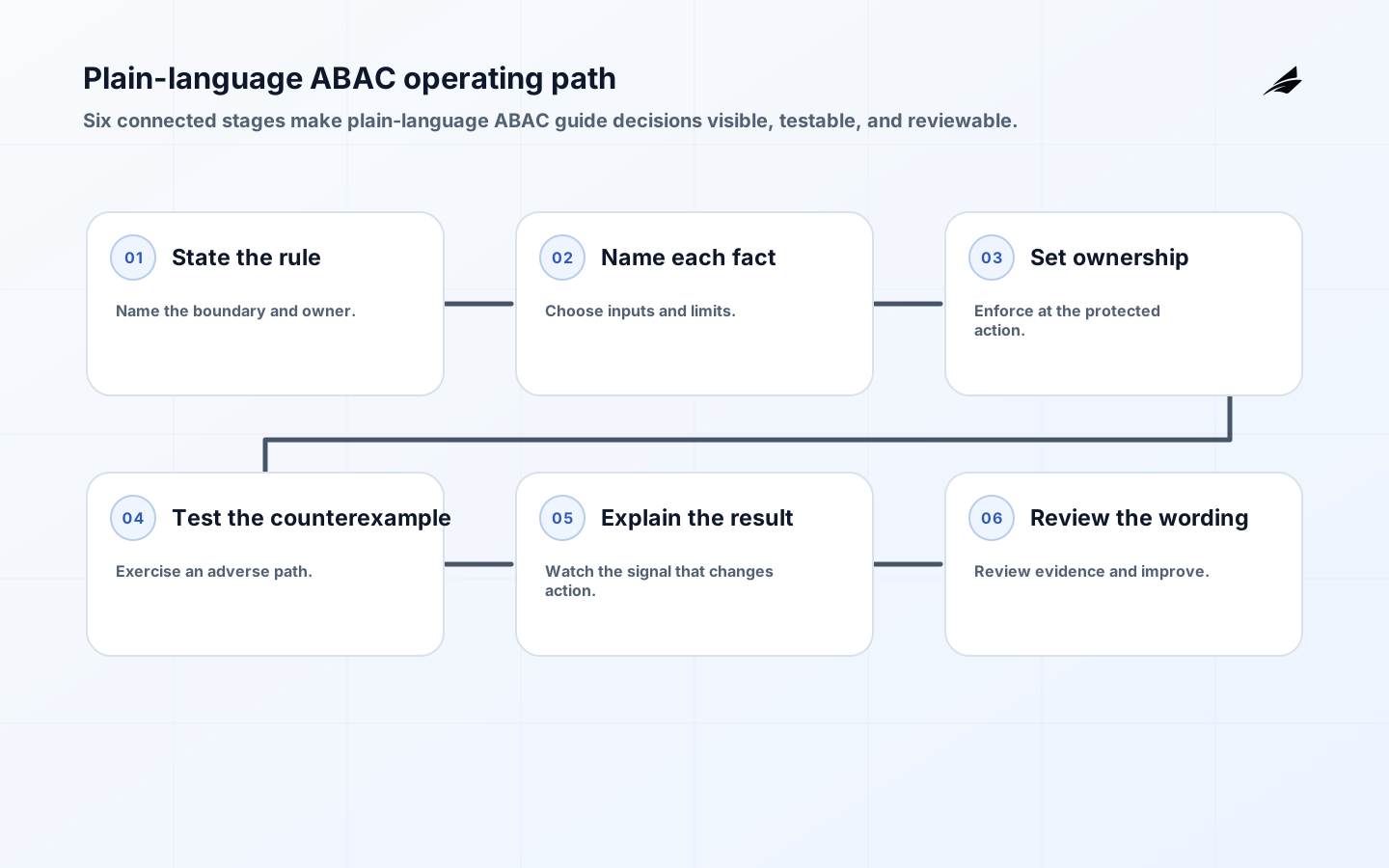
ABAC makes an authorization decision from facts about the requester, the resource, the requested operation, and sometimes the environment. That flexibility is valuable when a simple role cannot express the rule, such as allowing a clinician to view an assigned patient during an active shift or allowing a support specialist to access only a customer in the same tenant. It is not a reason to put every organizational fact into policy.
Choose the decisions that need context
Use ABAC where context changes the answer in a legitimate, explainable way. NIST defines ABAC as evaluating subject, object, operation, and possibly environment attributes against policy. That definition suggests a disciplined starting point: identify the protected action, list the attributes that actually decide it, and reject attributes with no dependable owner or update path.

An attribute is a security dependency. Department, employment state, tenant, project assignment, device posture, data classification, and time window can all be useful, but only if their source is known while freshness remains understood. A stale employment status or an unverified tenant identifier can turn an elegant policy into unintended disclosure. Keep a record of who publishes each attribute, how corrections flow, and what happens when it is absent.
| Design decision | Question to answer | Evidence |
|---|---|---|
| Attribute family | Example | Governance question |
| Subject | Employment state | Who corrects an offboarding error? |
| Resource | Tenant identifier | Is it immutable across copies and exports? |
| Environment | Managed-device signal | How fresh must the signal be? |
Treat attributes as governed data
Write policies in testable sentences before choosing a policy language: a signed-in support agent may view a case when the agent is assigned to the case, both are in the same tenant, and the case is not marked legal hold. The NIST ABAC guide is useful here because it frames ABAC as policy evaluation rather than a bag of conditionals. Deny by default and return a decision explanation suitable for operators, without exposing sensitive attribute values to the requester.
- Avoid: Importing every directory attribute without deciding whether it is authoritative.
- Test for: Writing policies that depend on free-text labels or manual exceptions.
- Do not accept: Failing open when the policy service cannot retrieve a required fact.
Write policies people can test
The practical standard for attribute-based access control is not a perfect diagram or a successful demonstration. It is whether the control still makes the intended decision when data is incomplete, a dependency is slow, an operator is rushed, or an attacker chooses the least protected path Use focused tests for denial, stale state, unusual volume, and recovery. Keep the result with the change record so later reviewers can see what was expected and what was actually verified — for plain-language ABAC.
| Operating signal | What it may reveal | First investigation |
|---|---|---|
| Condition | Decision | Test case |
| Same tenant and assignment | Permit case view | Cross-tenant request must deny |
| Missing classification | Deny export | Owner can repair source metadata |
| Emergency override | Permit with expiry | Alert and review afterward |
Operate the policy decision path
Operationally, watch for missing attributes, policy exceptions, and evaluation latency. A policy service needs availability planning because an unavailable decision point can interrupt work; its fallback must be chosen deliberately for each action. The OWASP Authorization Cheat Sheet is clear that access control should be enforced on the server, so clients must not be trusted to select a favorable attribute or policy branch.
Use a short review cadence for the parts of attribute-based access control that can cause material harm: privileged access, exception paths, high-value data, and emergency changes. The NIST Cybersecurity Framework 2.0 is helpful as an organizing model because it links governance, protection, detection, response, and recovery The goal is a control that a named owner can explain, test, and improve rather than a setting no one revisits
Implementation Details That Matter for plain-language ABAC
For ABAC, separate attributes used for authorization from attributes that are merely useful for reporting. A policy that depends on a location, manager name, or risk label acquires the quality problems of that data source. Document the authoritative issuer, permitted values, propagation delay, and correction procedure before using an attribute to allow sensitive work. If the source cannot meet the decision’s freshness requirement, redesign the policy around a more dependable fact or require an explicit approval. This is slower than importing a directory schema, but it keeps policy behavior explainable during offboarding and incident response.
Policy composition deserves an explicit rule. Multiple policies may apply to one request, and teams must decide whether any permit wins, every applicable policy must permit, or a deny overrides a permit. For sensitive cross-tenant or export actions, deny-overrides remains often easier to defend because an uncertain or conflicting rule does not become access. Record the policy set and version used for a decision. Without that evidence, a later change to a rule can make it impossible to explain why the system allowed a request at the time.
Use test fixtures that reflect the attribute lifecycle, not just happy-path values. Include a newly hired worker whose identity record is incomplete, a transfer between tenants, an expired project assignment, a device posture service outage, and a legal hold applied after a request was prepared. These cases show whether the authorization service safely handles missing or changing context. They also expose whether application code caches a permit longer than the policy or attribute validity allows.
Attribute release is itself a privacy and security decision. The policy engine may need a yes-or-no fact without disclosing the full employee profile, device inventory, or risk calculation to every application. Minimize the claims shared with callers, protect administrative changes to policy and attribute mappings, and audit those changes. When a product needs a new attribute, make its owner and lifecycle part of the feature request. That habit prevents a convenience field from becoming a hidden authorization dependency.
For policy-language detail, compare XACML 3.0, AWS IAM policy elements, Microsoft Conditional Access, and Google Cloud’s condition attributes. For adjacent practice, see the ABAC checklist, ABAC security review, and least privilege review.
Explain ABAC with a decision people can test
A plain-language ABAC example is easier to evaluate than a policy full of implementation terms: “A case worker may download a case file when the worker is assigned to the case, the file belongs to the worker’s organization, the case is open, and the request comes from a managed device.” Each clause names an attribute or relationship, and each can fail independently. The service should return a denial that is useful to an authorized operator without revealing private case details to the caller. This is the difference between explaining a policy and merely translating syntax.
Questions to answer before expanding plain-language ABAC guide
Keep the human rule and machine rule linked by a stable policy identifier. When a business owner changes “open case” to include a review state, replay the fixture cases and compare the decision set before deployment. Ask whether a stale assignment, missing organization label, or clock skew could permit a download. NIST’s ABAC definition is a useful common vocabulary, while the enforcement principle from OWASP keeps the final check at the server-side action. The guide is successful when a support engineer, developer, and reviewer describe the same boundary.
| Plain-language clause | Machine question | Failure response |
|---|---|---|
| Assigned to the case | Which system owns assignment and how fresh is it? | Deny and route to assignment support. |
| Belongs to the organization | How is tenant or organization relationship verified? | Deny without exposing another tenant’s data. |
| Managed device | Which posture signal is authoritative? | Use the documented safe fallback or deny. |
Practical Takeaways
- Tie ABAC decisions to a bounded action and a named owner.
- Make enforcement happen in a trusted service or policy boundary, not in a browser or a document — for plain-language ABAC.
- Treat exceptions, recovery, and observability as part of the design from the start — for plain-language ABAC.
- Use representative negative tests and review evidence after changes, not only before launch — for plain-language ABAC.
ABAC FAQ
Is ABAC a one-time implementation? No. The initial design establishes a baseline, but systems, identities, dependencies, and risks change Review it whenever a high-impact workflow changes and use incidents or recurring exceptions as evidence that the operating model needs adjustment
What should be measured first for ABAC? Start with the decision it protects, then measure successful and denied actions, exception volume, corrective work, and the time required to establish what happened Those signals reveal whether ABAC is supporting the intended workflow or simply moving risk to a less visible path.
How should a small team start with ABAC? Choose one high-consequence workflow, map its current inputs and failure states, assign an owner, add the smallest dependable control, and test both normal and adverse cases That bounded work creates evidence for the next ABAC decision without claiming the entire estate can be redesigned at once.
ABAC implementation also needs an emergency rule for attribute uncertainty. Decide in advance whether missing, delayed, contradictory, or unverifiable attributes cause a denial, a limited read-only result, or an escalated approval. The answer may differ for viewing a low-risk internal document and changing a payment destination, but it should never be an accidental default in application code. Capture the reason class for a denial so operators can distinguish a genuine policy block from a data-quality defect. Then give attribute owners a repair workflow with an audit trail. This preserves the security value of context-aware authorization while preventing users from working around confusing decisions through shared accounts or informal data exports.
Before releasing an ABAC rule, run it against a saved decision set that includes the intended permits, explicit denials, missing attributes, conflicting values, and recently changed assignments. Version that set with the policy. It gives reviewers a fast way to see whether a rule edit widened access unexpectedly and gives operators a reliable reproduction path when a user disputes a result.
Conclusion
ABAC is dependable when it maps to real work, uses authoritative inputs, makes a defensible decision at the point of action, and leaves an evidence trail for review. Start with one bounded workflow, make the recovery path real, and expand only after the team can explain what the control prevented, what it allowed, and who owns the next decision — for plain-language ABAC.