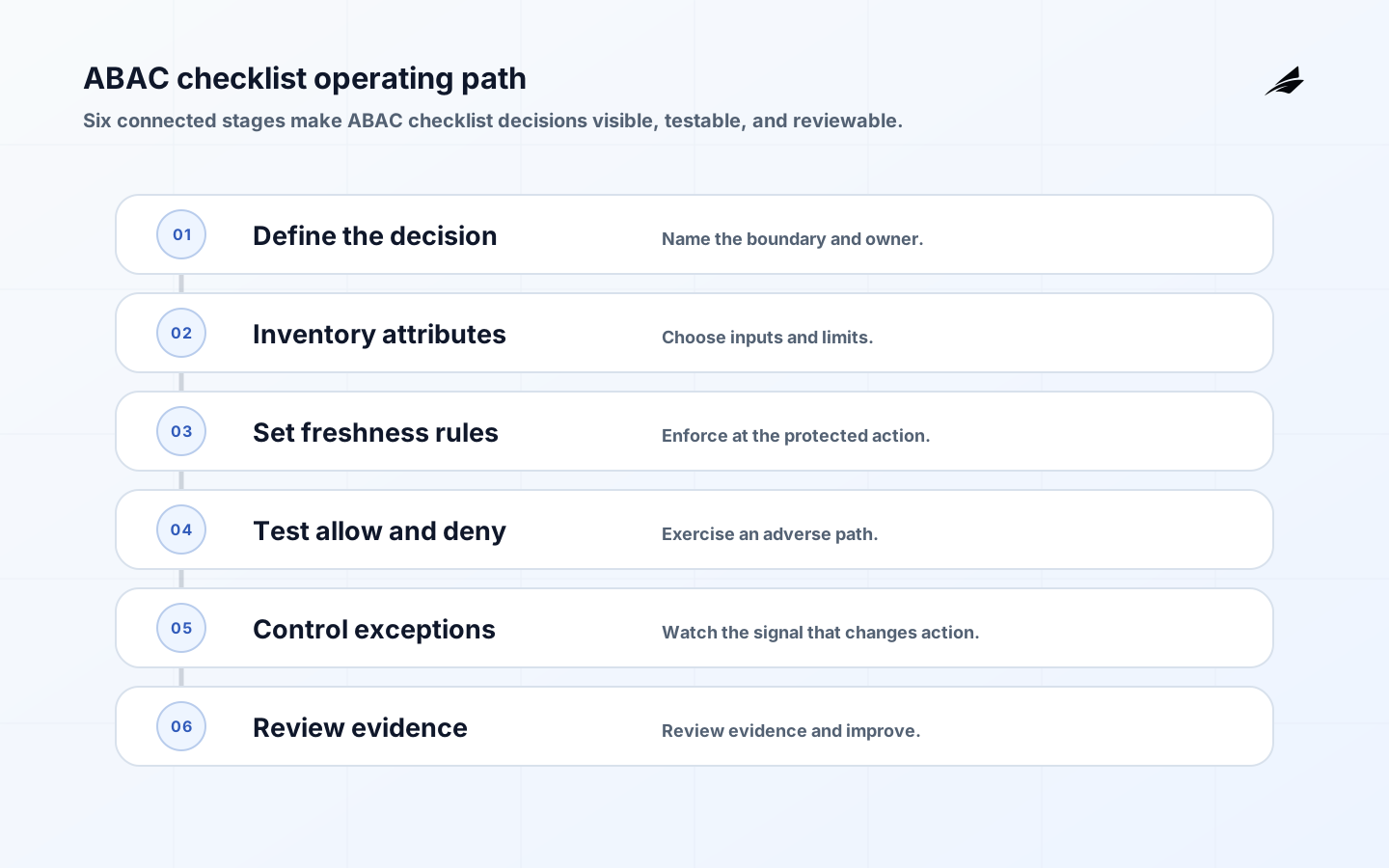
ABAC is a production capability with consequences for people, software, and recovery. ABAC work should begin with the decision that must remain true when a request, change, or failure reaches the sensitive boundary. ABAC is not improved by a larger checklist alone; it improves when ownership, enforcement, evidence, and repair are explicit. ABAC decisions below draw on NIST Guide to Attribute Based Access Control and OWASP Authorization Cheat Sheet. ABAC designs benefit from that source-backed framing because it makes a later investigation possible without relying on the memory of the person who made the original configuration.
Set the ABAC operating decision
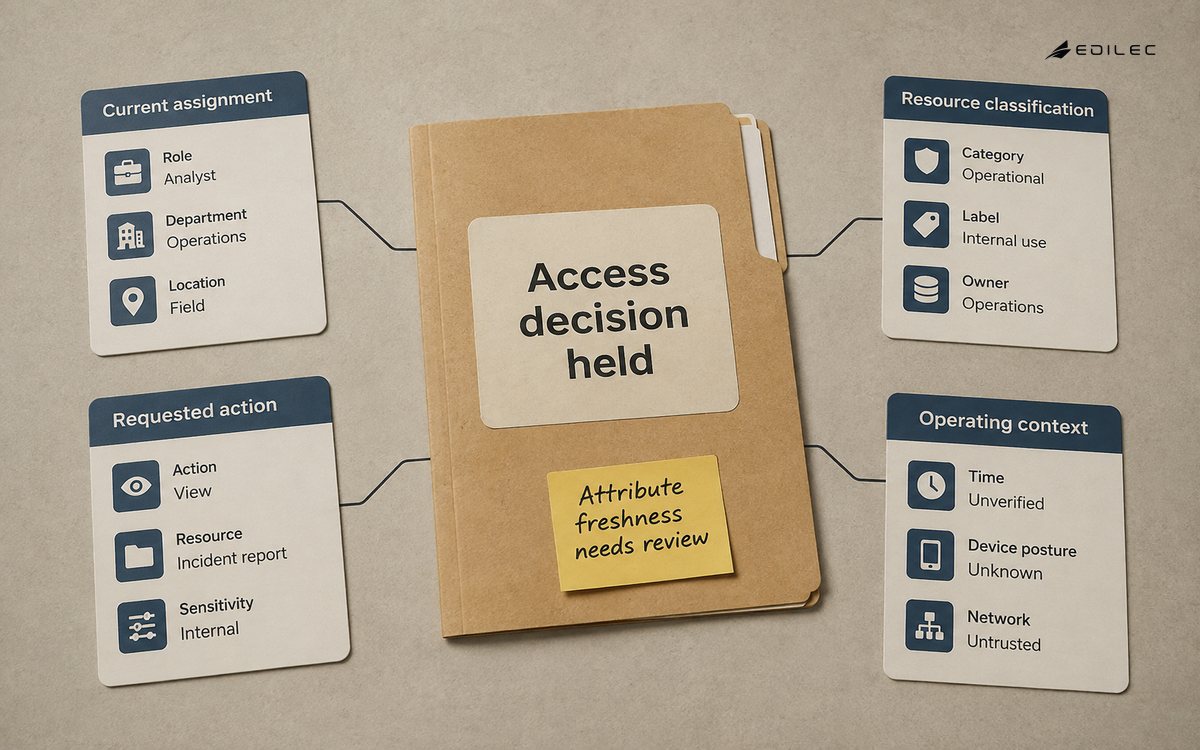
ABAC begins with the risk the system must control, not a product setting. For each subject, object, action, and environment attribute, identify the source of truth, the owner, the freshness requirement, and the harm from using a stale value. An HR entitlement and a device-compliance signal should not receive the same caching rule. ABAC is useful when access depends on context that roles cannot express cleanly, such as tenant relationship, data classification, device posture, case assignment, or a time-bounded approval. It becomes fragile when every available field is treated as a policy input. Write the expected outcome, accountable owner, approved exception route, and stop condition before rollout That record makes a technical choice reviewable and gives responders a basis for deciding whether observed behavior is intended or harmful
Map ABAC boundaries and dependencies
Keep attribute collection, policy evaluation, and resource enforcement distinct. The service that owns a record must enforce the outcome before returning data or performing work. Decide in advance whether a missing attribute fails closed, offers a limited emergency process, or blocks only a low-risk action. A useful boundary is specific enough that a reviewer can identify the actor, protected resource or connection, enforcing component, and behavior when a dependency is slow or unavailable State the irreversible moment too: an action may be technically reversible yet operationally irreversible once a customer, vendor, or downstream system has received the effect
| Design element | Question to answer | Evidence to retain |
|---|---|---|
| Attribute | Who is authoritative? | Freshness and failure rule |
| Resource label | Who classifies the object? | Classification history |
| Policy | Which decision does it express? | Version, tests, and owner |
| Enforcement point | Where is the result applied? | Request-level decision record |
Use proportionate ABAC controls
Use small readable policies with stable identifiers and representative allow and deny tests. Derive attributes from trusted services or signed assertions rather than client input. Every business exception needs an owner, expiry, and review date instead of becoming an invisible branch in application code. Match each safeguard to a credible failure mode. Preventive checks constrain known bad states; runtime signals detect conditions that escaped them; recovery procedures return the system to a safe state Keeping those functions separate prevents a team from declaring success merely because a request or deployment completed without an immediate error
NIST Zero Trust Architecture is useful for making enforcement and verification concrete The nearby guides on RBAC Mistakes and Fixes: A Practical Design Guide, Zero Trust: Verify Every Request with Current Evidence, Not Network Location, Audit Logs: Architecture Guide cover adjacent choices that commonly affect this design. Do not convert an emergency accommodation into a permanent privilege or configuration simply because it was needed once Give it a reason, owner, expiration, and a record visible to the people responsible for risk
Operate ABAC with evidence
Observe policy latency, evaluation errors, stale-attribute fallback, and deny reasons grouped by policy version. Replay a sampled decision set before a policy deployment and compare changed outcomes. Pair technical signals with a business outcome so security does not quietly block essential work. Decide before implementation which movement triggers investigation, pause, or rollback. Link dashboards, change records, and runbooks with stable identities or revisions so an operator can trace cause, effect, and decision across boundaries Evidence close to the work also makes handoffs and audit practical without turning every engineer into a historian
| Signal | What it can reveal | Review action |
|---|---|---|
| Decision errors | Broken policy or attribute service | Alert on error rate and fallback |
| Stale inputs | A decision may use old context | Track age by source |
| Policy drift | Rules no longer match work | Quarterly owner review |
| Denied work | A valid path is missing | Review reasons with process owners |
Roll out ABAC in six controlled stages
- Name the owner, protected boundary, and unacceptable outcome for ABAC.
- Capture a baseline for decision errors before changing enforcement.
- Implement the smallest scope that can provide real production evidence.
- Exercise one normal path and one harmful failure path with the operating team — for ABAC checklist.
- Review customer impact, support load, and recovery evidence before widening exposure.
- Convert observed gaps into a policy, test, alert, or runbook improvement.
Implementation details for ABAC
Implementation requires a concrete test of the production path, not an assertion that a configuration exists Attribute quality is the practical security boundary in ABAC. A policy can deny a terminated contractor only if employment state is current, propagated, and protected from overwrite. Define acceptable staleness by risk, test source outages and conflicting values, and record which attributes influenced a decision without writing sensitive contents to logs. Keep the test result with the change record so that later maintainers can see the conditions under which the control was verified — for ABAC checklist.
Operating discipline keeps a sound design from drifting after the initial rollout Store policies with tests, review them with protected-resource owners, and stage them against representative requests before enforcement. Include intended allows, near-miss denies, stale or missing attributes, cross-tenant access, and the emergency condition. This turns context awareness into a repeatable engineering practice rather than a collection of assumptions. Assign the review cadence to the people who understand the affected work, and use actual events and access patterns to refine the model rather than adding blanket privilege or silent exceptions — for ABAC checklist.
Recovery planning is part of the security design. When a rule becomes a long chain of exceptions, improve the classification, entitlement, or workflow instead of extending opaque policy logic. Simplicity is a reliability control because it shortens review and incident diagnosis. A practical exercise should confirm both that the harmful state can be stopped and that legitimate work can resume with a recorded decision trail — for ABAC checklist.
Before expanding ABAC, review the design with the owner of attribute and the operator who will respond when enforcement point fails. Ask them to demonstrate the evidence described in the table, including the current decision, the last approved change, and the recovery authority This review has a practical purpose: it exposes whether permissions, policies, certificates, secrets, events, or workflows are only described in documentation or are actually usable under production conditions Record the gaps as owned work, then repeat the exercise after the change rather than treating the first walkthrough as final proof
Set a review date and a measurable completion condition for this ABAC change. Evidence should show that the intended boundary is enforced, the exception route is controlled, and the responsible team can recover from the most likely failure without creating a wider security exposure — for ABAC checklist.
Turn the ABAC checklist into a decision test
A checklist becomes useful when every item can be demonstrated against a real request. For a case-management system, choose a subject, case object, action, and environment: an assigned investigator may read a case during an active shift, but a transferred investigator must lose access after the authoritative assignment changes. Test the missing-assignment attribute, a stale cache, a malformed case label, and a support-approved emergency path. NIST SP 800-162 describes ABAC in terms of subject, object, operation, and environment attributes; those four categories make a small fixture set easier to review and maintain.
Questions to answer before expanding ABAC checklist
Treat attribute quality as a control dependency. Record the source, owner, freshness expectation, and failure behavior for each input. A device posture signal may be cached briefly for a low-risk view but not for a destructive action. If policy evaluation cannot tell whether an attribute is missing or false, the result will be difficult to investigate. Keep a policy identifier and decision reason in telemetry, while excluding sensitive attribute values. The checklist is complete only when a reviewer can explain both an allow and a deny without asking the original author.
| Checklist item | Concrete test | Owner |
|---|---|---|
| Attribute source | Change or withhold one input and verify the expected result. | System-of-record owner |
| Policy behavior | Replay allow, deny, stale, and conflicting fixtures. | Policy maintainer |
| Enforcement | Attempt the action through API, UI, job, and support route. | Protected-service owner |
ABAC takeaways
- ABAC works when the boundary and owner are explicit.
- Use controls because they interrupt a specific credible harm.
- Keep exceptions narrow, expiring, and reviewable.
- Measure the customer or system outcome as well as control health.
- Practice recovery, preserve evidence, and revise the operating record.
ABAC FAQ
What is the first implementation step? Start by naming the authoritative source, owner, freshness limit, and failure rule. A narrow owned boundary produces better evidence than an organization-wide conversion with unclear enforcement How should an exception be handled? Treat it as a temporary decision with a named approver, limited scope, expiry, and audit record (ABAC checklist exception). It must be easier to review than an informal bypass and must not silently become the default path What proves the design is working? Look for the operating signals above, a successful adverse-path exercise, and evidence that the relevant owner can explain which source classifies the object without undocumented behavior. OWASP Application Security Verification Standard provides a useful verification reference for that final test — for ABAC checklist.
For implementation detail, consult the NIST ABAC project, Cedar policy syntax, Google Cloud IAM conditions, and Microsoft’s Conditional Access grant controls. These references help validate attribute ownership, condition evaluation, and failure behavior.
Conclusion: make ABAC an operating capability
The durable version of ABAC is neither a one-time configuration nor a document completed in isolation. It is an owned decision with a defined boundary, proportionate controls, observable outcomes, and a practiced way to recover Begin with one high-value path, retain the evidence it produces, and expand only after the people responsible can explain and operate the result confidently