RBAC Mistakes and Fixes: Build Roles People Can Review
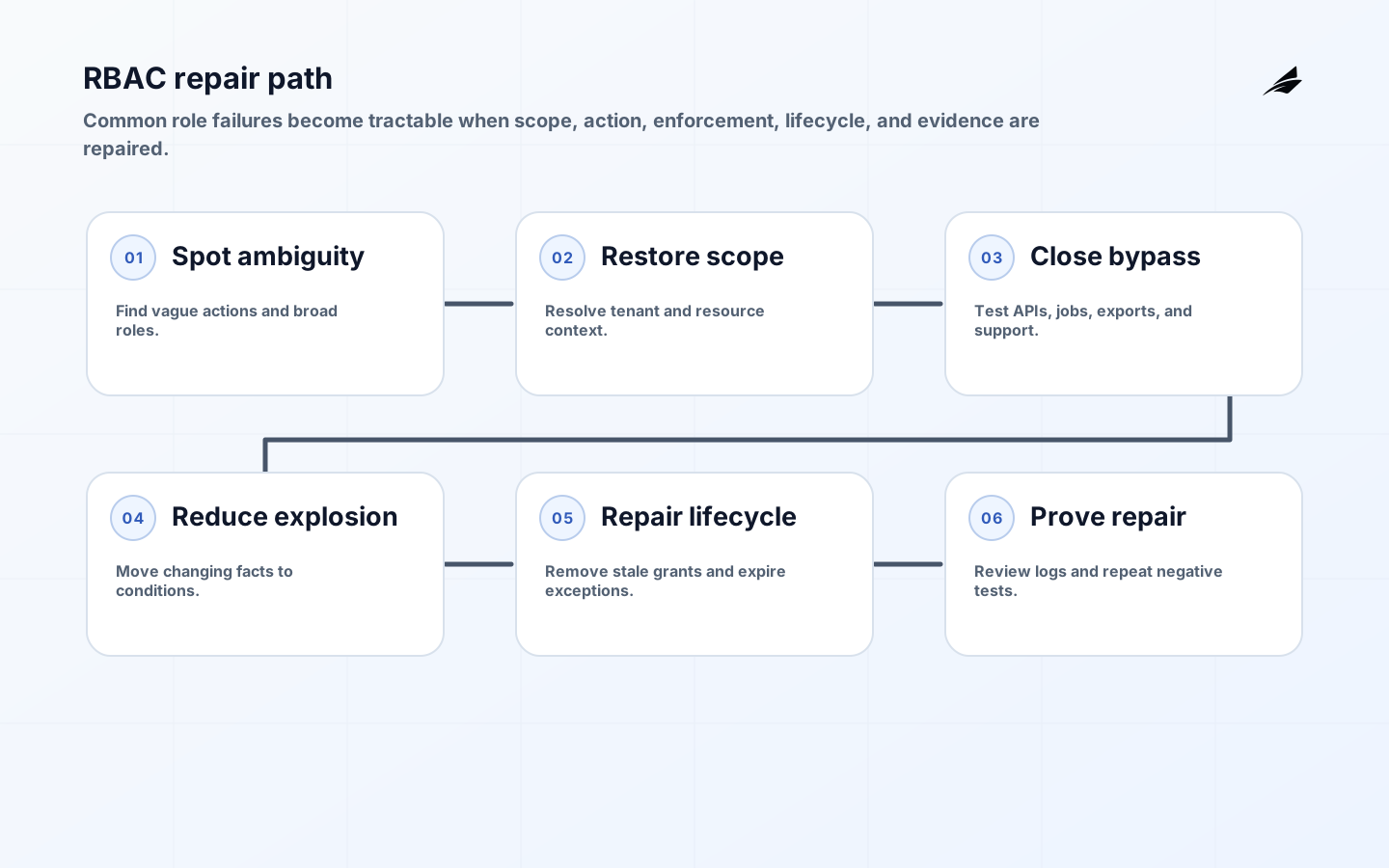
RBAC usually fails through accumulation rather than one dramatic design error. A first role is copied, a support exception is made permanent, a UI check is mistaken for authorization, and soon nobody can explain why an actor can reach a sensitive record. The repair is not always a new policy engine. It is often a clearer action vocabulary, a real scope check, a smaller role, or a test that reproduces the unwanted success.
Mistake 1: vague permissions
‘Manage users’ may include invite, edit, disable, reset MFA, export, and delete. Those actions have different consequences and should not share one unreviewed grant. Replace the vague permission with named actions and ask which are needed for the responsibility. Keep dangerous actions separate even when the same operator commonly performs them.

Mistake 2: role without scope
A regional manager role that can read every region is not regional. Scope must be an input to the server decision, not a label in the interface. Resolve tenant, project, region, or ownership from trusted records, and test an otherwise valid action against an out-of-scope object. NIST's policy guidance is useful here: stable roles and changing attributes should not be forced into one field.
| Mistake | What it causes | Repair |
|---|---|---|
| Vague action | Hidden high-risk authority | Split exact operations |
| Global role | Cross-tenant exposure | Bind scope server-side |
| UI-only check | Direct API success | Test endpoint and worker |
| Permanent exception | Unreviewed privilege | Add approval and expiry |
Mistake 3: trusting the interface
Hiding a button is not access control. Attackers and buggy clients can call the endpoint directly, submit a different object identifier, replay a job, or use a download URL. OWASP recommends server-side enforcement and testing. Build fixtures for wrong role, wrong tenant, stale membership, missing approval, and changed resource state. Run them against APIs, background jobs, exports, search, and administrative tools.
Mistake 4: creating a role for every exception
Role explosion makes review impossible. If ten roles differ only by a region or threshold, keep the stable responsibility as a role and express the varying facts as attributes or policy conditions. If the exceptions are actually different duties, retain separate roles but document the business reason. A role catalogue should explain why each role exists and who owns it.
| Signal | Likely cause | Decision |
|---|---|---|
| Many near-duplicate roles | Context forced into names | Move variable facts to conditions |
| Repeated denials | Role misses real duty | Clarify workflow and ownership |
| Unused permissions | Role copied broadly | Remove or split grant |
| Emergency use repeats | Normal path is incomplete | Design a safe standard path |
Mistake 5: ignoring lifecycle
A correct grant becomes incorrect when a person changes team, a project closes, a vendor contract ends, or a service is retired. Connect assignment and removal to authoritative lifecycle events, then reconcile periodically. Emergency access should be time-limited and reviewed afterward. Keep an audit trail that explains the grant, change, approver, and effective time.
Mistake 6: logging too little
Mistake 7: changing roles without a migration plan
Removing a permission from a role can break a workflow just as surely as granting too much can create exposure. Before changing a widely used role, identify current assignments, recent use, dependent jobs, support procedures, and customer-facing actions. Introduce a narrower replacement, move a representative group, observe denials and completion, then retire the old grant. Keep the effective policy version with the decision so a production incident can distinguish a migration issue from a bypass.
Do not solve a migration by leaving both roles permanently active. That hides whether the new model works and doubles the review surface. Give the compatibility role an owner and expiry, alert on its use, and tell operators what to do when it appears. A role change is complete only when the old authority has no assignments, no active sessions that rely on it, and no background path that quietly expects it.
Build a catalogue of authorization failures
Keep reusable fixtures for the failures that have mattered: wrong tenant, wrong object, removed membership, stale cache, expired approval, replayed job, hidden export, direct file URL, and support impersonation past expiry. Run them when roles, routes, data models, queues, or provider integrations change. The catalogue should include the expected user experience and the expected audit evidence, not only an HTTP status. A denial that is technically correct but impossible to explain can still damage operations.
| Change | Regression risk | Guard |
|---|---|---|
| New endpoint | Bypasses common middleware | Authorization test at resource boundary |
| New worker | Trusts stale queued scope | Replay after membership removal |
| New export | Combines records across tenants | Mixed-scope fixture |
| Role cleanup | Breaks legitimate work | Usage and completion review |
Give every role a decision owner
Security can provide the guardrails, but the business owner must explain why an action exists and what should happen when its context changes. Name an owner for the role, the resource, the assignment source, and the emergency path. When those owners disagree, record the consequence and choose the narrower authority until the model is resolved. Ownership prevents roles from surviving because everyone assumes another team is responsible.
A log that says ‘denied’ cannot help an operator decide whether policy is wrong, data is stale, or an attack is underway. Record actor, action, resource, scope, policy version, decision, reason, and correlation ID without storing secrets. Review both unexpected successes and denials. Success is more urgent when it reveals an authorization bypass.
Key takeaways
Review new features before adding permissions
When a feature asks for a new role or action, review the workflow before editing the catalogue. Identify the resource owner, the state transitions, the external effects, the data paths, and the support fallback. Ask whether the action can be split into propose and approve, whether scope can be narrowed to assigned records, and whether an existing role already expresses the responsibility. This prevents a feature deadline from becoming a permanent global permission.
After release, compare the role's intended use with actual decisions. Unexpected success is a security finding; unexpected denial is a product or data-model finding. Both deserve an owner and a fix. A role review that looks only for abuse misses the friction that causes employees to request broader access or use manual workarounds.
- Replace vague permissions with exact actions and consequences.
- Treat scope as a server-side fact, not a role name or UI filter.
- Test direct calls, jobs, exports, searches, and support tools.
- Use conditions for changing facts instead of multiplying near-identical roles.
- Tie grants to lifecycle events and time-limit emergency access.
- Log enough policy context to investigate decisions without leaking secrets.
Frequently asked questions
Keep the repair reviewable, repeatable, and owned by the team responsible for the protected resource.
Keep the repair reviewable.
Keep a before-and-after regression fixture for the repaired workflow so later changes cannot quietly reopen the path.
A useful repair also checks the customer journey. If people repeatedly request an emergency role, if support cannot explain a denial, or if a job fails after a role is narrowed, the underlying workflow or data boundary may need repair rather than another permission.
A repair is complete only when it reduces authority, preserves legitimate work, and leaves evidence that can be queried. Keep the original failure case beside the repaired workflow so later changes cannot quietly reopen the path.
Keep the regression fixture in the normal test suite and rerun it whenever a route, worker, export, policy, or resource lifecycle changes. Authorization gaps often return through a new data path rather than through the original endpoint.
One practical repair pattern is to replace a broad permission with a safer two-step workflow. Let an operator prepare a change, let an accountable owner approve it, and let the system execute only after the resource state and scope are rechecked. This reduces the value of a stolen session or an over-broad role without blocking the work. Record the proposal, approval, execution, and resulting state so the separation is real rather than a second button on the same page.
A useful post-fix review asks whether the repair reduced authority, improved scope, preserved legitimate work, and created evidence that can be queried. If only one of those changed, the team may have moved the problem rather than solved it. Keep the old regression fixture and add a new one for the repaired workflow.
When a fix is difficult, reduce the consequence first: narrow the resource scope, disable the risky action, require approval, or add monitoring while the deeper model is repaired. A bounded temporary control is better than leaving an unexplained success path active, provided its owner and expiry are recorded.
The best repair is usually the smallest change that makes the decision and its scope visible, then proves both the intended success and the unwanted success have changed.
What is the first step after finding an RBAC mistake?
Preserve a reproducing test, identify the resource and authority that were too broad, and reduce the consequence with a narrow scope, approval, or temporary disablement. Then make the permanent repair reviewable and assign its owner.
A mature repair process also checks the surrounding product design. If users repeatedly need an emergency role, if support cannot explain a denial, or if a job keeps failing after a role is narrowed, the answer may be a missing workflow or data boundary rather than another permission. Treat those signals as evidence and fix the underlying operating path.
Is role explosion proof that RBAC is wrong?
It is evidence that some changing facts may belong in attributes or conditions. Keep RBAC for stable responsibilities and use contextual policy where it improves clarity.
What should an access review ask?
Ask whether the actor still needs each exact action, whether scope is correct, whether use is evidenced, and whether an exception can be removed or time-limited.
Conclusion
RBAC becomes reliable when every grant has a reason, scope, owner, test, and end condition. Repair the model where it hides consequences, and the review conversation becomes concrete.
Pair this guide with Edilec's RBAC checklist, plain-language guide, and production changes. The OWASP Top 10 frames common application risk; its Authorization Cheat Sheet gives enforcement and testing advice; MDN's security documentation covers browser-facing boundaries; and RFC 7644 specifies SCIM operations relevant to identity lifecycle.