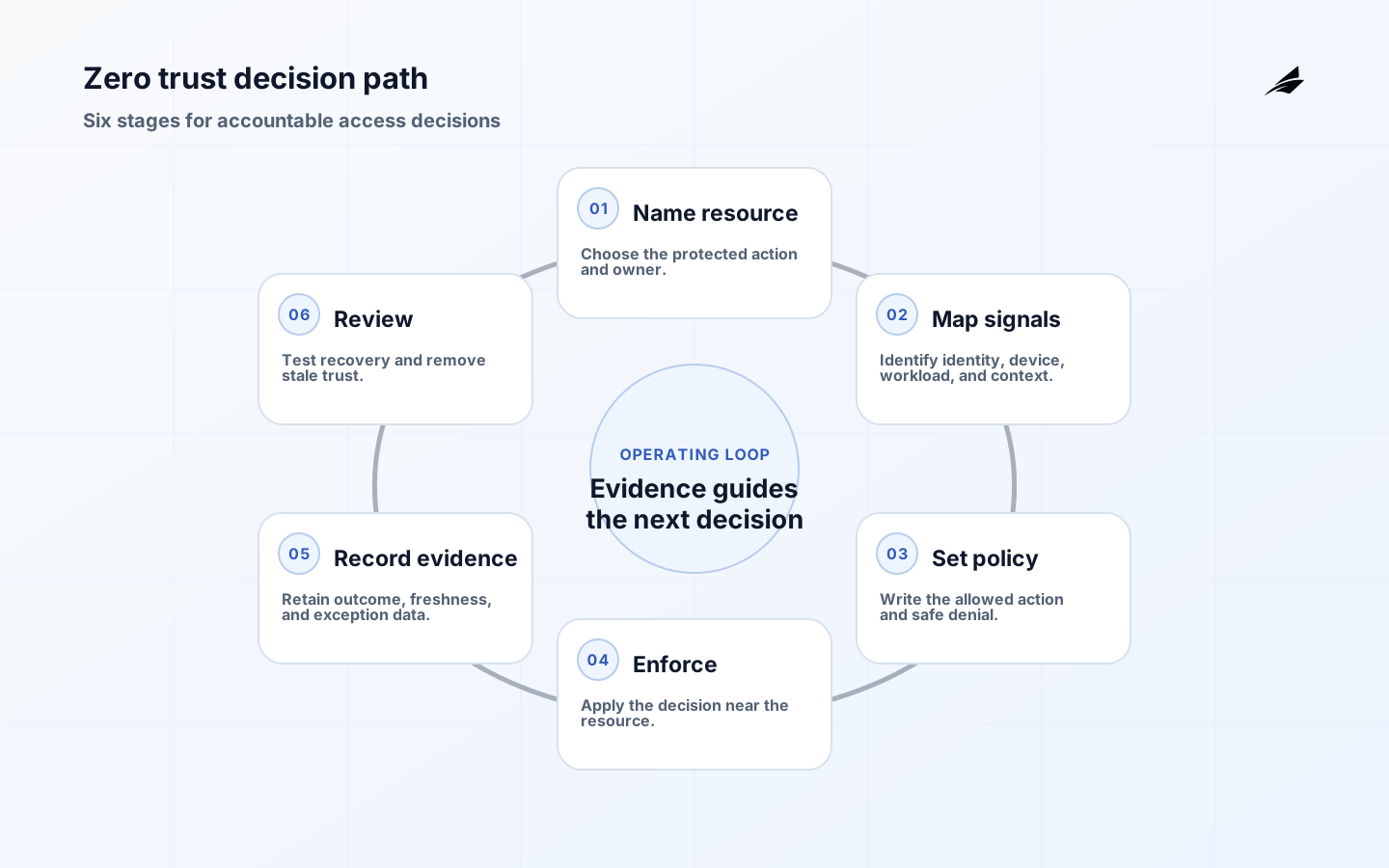
Zero trust is easiest to misunderstand when it arrives as a product label. Before the first build, it is a set of decisions about who may take which action on which resource, what evidence supports that decision, and what happens when the evidence is missing. NIST describes zero trust as a shift away from implicit trust based on network location and toward users, assets, and resources. That principle becomes practical only when a team can point to an enforcement point and explain its failure mode. This guide turns zero trust architecture into a pre-build conversation: define the protect surface, make policy inputs explicit, release narrowly, and retain evidence that the design still matches production.
Set the zero trust boundary
Start with a resource and a consequential action rather than a catalogue of tools. A resource might be a customer export, deployment control, source repository, support console, or internal service. The action might be read, change, approve, impersonate, or invoke. Map the actor, workload, device, data classification, identity provider, policy service, enforcement point, and recovery owner around that action. Include background jobs and vendor integrations; they often bypass the path that was drawn for a human user. The NIST zero trust architecture is a useful authoritative anchor because it keeps protection focused on resources, but the local boundary still needs a named owner and a testable outcome.

Ask four questions before choosing controls
- Which resource and action would cause the greatest harm if granted incorrectly?
- Which identity, device, workload, and context signals are authoritative for that action?
- Where can the decision actually be enforced, including automation and support paths?
- What should a user or service see when a signal is stale, unavailable, or contradictory?
| Boundary decision | Example answer | Evidence to retain |
|---|---|---|
| Protected action | Export customer records from the support console | Resource owner, data class, and allowed roles |
| Decision subject | Named employee on a managed device | Identity, device posture, and authentication event |
| Enforcement | Application policy plus export service check | Policy version and enforcement result |
| Recovery | Deny export and route to an approved break-glass review | Reason code, approver, expiry, and audit record |
Design an architecture that can explain its decision
A useful zero trust architecture separates policy decision from policy enforcement. The decision service evaluates a request using bounded inputs; the enforcement point applies the result near the application, data, or administrative action. For cloud-native service-to-service paths, the NIST access-control model for cloud-native applications is a useful reference for keeping workload identity and policy enforcement explicit. For every dependency, record ownership, allowed values, freshness, failure behavior, and the telemetry that proves it was consulted. A cached device posture, a replica with delayed identity state, or a service account with a forgotten key can otherwise turn a precise policy into an old or incomplete answer. The design should also distinguish authentication from authorization: proving who or what is making a request does not by itself establish that the requested action is permitted.
Turn policy into a reviewable access decision
Write each important rule as a decision record: subject, resource, action, required signals, allowed result, denial reason, exception authority, and review date. Keep the rule separate from the dashboard or vendor configuration that implements it. A good record lets a reviewer ask whether the signal was current, whether the policy was applied at the final action, and whether the result was logged without leaking secrets. If an exception is needed for an incident, give it a narrow scope and expiry. The CISA Zero Trust Maturity Model reinforces the importance of moving from aspirational language to capabilities that can be measured and improved. Link adjacent practices such as secure admin panels and audit logs when the same decision crosses those boundaries.
Choose signals by consequence, not by availability
A signal belongs in a policy because it changes the risk of the requested action, not because a platform can export it. For an ordinary read of low-sensitivity documentation, identity and membership may be enough. For a production deployment or bulk export, require stronger evidence such as recent authentication, managed-device posture, workload identity, approval state, and an unusual-activity check. Define the maximum staleness that is acceptable for each signal. If a risk feed is delayed by five minutes, that may be tolerable for a view and unacceptable for a high-impact change. Make that distinction explicit instead of applying a universal timeout that nobody can defend.
| Signal | Useful question | Safe degraded behavior |
|---|---|---|
| Identity | Who is requesting the action and how recently was it verified? | Require re-authentication or deny the sensitive action |
| Device | Is the device managed and within the required posture window? | Allow read-only work or route to support |
| Workload | Which service identity is making an automated request? | Limit the resource set and alert on an unknown identity |
| Context | Does time, location, approval, or behavior alter risk? | Step up verification and retain a reason code |
Release one protected journey before expanding
Choose a journey with a clear business outcome and an obvious rollback or containment action. Document the current implicit trust, deploy the new decision in observe-only mode where practical, compare expected and actual subjects, then enforce for a small audience. Exercise permitted, denied, stale-signal, break-glass, and dependency-outage cases. Keep the change reversible at the enforcement point; removing a policy file is not a rollback if a token, cache, or asynchronous worker can still perform the action. For identity recovery and session behavior, cross-check the related OAuth security decisions before calling the journey complete.
Operate zero trust with evidence
The useful operating record includes the request, resource, action, decision, policy version, signal freshness, enforcement result, exception reference, and user-visible outcome. Do not copy credentials, access tokens, or unnecessary personal data into a broad log stream. Segment metrics by resource and action so a healthy average cannot hide a failing export or administrative path. Review denial reasons for false blocks, exception age for policy drift, and enforcement coverage for bypasses. The NIST Cybersecurity Framework 2.0 gives a broader governance and response context for those signals; the local question is always what a threshold should cause the team to do next.
Make exceptions temporary and survivable
A break-glass path is part of the architecture, not an embarrassing failure of it. Define who can approve it, which action it permits, how long it lasts, how it is recorded, and how the affected resource is reviewed afterward. Separate emergency access from routine support so urgency cannot quietly become a standing role. Test the path with a responder who did not write it: they should know how to request access, how the user learns what happened, and how the security owner closes the exception. A short incident record should include the original deny, the reason for override, the data or system touched, and the follow-up control change.
Rehearse the operator path before launch
A zero trust design should be tested by the person who will handle a legitimate denial and by the person who will investigate an unexpected allow. Give them a request trace with the subject, resource, action, policy version, and signal freshness. Ask the operator to approve a bounded exception without granting a permanent role, then ask the investigator to explain why the original request failed. This exercise often reveals that the policy is precise but the recovery route is not: the device owner is unknown, the resource owner cannot be reached, or the audit record lacks a correlation identifier. Fix those handoffs before adding another control.
Use a production export as the rehearsal
Imagine a support agent needs to export a small customer set during an incident. The normal rule requires a managed device, recent step-up authentication, a case reference, and an export reason. The device signal becomes stale halfway through the request. A safe design denies the high-risk action, keeps the case visible, and offers an approved read-only path or time-limited review. The team should be able to show the deny, the user-facing explanation, the approver, the exact data scope, and the expiry. That is stronger evidence than a policy test that never leaves the healthy path.
| Rehearsal question | Pass condition | If it fails |
|---|---|---|
| Can the operator identify the resource owner? | Owner and escalation path are visible | Fix the inventory before rollout |
| Can the user recover from a false deny? | Safe correction or reviewed exception exists | Add support and identity recovery |
| Can an investigator reconstruct the decision? | Inputs, version, result, and trace are retained | Improve decision telemetry |
| Can the exception expire? | Expiry is enforced and reviewed | Remove the bypass or add automation |
Keep the rehearsal result with the access decision record and revisit it after material changes to identity, device posture, policy evaluation, or resource ownership. The purpose is not to prove that every denial is correct; it is to prove that a team can distinguish a legitimate user problem from an unsafe bypass and respond to both without recreating broad implicit trust.
Key zero trust takeaways
- Protect a named resource action, not an abstract network perimeter.
- Separate decision inputs, policy evaluation, enforcement, and recovery ownership.
- Set freshness and failure behavior for every signal that affects access.
- Roll out one journey with observable denies, exceptions, and a reversible enforcement change.
- Measure decision quality and bypass coverage, then retire stale exceptions.
Zero trust FAQ
Does zero trust mean the network no longer matters?
No. Network location, segmentation, and transport controls can still reduce exposure. Zero trust changes their role: being on a trusted network is not sufficient evidence for an important action, so identity, resource, device, workload, and context checks remain explicit.
Where should a small team start?
Start with one high-consequence path such as production administration, customer export, or repository release. Name the owner, map normal and exceptional routes, and prove that the policy is enforced at the final action before adding more signals or resources.
What proves the design is operating?
A useful proof pack shows representative allows and denies, current decision inputs, enforcement health, exception review, and a rehearsal of recovery when an identity or policy dependency is unavailable. A configuration screenshot alone is not proof of the production path.
Conclusion: make zero trust a decision system
Zero trust earns its keep when a team can explain an access decision under normal work, pressure, and recovery. Define the protect surface, use evidence with a known freshness, enforce near the resource, and keep exceptions bounded. Those choices make a security architecture more understandable before code exists and more defensible once users, automation, and incidents test it.