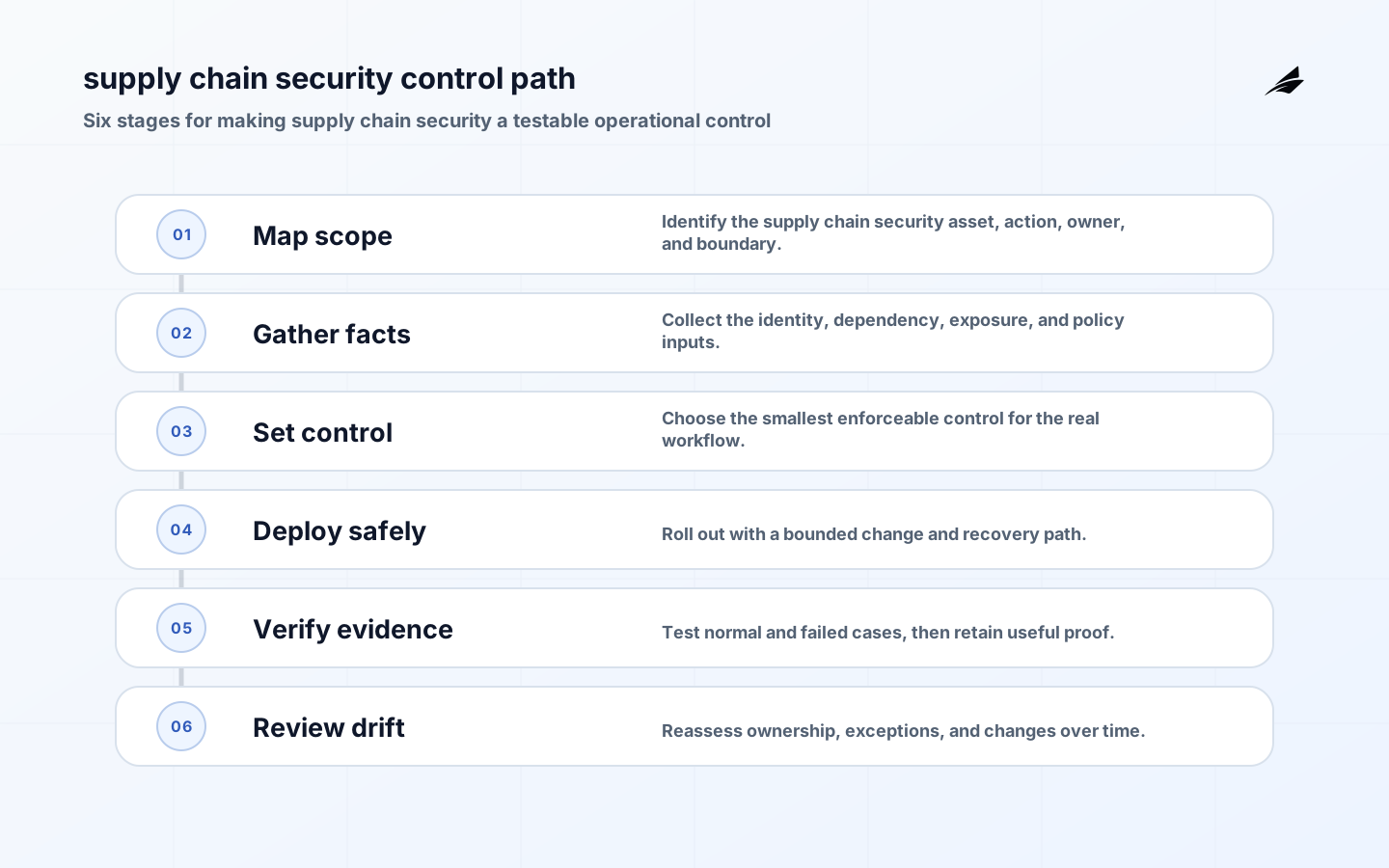
Supply chain security is the practice of making software delivery trustworthy from source change to deployed artifact. The chain includes more than open-source packages: source repositories, contributors, build systems, artifact registries, infrastructure definitions, signing keys, deployment automation, and external services can all influence what reaches production. A tool inventory is useful, but the key question is provenance: can the organization show what inputs produced a release, who or what was authorized to produce it, and whether the artifact deployed is the artifact that was reviewed?
Trace the software delivery path before buying controls
Begin with one representative release path. Follow a change from a protected source branch through dependency resolution, build, test, package, registry, approval, deployment, and runtime. Identify mutable inputs such as floating package tags, unpinned build images, manually uploaded artifacts, and secrets shared across environments. Name the control point and owner at every transition. This exercise often finds a gap more consequential than a missing scanner: an unprotected release token, an artifact that can be replaced in the registry, or a production deployment not tied to a build record.
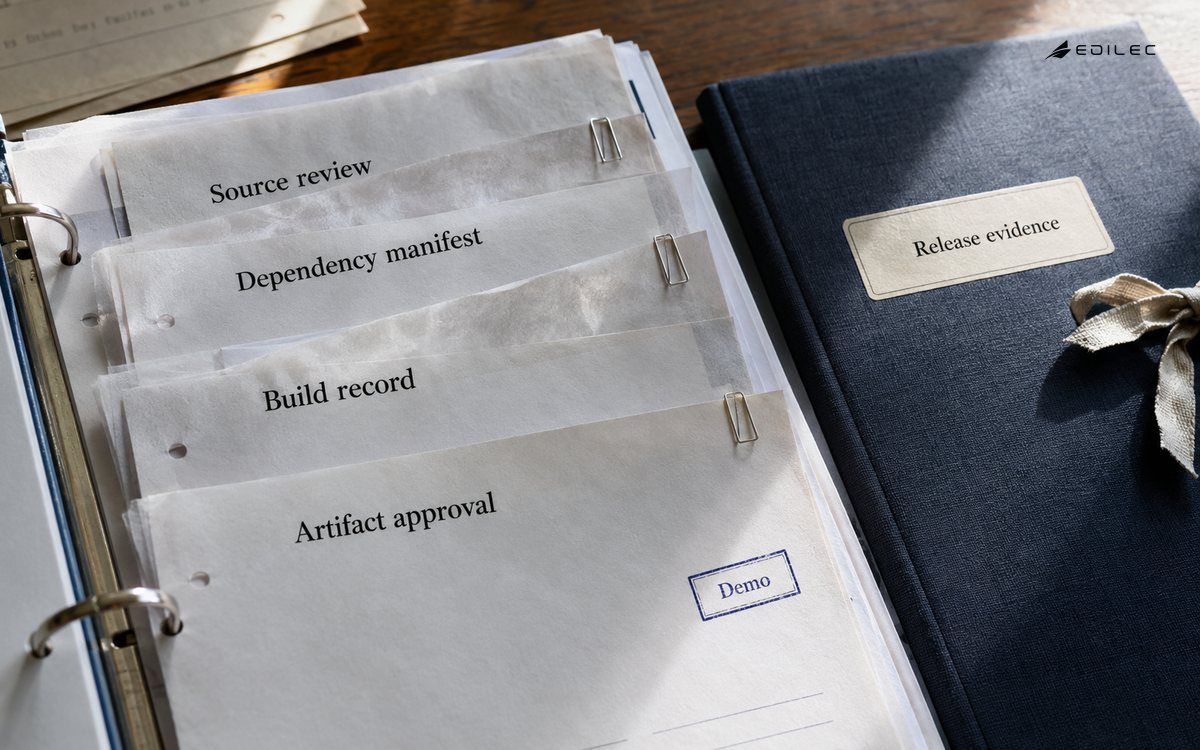
| Decision point | Practical choice | Evidence to retain |
|---|---|---|
| Delivery stage | Control objective | Evidence |
| Source change | Authorized, reviewed change enters the build. | Protected branch and review record. |
| Build | Known inputs run in a controlled environment. | Build provenance and resolved input record. |
| Registry | Artifact cannot be silently replaced. | Immutable digest and access event. |
| Deployment | Only approved artifact reaches the target. | Digest-to-environment deployment record. |
Design supply chain security controls that can be enforced
Harden source and build authority before trying to score every dependency. Use strong authentication, protected branches, review rules appropriate to the risk, and separate personal developer identity from automation identity. Build in an isolated, repeatable environment where inputs are pinned or recorded. Limit who can alter pipeline definitions, runners, registry retention, and release approvals. Build services should have narrowly scoped credentials and short-lived access; secrets rotation is therefore a direct supply-chain control, not a separate housekeeping task.
- Map source, build, registry, deployment, and runtime transitions.
- Protect pipeline and release identities as high-value credentials.
- Pin or record build inputs and publish immutable artifact digests.
- Use SBOMs for affected-release decisions, not as standalone assurance.
- Test whether an altered artifact or unauthorized pipeline action is stopped.
Operate supply chain security as a controlled change
Generate a software bill of materials when it supports real decisions, such as identifying affected releases after a vulnerability disclosure or meeting a customer requirement. An SBOM is an inventory claim, not proof that an artifact was safely built. Pair it with provenance that identifies build inputs, builder identity, and output digest. Preserve the relationship between the release record, artifact digest, environment, and deployment approval. Consumers should verify immutable digests rather than relying only on a human-readable version label.
Work through a supply chain security example
A focused drill can use a service with a container image. Pin the base image by digest, record the resolved dependencies, build from a protected workflow, publish an artifact digest, and deploy only that digest to a staging environment. Then attempt to substitute a tag with a different image or use a pipeline credential outside its intended repository. The expected result is a blocked or visible failure. This proves whether controls protect the actual delivery path rather than a compliance diagram.
Test and verify supply chain security
Manage suppliers proportionately. For a hosted build platform, registry, dependency, or managed service, understand the security responsibilities, identity integration, incident notification path, export options, and how you can revoke access. For critical components, define an alternate source or recovery approach. Avoid treating supplier questionnaires as continuous assurance; changes in ownership, permissions, service configuration, and advisories can alter the risk after the procurement review ends.
| Test or review | Expected behavior | Escalate when |
|---|---|---|
| Scenario | Expected result | Risk if absent |
| Tag substitution | Deployment verification rejects changed content. | A familiar tag masks a different artifact. |
| Compromised pipeline token | Scope limits access and activity is visible. | One token can alter unrelated releases. |
| New vulnerability | Teams locate affected release digests quickly. | Inventory cannot identify deployed exposure. |
| Emergency bypass | Exception has owner and expiry. | Temporary release path becomes permanent. |
Measure and govern supply chain security
Measure the properties that change exposure: percentage of releases with provenance, unpinned build inputs, production deployments tied to an immutable digest, dormant automation credentials, mean time to identify affected artifacts, and exceptions to branch or review rules. Investigate drift rather than only counting findings. A temporary bypass may be justified during an outage, but it should produce an accountable record and a return-to-control action.
Govern supply chain security through release policy. Define which services require review, provenance, signing or verification, SBOM generation, and deployment approval; then make the policy executable in pipelines where possible. Keep an exception register with owners and expiry. Revisit the model when adopting a new package ecosystem, CI runner, deployment method, or acquisition, because each changes the trust boundary.
A further operational consideration for supply chain security is that direct packages, transitive packages, build plugins, and base images have different influence on delivery and should be reviewed according to execution and exposure. Give this boundary a named owner and a regular review point. The useful evidence is not a generic attestation; it is a record that identifies the system, decision, and observed result. When the expected control does not hold, the response should be visible and bounded so people do not improvise an unreviewed workaround. This detail is often where a policy becomes an operating practice.
Reliable supply chain security depends on recognizing that recording source revision, build definition, resolved inputs, runner image, and output digest can create useful provenance even before builds are fully reproducible. Put the rule near the system that can enforce it and make the supporting workflow accessible to legitimate users. Document the inputs, authority, failure response, and recovery owner before relying on automation. That level of specificity helps teams distinguish a true requirement from a historical convenience, and it leaves a reviewer with enough context to assess whether the control still fits the current service.
In a mature supply chain security program, build, release, and deployment authority should be intentionally separated so one compromised account cannot alter every stage without producing visible evidence. Test the condition through the same path used in production, including an expected failure and a recovery step. Capture concise evidence, then review it when a dependency, team, or threat assumption changes. This keeps the design connected to actual behavior instead of allowing a diagram or written rule to stand in for a control that nobody has recently exercised.
The governance implication for supply chain security is that response to compromised release infrastructure depends on being able to freeze delivery, revoke automation access, identify a suspect window, and rebuild from reviewed source. Establish an owner who can make the necessary tradeoff, a time limit for exceptions, and an escalation path for material risk. A short, well-maintained decision record is more useful than a broad policy document because it tells operators what to do when the normal path cannot be followed and how the organization will return to it.
Artifact signing or verification should be introduced where it can be enforced and understood. A signature has value when the deployer or runtime checks the trusted identity, artifact digest, and applicable policy; a signature that nobody verifies is only metadata. Begin with a narrow critical path, publish the trusted issuer set, and test rejection of an untrusted or altered artifact.
Software delivery evidence should remain available for the operational period in which the organization may need to investigate a release. Align its retention with incident response and customer obligations, while protecting it from unauthorized alteration. Provenance records can disclose useful architecture and dependency information, so access control and integrity matter alongside collection.
Supplier and platform changes should be treated as delivery-path changes, even when no application code moves. A new hosted runner, registry setting, package mirror, or artifact retention rule can alter who influences a release and what evidence remains available. Include these changes in the same review used for release controls. The team then maintains continuity between its written supply-chain policy and the services that actually assemble and deliver production software.
Keep the release path legible to the people who operate it. A compact release record containing the source revision, artifact digest, approval, destination, and rollout result lets responders and engineers answer consequential questions quickly. That clarity is a practical security benefit during normal delivery and during incident response.
Key takeaways
- Map source, build, registry, deployment, and runtime transitions.
- Protect pipeline and release identities as high-value credentials.
- Pin or record build inputs and publish immutable artifact digests.
- Use SBOMs for affected-release decisions, not as standalone assurance.
- Test whether an altered artifact or unauthorized pipeline action is stopped.
Frequently asked questions
Does an SBOM make software safe? No. It helps identify components and affected releases, but it does not prove the artifact's provenance or the security of its build environment.
Do small teams need build provenance? The implementation can be modest, but every team benefits from being able to tie a deployed artifact to a source revision and controlled build.
Conclusion
In conclusion, supply chain security is evidence-driven control of how software becomes production software. Trace a real release, secure the identities and mutable steps that shape it, record immutable provenance, and practice a substitution failure. Those habits produce useful resilience even when the dependency landscape changes quickly.