Just-in-time privileged access replaces an always-on administrative grant with a controlled activation window for a specific person, resource and purpose. It reduces the time during which stolen credentials, compromised sessions or human mistakes can exercise elevated authority. JIT is not achieved by adding an expiry field to a broad administrator role. Eligibility, request context, approval, authentication, activation, monitoring, expiry and verification must function as one workflow.
Start with a role inventory and the operations that truly require elevation. Edilec's least-privilege field guide covers permission design; this article addresses temporary operation. The program outcome is fewer standing assignments and shorter privilege exposure without making urgent maintenance depend on informal account sharing. Measure both security and operability, including how often engineers cannot complete legitimate work within the designed path.
Separate JIT eligibility from active privilege
Eligibility means a principal may request a defined role under stated conditions; it is not permission to use that role continuously. Assign eligibility through governed groups tied to job function, training, employment status and conflicts of interest. Review it periodically and remove it on role change. Keep the active privileged role empty until a request passes policy. NIST SP 800-53 provides control families for account management, least privilege, privileged functions and audit that can inform this design.
Decompose global administrator roles before automation. A database restore operator, identity policy administrator and billing configuration administrator have different resources, approvers and evidence. Define maximum duration and concurrent activations by role. Prohibit activation where the principal would approve their own access or violate separation of duties. Service accounts should use workload identity and narrowly scoped automation rather than recurring human JIT requests that disguise standing machine privilege.
| Request field | Decision value | Reject when | Evidence retained |
|---|---|---|---|
| Target role and resource | Bounds authority | Wildcard or unsupported target | Immutable role version |
| Business purpose or incident | Explains necessity | Generic text with no work reference | Ticket or incident reference |
| Requested duration | Limits exposure | Exceeds role maximum | Start and expiry |
| Requester context | Confirms eligibility and risk | Inactive identity or risky device | Identity and posture result |
| Approver | Adds accountable review | Requester, subordinate or conflicted party | Decision, reason and time |
Design a decision-useful request and approval
Present the approver with principal, exact role, target, requested interval, purpose, change or incident reference, recent access, risk signals and conflicting duties. Approval should bind to these fields through an immutable request version. If the requester changes role, target or duration, require a new decision. Avoid approvals delivered only through email links with no authenticated view of the request. Low-risk, routine roles can use policy-based approval when eligibility and change windows are independently governed.
Set escalation and timeout behavior. A request that reaches its intended start time without approval should expire, not activate later unexpectedly. Emergency work needs a separate break-glass route with stronger authentication, narrow emergency roles, immediate alerts and retrospective review. Do not let routine work use the emergency route because normal approvals are slow; fix capacity and ownership instead. Track approver latency by role to reveal workflows that encourage bypass.
Bind activation to fresh strong authentication
Activation occurs only after policy rechecks eligibility, approval validity, employment state, device posture, conflicts and target availability. Require fresh authentication appropriate to administrative risk. NIST SP 800-63B-4 defines authenticator assurance concepts and phishing-resistant options that can guide the authentication profile. Do not treat an old ordinary-user session as sufficient proof for a consequential privilege transition.
Grant the narrow role through the target's authoritative control plane and record its returned assignment ID. Avoid merely setting a flag in the JIT portal while the cloud or SaaS platform remains unchanged. Where propagation is eventual, show activating until the target confirms effective access; do not start the usable duration before propagation unless that loss is deliberate. Issue a distinct privileged session where possible so elevation does not silently contaminate every existing browser or CLI session.
Monitor use and prove automatic expiry
During the window, capture administrative authentication, commands or API actions, resource, result and change reference at the systems that perform them. Risk-based controls can terminate access early when device posture changes, employment status changes or the request is canceled. The NIST Zero Trust Architecture supports continuing evaluation of access to resources rather than assuming one initial decision remains valid.
At expiry, revoke the target assignment, terminate or downgrade privileged sessions and verify that a privileged test action is denied. Use a durable expiry worker and a reconciliation job so scheduler failure cannot create permanent access. If target removal fails, mark the request revocation overdue, alert immediately and use a protected manual procedure. Never mark a request complete when the portal timer ends but the external role remains assigned.
| Workflow state | Exit condition | Failure handling | Key metric |
|---|---|---|---|
| Requested | Complete contextual request persisted | Expire incomplete requests | Request abandonment |
| Approved | Bound decision remains valid | Invalidate on material change | Approval latency |
| Activating | Target confirms role assignment | Retry safely or escalate | Activation completion |
| Active | Window open and policy remains valid | Terminate on risk or cancellation | Privilege minutes |
| Revoking | Target confirms removal and sessions close | Overdue alert and manual closure | Verified revocation latency |
Find standing access outside the JIT workflow
Reconcile target role assignments against approved active windows. Flag direct grants, nested group grants, local accounts, inherited subscriptions, stale emergency accounts and assignments whose expiry metadata differs from the JIT ledger. Prioritize roles capable of changing identity, logging, backups or the JIT system itself. A clean workflow does not reduce risk if administrators can grant equivalent privilege through an unmanaged console.
Report eligible population, standing privileged population, activations, privilege minutes, denied requests, emergency use, overdue revocations and unexplained assignments. Review whether narrow roles are usable; frequent requests for a global role can signal missing permissions in the designed role. Connect events to Edilec's audit log guide without storing passwords, session cookies or command secrets.
Use the six-stage Edilec JIT privilege window
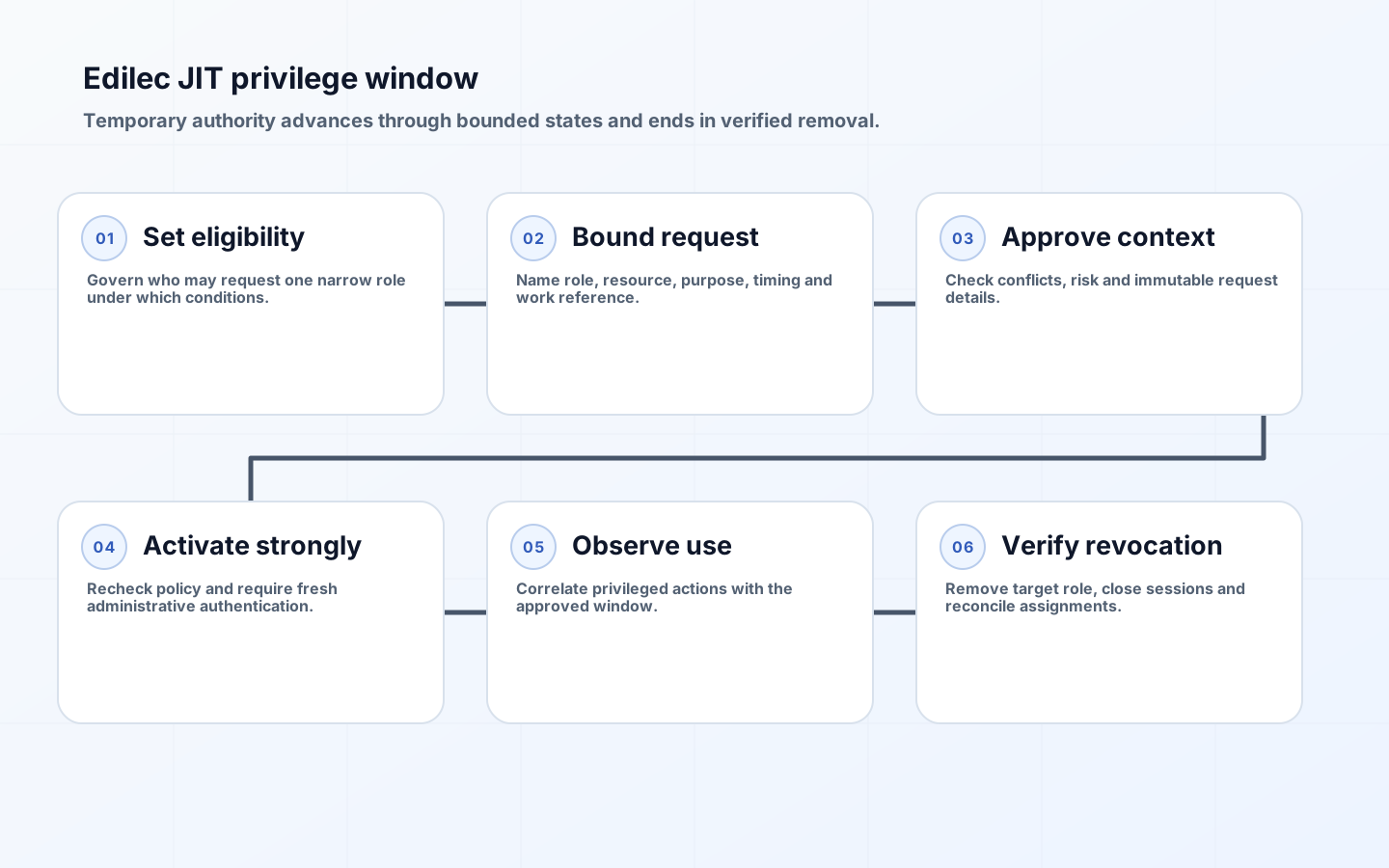
The six stages are establish eligibility, submit bounded request, evaluate and approve, activate with fresh authentication, observe privileged use, and revoke with verification. The Edilec diagram at this heading gives the access team and target-system owner a shared state model. Treat every transition as durable and idempotent, with a responsible component and an operator-visible failure state.

Pilot on one role with meaningful but recoverable impact. Test denied eligibility, changed request after approval, failed target activation, early cancellation, expiry during an active session and target API outage. Reconcile from the target back to the ledger. The identity pillar and cross-pillar visibility described in the CISA Zero Trust Maturity Model can help place JIT work in a broader program, but the target's verified role state remains the completion test. Publish support and emergency procedures before removing standing grants, then remove them explicitly; JIT layered over unchanged permanent access provides convenience without exposure reduction.
Protect the JIT control plane from privileged abuse
The system that grants temporary privilege is itself a high-value target. Separate administrators who define roles, approve eligibility, change workflow policy and operate the underlying platform. Require reviewed changes for maximum duration, approver rules, emergency roles and target connectors. Store signing keys and target credentials in protected services, rotate them, and prevent workflow administrators from reading reusable secrets. Export an immutable policy-change trail to an independently controlled destination so an attacker cannot both weaken a rule and erase the evidence.
Threat-model approval manipulation and availability. An attacker may create thousands of requests, substitute a target after approval, compromise a common approver, delay revocation workers or disable reconciliation alerts. Apply request rate limits, immutable request digests, dual control for the highest-impact roles and health checks from outside the JIT platform. Back up policy and ledger state, then test restoration without replaying expired approvals. A recovered control plane must re-read target assignments before issuing new changes.
Review JIT platform administrators through a separate access process; do not let the system recursively approve its own owners without independent oversight. Maintain a minimal offline recovery procedure for identity-provider or control-plane failure, including who can invoke it, which narrow actions are possible and how evidence is later imported. Exercise that path on a schedule. An emergency mechanism that has never been tested usually produces either lockout or overbroad access when it is finally needed.
Key takeaways
- Keep eligibility separate from active privilege and review both through different controls.
- Bind approvals to the exact principal, role, target, purpose and duration that will activate.
- Require fresh strong authentication and create a distinct privileged session where possible.
- Verify revocation at the target and reconcile assignments that exist outside active JIT windows.
- Operate break-glass access as a narrow, alerted and retrospectively reviewed emergency path.
Frequently asked questions
Does every JIT request need a human approval?
No. Low-risk roles can activate through preapproved policy if eligibility, context, duration and logging are strong. High-impact or conflicting actions generally benefit from independent review. Document the risk rule rather than making approval universal or absent.
Should expiry end the administrator's entire session?
It should remove elevated authority and invalidate any privileged session or token. The ordinary session may continue if the platform can reliably downgrade it. Test caching so old role claims cannot remain effective after target revocation.
How should break-glass access differ?
Use separate tightly held identities or roles, strong authentication, short duration, immediate notification and mandatory review. Exercise the path periodically. Emergency access should survive a JIT dependency failure without becoming a quiet permanent bypass.
Conclusion
Just-in-time privileged access reduces exposure only when the target has no equivalent standing grant and expiry is verified. The workflow must turn eligibility and purpose into narrow temporary authority, observe its use and close it even during failures. That requires IAM, target-platform and operations ownership together.
Begin with one high-value role, measure privilege minutes and reconcile target assignments daily. Align decisions with Edilec's zero trust guide so resource access uses current identity and context. Once revocation and emergency recovery are dependable, scale to more roles without broadening the approval envelope.