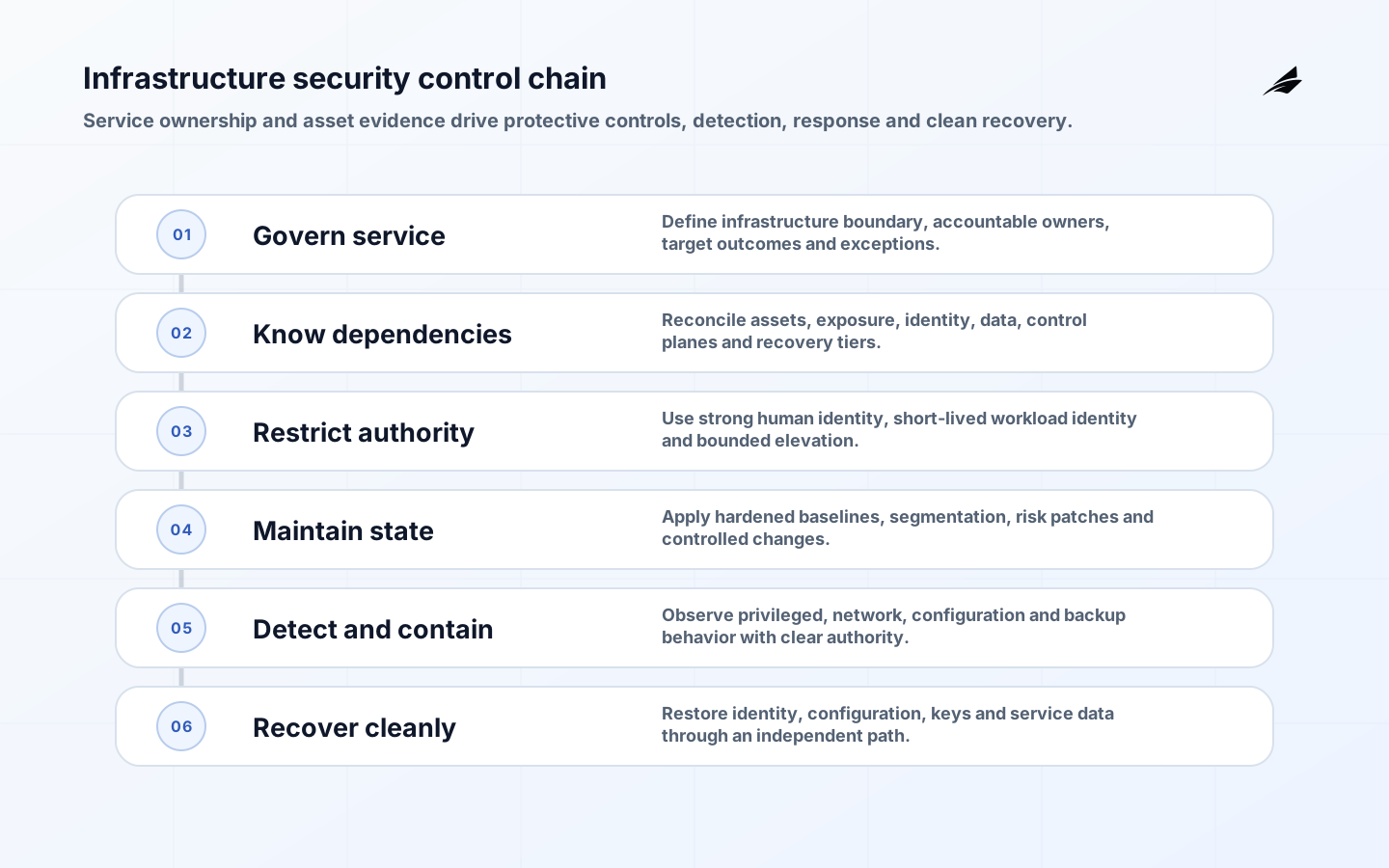
Infrastructure services cybersecurity is the practice of making compute, network, storage, identity, virtualization, cloud and management services defensible throughout their lifecycle. The implementation target is not a perfectly hardened server in isolation. It is an operating system in which assets have owners, access is explicit, configurations are controlled, exploitable weaknesses are prioritized, suspicious behavior is visible and recovery is tested. This checklist turns those outcomes into evidence that platform, security and service owners can review together.
NIST Cybersecurity Framework 2.0 organizes outcomes under Govern, Identify, Protect, Detect, Respond and Recover. Use that structure to avoid a tool-led program that overinvests in protection while ownership, detection or recovery remain weak. NIST SP 800-53 supplies detailed control families, and CISA's Cross-Sector Cybersecurity Performance Goals identify high-impact practices. Tailor both to the organization's mission, threats and obligations. A control is implemented only when its scope, owner, operation and verification are clear.
1. Govern the infrastructure boundary
Define which environments, accounts, subscriptions, data centers, networks, clusters, appliances, endpoints and management services are included. Map them to business services and data classifications. Name an accountable service owner, technical operator, security owner and recovery owner for each critical platform. Include colocation, managed services and suppliers. Shared responsibility must describe who configures, monitors, patches, investigates and restores—not merely who owns the contract.
Create a current-state and target profile using CSF 2.0 outcomes. Record risk decisions, exceptions, due dates and compensating controls. Establish architecture and change authorities, emergency powers and escalation thresholds. Connect infrastructure risk to enterprise risk: unsupported virtualization, an exposed management plane or an untested identity recovery path can affect many services at once. Review concentration and systemic dependencies rather than scoring every asset separately. The cybersecurity services scope guide can help align program boundaries and delivery.
2. Establish authoritative asset and dependency evidence
Build inventory from control planes, network observation, endpoint agents, configuration repositories, procurement and physical records. Give each asset a stable identifier, owner, service, environment, location, criticality, data class, operating system or firmware, exposure, management method, support status and recovery tier. Include ephemeral workloads, service accounts, certificates, DNS, external addresses, backup systems, remote-management paths and shadow cloud accounts. Reconcile sources; no scanner sees everything.
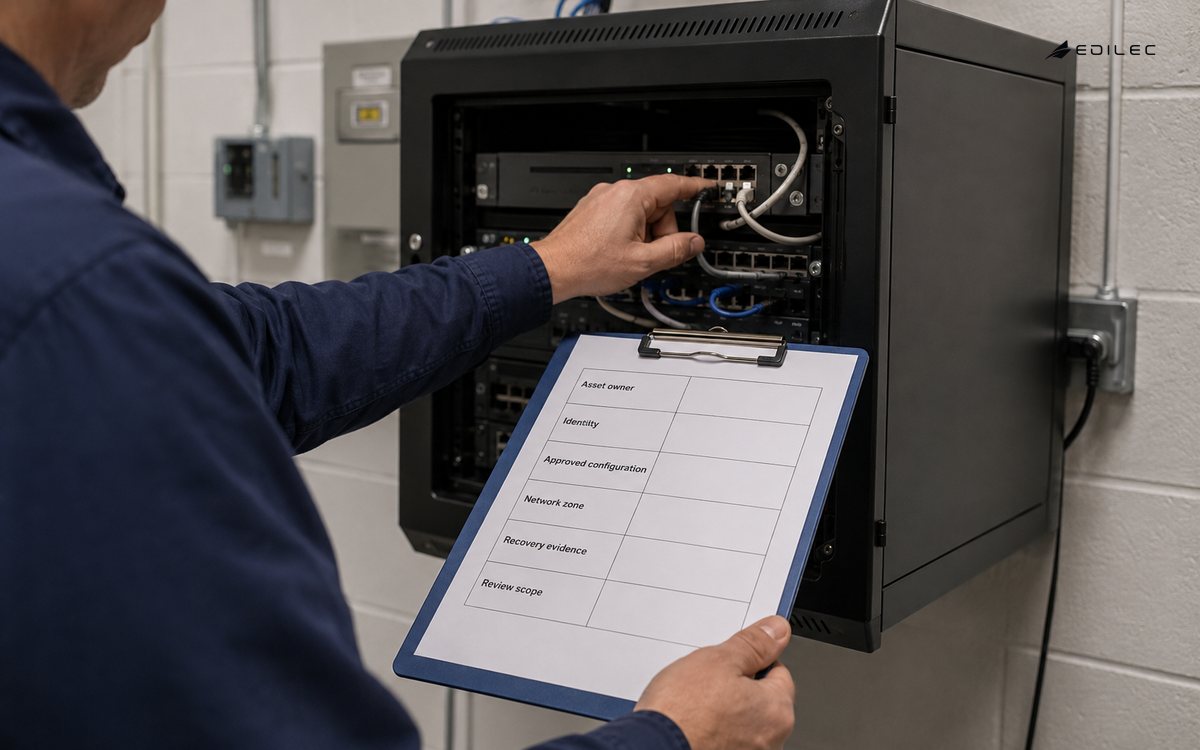
Map critical dependencies and trust paths. For a service, trace identity, name resolution, time, certificates, routing, secrets, storage, logging, backup and deployment. Mark control-plane dependencies shared across otherwise separate environments. Use discovery coverage and unknown-owner age as metrics. An inventory becomes operational when a newly observed unmanaged asset creates work, a terminated service is removed, and ownership or exposure changes trigger control review. A spreadsheet refreshed before audit is not sufficient evidence.
| Infrastructure layer | Minimum evidence | Critical question |
|---|---|---|
| Identity | Human and workload accounts, roles, keys and owners | Can privileged activity be attributed and revoked? |
| Network | Flows, zones, gateways, external exposure and management paths | Can compromise reach a critical control plane? |
| Compute | Image, patch, configuration and workload owner | Is the running state approved and supported? |
| Data and backup | Stores, keys, copies, retention and restore tier | Can authoritative data be recovered? |
| Observability | Log source, route, retention and alert owner | Would material misuse be visible? |
3. Secure human and workload access
Centralize workforce identity, require strong multifactor authentication, disable shared administration and use separate privileged identities. Apply least privilege through roles tied to duties, not individuals. Use just-in-time or time-bound elevation where possible and review high-risk grants frequently. Protect break-glass access with independent credentials, strong custody, alerting and exercises. Joiner, mover and leaver workflows must cover infrastructure consoles, local accounts, automation platforms, vendors and physical access.
Treat workload identities as first-class assets. Prefer short-lived credentials and platform identity over embedded static secrets. Bind identity to a specific service and environment, rotate automatically and restrict where credentials can be used. NIST zero trust guidance rejects implicit trust based only on network location or asset ownership; evaluate user, device, workload and resource context. Put administrative interfaces behind dedicated, monitored paths and block routine internet exposure. Verify authorization server-side even when a management portal hides a button.
4. Standardize hardening and segmentation
Create versioned secure baselines for operating systems, hypervisors, containers, databases, network devices and cloud services. Remove default credentials and unnecessary services, restrict management protocols, encrypt administrative traffic, protect boot and firmware where supported, configure logging and enforce time synchronization. Build approved images through a controlled pipeline and scan both image and running state. Document exceptions with owner and expiry. Configuration drift should create actionable work rather than silently updating the baseline.
Segment by trust and consequence. Separate user, workload, management, backup, security-tooling and recovery planes. Restrict east-west service flows to documented needs and control egress so compromised workloads cannot communicate freely. Protect identity, orchestration, hypervisor, backup and logging systems as high-value infrastructure. Test policy from the attacker's path: can a low-trust subnet reach management, can a workload query cloud metadata broadly, and can a compromised administrator erase both production and backups?
5. Operate vulnerability, patch and change management together
Ingest vendor advisories, asset exposure, scanner findings, threat intelligence and CISA's Known Exploited Vulnerabilities Catalog. Prioritize known exploitation, internet reachability, privilege, business consequence and available mitigation rather than CVSS alone. Define clocks by risk and record patch, compensating control, exception or retirement. Verify remediation on the actual asset. Appliances, firmware, hypervisors and management software need the same discipline as servers, even when patch windows are harder.
Use staged change rings, automated prechecks, configuration backups and clear abort criteria. Test application compatibility and failover where a patch affects shared infrastructure. Emergency changes remain attributable and reviewed after the event. Track unsupported assets and replacement milestones. A vulnerability backlog should show exposure duration and risk ownership, not only ticket count. Repeated patch failure may indicate missing capacity, fragile architecture or a supplier constraint that governance must resolve.
| Control gate | Required proof | Stop condition |
|---|---|---|
| Build | Approved image, components and hardening tests | Unknown component or failed baseline |
| Access | Named identity, least privilege and strong authentication | Shared or indefinite privileged access |
| Change | Risk, test, recovery and owner | No way to restore service |
| Exposure | Required flow and monitored boundary | Unowned public or management interface |
| Recovery | Isolated backup and recent restore evidence | Credentials or data cannot be recovered |
6. Build detection and response around infrastructure behaviors
Collect identity decisions, privileged activity, control-plane events, network flows, endpoint telemetry, configuration changes, DNS, security-tool health and backup administration. Normalize time and preserve stable asset and account identifiers. Define detections for unexpected elevation, disabled logging, new public exposure, credential misuse, lateral movement, unusual egress, mass configuration change and backup tampering. Each alert needs an owner, context, severity rule, investigation steps and containment authority.
NIST SP 800-61 Rev. 3 integrates incident response with CSF 2.0 risk management. Prepare communication, evidence preservation, supplier coordination and decision authority before an incident. Exercise the loss of identity, remote management, a region, hypervisor control or a key supplier—not only malware on one host. Confirm responders can isolate without destroying evidence and can use out-of-band communications. Review detection gaps and infrastructure design after every exercise and incident.
7. Prove recovery and continuous assurance
Define recovery objectives for business services and derive infrastructure tiers. Protect backups with separate authority, immutability or isolation appropriate to risk, encryption and monitored deletion. Include infrastructure configuration, identity, keys, certificates, DNS, network policy, images and operational documentation. Restore into a clean environment, validate data and application behavior, and measure elapsed time. A successful backup job is not proof of recoverability.
Create a control assurance calendar. Automate evidence where it is trustworthy, then sample manually for blind spots. Measure owned inventory coverage, privileged-access age, external exposure, exploited-vulnerability remediation, configuration compliance, detection coverage, incident exercise findings and tested recovery. Report exceptions with business consequence and trend. Avoid a single security score that hides missing critical evidence. The goal is to identify which control outcome cannot currently be trusted and fund its repair.
8. Implement in service-aligned waves
- Select one critical business service and map its infrastructure, owners and dependencies.
- Close unknown assets and privileged paths before adding more monitoring tools.
- Apply approved baselines, segmentation and controlled management access.
- Integrate risk-based vulnerability and change workflows with asset evidence.
- Deploy behavior-focused detection and exercise containment with service owners.
- Restore the service, identity and configurations into a clean environment.
- Expand the paved controls to the next service and retire duplicate manual paths.
Define acceptance per wave: reconciled inventory, no unowned privileged access, critical flows documented, high-risk findings resolved or accepted, representative detections exercised and recovery proven. Provide reusable infrastructure modules, policies and dashboards so the secure path is easier. Allow controlled exceptions for genuine platform differences. Review the infrastructure cybersecurity FAQ with service and executive owners before expanding scope.
Key takeaways
- Organize infrastructure security across Govern, Identify, Protect, Detect, Respond and Recover.
- Make asset, dependency and ownership evidence drive control workflows.
- Protect human and workload identities plus shared management planes.
- Prioritize known exploitation and consequence, then verify remediation on assets.
- Treat clean recovery and exercised response as implementation requirements.
Frequently asked questions
Should infrastructure security start with a framework or a scanner?
Start with business scope and a framework of outcomes, then use scanners as evidence sources. A scanner cannot assign ownership, decide consequence, cover every asset or prove response and recovery.
Does zero trust eliminate network segmentation?
No. Zero trust removes implicit trust based solely on location and emphasizes resource-level decisions. Segmentation remains useful for limiting paths and consequence, but it must work with identity, device, workload and policy controls.
How often should restore tests run?
Set cadence by recovery tier, change rate and risk. Test after material architecture or backup changes and run full service exercises periodically. Frequent automated restore checks can complement, not replace, end-to-end exercises.
Conclusion
Secure infrastructure is a continuously verified service. The organization can identify what exists, restrict who and what may act, maintain approved state, respond to exploitation, observe misuse and recover critical functions without relying on the compromised path. Implement those outcomes one business service at a time, and the resulting evidence will be more useful than a collection of disconnected security products.