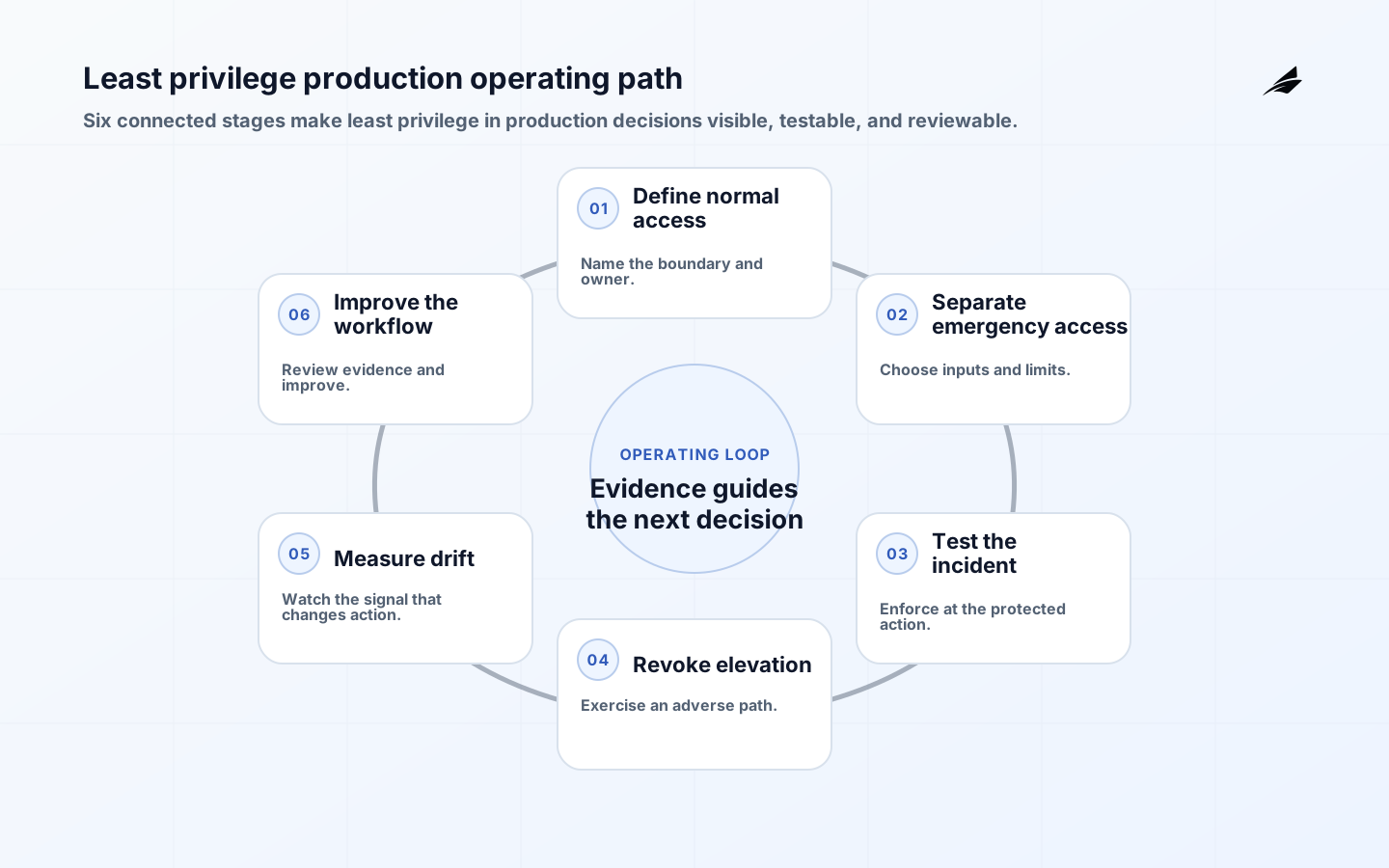
Least privilege becomes consequential when a team has to operate it through ordinary releases, outages, support requests, and investigations. The protected thing is the access grant, not a checkbox in a platform console. For founders, the useful question is whether people can explain the rule that made access or handling possible, show the evidence behind it, and change it without creating an unbounded exception. A broad or durable grant lets an ordinary mistake, compromised identity, or abandoned integration reach far beyond its legitimate task. This guide treats least privilege as a production capability: a set of bounded decisions, enforcement points, records, and review routines that keep the intended control true after launch.
Set the least privilege boundary
Start with human, service, machine, and emergency access across cloud accounts, data stores, internal tools, and delivery systems. Draw the request or data path in enough detail to name the asset, actor, action, policy input, enforcement point, and recovery route This avoids a familiar failure: a team purchases a control or adopts a standard, then discovers that a proxy, integration, background worker, or support workflow takes a path outside it The map should identify the system of record for each decision and the person who can approve an exception It should also show where a missing dependency produces a deny, a bounded continuity mode, or an alert A boundary that can be tested is more useful than a broad promise of protection
The boundary should join adjacent practices without blending their ownership. secure administration paths are a useful comparison whenever administrators can alter this control, while audit-log design helps make resulting decisions investigable — for least privilege in production. In least privilege in production, this same control is scoped to the article's stated boundary. Keep the question narrow: which normal and exceptional paths can affect the access grant, and what stops the wrong path from doing so? That focus lets a small team make a real improvement without waiting for a total platform redesign — for least privilege in production.
Design a production least privilege architecture
A durable architecture makes the relevant decision explicit and puts enforcement where it can affect the requested action For this topic, a policy decision point evaluates identity, resource, action, context, and time while enforcement points deny requests that lack an explicit permitted path. Each component needs a crisp contract: inputs it accepts, information it treats as authoritative, maximum acceptable staleness, failure behavior, and safe telemetry Do not assume a dashboard setting or an upstream assertion has reached every application path Cache behavior, replicas, asynchronous jobs, and manual processes all deserve a place in the design The result is not a single perfect control; it is a system whose trust boundaries, dependencies, and consequences can be reviewed before an incident forces the issue
| Decision area | Production rule | Why it matters |
|---|---|---|
| Baseline | Deny by default and make a grant an explicit, reviewable decision. | Prevents inherited convenience from becoming uncontrolled authority. |
| Scope | Bind a grant to a task, resource set, environment, and action. | A read-only production support task should not become account administration. |
| Duration | Use just-in-time or time-bounded access where feasible. | Limits standing privilege and makes ownership review meaningful. |
| Exceptions | Make emergency elevation attributable and observable. | Urgent access can remain accountable without blocking response. |
Make least privilege decisions reviewable
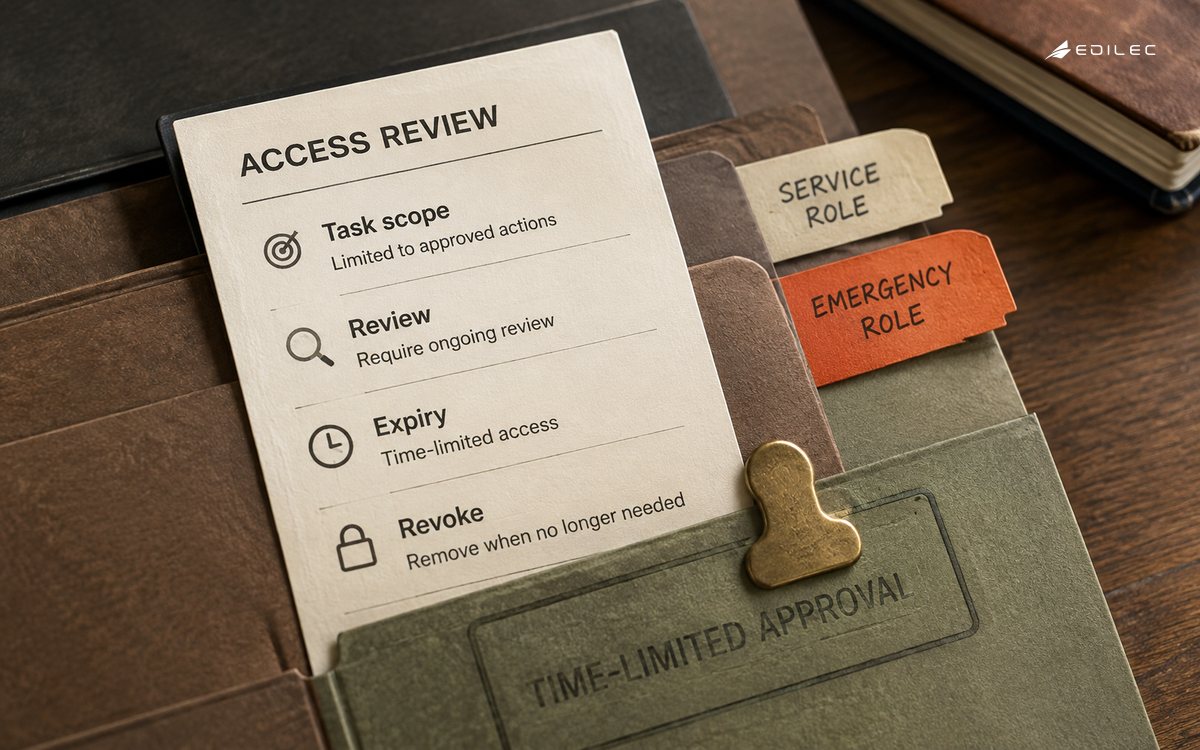
Write down the task boundary, resource scope, environmental conditions, duration, approval authority, and removal trigger for each grant. A concise decision record should state the expected behavior, the false-permit and false-deny cost, the accountable owner, the monitoring signal, and the deadline for re-evaluation This turns an exception from a quiet configuration change into a time-bounded operating choice The detailed guidance in NIST SP 800-53 Rev. 5, Security and Privacy Controls are a strong technical baseline, but production teams must still decide how its controls apply to their own routes, assets, customers, and failure modes. Reviewers should be able to answer why a particular outcome is permitted and what evidence would show that the decision has drifted — for least privilege in production.
- Inventory privileged paths before rewriting permissions; the visible role list is not the complete authorization model.
- Name an accountable business owner as well as the technical approver for material access.
- Represent a service identity as a workload with a task, not as an anonymous administrator.
- Use staging or a policy simulator to see the blast radius of a denial before production enforcement.
- Schedule review around organizational changes, supplier offboarding, and product retirement.
Implement least privilege without losing the operating model
Use a staged release that exposes assumptions early. Start with a small cohort, trace both allowed and denied actions, test break-glass access, and compare actual use with the permissions being proposed. A change plan should identify the old rule, proposed rule, affected paths, test cases, observability, rollback condition, and person authorized to pause rollout Include a support and recovery path, because users will encounter denied actions, expired state, or an interrupted workflow The goal is not to eliminate every exception; it is to make exceptions visible, attributable, and temporary This is also the right point to align engineering work with the more general practices in OWASP Authorization Cheat Sheet, rather than treating a security control as a detached compliance activity.
| Observed condition | Likely meaning | Practical response |
|---|---|---|
| Permission is unused | Access model reflects an old task. | Review last use and task ownership before renewal. |
| Denied business action | Policy is too narrow or the workflow changed. | Capture the request context and approve the smallest justified adjustment. |
| Shared administrator account | Attribution and removal are impossible. | Migrate to individual or workload identities with controlled elevation. |
| Broad vendor role | Role bundle exceeds the integration need. | Replace with scoped permissions and a regression test. |
Operate and measure least privilege
Production confidence comes from evidence that the intended path is still the actual path Retain grant creation, policy changes, denied attempts, privileged actions, emergency elevation, and periodic access-review outcomes. Protect the records themselves: logs should help an investigator understand decisions without copying secrets, tokens, or unnecessary personal data into a broad telemetry system Define a small review cadence for configuration changes, exception age, coverage gaps, and control health The aim is a signal that prompts a decision, not a decorative metric The primary guidance in NIST SP 800-207, Zero Trust Architecture and CISA Zero Trust Maturity Model can help test whether local choices still align with current, authoritative practice.
For production access review, consult AWS Access Advisor, Kubernetes Pod Security Standards, Google Cloud service-account best practices, and Microsoft PIM deployment planning. Compare the incident path with the least privilege checklist, engineering least privilege, and ABAC in production.
Operate least privilege through the first incident
Least privilege in production is tested when a legitimate user is blocked during an outage or a responder needs temporary authority. Separate normal roles from break-glass access, require a reason before use, limit the elevation to the affected resource and short interval, and record the action for after-action review. NIST SP 800-53 and the CISA Zero Trust Maturity Model both support treating access as an ongoing control with monitoring and reassessment; the local runbook must say who can authorize, what evidence is retained, and how access is removed.
Questions to answer before expanding least privilege in production
A realistic exercise starts with a revoked service credential, a queued job, and a customer-facing deadline. The responder should be able to identify the failed dependency, restore only the required action, and return the system to its normal permission state without copying secrets into tickets or logs. Afterward, compare the emergency action with the intended workflow. If the same elevation is needed repeatedly, automate the task or narrow the ordinary boundary more accurately. Production maturity is visible in the cleanup as much as in the initial denial.
| Incident moment | Least privilege response | Evidence |
|---|---|---|
| Blocked task | Confirm target and reason before changing access. | Request, owner, and failed decision. |
| Emergency elevation | Use a short, scoped, approved grant. | Approval, start/end, and actions performed. |
| Recovery | Revoke elevation and correct the normal path. | Removal record and verification test. |
Key least privilege takeaways
- Protect the access grant by defining the decision boundary before selecting or expanding tooling.
- Use accountable, time-bounded rules for the task boundary, resource scope, environmental conditions, duration, approval authority, and removal trigger for each grant.
- Release controls through observable, reversible steps and test both the intended and denied paths — for least privilege in production.
- Keep evidence that shows the deployed behavior, not merely the policy that was approved — for least privilege in production.
Least privilege FAQ
Is least privilege the same as giving everyone read-only access? No. It is a fit between authority and a defined task; some operations legitimately need write or administrative actions, but only with bounded scope and evidence. Does it require a large identity program first? No. Begin with the high-consequence paths, remove dormant privilege, and improve the decision model incrementally.
Plan for failure and escalation for least privilege in production
A policy outage or incorrect denial needs a recovery procedure that is as deliberate as the normal rule. Keep emergency elevation separate from ordinary roles, limit it to an individual and a short interval, and collect the business reason before access is exercised. When a team discovers a missing permission, inspect the task and resource first; adding a broad inherited role may restore one workflow while creating a larger, unreviewed access surface.
Review the model with people who actually perform the work. They will identify legitimate cross-system actions and dangerous shortcuts that a role spreadsheet cannot reveal. Their input should improve the task definition, not become a reason to keep permanent broad access.
Before approving an exception, ask what task will disappear when it expires and what technical change will make the exception unnecessary. This keeps reviewers from granting a broad role as a substitute for missing automation or a poorly modeled workflow. The final access record should make future removal straightforward, even after the original requester has changed teams.
Conclusion: keep least privilege operable
Least privilege is strongest when its daily decisions remain narrow, explainable, and testable. Set the boundary, name the owner, enforce the rule near the protected action, preserve safe evidence, and revisit exceptions before they become the architecture That discipline makes the access grant easier to operate during routine change and far easier to defend when conditions become urgent.