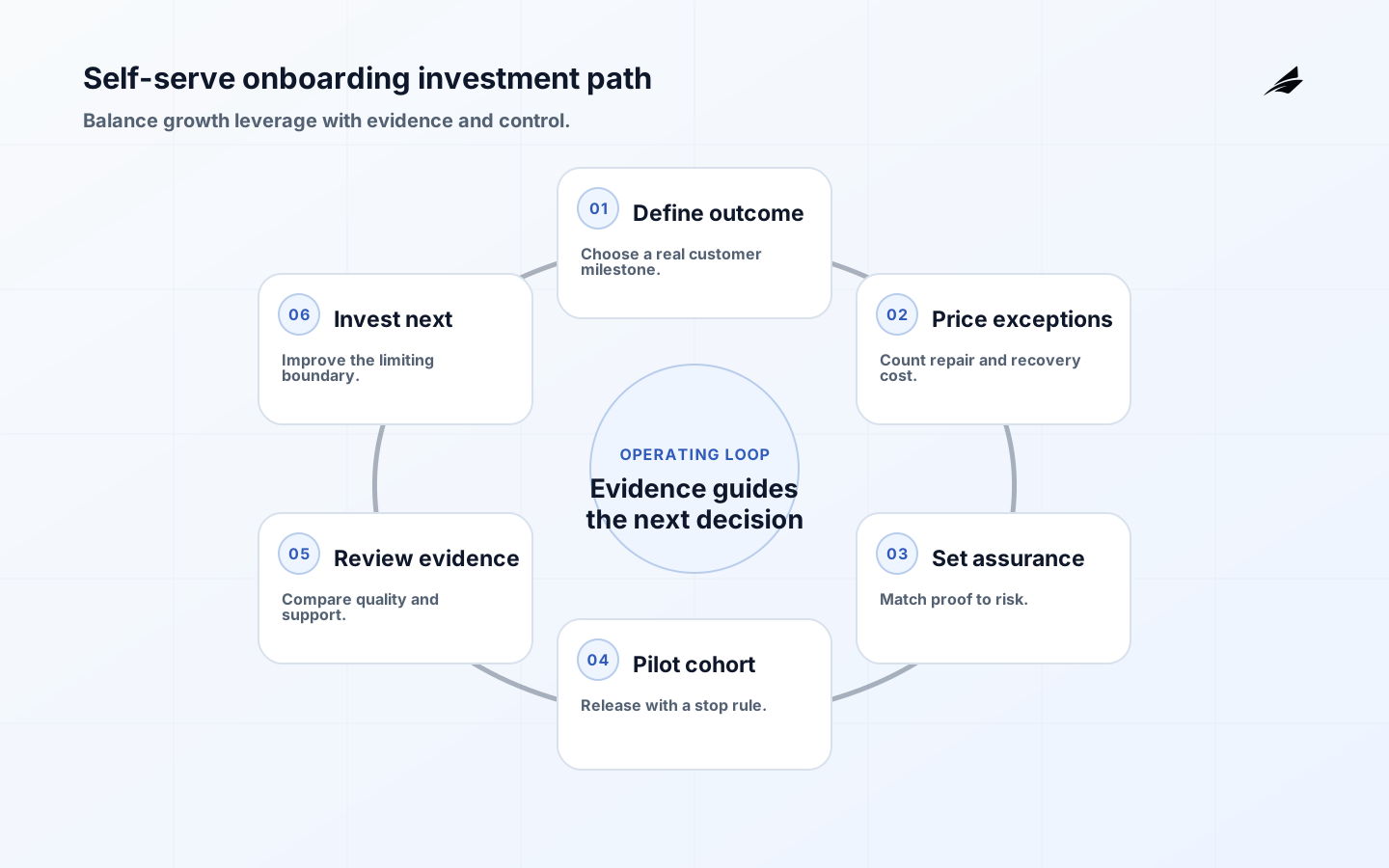
Self-serve onboarding is often described as a growth feature, but a buyer or CTO should evaluate it as a production operating capability. It changes how the company establishes identity, creates customer boundaries, grants access, teaches the product, collects commercial signals, and handles exceptions. The promise is leverage: more customers can reach value without a meeting. The risk is silent scale: a small ambiguity in tenant ownership or entitlement can become thousands of inconsistent accounts. The investment decision should therefore balance conversion with control, support load, recoverability, and the quality of the customer state created.
Pair this guide with the SaaS MVP delivery plan, in-app guidance planning guide, and feature-flag security review. Together they show how onboarding decisions interact with product scope, guidance, release controls, and trial behavior.
Define the business outcome before the funnel
Choose the event that proves a customer has received useful value. It might be a team completing a workflow, an integration producing a trustworthy result, or an administrator configuring a repeatable process. Then identify the account and tenant conditions required for that outcome. A signup rate is useful only when it leads to a correct, supportable customer state. Write down what is included in self-serve, what requires review, and what is deliberately out of scope for the first version. This prevents a conversion target from quietly becoming permission to skip essential evidence.

| Decision | Growth question | Control question |
|---|---|---|
| Audience | Who can discover and start without help? | Which identities and domains need review? |
| Activation | What real outcome should occur? | What data and actions are needed to reach it? |
| Commercial | When can a plan or trial begin? | Which billing state is authoritative? |
| Exception | Which cases should still feel fast? | Who owns the decision and its expiry? |
Compare leverage with the cost of exceptions
Estimate more than engineering build time. Include identity-provider integrations, accessible UX, security review, event instrumentation, support tooling, billing reconciliation, abuse prevention, data retention, and the cost of correcting incorrectly provisioned customers. An automated path that converts ten more accounts but creates a high-severity repair for one of them may be a poor trade. Conversely, a narrow verification step can be worth its friction if it prevents expensive rework. Use a cohort model and identify which assumptions are reversible. The highest-value early investment is often not more screens; it is clearer state and evidence.
Use risk-based identity and access gates
NIST’s identity guidance separates proofing, authentication, and federation assurance. Apply that separation to the buying decision. A low-risk trial may need a verified contact and ordinary authentication; access to sensitive customer data, bulk export, or administrative control may require stronger assurance. Do not let a verified email stand in for organizational ownership, and do not let a browser callback establish broad tenant authority by itself. Account recovery, email change, and invitation acceptance deserve the same design attention as signup because they can become alternate entry paths.
- Set the minimum evidence for starting, activating, and expanding an account.
- Keep tenant ownership and user identity as separate concepts.
- Make recovery no weaker than the authentication path it replaces.
- Use server-derived context for tenant and entitlement decisions.
- Document which exceptions may be granted and who must review them.
Evaluate the experience as an operating surface
The buyer journey includes forms, email, redirects, invitations, imports, billing, guidance, and support. WCAG 2. 2 gives concrete tests for focus, input assistance, target size, consistent help, and accessible authentication; those are not polish items when a blocked user cannot finish setup. Ask whether the system preserves progress, explains pending work, and offers a bounded recovery. Review the language for unknown accounts and failed verification so it does not disclose unnecessary information. A good experience reduces unsafe improvisation because the next action is clear to both the customer and the operator.
| Investment option | Best fit | Main risk |
|---|---|---|
| Lightweight signup | Low-risk product with simple workspace state. | Weak identity and poor activation evidence. |
| Guided setup | Product needs configuration before value. | More friction and more state to support. |
| Assisted exception | High-value or high-risk accounts. | Manual work becomes the default if scope is vague. |
| Federated onboarding | Organizations need managed identity. | Provider, redirect, and membership assumptions drift. |
Demand a durable state model
A buyer should be able to see the state model, not just a funnel chart. Ask how account, tenant, membership, provisioning, billing, and activation states are stored and reconciled. Every asynchronous action should tolerate duplicate delivery and late completion. Every access decision should check current state, not only an old token claim. A durable model makes a product easier to scale because new channels and integrations can subscribe to explicit transitions instead of scraping UI behavior. It also makes support safer: an operator can inspect the truth and repair one state without issuing a broad manual grant.
Pilot with a cohort and an exit rule
Choose a segment with stable ownership and a measurable baseline. Define entry criteria, the observation window, stop conditions, and the exact return path before enabling the new flow. Compare time to first outcome, completion quality, manual repair, security denials, billing mismatch, and support contact. Test provider delays, browser interruption, duplicate invitations, tenant collisions, and a user whose role changes mid-setup. Expand only when the evidence supports the original hypothesis. A rollout that cannot be paused without losing customer state is not ready for broad adoption.
Choose measures that protect the business
Protect a balanced scorecard: activation time, activation quality, account-to-tenant correctness, support intervention, recovery completion, fraud or abuse signals, and commercial reconciliation. Segment by route and customer shape only when the result changes an investment choice. Monitor the percentage of accounts in pending or recovery-required states and the age of the oldest one. Pair growth measures with user-impact and safety measures so the team cannot call a broken entitlement path a successful conversion improvement. Review metrics after major changes to plan design, identity providers, or product workflow.
- Trace a new account from signup through first value and a later return visit.
- Interrupt each external callback and inspect the durable state.
- Test an account that belongs to two potential organizations.
- Revoke access while a setup job is still pending.
- Review every manual repair for a candidate product or policy improvement.
A practical investment review should end with named acceptance evidence. Ask the team to demonstrate a new account that completes the intended workflow, an account that pauses at a required verification step, an account whose provider callback is delayed, and an account that needs human review. Inspect the resulting tenant, membership, entitlement, event trail, and support view. This small set reveals whether the proposed experience is genuinely self-serve or merely moves hidden assembly work to an internal queue. It also gives leadership a baseline for deciding whether the next investment belongs in acquisition, onboarding guidance, identity assurance, or recovery tooling.
The most useful executive artifact is a one-page decision record that states the customer outcome, the automated boundary, the evidence required before access, the manual handoff, and the measures that will decide the next investment. Include the cost of a false positive and a false negative. That framing keeps a self-serve onboarding program honest: it can be fast where uncertainty is low and deliberate where the consequence of a wrong decision is high. Review the record after the first meaningful cohort rather than treating the original assumptions as permanent.
Key takeaways for buyers and CTOs for Self-Serve Onboarding
- Treat self-serve onboarding as production infrastructure with a customer outcome.
- Price the exception and recovery model alongside the conversion opportunity.
- Use risk-based identity assurance and separate entry from entitlement.
- Require durable state, idempotent automation, and a visible human handoff.
- Approve expansion only when cohort evidence protects both growth and correctness.
Self-serve onboarding buyer FAQ
The investment case becomes clearer when a team can describe the customer outcome, the control boundary, and the evidence it will review after launch.
What should a buyer ask about self-serve onboarding?
Ask which steps are automated, what evidence they create, how tenant scope is enforced, and how a customer recovers from a partial or failed setup. Ask to see the state and audit record, not only the funnel.
When is self-serve the wrong default?
It is the wrong default when identity, data sensitivity, contractual obligations, or implementation complexity require an accountable human decision before access. Keep the handoff narrow and time-bound.
What KPI should a CTO protect?
Protect time to a real first outcome together with workspace correctness, support intervention, and security or billing exceptions. Conversion without correctness is a misleading KPI.
How can onboarding scale without losing control?
Use explicit states, risk-based gates, idempotent automation, cohort rollout, and an operational owner for exceptions. Scale the evidence and recovery path as the signup volume grows.
A buyer and CTO review should end with a bounded rollout decision. Name the journey that self-serve onboarding must make reliable, then list the identity, entitlement, help, and support signals that prove it is working. A small team can launch with a narrow account path, a clear handoff to people, and a rollback for confusing or unsafe states. The buyer needs evidence that the experience reduces avoidable work; the CTO needs evidence that it can be observed, changed, and recovered without hidden coupling. Treat those as one decision record, with an owner and a review date.
Conclusion: invest in controlled momentum
Self-serve onboarding is worth investing in when it creates a faster route to a correct customer outcome, not merely a faster route to an account record. Buyers and CTOs should ask where evidence is established, where authority is granted, how failures are reconciled, and who owns the exceptions. Build or buy the smallest capability that answers those questions, pilot it with a bounded cohort, and let the resulting operational evidence guide the next step.
For self-serve onboarding, review the buyer and cto guide evidence during normal handling. Give self-serve onboarding a named owner and a review date for and cto guide.
A durable operating note for self-serve onboarding records the assumptions that made the decision safe: the authoritative source, effective time, permitted actor, protected resource, and recovery route. Keep customer language aligned with the recorded state for self-serve onboarding.
For self-serve onboarding, a good handoff ends with observable evidence rather than a verbal promise.
The smallest useful improvement to self-serve onboarding is often a sharper boundary, not another feature.
For Self-Serve Onboarding, NIST SP 800-63-4: Digital Identity Guidelines defines scope; OWASP Authentication Cheat Sheet supports the control; OWASP Email Validation and Verification in Identity Systems clarifies evidence; Web Content Accessibility Guidelines (WCAG) 2. 2 guides recovery; RFC 9700: Best Current Practice for OAuth 2 0 Security frames review; Product Analytics onboarding view supports measurement. Measure self-serve onboarding outcomes alongside correction effort.
For self-serve onboarding, review the buyer and cto guide control during a reconciliation pass. For self-serve onboarding, review the buyer and cto guide scope during normal handling.
For self-serve onboarding, review the buyer and cto guide ownership during a reconciliation pass. For self-serve onboarding, review the buyer and cto guide control during normal handling.
For self-serve onboarding, review the buyer and cto guide recovery during normal handling. For self-serve onboarding, review the buyer and cto guide recovery during a reconciliation pass.
Evidence for “Self-Serve Onboarding: Buyer and CTO Guide to Controlled Growth” is grounded in NIST SP 800-63-4: Digital Identity Guidelines, OWASP Authentication Cheat Sheet, OWASP Email Validation and Verification in Identity Systems, Web Content Accessibility Guidelines (WCAG) 2.2, RFC 9700: Best Current Practice for OAuth 2.0 Security, Product Analytics onboarding view; each source informs a specific decision, test, or operating trade-off described in this guide.