A Field Guide to Self-Serve Onboarding for Growing Teams
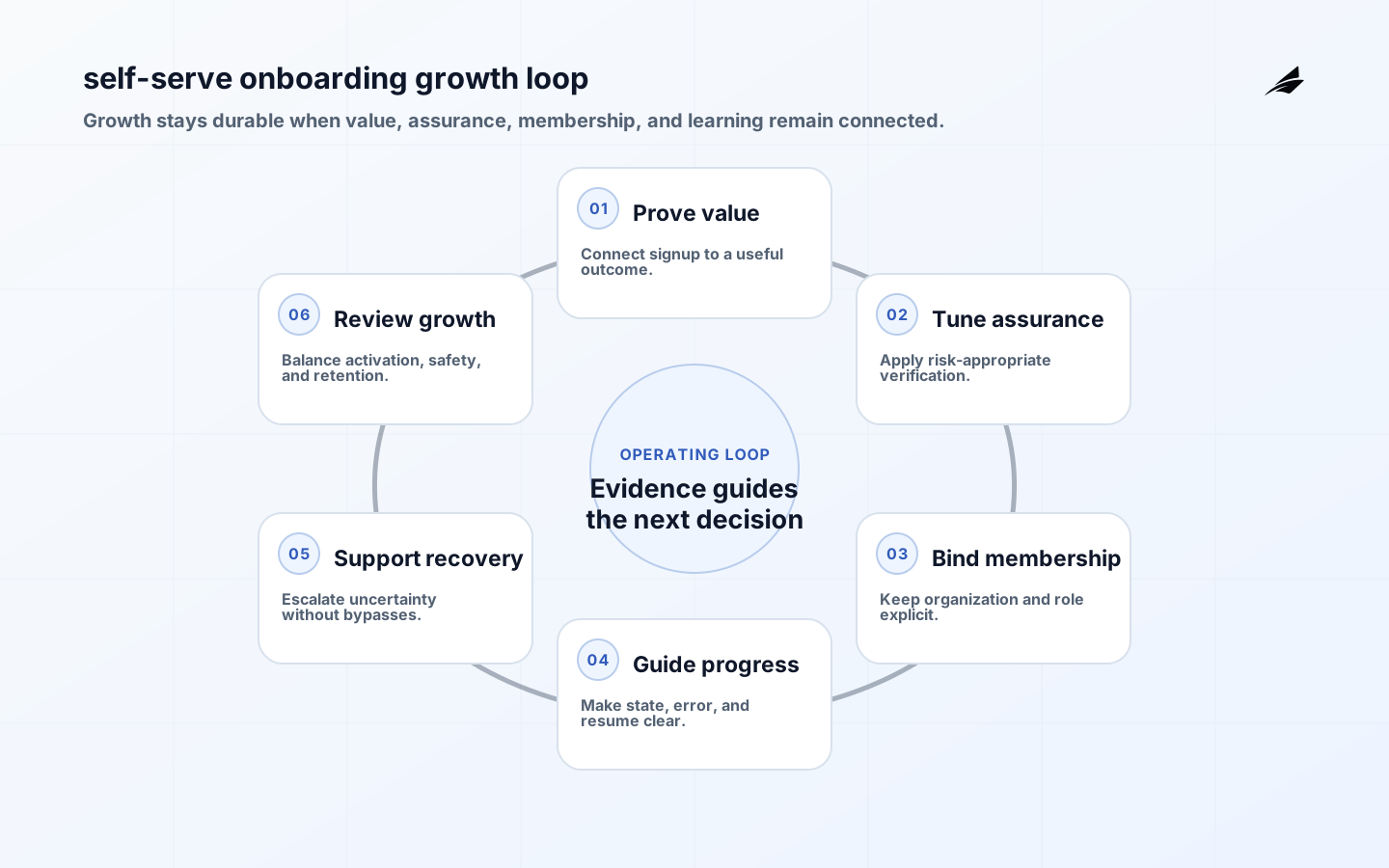
For a growing team, self-serve onboarding is both a product experience and a trust system. It should help the right user reach a meaningful first outcome without requiring a meeting, while still protecting identity, organization boundaries, sensitive data, and high-consequence actions. The practical challenge is that a flow that worked for the first hundred users may become ambiguous at ten thousand: more identity methods, more invitations, more support cases, more abuse, and more ways to leave half-created state behind. Use this field guide to keep value, authority, accessibility, recovery, and measurement connected. NIST’s Digital Identity Guidelines Revision 4 provides a useful basis for choosing assurance and authentication behavior proportionate to risk.
Define the first outcome and the durable habit
Signup is a milestone, not the outcome. Name the first action that proves the product has become useful, then the repeated behavior that makes the account worth keeping. For a planning product, that may be creating a workspace and completing a shared plan; for an analytics product, it may be connecting a source and answering one question. Link to self-serve onboarding decisions before the first build when revisiting the initial boundary. Measure where users reach value and what prevents them from returning. Do not optimize a completion event that has no relationship to a trusted product outcome.
| Stage | User needs | Team must watch |
|---|---|---|
| Start | Clear promise and low-risk first step. | Abuse, duplicate accounts, and unclear value. |
| Verify | Understand why and what happens next. | Expiry, enumeration, and recovery failure. |
| Set up | Guided path with resumable state. | Partial state, wrong scope, and validation errors. |
| Collaborate | Safe invitation and role clarity. | Forwarded links and excess authority. |
| Return | Evidence of value and next useful action. | Activation quality and support burden. |
Tune assurance to the product risk
A growing team should avoid both extremes: asking every trial user for high-friction proof, or treating a verified email as enough for every capability. Use NIST’s identity guidance to distinguish proofing, authentication, federation, and risk. Make lower-risk exploration available when appropriate, then require stronger assurance before exports, sensitive data, team administration, or consequential actions. Expire verification tokens, rate-limit attempts, prevent account enumeration, and make recovery usable without weakening the identity boundary. Keep a named owner for exceptions so support does not invent an unofficial assurance process in chat.
Keep organization membership explicit
Separate the account from the organization and the organization from its memberships. The first user may create a workspace, but that does not mean every future identity method should inherit ownership. Invitations should name organization, role, expiry, and intended recipient; acceptance should verify the identity and prevent cross-tenant confusion. If a user belongs to multiple organizations, make the active scope visible and require the server to enforce it for every resource. Test forwarded invitations, reused tokens, removed members, domain changes, duplicate organization names, and a user switching organizations during a pending setup step.
Separate login, membership, and capability
The user can authenticate and still lack permission to create a project, invite a teammate, or export data. OAuth 2.0 helps describe delegated access and token scopes, but the product must enforce membership, resource, action, and state checks on the server. Keep client-side onboarding state as a guide, not as authority. When an identity provider returns claims, map them to a controlled organization and role policy. If the team adds a new capability, define its default state for new and existing members, its approval needs, and how it is removed.
| Control | Good default | Failure to rehearse |
|---|---|---|
| Invitation | Scoped, expiring, visible role and organization. | Forwarded or reused token. |
| Workspace creation | Idempotent, owned, and resumable. | Double click or browser refresh. |
| Recovery | Clear, rate-limited, risk-aware path. | Lost factor and changed email. |
| Capability unlock | Explicit policy and server check. | Client state or stale membership. |
| Human handoff | Named team and bounded escalation. | Stuck high-risk user. |
Make every state understandable
Users should not need support to decode whether they are unverified, pending approval, invited, active, or blocked. Use meaningful headings, plain language, field-level errors, visible focus, and a stable resume path. WCAG 2.2 includes requirements for labels, keyboard access, contrast, focus, timing, reauthentication, and error identification that apply directly to onboarding. Tell the user whether the service accepted the action, whether an email was sent, whether a background setup is still running, and what they can safely do next. Preserve entered data when a non-sensitive validation error occurs, but never retain secrets in an unsafe draft.
Use less data and validate it consistently
Growing teams often add fields to support future segmentation, sales, or reporting. Treat each new field as a product and privacy decision: purpose, visibility, retention, correction, and deletion. OWASP’s Input Validation Cheat Sheet supports allowlisting, normalization, and context-aware validation. OWASP ASVS helps organize tests for session, access, input, error, and data behavior. Validate at the server, return safe errors, and do not use a display name or organization string as an authorization key. Make the data model support correction without silently changing the historical identity of an account or organization.
Example: grow a team workspace flow
A small team product begins with one verified user creating a workspace and completing a sample task. The owner can invite two teammates with a scoped role, but the product does not expose exports or billing changes until the organization passes an additional check. Setup state is durable: a browser refresh returns the user to the right step, and a failed background import shows pending rather than pretending success. If an invite is forwarded, the recipient sees the target organization and must satisfy the membership rule. Support receives a bounded escalation with the account, organization, state, and reason, not a request to bypass controls. The team measures first task completion, invite acceptance, recovery, and support handoff.
Measure growth without rewarding unsafe shortcuts
Track time to first value, completion and abandonment by step, verification success, invitation acceptance, setup errors, recovery outcomes, capability unlocks, support handoffs, and retention after the first useful action. Watch for leading indicators of abuse: repeated attempts, unusual invitation volume, disposable identity patterns, and rapid switching across organizations. Segment only when the use is justified and the result can improve the experience or safety. If conversion rises after removing a check, compare downstream fraud, wrong-tenant incidents, support effort, and customer trust. A durable onboarding improvement increases trustworthy activation, not just the number of accounts created.
Create a maturity path for the team
Start with one identity method, one organization model, one first-value outcome, and one recovery route. Add federation, multiple roles, imports, billing, or higher assurance only after the earlier path has reliable evidence. Every expansion needs an owner, threat and failure review, acceptance tests, metrics, support guidance, and a disable or rollback plan. Review exceptions monthly: repeated manual approvals may indicate a missing product state, while repeated verification failures may indicate unclear copy or an over-demanding requirement. Keep the flow understandable as the number of capabilities grows.

Key takeaways
- First value, repeated product use, and a trustworthy activation measure.
- Risk-appropriate identity assurance, verification, recovery, and exceptions.
- Explicit account, organization, membership, invitation, and capability boundaries.
- Accessible, resumable states with clear errors, timing, and next actions.
- Minimal, validated data with purpose, visibility, retention, and correction.
- A staged maturity path that adds complexity only with evidence and ownership.
Frequently asked questions
What is the most valuable onboarding metric?
Usually a trustworthy first-value outcome tied to the product’s promise, such as completing a meaningful task. Pair it with safety and quality measures so the team cannot improve the number by removing necessary checks.
When should a flow hand off to a person?
Use a human handoff when the risk, identity uncertainty, organization claim, or recovery case exceeds the self-serve contract. Make the handoff bounded, visible, owned, and recorded rather than an informal bypass.
A practical operating rhythm for onboarding growth
For each onboarding change, keep a compact record of the target cohort, first-value hypothesis, identity and membership assumptions, capability gates, accessibility checks, recovery path, metrics, and owner. This lets a growing team distinguish a copy experiment from a change to authority. Review the record with product, engineering, support, security, and data owners when the change affects more than one boundary. Link to self-serve onboarding decisions to keep the original decision visible, and to product onboarding systems when the flow expands beyond activation into adoption and retention.
Create a small set of reusable journey tests. Start with a new user, an invited teammate, a user who belongs to two organizations, a user with an expired verification token, a recovered account, and a user who reaches a higher-risk capability. Test refresh, back button, duplicate click, slow network, email delay, identity-provider error, and session timeout. Verify that each path ends in a durable state and that no client-side transition grants authority by itself. These tests become more valuable as the team adds federation, imports, billing, and role-based collaboration.
Keep the human handoff as coherent as the self-serve path. State the reason for escalation, the scope a support agent may inspect, the evidence that must be collected, the response target, and the condition for returning the user to self-serve. Do not ask users to send passwords, recovery codes, or unnecessary identity documents through informal channels. If a team member changes an organization owner or restores access, record the decision, the approval, and the resulting membership state. A controlled handoff protects both the user who is stuck and the team member trying to help.
Use growth data to improve the product contract, not only the funnel. When users abandon after an invitation, inspect role wording, organization context, and the intended value of collaboration. When recovery fails, inspect assurance, contact-change policy, and support ownership. When a cohort activates quickly but later asks for manual corrections, the first-value event may be too weak or too easy to reach. Review security and support signals beside conversion and retention. The team should be able to explain why a change improved the user journey and why it did not weaken a boundary.
As the product grows, document the moments when the onboarding contract changes: adding a new identity provider, allowing multiple organizations, introducing billing, enabling imports, or raising the assurance required for a capability. Each change can affect recovery, data visibility, invitations, and support. Use product onboarding systems to keep the lifecycle coherent, and admin console design to review what staff will need to manage. Re-run representative journeys after each change, including a user who is midway through setup and a user whose membership has changed. This protects existing users from being stranded by a flow that was optimized only for new accounts.
Conclusion: grow the path without losing the boundary
Self-serve onboarding can scale a product’s reach when it scales trust as well as convenience. Keep first value, identity, membership, authority, accessibility, recovery, and measurement in one operating model. Add complexity in stages, learn from exceptions, and let evidence decide when the next capability is ready.