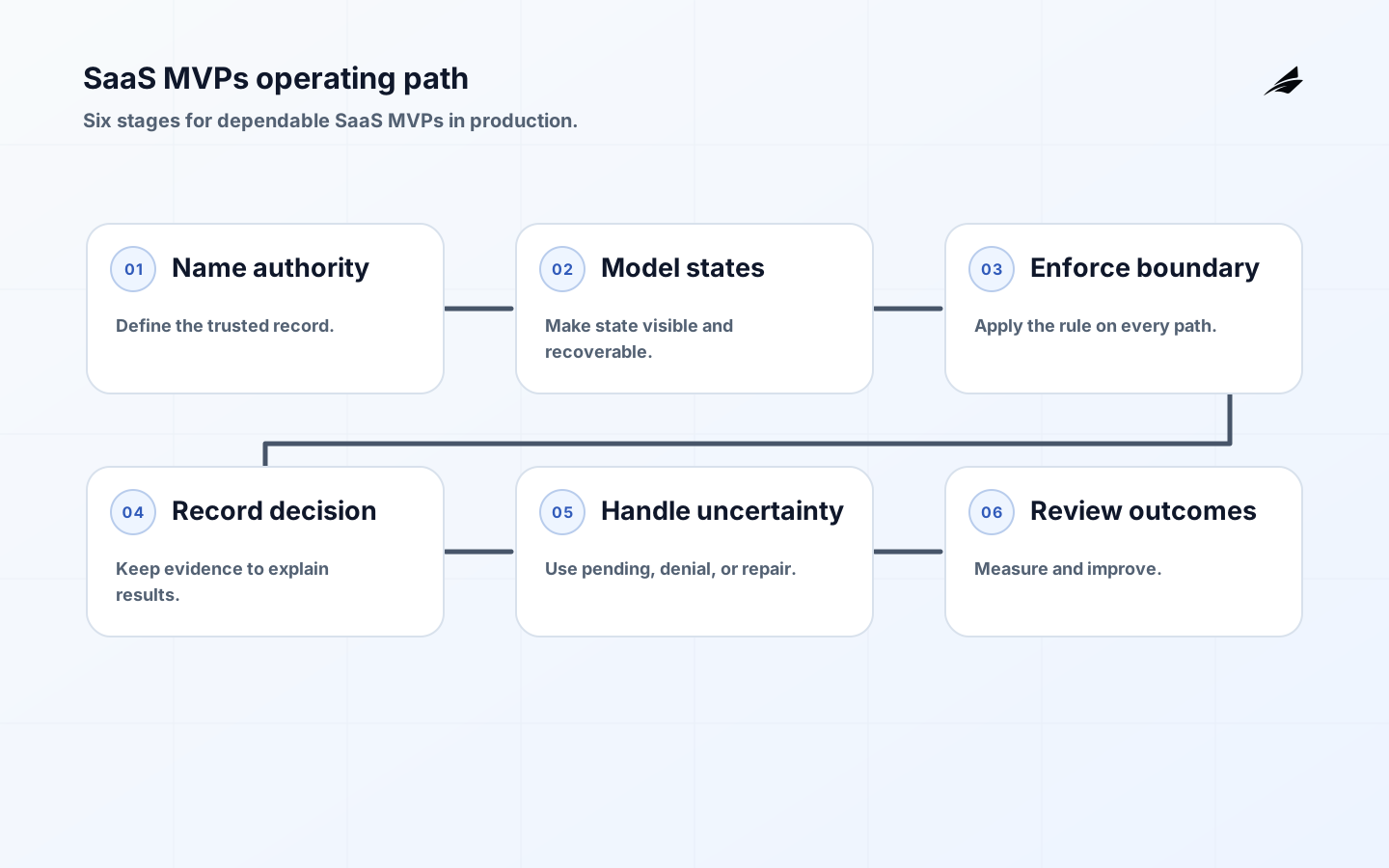
The first build of a SaaS MVP is shaped by decisions made before code exists. Teams often begin with screens and a feature list, then discover that the customer, workspace, permission model, data boundary, support promise, and success signal were never agreed. That uncertainty becomes expensive once real users depend on the product. A useful pre-build decision set is small enough to discuss quickly but concrete enough to guide the first architecture, workflow, and release.
Key takeaways
- Choose one customer problem and one repeatable workflow that the first product must make better.
- Decide what a user, workspace, role, and record mean before designing screens around them.
- Set the smallest safe data, billing, support, and deployment boundaries that can serve the first users.
- Name the authority for every important change and make correction possible without hidden database edits.
- Define evidence for learning so the team can distinguish product value from accidental activity.
Choose the problem and the first promise
Describe the customer in a situation, not only as a market label. Who is trying to do what, what makes the current approach costly or unreliable, and what observable result would make the product worth returning to? A first release should have one primary workflow with a clear beginning, middle, and outcome. Supporting features are justified when they unblock that workflow, protect its data, or make its result understandable.
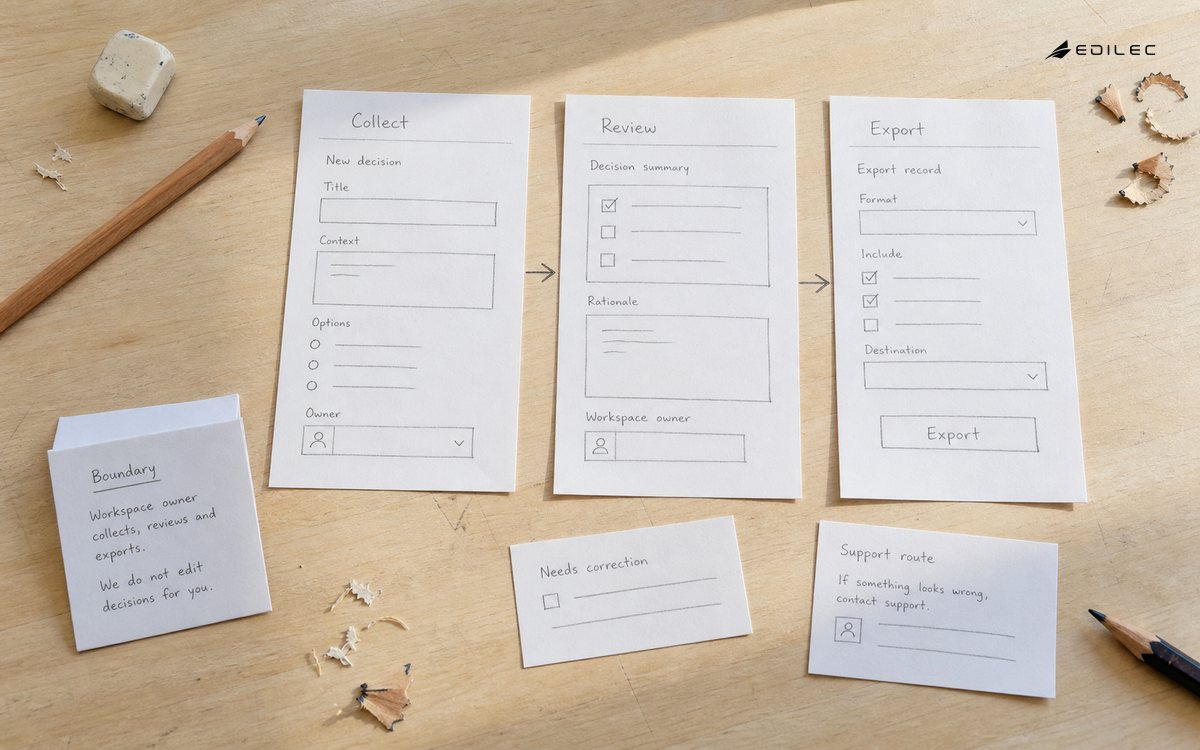
Write the promise in operational terms. “Help teams collaborate” is too broad to guide a build; “let a workspace owner collect, review, and export a decision record” gives the team something to model. Identify what the product will not do yet. A narrow boundary makes it easier to choose defaults, explain limitations, and learn from the right customer behavior without pretending that every adjacent problem is solved.
| Decision | Question to answer | Result for the first build |
|---|---|---|
| Primary user | Who performs the core workflow most often? | A named role with a concrete job. |
| Core outcome | What durable result proves the task worked? | A record, export, decision, or completed handoff. |
| Boundary | What related work is deliberately out of scope? | A smaller surface the team can support. |
| Learning signal | What behavior indicates repeat value? | A measurable return to the core workflow. |
Decide tenancy, identity, and ownership
Choose whether the first product serves individuals, teams, or both. If a team can exist, model the workspace and membership relationship early even if the first interface has one owner. Decide whether a person may belong to several workspaces, who creates the first workspace, how an invitation works, and what happens when the owner leaves. These choices affect every record query and every support conversation.
Authentication proves an identity; it does not decide access. The OWASP Authorization Cheat Sheet is a useful reference for keeping those concerns distinct. Write down the subject, resource, action, and scope for the core mutations. If the answer is not known, choose a safe default and an explicit route for a human correction. Avoid relying on a hidden administrator role that has no defined limits.
Set the data and state model before screens
List the minimum durable entities needed for the first promise and the relationships that protect their meaning. Give records stable identifiers, an owner or workspace scope, creation source, timestamps, and a lifecycle. Decide which changes are edits, which are new versions, and which need a history that explains who changed what. A screen that can overwrite a decision without preserving who changed it will be difficult to support even when the database is small.
Model unfinished work explicitly. A file import, report generation, invitation, or external sync may be accepted before it completes. Use states that let the customer resume or understand the operation. Make retries idempotent and decide what happens after a timeout. The goal is not a large framework; it is enough durable state to avoid guessing whether a side effect happened.
| Data question | Decision to make | Why it matters now |
|---|---|---|
| Scope | Which workspace or person owns each record? | Prevents accidental cross-customer access. |
| Lifecycle | What states can the record occupy? | Makes incomplete work and recovery visible. |
| History | Which changes need an explanation later? | Supports trust, support, and correction. |
| Retention | What is kept, for how long, and why? | Avoids collecting data without a product need. |
Choose the smallest architecture that preserves options
An MVP does not need every service separated, but it does need clear ownership of decisions. A small application can keep the request path, database, and worker in one deployable unit while still separating authorization checks, state transitions, and side effects in code. Choose boundaries where a failure or change would otherwise be hard to reason about. Keep external provider references and operation IDs so a later integration does not require reconstructing history from logs.
Select dependencies with operations in mind: backups, migrations, credential rotation, rate limits, failure behavior, and local testing. Avoid a service simply because it is fashionable. Conversely, do not hide an essential queue, file store, or payment provider behind an assumption that it is always available. The NIST SP 800-218 Secure Software Development Framework is a useful reminder to include security and maintenance practices from the start of the development lifecycle.
Decide how the first team will operate it
Name who handles a failed import, a locked account, a disputed result, a data deletion request, and a billing question. Give that person enough visibility to inspect current state and enough authority to take a narrow, recorded action. A support promise is part of the product boundary; if the team cannot explain how a customer gets unstuck, the workflow is not ready for dependence.
Define the minimum operational signals before launch: successful completion of the core task, failed or pending operations, unauthorized attempts, data integrity checks, and support corrections. The OpenTelemetry documentation can provide a practical starting point for traces, metrics, and logs. The OWASP Logging Cheat Sheet is useful when deciding what to record and what sensitive values to exclude.
Set commercial and access boundaries
Decide whether the first users are free, invited, trialing, paid, or handled through a manual agreement. Even when billing is postponed, specify which capabilities are available and what event changes them. Keep commercial state separate from authorization and product data. If a payment provider will be added later, choose stable account and workspace identifiers now so the eventual mapping is explicit rather than inferred from an email address.
Write the answer for cancellation, failed payment, refund, and owner departure before they occur. A small product can offer a manual route, but the route should have an owner, a reason, and a record. This is less about predicting every edge case than about avoiding a hidden promise that the first support request will expose.
Choose a learning-focused first release
Release to customers whose problem matches the chosen promise and whose account shape the team can support. Define what evidence would confirm usefulness, what evidence would show confusion, and what signal should pause the rollout. Review individual journeys as well as counts. A high number of created accounts means little if users do not reach the durable outcome or require repeated manual rescue.
Make rollback and repair part of the release conversation. A flag can stop new exposure, but it may not undo records already created or messages already sent. Decide how to migrate or correct those records forward. Keep a short list of known limitations and make them visible to support so early customers receive a precise answer rather than a promise the product cannot yet keep.
Challenge the decisions before coding
Walk through a duplicate submission, a deleted workspace, an invited user with the wrong account, a background task that finishes after the request times out, and a customer who needs to correct a record. Ask which fact is authoritative, what the customer sees, and who can repair it. Also test the negative space: what happens when the product does not know whether a dependency succeeded, when a person changes roles, or when the core workflow is unavailable during a release?
Frequently asked questions
How much architecture should an MVP have?
Enough to preserve ownership, authorization, durable state, and recovery for the core workflow. A single deployable application can meet that standard. The useful question is whether the team can change or repair a decision without guessing where its authority lives.
Which evidence matters before the first build?
Define the customer outcome, the event that proves it happened, and the failure or support signal that would challenge the assumption. That gives the first release a learning target without pretending that activity alone is value.
For delivery teams working on SaaS MVPs, this information boundary should connect customer outcomes, tenant state, entitlements, release controls, support actions, and operating cost to evidence an accountable owner can inspect. For adjacent decisions, continue with Edilec's Multi-tenant SaaS Architecture: Production Boundaries That Hold and Feature Flags in Production: Safe Release and Rollback. In this operating review, move beyond the information boundary only after the owner can show the accepted result, the exception path, and the signal for another review.
Conclusion
The best pre-build decisions are the ones that make the first release smaller and more trustworthy at the same time. Choose a precise customer promise, model ownership and state, set commercial and data boundaries, define recovery, and decide how learning will be observed. With those foundations in place, the team can move quickly without turning every early customer into an experiment in hidden assumptions.