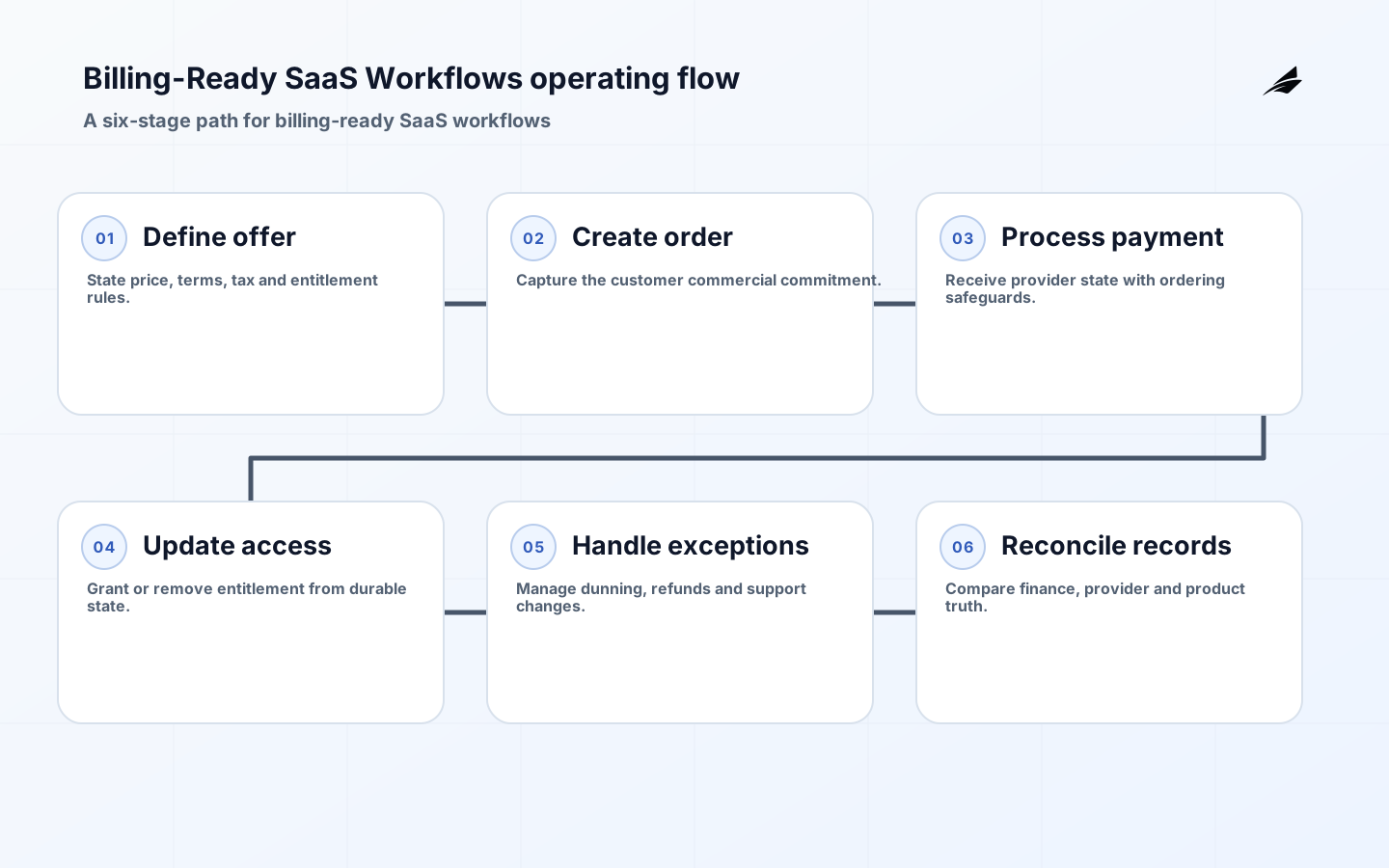
Billing-ready SaaS workflows are not a feature checklist. For IT managers, planning these workflows is a way to make commercial changes that result in correct product access and reconcilable financial records. Start with the real case: a customer starts, changes, pauses, renews, or ends a paid relationship, not the interface a team hopes to build. Follow one representative case from its trigger through its durable records, permissions, automated decisions, human handoffs, and customer-visible result. This exposes the questions that decide whether a release is operable: who owns the decision, which record is authoritative, what evidence is retained, and how a person recovers when the ordinary route fails. The guide focuses on those choices so the work can survive launch pressure instead of becoming an attractive but ambiguous workflow.
Define the billing-ready SaaS workflows operating boundary
A useful boundary starts by naming offer, order, invoice, payment state, entitlement, adjustment, and reconciliation result. Those are not merely data fields; together they explain why the system took an action and who can correct it. Write down the initiating event as a customer starts, changes, pauses, renews, or ends a paid relationship. Then test the model with a normal case, a late or duplicate event, a request from an unauthorized actor, and a case that requires support intervention. The difficult example is often the one that reveals a missing state or unclear owner. Do not delegate this work solely to an implementation ticket. Product, engineering, support, finance where relevant, and security need the same vocabulary before their work can fit together.
| Boundary question | Decision to make | Evidence before release |
|---|---|---|
| Outcome | What completed result proves value? | commercial changes that result in correct product access and reconcilable financial records |
| Authoritative record | Which data settles a disagreement? | offer, order, invoice, payment state, entitlement, adjustment, and reconciliation result |
| Decision right | Who may approve, override, or reverse? | Named role and reviewed policy |
| Failure route | What happens when the normal path breaks? | billing and product state diverge after retries, proration, refunds, or delayed provider events |
Design decisions before interfaces
Treat the workflow as a sequence of decisions, not a sequence of screens. For Billing-Ready SaaS Workflows, each transition should have a triggering fact, a permitted actor, a visible state, and a consequence that can be checked later. Put policy in one reviewable place rather than scattering it among browser conditions, background jobs, and operator memory. Where an integration participates, preserve its event identifier and ordering information; retries without idempotency can quietly produce a second grant, charge, report, or message. The design should also distinguish customer action from staff action. Support may need limited tools, but broad impersonation or unlogged edits destroy the evidence needed to resolve a dispute.

- Describe the smallest complete path from a customer starts, changes, pauses, renews, or ends a paid relationship to commercial changes that result in correct product access and reconcilable financial records.
- Give every state a plain-language definition and an accountable owner.
- Record why an override is allowed, who may apply it, and how it is reviewed.
- Keep identifiers that connect the customer view, service logs, and downstream record.
- Make failed work visible in a queue instead of silently retrying indefinitely.
- Design the recovery message so a customer or operator knows the next safe action.
Build billing-ready SaaS workflows controls into delivery
Security, accessibility, and reliability are part of the customer experience here. An authorization decision should be evaluated at the point an action is requested, with tenant or account context carried through services and jobs rather than inferred from a convenient client value. Logging should capture an actor, target, action, decision, and correlation reference without dumping sensitive payloads. For customer-facing steps, keyboard operation, labels, focus management, error identification, and understandable status changes are release criteria, not polish. Finally, exercise recovery in a non-production environment: restore the expected state after a malformed event, temporary dependency failure, revoked access, and staff correction. The resulting runbook is evidence that the design can be operated. For Billing-Ready SaaS Workflows: A Practical Guide for IT Managers, the controls must protect the particular outcome this workflow promises, rather than serve as a generic delivery checklist.
| Control area | Practical question | Release check |
|---|---|---|
| Authorization | Can a valid actor cross the intended boundary? | Negative tests cover role, tenant, object, and action |
| Integrity | Can retries or out-of-order messages duplicate work? | Idempotency and ordering cases are exercised |
| Accessibility | Can people complete and understand the workflow? | Keyboard and error paths are reviewed |
| Operations | Can the team locate and repair a failed case? | Runbook, alert owner, and audit trail are tested |
Review a real operating case
Billing-ready workflows need a realistic change sequence, not only a successful checkout. Test a delayed payment-provider event, a customer who changes plans mid-period, a payment that later fails, a refund, and a staff-approved commercial exception. For every case, specify whether access changes immediately, at a future date, or after a confirmed finance state; ambiguity here creates costly support promises. Preserve the provider event reference and the product decision that followed it, then reconcile those records on a regular schedule. Finance must be able to explain a balance without reading application code, while product support must be able to explain access without editing invoices. A shared, durable model makes both conversations possible.
Measure the outcome, not activity
Instrument the behavior that would change the next product decision. For this guide, a central measure is percentage of commercial changes reconciled without manual correction. Pair it with a quality measure such as failed transitions, support-assisted completions, policy denials, reconciliation adjustments, or time spent in an exception queue. Segment results by the customer, plan, entry route, or tenant type that matters to the decision; a blended average can hide a damaging failure for a valuable group. Review a small set of representative records alongside the dashboard. Quantitative signals say where to look, while the underlying case reveals whether the model, interface, integration, or operating procedure needs attention.
Establish a commercial-state review
Schedule a commercial-state review while the workflow is still small enough to inspect. Bring a handful of completed records, one failure or near miss, and the measure that shows whether the intended result is improving. For billing-ready SaaS workflows, examine provider events, entitlement changes, and reconciliation exceptions. Ask whether the policy was understood at the point of action, whether the durable record matches what the customer saw, and whether recovery required an undocumented workaround. The purpose is not status theater. It is to give finance, product, and support teams a regular place to resolve ambiguity before it becomes an irreversible product promise. Write down the decision, owner, and next observation so the next review begins with evidence rather than recollection.
Process provider events as durable commercial facts
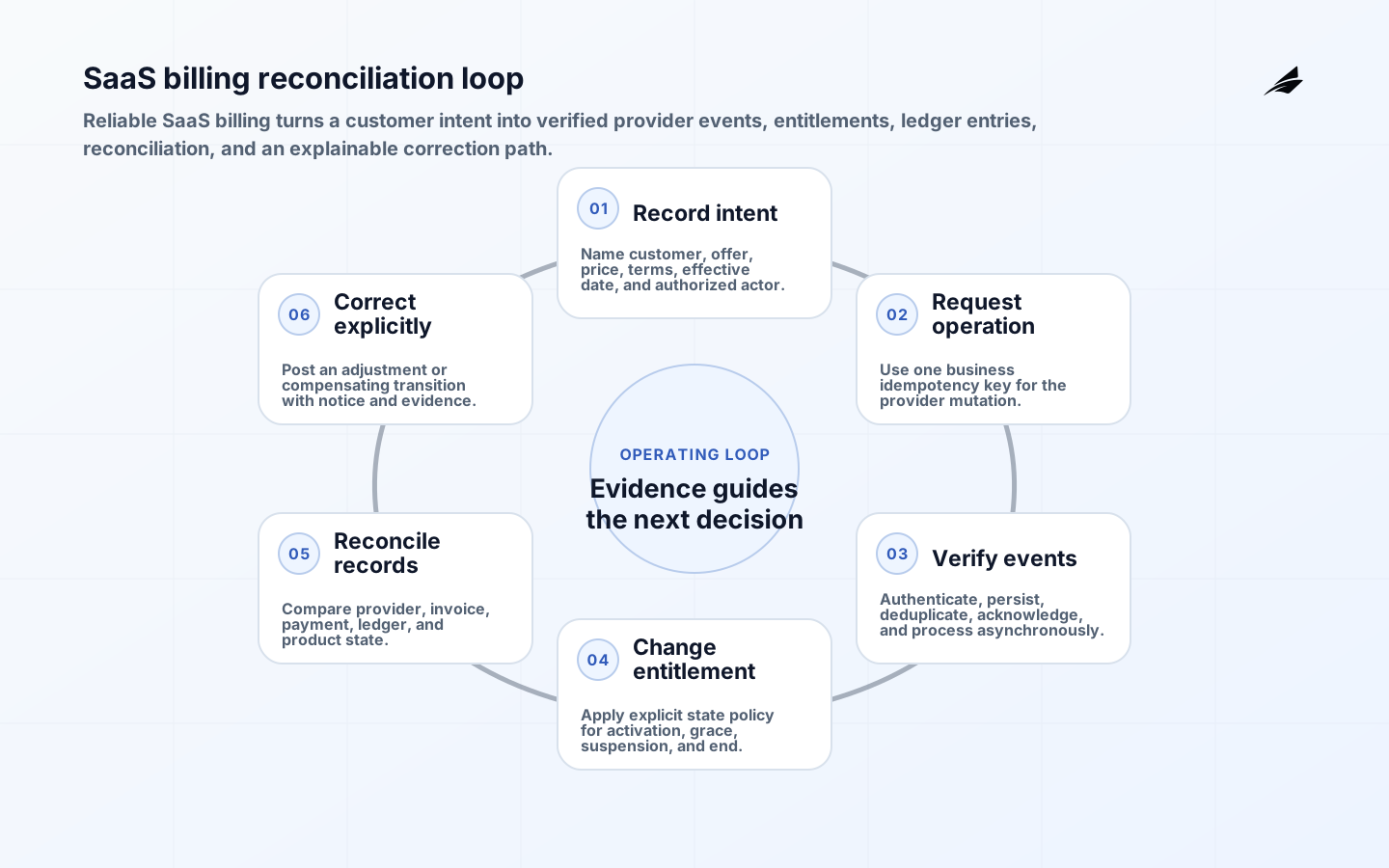
A payment-provider webhook is a notification, not the complete commercial state machine. Verify the sender, persist the event reference, acknowledge promptly, and process work asynchronously. Providers may retry delivery, and events can arrive more than once or out of the sequence a product expects. Stripe’s webhook guidance recommends signature verification and handling duplicate events; use a durable inbox with a uniqueness rule, then make each state transition idempotent. The Stripe idempotency documentation is also useful for outbound mutations. An idempotency key should represent one intended business operation, not be reused across unrelated retries.
| Commercial event | Product decision | Reconciliation question |
|---|---|---|
| Checkout completed | Create or activate the intended subscription after verified confirmation | Does the provider object map to exactly one customer and offer? |
| Payment failed | Apply the documented grace, retry, notice, and access policy | Do invoice, retry schedule, customer notice, and entitlement state agree? |
| Plan changed | Calculate effective date, proration policy, and entitlement transition | Can finance and support reproduce the charge and access history? |
| Refund or credit | Post the financial adjustment and apply the approved access rule | Is the adjustment represented without rewriting the original transaction? |
| Subscription ended | Stop renewal and transition access according to policy | Did every downstream entitlement and scheduled job reach a final state? |
Reconciliation closes the gap between provider state, invoices, cash, credits, taxes, and product access. Run it as a scheduled control rather than waiting for a support ticket. Compare external objects and events with the internal subscription, entitlement, and ledger records; classify differences by missing event, failed transition, stale projection, policy dispute, or financial adjustment. Do not let a billing screen become the only audit trail. Preserve immutable commercial events and derive current views from them where practical. When a correction is required, post an explicit adjustment or compensating transition so finance, support, and customers can understand the sequence.
Product and finance teams can deepen this model with SaaS MVP Planning: A Practical Guide for Founders, Multi-Tenant Architecture: A Practical Guide for Operations Teams, and Product Onboarding Systems: A Practical Guide for Product Leaders.
Key takeaways for billing-ready SaaS workflows
- Scope the release around one accountable outcome: commercial changes that result in correct product access and reconcilable financial records.
- Model offer, order, invoice, payment state, entitlement, adjustment, and reconciliation result before selecting screens or integrations.
- Test the failure that matters most: billing and product state diverge after retries, proration, refunds, or delayed provider events.
- Treat access, auditability, accessibility, and recovery as product requirements.
- Use percentage of commercial changes reconciled without manual correction to decide whether to expand the workflow.
Frequently asked questions
How much should the first release automate? Automate only the portion of a customer starts, changes, pauses, renews, or ends a paid relationship whose inputs, policy, and correction path are understood; route ambiguous or consequential cases to a named reviewer. Is a dashboard enough to prove progress? No. The team needs traceable records and sampled cases showing that the measured outcome is genuine. When should the scope grow? Add adjacent paths after the core route reaches commercial changes that result in correct product access and reconcilable financial records reliably and the support team can explain exceptions. What should be documented? State definitions, decision rights, integration contracts, access rules, recovery steps, and the metric review cadence. That compact operational record is more valuable than a broad promise of future capability.
Conclusion
Billing-Ready SaaS Workflows becomes dependable when the service can explain its own behavior. Define the boundary, make decisions and records explicit, build controls into the normal path, and use operating evidence to decide what changes next. That discipline gives IT managers a smaller but more useful release: one that can produce commercial changes that result in correct product access and reconcilable financial records, surface its exceptions, and improve without losing the trust of the people who depend on it.