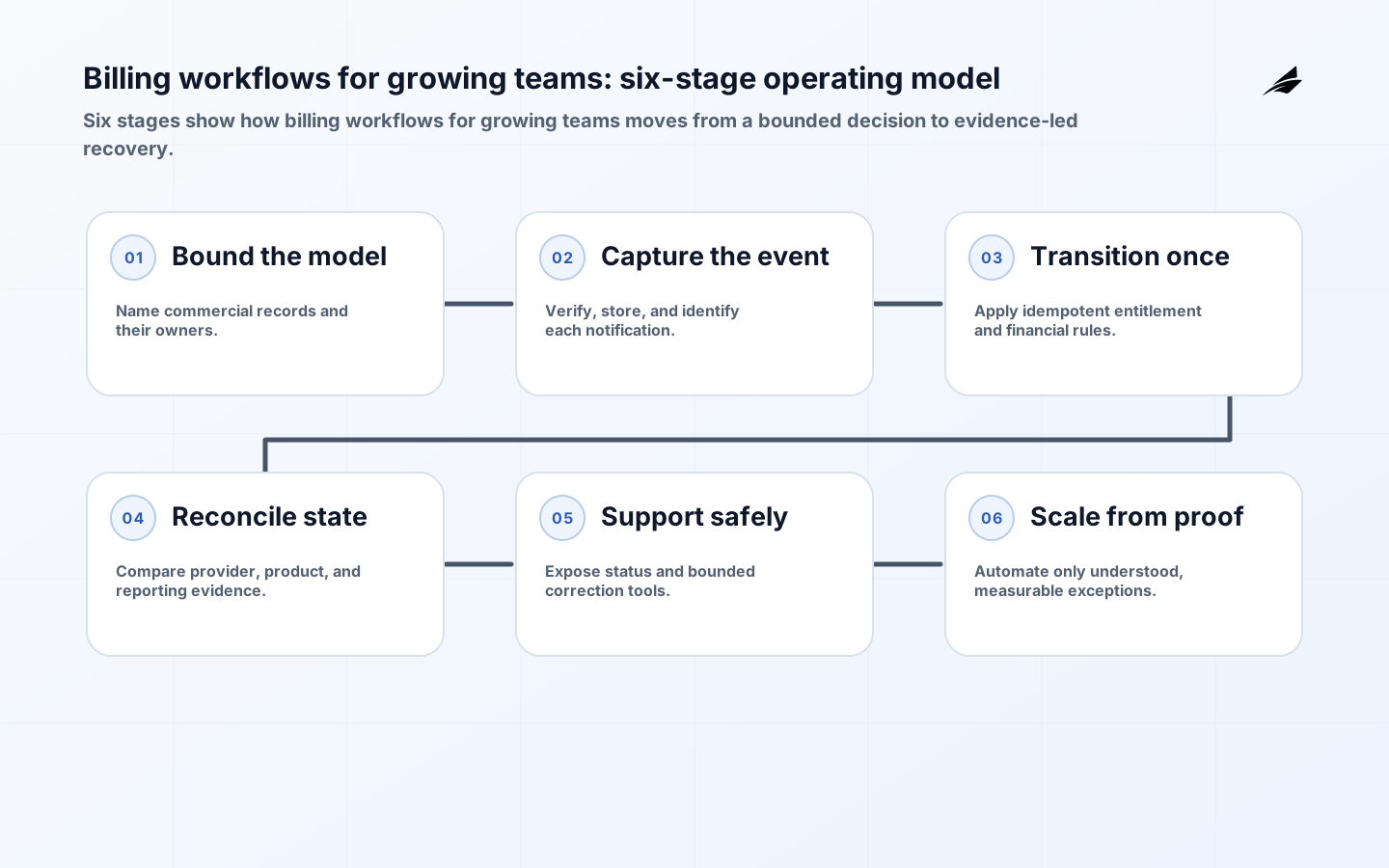
Growing teams need billing workflows that remain understandable as plans, payment methods, customer support actions, and product entitlements multiply. Billing workflows are an operating decision, not a screen-level choice. For CTOs, the question is whether a commercial event changes an invoice, subscription, entitlement, or customer-facing balance. A dependable growing-team billing design stays explainable when data arrives late, a request retries, an administrator changes a rule, or a customer asks why an outcome occurred. Stripe Subscription Webhooks and Stripe Usage-based Billing provide useful anchors: establish trusted context, check important decisions at the boundary, and retain evidence for investigation. This growing-team billing guide turns those principles into a practical design that product, engineering, operations, and support can review together.
Define the billing workflows decision before selecting tools
Write a short decision contract. For growing-team billing, name the subject, protected outcome, authority, effective time, policy version, allowed result, denied result, and behavior when a required fact is unknown. Here, the authority is verified payment-provider events and a durable internal ledger, never a browser return or mutable display field. Relevant inputs include signed provider payload, event identifier, invoice reference, customer mapping, price version, and event time. For growing-team billing, this reveals disagreements early: one group may decide for a person while another decides for a workspace, or one uses processing time while another uses source-event time. Give the growing-team billing rule an accountable owner and retain a reason code for consequential outcomes.
| Decision element | Concrete choice | Evidence to retain |
|---|---|---|
| Outcome | whether a commercial event changes an invoice, subscription, entitlement, or customer-facing balance | Subject, resource, action, and correlation identifier. |
| Authority | verified payment-provider events and a durable internal ledger, never a browser return or mutable display field | Source record, version, and effective time. |
| Uncertain input | Choose deny, pending, or review deliberately. | Reason code, owner, and next action. |
| Repair path | Use a narrow auditable correction route. | Actor, approval, original state, and result. |
Model billing workflows state, time, and ownership
For growing-team billing, make lifecycle state explicit rather than inferring it from whichever field changed last. A workable set is initiated, awaiting payment, paid, failed, disputed, refunded, and reconciled. For growing-team billing, store transition source, actor where relevant, event time, processing time, idempotency or correlation identifier, and policy version. For growing-team billing, decide ordering rules: stale facts must not overwrite newer facts, while duplicate delivery must be harmless. For growing-team billing, these details turn product language into test cases for normal flow, late input, retry, reversal, and manual intervention.
Build the billing workflows path around durable facts
Separate charging money, recording financial state, and granting product access. Accept provider events through a signed idempotent intake path; store raw delivery and processing result; then issue a domain command for the ledger or entitlement. Preserve the price, currency, tax context, and effective time that applied, rather than recalculating history from the current plan catalog.
- Create one authoritative record for whether a commercial event changes an invoice, subscription, entitlement, or customer-facing balance.
- Persist source, version, event time, processing time, and correlation context.
- Make duplicate delivery and safe retries normal behavior.
- Expose a bounded repair action rather than editing primary records by hand.
- Trace a reader-facing result back to input facts and policy version.
Put security and recovery controls at the billing workflows boundary
Use a monotonic transition rule: an old event cannot overwrite newer state and a duplicate is harmless. Reconcile provider and internal records on a schedule with an owned mismatch queue. Finance and support need a narrow correction route with approval, reason, and reference to the original record. NIST Secure Software Development Framework and OWASP Authorization Cheat Sheet are useful when turning this into acceptance criteria. For growing-team billing, the goal is a bounded, observable response to unexpected input. For growing-team billing, decide who can inspect records, who can alter a decision, which actions require approval, and how long exceptional access lasts. For growing-team billing, keep customer-facing explanations separate from sensitive diagnostics while preserving a correlation identifier for authorized investigation.
| Control | Failure it limits | Operational proof |
|---|---|---|
| Input validation and idempotency | Retries, malformed input, and replayed requests. | Rejected-input count and duplicate-safe tests. |
| Scoped authorization | An actor reaches a record or action outside the intended boundary. | Decision log with subject, target, and version. |
| Auditable repair | An urgent correction becomes an invisible permanent change. | Approval, expiry, reason, and before-and-after state. |
| Reconciliation or review | Two sources drift without notice. | Scheduled comparison and owned exception queue. |
Measure whether billing workflows remain trustworthy
Choose growing-team billing measures that reveal decision quality, not just traffic. Watch unreconciled events, duplicate-event handling, payment-to-access delay, and manual adjustment volume. For growing-team billing, pair outcome measures with evidence-quality measures: records carrying a policy version, exceptions with an owner, and the age of unresolved anomalies. For growing-team billing, build reporting around questions someone can act on, such as which changes lack verified input or which customer-visible results cannot be traced to durable facts. For growing-team billing, alerting must reach a team with authority to repair the condition.
Make tradeoffs explicit as billing workflows grows
When billing touches adjacent controls, compare feature flags for growing teams, pricing gates for growing teams, and workspace models for reliable operations. Use the comparison to keep commercial authority and support repair paths explicit.
Run a financial reconciliation review before widening scope
A scheduled financial reconciliation review keeps billing workflows connected to live operating evidence instead of assumptions made during implementation. Ask reviewers to compare provider events, ledger records, invoices, refunds, and entitlement changes for one reporting period. Use a small sample of ordinary cases and a small sample of intentionally difficult cases; the point is to test whether the growing-team billing decision contract still holds as dependencies, roles, and data volume change. Bring product, engineering, and the growing-team billing team handling exceptions to the same review. For growing-team billing, each should be able to identify input facts, policy version, customer impact, and repair path without translating between separate systems.
The review should end with an exception record linking the provider event, internal decision, correction approval, and customer communication. For growing-team billing, turn recurring findings into owned work: a missing field becomes a contract change, an unclear exception becomes a runbook improvement, and a risky manual step becomes a controlled workflow candidate. For growing-team billing, this practice matters before wider rollout, a major permission or commercial change, a migration, or a new integration. It gives billing workflows regular contact with the people who must explain and operate it, rather than waiting for a customer escalation to expose ambiguity.
Key takeaways for billing workflows
- State the decision and authority before choosing a vendor or interface.
- Persist time, version, and reason so difficult outcomes can be explained.
- Treat “a webhook is delivered twice, arrives late, or conflicts with state inferred from a checkout redirect” as a planned test case.
- Protect the boundary with scoped permissions and an auditable repair path.
- Measure unresolved anomalies and evidence quality alongside product outcomes.
Growing-team billing FAQ
For billing workflows, when is a first implementation ready? For growing-team billing, when normal and exceptional paths can be tested, observed, and repaired without guessing. What should be centralized first? For growing-team billing, centralize the authoritative decision record and audit trail; keep delivery details local where that reduces coupling. How should missing input work? For growing-team billing, choose pending, deny, or review based on customer and risk impact, then retain a reason and owner. Who owns it? For growing-team billing, product owns the intended outcome, engineering owns implementation and controls, and the repair team needs a clear escalation route.
Billing workflows for growing teams connects to billing workflows in production, billing workflows before the first build, and release notes for growing teams. Use these related guides to connect billing operations with pre-build authority decisions and release communication as the team grows.
Use a small billing model that can grow
For implementation context, compare Stripe: Using webhooks with subscriptions, Stripe: Receive events in your webhook endpoint, NIST Secure Software Development Framework (SSDF), and OWASP Authorization Cheat Sheet when choosing the boundary and its evidence.
Start with a bounded commercial model rather than an all-purpose finance platform. Name the account, customer, subscription, price, invoice, payment attempt, entitlement, credit, refund, and event. Store the provider reference beside the internal reference, and preserve state transitions rather than only the latest status. This gives the team room to add usage, trials, coupons, and multiple payment methods without losing the ability to answer why a customer was charged or granted access.
Make asynchronous billing work recoverable
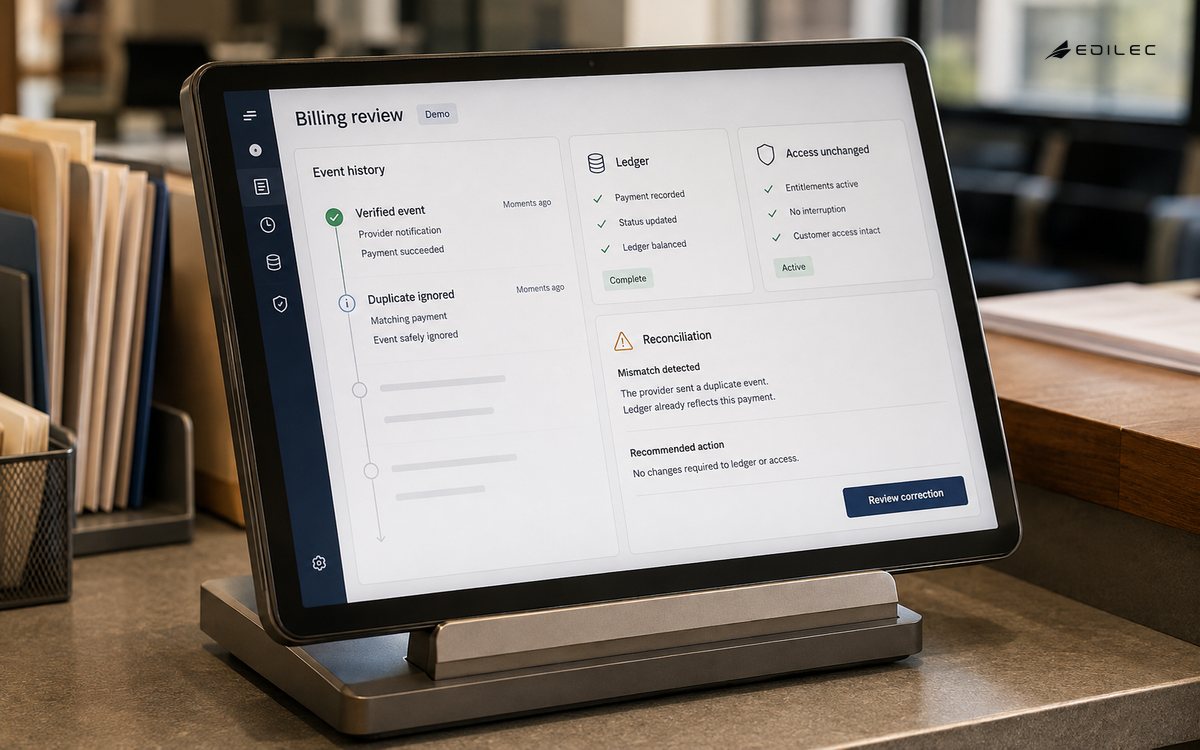
Treat webhook delivery as a reliable input that can still be duplicated, delayed, retried, or reordered. Verify the message, store it, acknowledge it safely, and process it through an idempotent transition. A reconciliation job should compare current provider objects with internal state and identify records that need a person. Avoid silently re-running a financial action because a worker timed out after the provider accepted the request.
Give support safe tools for billing exceptions
Support should be able to see event history, current state, pending reconciliation, and customer-facing explanation without editing financial rows directly. A correction tool should require a reason, show the proposed effect, apply the same policy checks as an automated path, and expire temporary access. This reduces the pressure to grant broad database access when a customer is waiting for help.
| Workflow area | Minimum capability | Scaling signal |
|---|---|---|
| Subscription lifecycle | Versioned states and effective times | Plan changes are explainable without manual archaeology |
| Payment events | Verified, deduplicated, replayable handling | Retry volume does not create duplicate outcomes |
| Entitlements | Explicit rule from commercial state to access | Support can explain why access changed |
| Reconciliation | Comparison of provider and product records | Exceptions have an owner and age |
Decide when to automate a billing exception
Automation should be earned by evidence. Use the matrix to keep high-consequence or ambiguous cases visible until the team understands their frequency and safe response.
| Exception | Automate now? | Required evidence |
|---|---|---|
| Duplicate known event | Yes, with idempotency | Stable event key and stored outcome |
| Late but current provider state | Usually, after retrieval | Object version and effective time |
| Ambiguous customer mapping | No, route to review | Candidate records and owner |
| Refund or access dispute | Only under approved policy | Actor, reason, amount or scope, and reversal path |
Growing-team billing practices to carry forward
- Start with a small, explicit model and durable state transitions.
- Make asynchronous events verifiable, idempotent, and reconcilable.
- Give support evidence and bounded tools instead of direct data-edit access.
Practice billing repairs with support
Practice duplicate and delayed events, ambiguous customer matching, partial refund, support override, and a reconciliation job that runs after a plan change. Let support explain the customer-facing state while finance and engineering verify the underlying evidence and repair path.
Growing-team billing questions
What should a small team build first? Build a clear state model, verified event intake, idempotent transitions, customer-visible status, and a reconciliation view. Add complexity only when a real decision requires it.
How should usage be recorded? Define the billable unit, source event, measurement period, correction rule, and customer-visible evidence before calculating money.
When is a manual override acceptable? When the case is understood, the actor is authorized, the reason and expiry are recorded, and the result can be reversed or reconciled.
Conclusion: build billing workflows as an operable decision system
The durable version of billing workflows is not the one with the most configuration. It is the one that can answer what happened, why it happened, who may repair it, and how the team knows it is working. Establish authority, model state changes, enforce the boundary, and keep recovery evidence close to the growing-team billing decision. That gives CTOs a system that can evolve with customers and commercial pressure without becoming opaque when it matters. Before the next expansion, inspect one ordinary result and one disputed result from billing workflows. Follow each from input through policy and recorded outcome, then confirm that an authorized colleague could explain the same path without relying on personal memory. That small exercise exposes missing evidence early and turns the operating model into routine team practice.