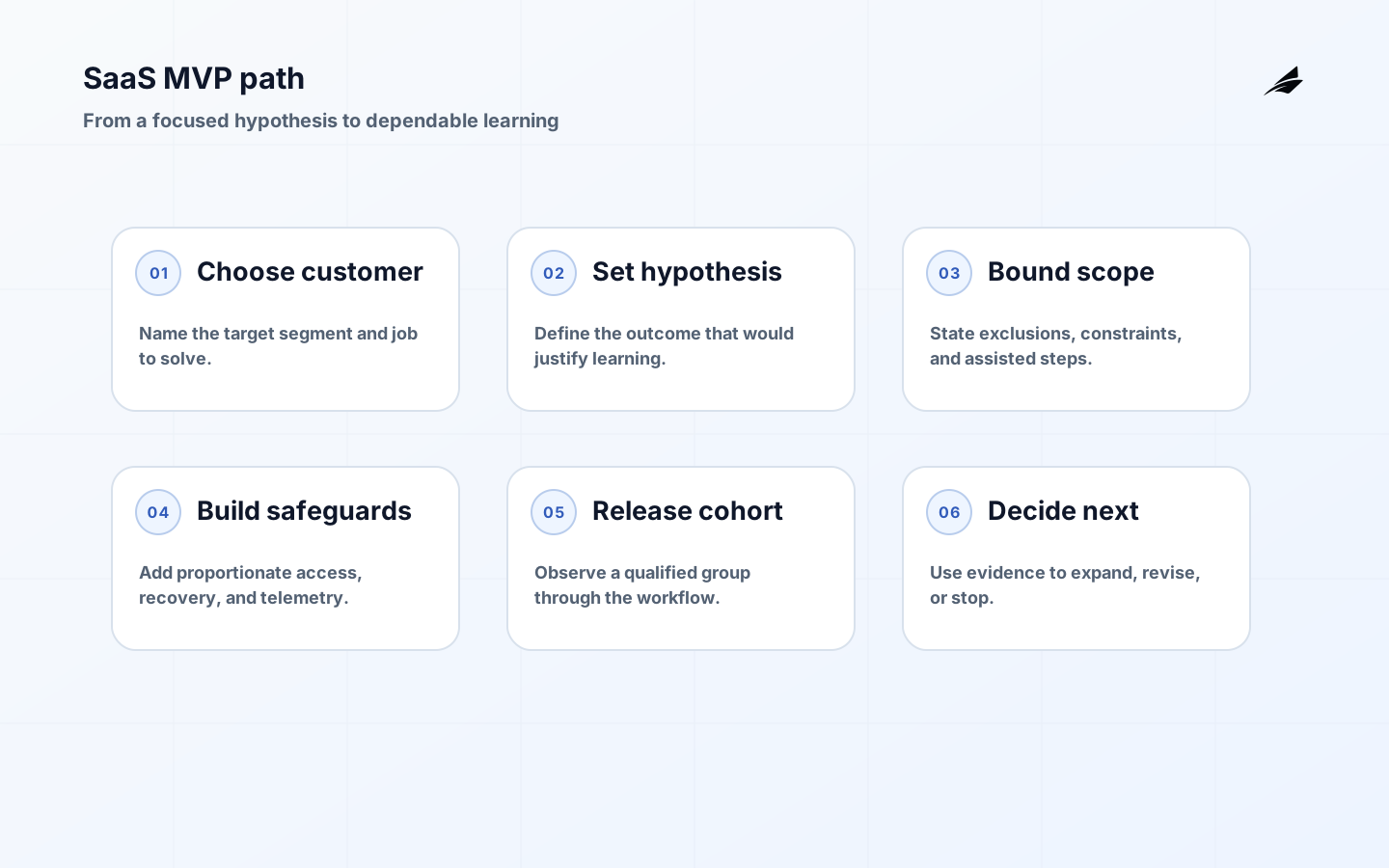
SaaS MVPs is a product-engineering concern because it shapes what a customer can trust in the product, what an operator can explain, and what a delivery team can change safely. For product teams, the work is not to collect more tooling or policy language. It is to make one important decision visible: what state is authoritative, who owns it, which controls enforce it, and how the team learns when reality differs from the plan.
Why SaaS MVPs Matters
SaaS MVPs are frequently misunderstood as a smaller backlog. That produces an early product with many incomplete surfaces: a signup exists but no credible path to value, an integration works only in a demo, permissions are postponed, and support has no way to recover a customer. The minimum in an MVP should describe the smallest dependable product experience that can test a meaningful business hypothesis. It is not permission to make consequential behavior vague or unsafe.
Choose one target customer, one high-value job, and one measurable learning goal. Then identify the minimum workflow required for that customer to reach the promised result with appropriate security, accessibility, and operational support. Everything else is either a deliberate constraint, a manual assisted step, or a later option. This forces a difficult but useful distinction between a feature that proves value and a feature that merely makes the product feel complete to its builders.
Build the Operating Model
An MVP has two dimensions. The customer dimension is the narrow workflow that delivers first value. The operating dimension is the minimum capability to run that workflow responsibly: identity and roles, data ownership, error handling, observability, support contact, and a safe release path. The operating dimension should be proportionate to the risk. A prototype that never handles real data can accept different shortcuts from a paid product that stores customer records or triggers financial actions.
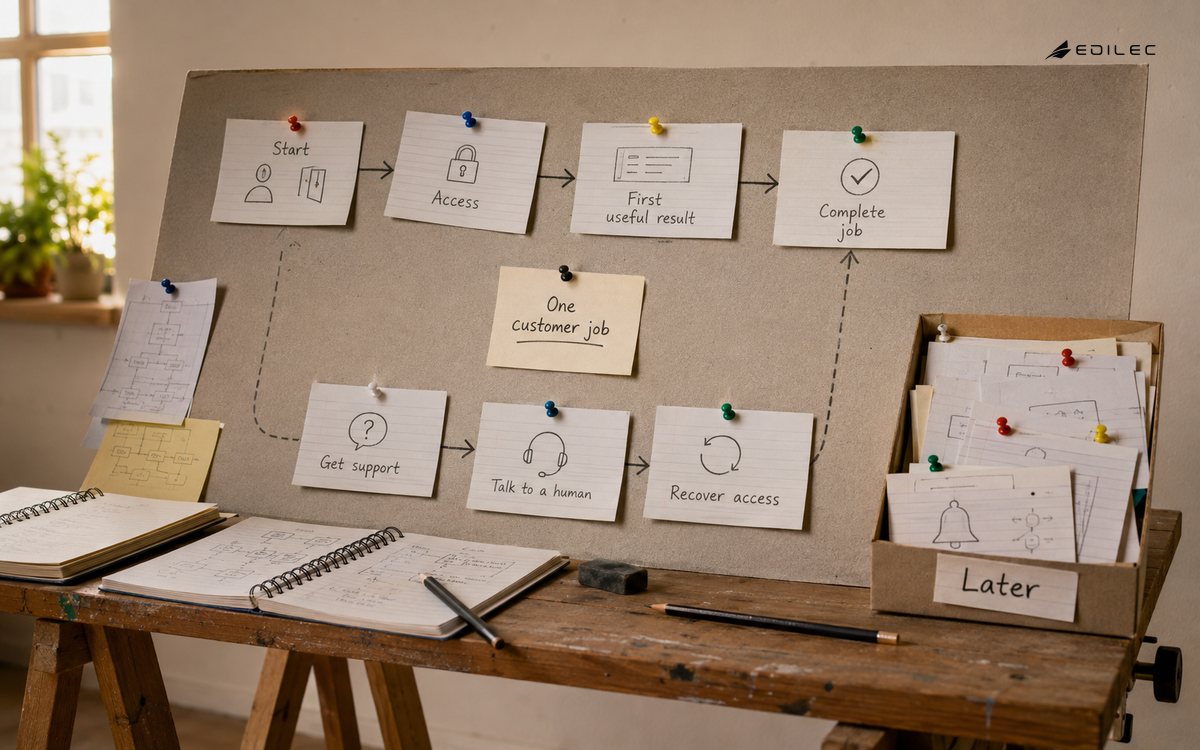
| MVP element | Minimum dependable version | Do not postpone |
|---|---|---|
| Customer workflow | One end-to-end job for a defined segment | Clear success and failure states. |
| Access | Named roles and server-side authorization | Who can view or change customer data. |
| Operations | Logs, support route, and rollback path | Ability to diagnose and recover real use. |
| Learning | Instrumented outcome and feedback loop | Evidence that informs the next investment. |
Write the MVP contract before implementation. It should name the target customer, job, expected outcome, excluded cases, data handled, success metric, known constraints, and exit criteria for the experiment. Include who can create an account, what roles exist, what happens when a workflow fails, and which requests need human review. A clear contract gives sales and support an honest way to position the release and gives engineering a boundary against last-minute scope expansion.
Design the Architecture and Controls
Favor reversible choices and well-defined seams in the workflow, without inventing unnecessary platform layers. Keep authoritative data and business rules on the server. Use a minimal deployment pipeline with environments, configuration control, logs, and rollback capability. Add feature flags where controlled exposure is needed, but give each flag an owner and removal date. Accessibility and security are not post-launch polish: semantic controls, least privilege, input validation, and audit evidence are part of a dependable first release.
The main MVP failure mode is learning from the wrong signal. If only friendly users can succeed because a founder manually repairs every account, the product may appear validated while the workflow is not. If a broad launch attracts customers outside the target segment, their needs may swamp the experiment. If a bug corrupts data, the team may spend the next month rebuilding trust instead of learning. Set constraints deliberately and expose assisted steps in the measurement.
Roll Out with Evidence
Recruit a small cohort that matches the target customer and agree on the supported use case before onboarding them. Observe their workflow, collect consented feedback, and instrument the points where the hypothesis could fail. Release in stages, with a way to pause or roll back. Review the result against the contract: did customers complete the job, did they return, and did operating burden remain acceptable? Expand scope only when the current workflow earns the next investment.
| Signal | What it can reveal | First response |
|---|---|---|
| High assisted-intervention rate | The workflow is not yet self-sufficient | Expose the missing product capability or narrow scope. |
| Activation, low repeat use | First value is not durable | Interview the target cohort and revisit the job. |
| Defects in core flow | The release path lacks safeguards | Add tests, observability, and a rollback check. |
| Requests outside the contract | Audience or positioning is too broad | Re-state the supported use case and qualify access. |
Operate and Measure
Use a few measures that connect behavior to learning: qualified activation, time to first outcome, successful completion, repeat use, assisted-intervention rate, defect escape rate, and the cost or time required to support each active customer. Include a qualitative question about whether the product solved the intended job. Vanity measures such as signups can provide context, but they should not overrule evidence from the target workflow. An MVP succeeds when it produces a clearer next decision.
- Define the minimum as a dependable learning experience.
- Select one customer, job, and measurable hypothesis.
- Build proportionate operational safeguards into the first release.
- Make manual assistance visible in the evidence.
- Expand only after the current workflow earns it.
Implementation Detail
A useful MVP example is a narrow vendor-approval workflow. The first release may let one operations role submit a vendor record, attach the required evidence, and route it to one approver, while intentionally excluding complex delegation and bulk imports. That is acceptable only if the product clearly states the constraint, protects the records, records the decision, and lets support recover a failed submission. The team can learn whether the workflow removes the real bottleneck before investing in a broad procurement platform.
Make manual work an explicit part of the experiment design. An internal reviewer may validate edge cases, or a customer-success person may help connect a source during the first cohort. Record when that happens, why it was needed, and how long it took. Otherwise the activation metric hides the cost of making the product work. The evidence can then distinguish a workflow worth automating from a mismatch between the target customer's needs and the product's proposed solution.
Review Before Scaling
Before inviting a cohort, rehearse the core failure paths. A user enters invalid input, a role is missing, a background job fails, an integration callback arrives twice, or a deployment must be rolled back. The team should be able to detect the condition, explain it safely, and restore a usable state. This does not require enterprise-scale infrastructure. It requires proportionate safeguards for the consequence of the experiment, particularly when real customer data, money, or approvals are involved.
The MVP review should produce a decision, not a celebration of shipping. Compare observed outcomes with the original hypothesis, including the customers who did not complete the task and the operational effort required to support those who did. Decide whether to deepen the workflow, change the segment, remove a constraint, or stop. A clear stop decision is evidence of disciplined product engineering. It protects the team from converting an inconclusive prototype into a permanent, fragile service by inertia.
Keep an explicit transition plan for work that proves valuable. It should state which manual steps will be automated, which safeguards must mature before a broader launch, what data migration is required, and how early customers will be supported. This avoids the false choice between abandoning a successful experiment and immediately turning it into a fully featured platform. The next release can remain focused while strengthening the proven path. Review this evidence with the owner of SaaS MVPs, the people who operate the surrounding workflow, and the team responsible for customer communication. Agree on one change, one measure, and one follow-up date. That closed loop keeps local fixes from becoming unexamined policy and makes the next decision easier to defend.
Key Takeaways
- Make SaaS MVPs a named operating decision rather than an implicit implementation detail.
- Keep customer impact, evidence, and recovery visible to the team that owns the workflow.
- Start with a narrow path, learn from real outcomes, and expand only after the controls hold.
Frequently Asked Questions
Where should a team start with SaaS MVPs? Start where an incorrect decision would create meaningful customer, commercial, or operational harm. Map the current state, the owner, the boundary, and the evidence available during failure. How much process is enough? Use the smallest process that makes the decision repeatable, reviewable, and recoverable. Add rigor when the data, action, or customer consequence makes a shortcut unsafe.
Conclusion
Strong SaaS MVPs work is not a one-time project. It is a durable agreement between product, engineering, and operations about how the system behaves under ordinary and difficult conditions. When the contract, controls, telemetry, and recovery path agree, product teams can improve the product without turning each release or customer exception into a new source of uncertainty.
The practical continuity test for SaaS MVPs is whether a qualified teammate who did not design the workflow can inspect the current state, understand the relevant decision and its limits, and take the next safe action without improvised access or tribal knowledge. Keep the owner, evidence location, escalation route, and recovery rule visible. That discipline makes routine operations calmer and gives the organization a reliable starting point when a customer, release, or incident exposes a new edge case.
Sources
The implementation advice in this SaaS MVPs guide is grounded in Manifesto for Agile Software Development, OWASP Application Security Verification Standard, Web Content Accessibility Guidelines 2.2, Google SRE error budget policy. These references are useful for checking platform-specific controls and terminology during delivery; the decisions here still need to be applied to the product's data, risk, and customer context.