What Changes When Alert Routing Moves into Production
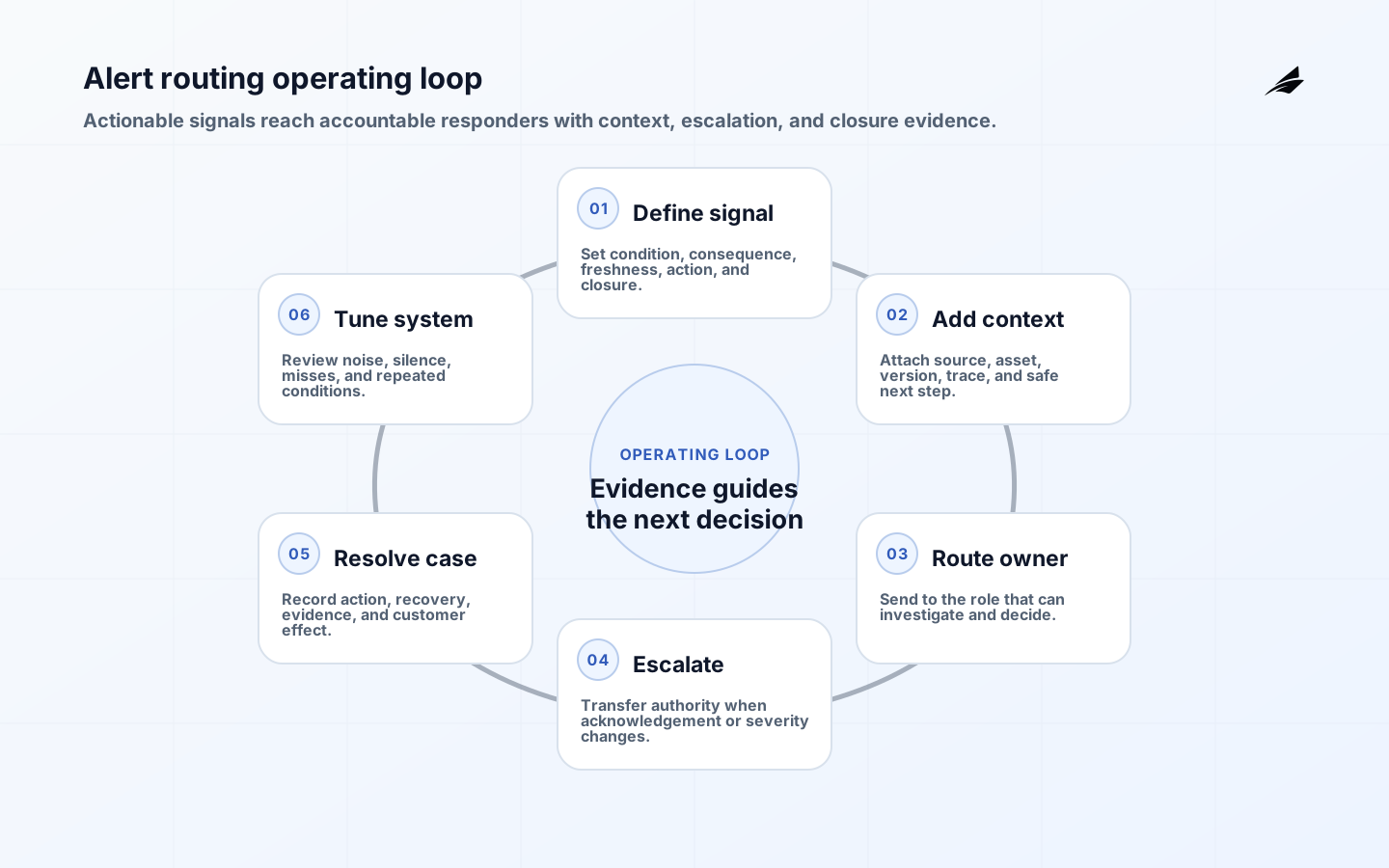
Alert routing becomes a production service when people rely on it to notice risk and decide what to do. A prototype may send a message whenever a threshold is crossed. A production system must distinguish a symptom from an incident, suppress noise without hiding a real failure, route by ownership and consequence, escalate when nobody responds, and preserve evidence for later review. The core promise is not that every alert reaches someone. It is that the right signal reaches the right authority with enough context to act, and that the organization can prove what happened when routing fails.
Specify what deserves a page and what does not
For every alert class, name the condition, source, affected asset or service, severity, freshness window, expected action, owner, escalation timer, and closure rule. Separate informational events from actionable alerts. If an operator is expected to wake up, stop a process, call a customer, or isolate a device, say so explicitly. A threshold without an action is a dashboard decoration. A notification without a consequence class is difficult to prioritize and impossible to tune responsibly.

NIST's incident handling guide is useful for connecting preparation, detection, analysis, containment, recovery, and lessons learned. Map those phases to the alert lifecycle. An alert should create a durable case or correlation when it represents a material condition, and the case should show acknowledgement, ownership, evidence, decision, and closure reason. Do not make responders reconstruct an incident from chat history and scattered notifications.
| Alert field | Decision | Why it matters |
|---|---|---|
| Condition | What exact observation or rule creates the alert? | Prevents vague and non-reproducible signals |
| Consequence | What can happen if nobody acts? | Sets urgency and escalation |
| Owner | Which role can investigate and decide? | Avoids broad or unowned routing |
| Freshness | When is the alert stale or superseded? | Stops old state from driving new action |
| Closure | What evidence ends the case? | Supports reliable learning and audit |
Make alert conditions explainable
Start with a small set of alerts tied to real user, safety, security, or business outcomes. Test missing data, delayed data, duplicated events, maintenance windows, dependency failures, and a metric that recovers before a person responds. Use time windows and state transitions where a single noisy sample is not enough. Add suppression only when the suppressed relationship is understood and the system can still show that risk exists. Silence is a policy decision, not an absence of failure.
OpenTelemetry's logs data model helps keep alert evidence consistent across services. Put the event time, severity, source, version, correlation, and first responder check in the alert; keep large or sensitive payloads behind controlled links.
Send each condition to the role that can act
Route to the team that can take the next meaningful action, not merely the team that owns the emitting metric. A device fault may require a site operator, while a fleet-wide pattern may require reliability or security. Distinguish primary owner, backup owner, incident commander, subject-matter expert, and customer communicator. Keep the routing table versioned and test it after team changes. An alert that reaches a closed group is a system failure even when the rule itself is correct.
Use escalation as a time-bounded transfer of authority. If the primary does not acknowledge, route to a backup; if the condition becomes more severe, elevate the response; if the signal is resolved, stop escalation and record why. Do not escalate every repeated alert independently. Group related events with a stable incident key so responders see the shape of the problem rather than a flood of identical pages.
Bound silence, grouping, and maintenance windows
Suppression and maintenance windows need ownership, scope, start and end time, reason, and a visible audit trail. A broad mute may protect responders from noise while also hiding a genuine outage. Prefer targeted suppression that states which alerts are affected and which safety or security classes remain active. Expire temporary rules automatically unless a person renews them with a reason. Review suppression usage as a risk metric; frequent mutes may mean the source or threshold needs redesign.
Deduplicate by a meaningful key such as service, asset, failure mode, and incident window. Preserve counts and first-seen and last-seen times so repetition is not lost. A notification system should not treat a resolved alert and a new occurrence as the same forever. Keep the distinction between current state and event history. That distinction is essential when responders investigate whether a control has recovered or merely stopped reporting.
| Failure mode | Control | Review signal |
|---|---|---|
| Alert storm | Group by incident key and rate-limit delivery. | Suppressed count and queue pressure |
| Missed alert | Test the rule, source freshness, route, and escalation. | Synthetic checks and unacknowledged cases |
| Wrong owner | Resolve current service, asset, and site ownership. | Reroutes and stale contacts |
| Stale page | Attach timestamps, expiry, and recovery state. | Open cases past freshness |
| Hidden risk | Expire maintenance and preserve critical classes. | Mute duration and exception review |
Match urgency to channel and escalation
Use a channel that matches the response time and availability requirement. A dashboard may be enough for a low-urgency trend; a ticket may be suitable for work during business hours; a page or voice escalation may be required for an immediate operational risk. Do not assume a channel is reliable because it worked in a test. Monitor delivery, acknowledgement, bounce, delay, and escalation. Maintain a fallback when a provider or identity system is unavailable.
For connected operations, include the local condition and safe next step. A device alert should say whether the reading is current, whether commands are still allowed, and who owns physical inspection. NIST OT security guidance supports preserving safety and availability while applying controls; alert routing should therefore help operators make a safe decision rather than simply increase urgency.
Exercise delivery through closure
Test from signal generation through delivery, acknowledgement, escalation, investigation, recovery, and closure. Include a quiet period, an alert storm, a provider outage, a stale contact, a maintenance window, a permission change, and a cross-site incident. Verify that the right person can access the evidence and that the system does not leak sensitive information into a channel with a wider audience. Record the test result as release evidence, not as a one-time demonstration.
Run synthetic checks continuously for critical routes. A rule can be correct while the transport, integration, contact directory, or escalation policy is broken. For each alert class, record detection-to-page delay, acknowledgement age, assignment time, mitigation interval, recovery duration, and false-positive burden. A lower page count is not automatically better; the meaningful outcome is faster and safer response to important conditions.
Use alert outcomes to tune the service
Give every alert class an owner and a review cadence. Look at acknowledgement quality, reroutes, repeated pages, suppression, escalation, customer impact, and the quality of closure evidence. Retire alerts that never lead to action, but first ask whether the underlying issue is fixed or merely tolerated. Use post-incident learning to change thresholds, ownership, instrumentation, runbooks, and service design. NIST's log management guidance is a useful reminder to protect the evidence that makes this review possible.
Use the related Edilec guides for a broader path: what changes when SCADA integrations move into production, what changes when field service portals move into production, and IoT telemetry explained. Alert routing is strongest when the source data, operating workflow, and human response are designed together.
Treat alert content as a compact decision aid. Put the condition, impact, time, owner, current state, and first safe check near the top. Put deeper evidence behind a controlled link. This reduces cognitive load during an incident and lowers the chance that a responder takes action on a stale screenshot or a copied metric without its time window.
Separate alert policy from notification preference. A person may choose a quiet channel for low urgency, but a service owner should not be able to mute a critical security or safety class without an accountable review. Store who changed the route, why, scope, and expiry. Reconcile the routing directory with team ownership so a reorganized team does not create silent failure.
Use recovery alerts sparingly and clearly. A recovery event should say which condition ended, whether the underlying service is healthy, and whether follow-up remains. Do not close a case merely because a metric returned below a threshold if data loss, customer impact, or manual repair is still unresolved. Closure is a business and operating decision, not only a time-series transition.
Review alert classes with the people who receive them. The responder can tell whether the payload contains enough context, whether the page arrives too late, and whether the action is feasible during an overnight shift. Pair that feedback with incident and customer evidence. The goal is not to make alerts comfortable; it is to make important response more reliable and less wasteful.
Maintain a route test matrix for alert class, source, owner, channel, escalation, and recovery. Run it after contact, identity, provider, service, or policy changes. Keep the test result with the alert definition and review failures like production defects. A synthetic page delivered successfully is useful evidence, but the route still needs a human or simulated acknowledgement and a verified case transition.
The best alerting programs make fewer promises and keep them. They do not page on every interesting metric; they identify conditions where a timely decision matters. They also preserve a path for slow-burn degradation through dashboards, tickets, or review queues. Match the response channel to consequence, and make the escalation route as current as the service ownership it represents.
Set an explicit policy for alerts that cannot be delivered. The system should record the failed channel, preserve the condition, try the approved fallback, and notify the route owner when the delivery service itself is degraded. Do not let a provider outage erase the case. A durable failure record helps responders decide whether to switch channels, use a local procedure, or accept a bounded delay.
Key takeaways
- Define the condition, consequence, owner, freshness, action, and closure evidence for every production alert.
- Improve signal quality before adding more notification channels.
- Route by authority and operating consequence, then escalate with time-bounded ownership.
- Make suppression targeted, temporary, visible, and reviewable.
- Test providers, identities, contact changes, storms, outages, and stale data end to end.
- Use alert performance and closure quality to improve the underlying product and service.
Frequently asked questions
How should teams reduce alert noise?
Begin by removing alerts with no clear action, then improve source freshness, grouping, thresholds, and ownership. Suppression can help during known maintenance, but it should be scoped, time-bounded, and audited. Review both pages and silent failures so reducing noise does not simply move risk out of sight.
What counts as an acknowledgement?
An acknowledgement should identify a responsible person or team and begin the expected response. A delivery receipt or an automated status change is not enough for a high-consequence alert. Keep acknowledgement time, owner, action, and escalation state in the case record.
Conclusion
Production alert routing is a decision service for the people who operate a system. Make signals meaningful, ownership current, channels observable, suppression accountable, and closure evidence durable. Done well, routing reduces both missed risk and wasted attention because every important alert has a clear path to action.