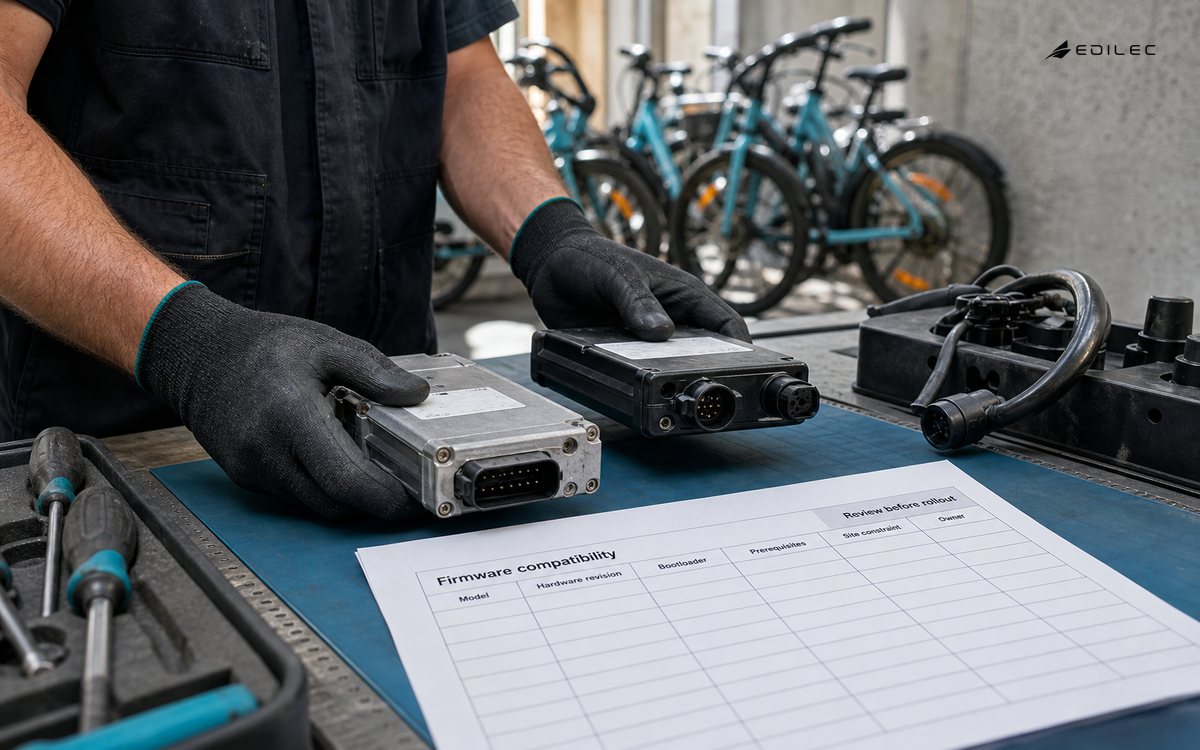
Firmware updating is most useful when it is treated as an operating decision rather than an isolated technical feature. Create a compatibility ledger that links model, hardware revision, bootloader, current version, prerequisites, site constraint, and owner. Define whether a release is mandatory, deferred, or excluded. For firmware release operations, the goal is to make normal work dependable while ensuring that a fault, handoff, or unusual site constraint produces a visible and accountable response.
Firmware Operations: State the Release Outcome
At its core, firmware update operations establish how people, equipment, services, and evidence should behave around a shared operational need. Begin by stating the outcome that matters, the consequences of getting it wrong, and the person who can accept or reject a change. The design is supportable only when that agreement survives shift changes, vendor involvement, and the pressure of an incident.
Maintain a release compatibility record for each model, hardware revision, bootloader, current version, prerequisite, site limit, and responsible owner. Define whether a release is mandatory, deferred, or excluded. For firmware release operations, keep the decision record small enough to use: the normal state, the trigger for attention, the permitted action, the escalation point, and the evidence that proves the action was completed. For firmware release operations, this turns ambiguous technical discussion into a practical agreement that operations and engineering can both test.
| Decision area | Question to settle | Evidence to keep |
|---|---|---|
| Scope | Which assets and workflows belong to firmware updates? | Owner, boundaries, and exclusions |
| Data and access | What is authoritative and who may act? | Identity, time, policy, and permissions |
| Exception path | Fleet firmware: what happens when the normal path fails? | Contingency path, acknowledgement, and disposition |
Firmware Operations: Separate Artifact and Activation
Use signed packages and a verified chain from approval to install. Separate download from activation so operational staff can choose restart timing, and use rollback-capable designs where supported. For firmware release operations, state the authoritative records, allowed access paths, retention rule, and expected behavior when an upstream or downstream component is unavailable. For firmware release operations, these choices are where a design either protects operational context or quietly discards it.
A robust firmware-update architecture distinguishes healthy, delayed, uncertain, rejected, and manually overridden states. A firmware status is unsafe to trust when its source time, quality, or policy context is missing. Retain the historical context needed to show what the firmware system knew then, rather than relying on today's dashboard state.
For firmware release operations, the adjacent work in Device Identity Lifecycle: Core Principles is relevant here because connected operations depend on deliberate boundaries between observation, administration, decision support, and control. For firmware release operations, integration is valuable only when it leaves those boundaries more understandable, not less.
Firmware Operations: Gate Each Cohort
Stage representative canaries, small cohorts, and progressive expansion. Record download, verification, activation, healthy check-in, and functional confirmation separately; silence is not success. For firmware release operations, reviewers should be able to see who acted, which policy or version applied, what data was available, and how an exception was resolved. For firmware release operations, keeping that evidence close to the workflow limits the need to reconstruct a decision from scattered tickets and informal memory.
For firmware release operations, access should be as narrow as the task allows, with distinct identities for people, services, and devices. Fleet firmware: a temporary exception needs a reason, owner, and expiry. Fleet firmware: an emergency route needs a documented approval and recovery procedure. For firmware release operations, these controls are not paperwork; they keep a convenience decision from becoming a permanent unexamined dependency. For firmware operations, tie the campaign review to update evidence and campaign-gate approval.
| Review signal | What it can reveal | Practical response |
|---|---|---|
| Campaign eligibility | Fleet firmware: a condition may be outside the expected operating model. | Fleet firmware: inspect context before widening access or suppressing the signal. |
| Failed verification | Fleet firmware: a decision or recovery path may lack ownership. | Fleet firmware: assign a reviewer and make the next step visible. |
| Manual bypass | Fleet firmware: the designed path may not fit daily work. | Fleet firmware: document the reason and improve the operating procedure. |
Firmware Operations: Rehearse Interruption and Recovery
Practice power loss, link loss after activation, expired signing credentials, incompatible hardware, storage exhaustion, and rollback. Retain package hash and exception disposition with asset history. A focused first release reveals support demand, manual workarounds, late or bad data, and the effort required to restore normal operation—evidence a broad platform promise cannot provide. Increase scope only after the responsible team can operate the first scope repeatedly and explain its limits.
For firmware release operations, before expanding, run a planned exercise with interruption, malformed or disputed data, restart, and a handoff between roles. Fleet firmware: define the degraded state and the point where human review is required. For firmware release operations, the exercise should leave behind a runbook update, an owner for open issues, and a short record of what changed in the design. Use the interruption exercise to revisit update evidence and campaign-gate approval before expansion.
Firmware Operations: Measure Cohort Health
Track campaign eligibility, failed verification, unhealthy check-ins, cohort exception rate, and rollback demand. Fleet firmware: interpret each measure with operating context. For firmware release operations, A lower count is not automatically better if staff have stopped reporting a condition or moved work outside the governed path. For firmware release operations, measures should give an owner a clear place to inspect, a question to ask, and an improvement to test.
For firmware release operations, use incident reviews and planned exercises to test whether the metrics remain meaningful. For firmware release operations, if a measure cannot tell the team what to inspect or change next, it is reporting decoration. For firmware release operations, keep definitions, thresholds, data-quality treatment, and calculation changes visible to the people who depend on the results. Connect metric review to firmware update evidence and campaign-gate decisions so the measures remain actionable.
Firmware Operations: Keep Release Evidence Complete
A release record should connect the human approval to the exact artifact and target set. Include the package hash, signing identity, compatibility criteria, campaign window, cohort definition, and pause threshold. This lets an investigation distinguish a device defect from a targeting or workflow failure. It also makes a supplier-provided release easier to evaluate because the evidence is attached to the rollout, not buried in an email exchange.
Post-update monitoring should focus on the function the device supports, not only its connection status. A unit can check in successfully while reporting a new error, operating with a degraded interface, or creating unexpected load on a gateway. Define the functional confirmation for each class of asset and collect it at the campaign gate. That is the moment a fleet update becomes an operations playbook rather than an IT task.
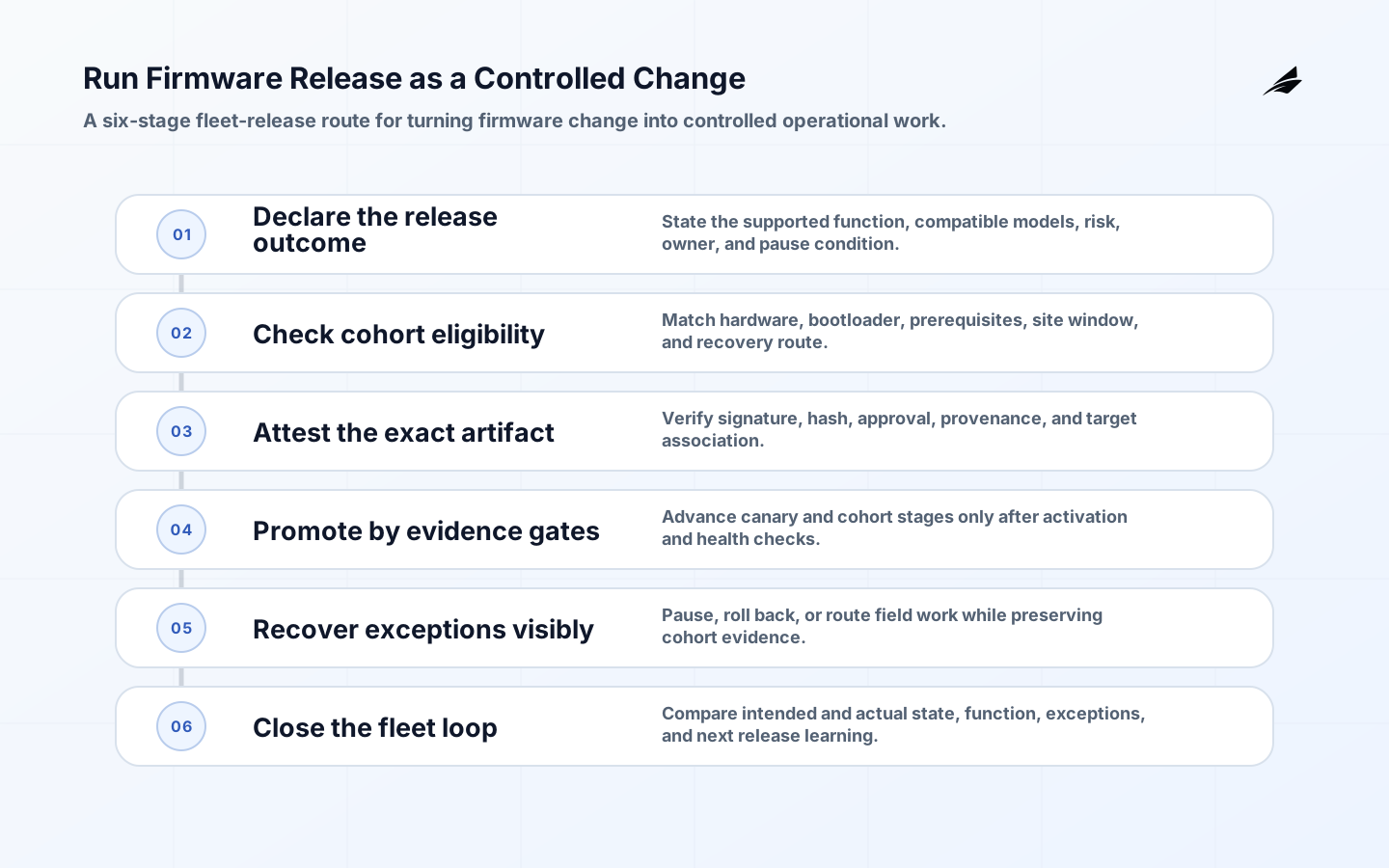
Run Firmware Release as a Controlled Change
Example: Gate a Mixed-Hardware Fleet
A mixed-hardware fleet exposes why a release needs gates. Suppose one product family contains two processor revisions and three bootloader versions across sites with different maintenance windows. The release owner should create eligibility rules before publishing the package, verify that each cohort has a compatible recovery path, and exclude devices whose configuration or safety state is not known. A single “fleet updated” number would hide those important differences.
Use gates that correspond to real evidence: artifact verification, lab boot, representative-site activation, healthy telemetry, and a review of exceptions. Each gate should have a decision owner, a threshold, and a next action. A gate that only records that a script ran does not prove the device reached a safe operating state. Keep the exception queue visible so deferrals do not silently become permanent exposure.
After the rollout, compare intended and actual state. Examine devices that never attempted, devices that failed before reboot, devices that booted but lost a function, and devices that recovered through a local procedure. Record the lesson in the compatibility rule or runbook before the next release. That closes the loop between fleet operations and engineering rather than treating the rollout as finished when the campaign ends.
Patch planning, Azure Device Update, AWS IoT Jobs, and contingency planning connect fleet release gates to eligibility, execution, exception handling, and recovery. SP 800-40 Rev. 4: Guide to Enterprise Patch Management Planning; Understand Azure Device Update for IoT Hub; AWS IoT Jobs walkthrough; SP 800-34 Rev. 1: Contingency Planning Guide.
The device-identity primer, firmware updates guide, and connected-operations guide help connect this playbook to identity, release mechanics, and workflow evidence. For firmware release operations, Device Identity Lifecycle: Core Principles clarifies one boundary; Gateway Security: Engineering Notes adds a complementary operating pattern; and How Engineering Teams Should Think About Offline Sync helps connect the decision to a wider connected-systems workflow.
Firmware Operations Key Takeaways
- Firmware Updates should begin with a concrete operational outcome and accountable owner.
- For firmware release operations, make degraded, uncertain, and exceptional states visible to the person who must act.
- For firmware release operations, use narrow permissions, versioned change, and retained evidence to keep the workflow supportable.
- For firmware release operations, test interruption, bad data, recovery, and handoff before expanding the pattern.
- For firmware release operations, review real exceptions with operations staff and turn the result into a maintained procedure.
For supporting fleet controls, compare this release playbook with Device Identity Lifecycle: Core Principles, Gateway Security: Engineering Notes, and How Engineering Teams Should Think About Offline Sync. A fleet release closes only when cohort evidence, functional health, exceptions, and recovery actions agree with the intended change.
Firmware Operations FAQ
How Often Should a Firmware Release Be Planned?
Follow exposure, consequence, vendor support, and operational windows rather than a calendar ritual. The decision should be risk-based and evidenced. For firmware release operations, the durable answer is the one that gives a later reviewer enough context to understand the condition, the decision, and the evidence without relying on undocumented local knowledge.
How Should Devices Without Remote Update Be Managed?
Keep them visible with a field procedure, owner, deadline, and compensating controls. Quiet exclusion makes the fleet state unknowable. For firmware release operations, put the answer in a runbook, assign an owner, and revisit it after incidents, asset changes, or evidence that the original assumption no longer holds.
Firmware Operations Source Notes
These primary publications informed the security and operational framing in the reference. For firmware release operations, apply them alongside the standards, supplier guidance, and site procedures that govern a specific deployment. Read the source notes alongside firmware update evidence and campaign-gate decisions when tailoring a deployment.
- NIST SP 800-82 Rev. 3 anchors the OT security framing for this fleet's operational technology and availability concerns.
- NISTIR 8259A informs the device capability and lifecycle framing for this firmware workflow.
- NIST SP 800-207 informs the access and trust-boundary controls used during release operations.
- NIST SP 800-193 informs the platform-resilience and recovery expectations for firmware release.
Campaign communications should be as deliberate as the technical gates. Site contacts need to know the target window, expected device behavior, service effect, stop condition, and route for reporting a problem. The release owner needs a concise view of progress by cohort and a way to distinguish a genuine failure from a device that was never eligible. Clear communication reduces unnecessary manual intervention while making a real operational concern visible early enough to pause safely.
Conclusion: Close the Firmware Operations Loop
Firmware updating is successful when staff can detect an exception, understand its consequence, take an authorized next step, and recover with evidence instead of improvisation. For firmware release operations, start with the accountable workflow, make assumptions and degraded states visible, and improve the design from the exceptions that real operations reveal.