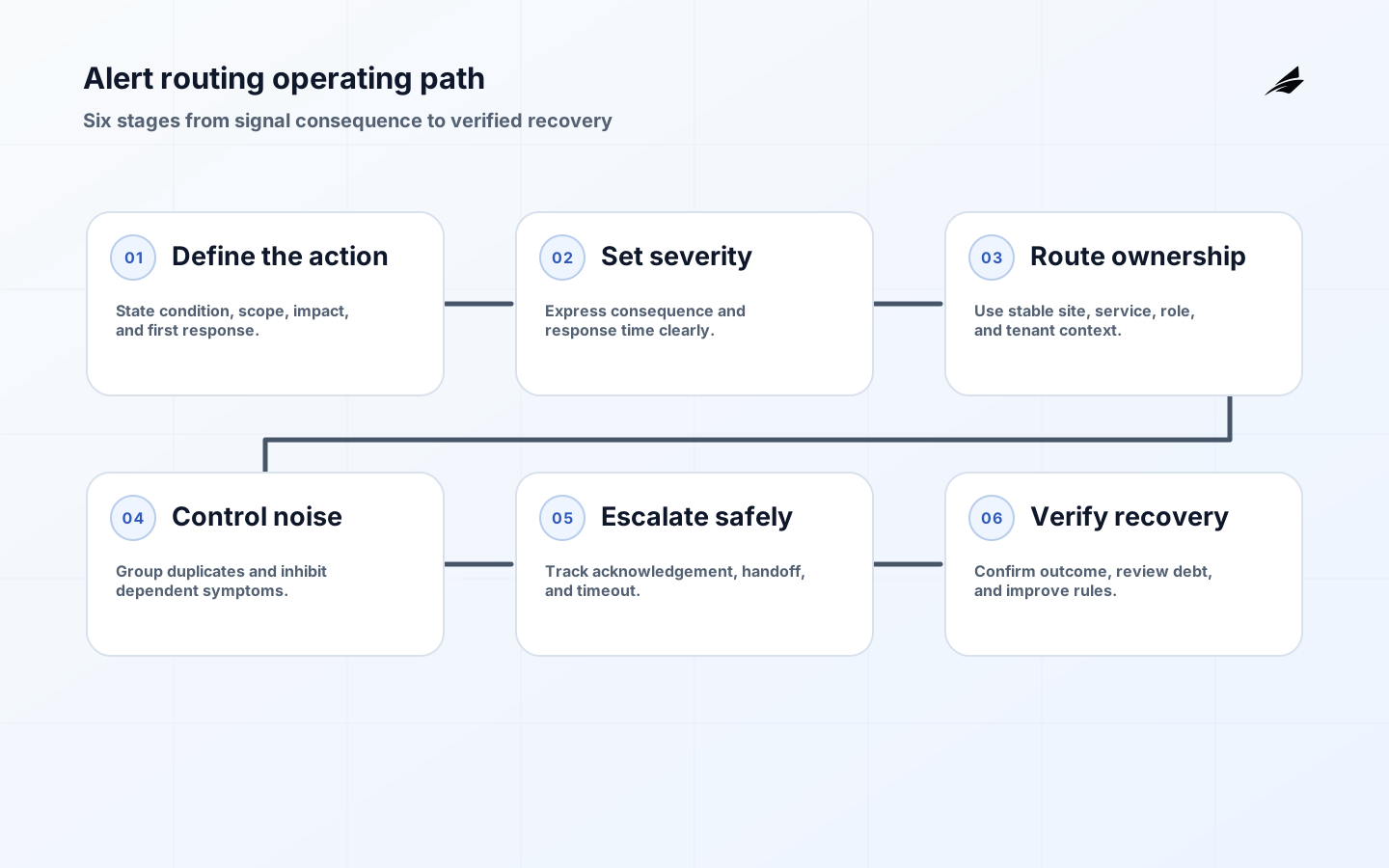
Alert routing is the operating decision that turns a signal into a person, team, or automated action. A connected product can detect thousands of conditions, but an alert is useful only when someone can understand it, decide what to do, and know when the issue is resolved. Prometheus Alertmanager documents grouping, inhibition, silencing, and notification routing; those mechanics are valuable, but they do not decide your ownership model. Start with the consequence, the responder, the evidence, and the escalation path. Alert routing should reduce uncertainty, not move a noisy dashboard into a louder inbox.
Define the Actionable Decision
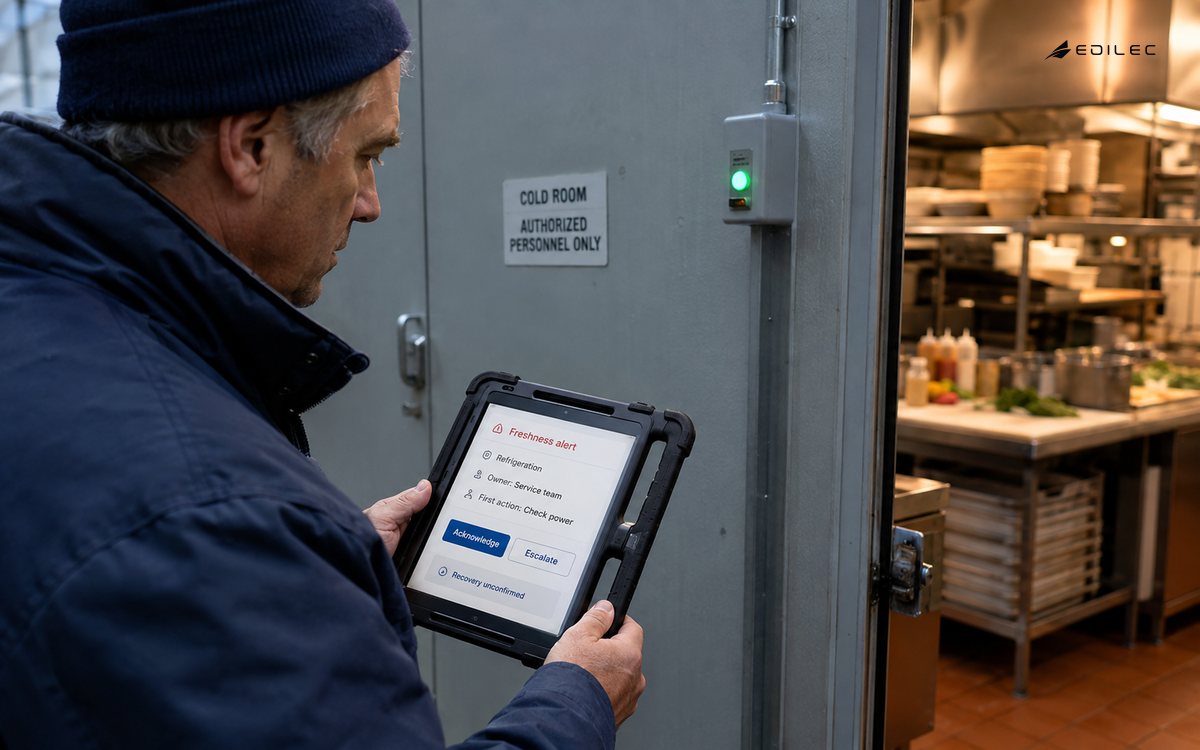
Write every alert as a decision statement: what changed, for whom, by how much, for how long, and what action is expected. “Device offline” is incomplete if the responder cannot tell whether the device is critical, intentionally powered down, or behind an unavailable gateway. A useful alert might say that a refrigeration site has exceeded its freshness boundary for twenty minutes and that the coordinator should verify power before escalating. Link to IoT telemetry in production for the freshness and provenance contract. If no action or owner exists, keep the signal in a dashboard until the team can define one.
| Alert field | Question | Example |
|---|---|---|
| Condition | What changed and compared with what? | No valid pressure reading for twenty minutes. |
| Scope | Which asset, site, tenant, or service? | Pump P-14 at Site North. |
| Impact | What decision or risk is affected? | Inspection SLA may be missed. |
| Action | What should happen first? | Check power, then inspect gateway status. |
Use Severity to Express Consequence
Severity should describe consequence and response time, not how alarming a metric looks. Define the criteria for critical, high, medium, and informational states in plain language. A high CPU signal may be informational when redundancy is available and critical when it is the last path for a safety decision. Avoid letting every threshold become a page. Prometheus alerting rules provide the rule mechanism, while the Alertmanager configuration reference shows the routing structure that carries labels, grouping, and notification policy. Your service should still define pending time and runbook ownership. Review severity with the people who receive it because an elegant taxonomy that nobody trusts quickly collapses into “everything is urgent.”
Route by Ownership and Context
Route alerts using stable dimensions such as site, product, service, device family, tenant, and duty role. Do not route solely by the engineer who wrote the rule. Ownership changes, teams rotate, and a single team may support different business consequences. Include the context a responder needs without forcing them to search five systems: last known good time, current impact, related alerts, device or service identity, recent change, and runbook link. Keep labels bounded; high-cardinality identifiers can make routing and grouping expensive. A device identity design should give you stable references without leaking credentials or personal data.
Group Duplicates without Hiding Incidents
Grouping prevents one network outage from producing hundreds of identical pages. Group by the incident boundary, such as site and failure class, but preserve enough detail to identify affected assets. Set a short group wait for fast-moving events and a longer wait when related alerts commonly arrive together. Test a gateway outage, a broker outage, and a single sensor fault to ensure grouping behaves differently where it should. Inhibition can suppress dependent symptoms, but it must not hide a higher-severity independent failure. Document which alert acts as the source and how the suppressed alerts remain discoverable.
| Mechanism | Useful for | Risk to control |
|---|---|---|
| Grouping | Many alerts from one incident. | Over-broad groups conceal distinct faults. |
| Inhibition | Suppressing dependent symptoms. | A bad source rule hides real impact. |
| Silence | Planned work or accepted noise. | Unbounded silence becomes neglect. |
| Escalation | No acknowledgement or recovery. | Missing duty owner delays action. |
Choose a Notification That Can Be Acted On
A page, email, ticket, chat message, dashboard badge, or automation can be appropriate depending on consequence and time. The message should state the condition, scope, impact, first action, owner, runbook, and correlation reference. Keep repeated notifications useful by adding changed evidence rather than replaying the same sentence. Verify that the channel works during a network or identity incident; an alert path that depends on the failing system needs an alternate route. Avoid sending sensitive telemetry into channels with broader membership than the underlying data requires.
Design Acknowledgement and Recovery
An acknowledgement means someone accepted responsibility, not that the problem is fixed. Define acknowledgement timeout, escalation behavior, handoff, and what closes the alert. Recovery should use a clear signal and may require a human confirmation when an automatic green state would be misleading. Do not close an alert merely because a device reconnects if its readings are still stale or invalid. Track alert age, time to acknowledgement, time to mitigation, recurrence, and false-positive rate. These measures help improve routing without rewarding teams for suppressing difficult alerts.
Protect the Alerting Control Plane
Alert rules, routing policy, silences, and notification integrations can change operational behavior and deserve access control. Apply least privilege, require review for high-impact policy changes, audit edits, and expire emergency silences. IoT security guidance such as NISTIR 8259A includes cybersecurity state awareness; connect device security signals to a responsible route rather than burying them in raw logs. Ensure a compromised device cannot forge a trusted severity or impersonate an operator. Test policy rollback and alert delivery after credential rotation.
Write Runbooks around Decisions
A runbook should help a responder decide the first safe action, gather evidence, mitigate harm, and escalate. Keep commands, permissions, dashboards, and expected results current. Include the cases that look similar but require different responses: device powered off intentionally, site network down, broker rejecting credentials, sensor out of calibration, and genuine threshold breach. Link from the alert to the exact runbook section, not to a generic operations homepage. Review runbooks after incidents and during onboarding so the service does not depend on one experienced engineer remembering hidden context.
Pilot with Real Noise and Real People
Choose a critical workflow and a small set of alerts. Test normal operation, a planned maintenance window, a gateway outage, a high-impact threshold, a duplicate storm, and a false positive. Have the actual on-call person receive and acknowledge the alert; a test that only checks a webhook is incomplete. Compare the intended route with the responder’s experience: could they identify scope, impact, first action, and escalation without a separate meeting? Use alert routing in production as related context, then widen only when the evidence shows fewer missed decisions rather than more notifications.
A routing review should follow one alert from rule evaluation to resolution. Inspect the labels, grouping key, notification content, acknowledgement state, escalation timer, silence behavior, runbook, and recovery signal. Then ask the responder to perform the first action with normal permissions. This reveals missing context, over-broad groups, stale links, and routes that depend on the same failing system they are supposed to diagnose.
Keep a small catalog of alert patterns rather than hundreds of independent conventions. For example, a freshness alert, an authentication alert, a capacity alert, and a safety-threshold alert can each have a defined severity model and runbook shape. Product-specific details remain in labels and annotations. Consistency helps responders recognize what kind of decision is required without making every alert sound identical.
Review alert debt monthly: repeated silences, unowned rules, alerts with no response, recurring false positives, and alerts that close without a confirmed outcome. The purpose is not to remove alerts for a cleaner dashboard. It is to make the remaining routes trustworthy enough that people act when the signal matters.
Treat the first alert review as a usability test. Ask a responder to interpret the notification, find the runbook, acknowledge it, make the first safe change, and confirm recovery. Record every question they ask. Those questions identify missing context more reliably than a static rule review, especially when the alert concerns a connected site where several layers can fail together. See network observability for related diagnostic context.
Keep an alternate route for the highest-consequence alert. If the normal notification service, identity provider, or network path fails with the monitored system, the responder still needs a way to learn that action is required. Test the alternate route during a scheduled exercise and record who owns its maintenance.
If a route cannot name a responder, change the route before increasing its severity.
Review recurring silences and unowned rules as signs of an operating-model problem, not merely a noisy dashboard.
Keep escalation contacts current and verify them during a real exercise.
Keep the owner visible in the notification itself.
Practical Takeaways
- Define the action, consequence, scope, owner, and response window for each alert.
- Use severity to express impact and urgency, not metric drama.
- Group duplicates around the incident boundary without hiding distinct faults.
- Make acknowledgement, escalation, mitigation, and recovery explicit.
- Protect routing policy, silences, and integrations with access control and audit.
- Measure responder outcomes and test alerting with the people who will receive it.
FAQ: Alert Routing
When should a signal be an alert?
Make it an alert when a defined person or automation should act within a defined time because a consequence is possible. Keep signals that need investigation but no immediate action in a dashboard or report, with a clear owner for review.
Are silences bad practice?
No. Planned maintenance and accepted temporary conditions need silences, but every silence should have an owner, reason, scope, and expiry. Review repeated silences as evidence that the rule or service contract needs improvement.
Conclusion
Good alert routing is a compact operating contract between evidence and action. Define the consequence, route with context, control noise, protect the policy, and measure whether responders can restore a safe state. Growing teams gain reliability when alerts make responsibility clearer instead of merely increasing the number of places a signal can appear.