OPC UA security and discovery guidance, CISA industrial-control practices, and NIST OT security guidance support the mediation model with explicit authority, secure interfaces, and operational constraints. OPC UA Part 2: Security Model; OPC UA Part 12: Discovery and Global Services; Recommended Cybersecurity Practices for Industrial Control Systems; SP 800-82 Rev. 3: Guide to Operational Technology Security.
SCADA Integration: Name the Permitted Exchange
Make the SCADA decision challengeable by naming its initiating condition, accountable owner, authoritative inputs, action, and proving evidence. For SCADA integration, the practical question is which data or command exchange is permitted, by which interface, and with what confirmation. Keep observation distinct from command, request distinct from confirmation, and a convenience view distinct from the system of record. For each input, define stale, estimated, duplicated, and unavailable states and show how the worker sees them. That discipline keeps a fast demonstration from becoming the sole explanation for a consequential change. NIST CSF 2.0 can organize the SCADA discussion across governance, identification, protection, detection, response, and recovery; local procedures still need named owners.
| Decision element | Question to settle | Evidence to retain |
|---|---|---|
| Outcome | SCADA mediation: what useful decision or bounded action is supported? | A named workflow and acceptance example |
| Authority | SCADA mediation: which source, person, or policy is decisive? | Owner and source-of-truth record |
| Failure | SCADA mediation: what is the safe state when an input is unavailable? | Test result and recovery owner |
| Change | SCADA mediation: who may alter rules, mappings, or access? | Reviewed change and rollback point |
SCADA Integration: Establish the Control Boundary
Map the boundary around SCADA servers, historians, integration gateways, business applications, and operators. The SCADA map must include external services, temporary support access, configuration stores, and every path that can influence the result. A responsibility matrix is the most useful artifact: source, destination, purpose, direction, identity, timing, and owner. Test every connection against the stated outcome and remove links that are merely convenient. The risk is concrete: a convenient integration can obscure authority and create a route for unintended operational changes. NISTIR 8259A's device baseline underscores unique identification, configuration control, data protection, logical access, software update, and cybersecurity-state awareness. Document compensating controls for assets that lack a capability; do not imply an unsupported control exists.
- SCADA mediation: name the business and technical owner for each consequential path.
- SCADA mediation: record the normal state, degraded state, and recovery state.
- SCADA mediation: keep identities and privileges proportionate to the action.
- Across the SCADA mediation boundary, mark data age, quality, and time basis where a person could mistake it for current fact.
- SCADA mediation: give temporary exceptions an approver, expiry, and removal check.
- SCADA mediation: test the boundary with realistic maintenance and outage conditions.
SCADA Integration: Explain Each Handoff
For SCADA integrations, the architecture must make responsibility visible as well as data movement. The SCADA architecture earns its keep by explaining each handoff, not by drawing data movement alone. Follow one representative case from originating signal through validation, policy, storage, display or action, and later review. Capture event time separately from receipt and handling time; otherwise an old fact may look current. Stable identifiers let retries and manual reconciliation avoid creating a second record for the same work. At each trust boundary, authenticate the caller, constrain its role, and log the decision without secrets. NIST SP 800-207 makes the point plainly: network location alone does not establish trust. Use a gateway or mediated service when the equipment cannot support a direct control, while preserving the trust intent.

SCADA Integration: Separate Failure and Recovery
Failure behavior is where SCADA integration becomes credible. Across the SCADA mediation boundary, plan for a missing dependency, a delayed record, a duplicate message, expired access, a partial rollout, and a human handoff at the worst possible moment. Isolate the integration, retain the audit trail, and restore only the vetted exchange after investigation. Across the SCADA mediation boundary, do not call a retry a recovery strategy: retries need a bounded schedule, stable identifiers, and a way to tell whether an earlier attempt succeeded. SCADA mediation: keep an exception queue small enough that a named team can investigate it. A recovery runbook should identify the evidence to compare, the person authorized to resolve a disputed result, and the condition that permits normal handling to resume. SCADA mediation: exercise that runbook in a representative environment, not only in a clean lab.
| Condition | Expected behavior | Operator check |
|---|---|---|
| Delayed or stale input | SCADA mediation: preserve the value with its age and limit actions needing freshness | SCADA mediation: confirm the state is visible, not silently substituted |
| Policy or identity failure | SCADA mediation: deny the sensitive action and record the reason | SCADA mediation: use a time-limited exception only through the approved path |
| Partial service loss | SCADA mediation: continue only the bounded work that remains safe | SCADA mediation: verify queue, local state, and recovery owner |
| Unexpected result | SCADA mediation: contain the affected path before broad changes | SCADA mediation: compare the operational record with retained evidence |
SCADA Integration: Measure Decision-Relevant Signals
Start with new endpoints, mapping errors, write attempts, delayed data, and interface-account use. SCADA mediation: each measure needs an owner, threshold, and response habit. A count without a question is dashboard decoration, while an alert without a recipient is noise. Pair leading signals such as overdue credential rotation or backlog growth with outcomes such as failed recovery exercises and support time. Review ordinary successes alongside incidents; drift often appears in routine work before an outage exposes it. Preserve an interface contract, direction-of-flow decision, account scope, and test evidence for abnormal conditions. A small sample of routine transactions can uncover undocumented paths, stale inventory, and staff workarounds that aggregates conceal.
SCADA Integration: Stage a Reversible Release
A SCADA integration rollout needs a review group that includes the people who operate the affected workflow. Choose a test cohort or workflow with a known consequence and operators who can participate. Set a baseline, verify normal handling, introduce one uncomfortable condition, and review the result with its future support team. Keep SCADA configuration, policy, and interface changes traceable and reversible until evidence supports expansion. Judge the release with service impact, safety, evidence quality, and support readiness together. Technical success is incomplete if a technician cannot tell what state the asset is in or a supervisor cannot determine who owns the next action. Update the operating procedure with lessons, then retest after material device, site, or dependency changes.
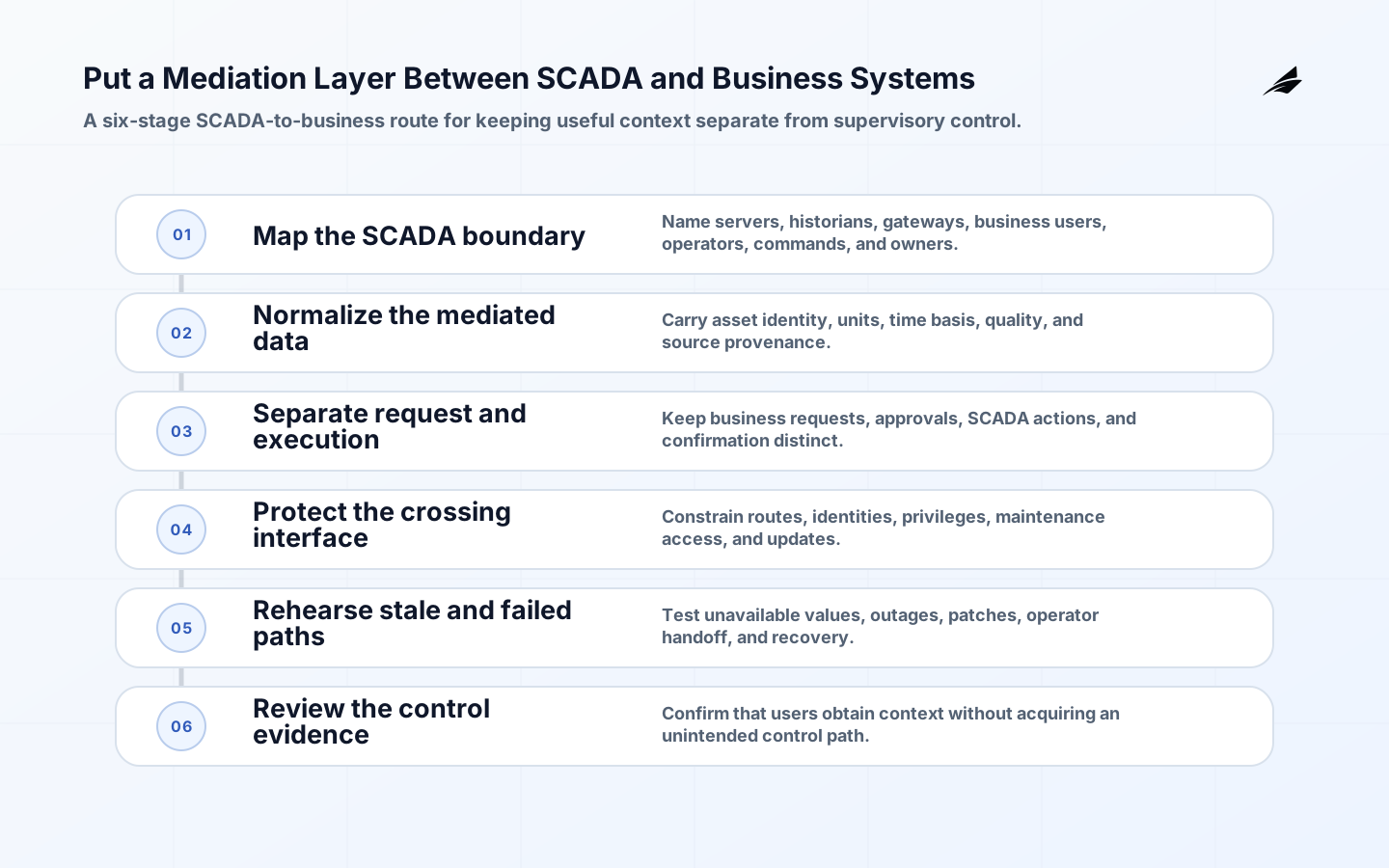
For SCADA work, explicitly classify every exchange as read-only context, bounded request, or control action. A business need for visibility does not establish a need to write into the supervisory environment. Place protocol conversion, validation, rate limiting, and credential mediation at a managed boundary, then test malformed values, unavailable source data, and delayed acknowledgements. Operators should be able to recognize whether an external request was observed, accepted, rejected, or actually confirmed by the workflow side of the interface.
Put a Mediation Layer Between SCADA and Business Systems
Example: Give Maintenance a Historian-Backed View
A maintenance view can be valuable without becoming a control channel. Let a mediator read selected historian values, attach asset identity and quality flags, and expose a read model to the work-management system. If a planner proposes a change, keep the request outside the read path until an authorized operator confirms it through the approved interface. This separation makes it possible to improve the business view without silently changing the control boundary.
Map every value to its source, engineering unit, timestamp, quality state, and update behavior. A stale value should be visibly stale; a substituted value should identify the substitution rule. Avoid treating a missing historian point as zero. The integration should fail closed for commands and fail visibly for observations when required evidence is unavailable.
Review the mediation layer with operators, control engineers, and security owners together. Ask how a late value affects a decision, how an identity change is approved, how the interface is restored after a patch, and how to prove what was displayed when an incident occurred. Shared review prevents a technically elegant connector from becoming an unexplained operational dependency.
NIST SP 800-82 Rev. 3 is the primary OT security reference for SCADA boundaries; the NIST Cybersecurity Framework structures governance and recovery; NISTIR 8259A supports device capability questions; and NIST SP 800-207 reinforces explicit authorization instead of inherited trust.
The SCADA practical guide, its production companion, and the reliability checklist together help teams place this mediation layer in a wider operating model. Across the SCADA mediation boundary, SCADA Integrations for Connected Systems: A Practical Guide clarifies one boundary; SCADA Integrations in Production: Exchange Data Without Creating a Hidden Control Path adds a complementary operating pattern; and SCADA Integrations Checklist for Reliable Digital Operations helps connect the decision to a wider connected-systems workflow.
SCADA Integration Key Takeaways
- SCADA integrations begins with a specific operational decision, not a technology purchase.
- SCADA mediation: make authority, time, quality, identity, and recovery visible at every handoff.
- SCADA mediation: use a documented boundary to reduce accidental paths and unclear ownership.
- SCADA mediation: test degraded operation before a broad rollout relies on it.
- SCADA mediation: measure signals that cause a named review or action.
- SCADA mediation: keep evidence sufficient to explain a result after the moment has passed.
For adjacent OT integration boundaries, compare the mediation approach with A Field Guide to Network Observability for Growing Teams, A Field Guide to Connected Operations for Growing Teams, and Alert Routing Checklist for Reliable Digital Operations. The mediation layer earns its place when a business user can obtain useful context without gaining an accidental path to supervisory control.
SCADA Integration FAQ
How much should the first SCADA integration cover? Cover one bounded exchange end to end, including source validation, command authority, an unavailable dependency, operator handoff, and recovery evidence. The first exchange should prove ownership and evidence without being large enough to create a fleet-wide incident. Is a policy document enough? No. Policy states intent; the operating design must also name enforcement points, exceptions, monitoring, and the people responsible when conditions change. When should SCADA integrations be reviewed? Revisit the SCADA boundary after a material incident, a new device or integration class, changed data sensitivity, or recurring manual workarounds. These signals indicate that the original boundary may no longer fit the work.
Conclusion: Keep SCADA Integration Accountable
Reliable SCADA integration makes the next action clearer under pressure. Make the important SCADA workflow explicit, show its normal and degraded paths, and retain enough evidence to improve it rather than guess. For deeper context, read SCADA Integrations for Connected Systems: A Practical Guide, SCADA Integrations in Production: Exchange Data Without Creating a Hidden Control Path, and SCADA Integrations Checklist for Reliable Digital Operations.