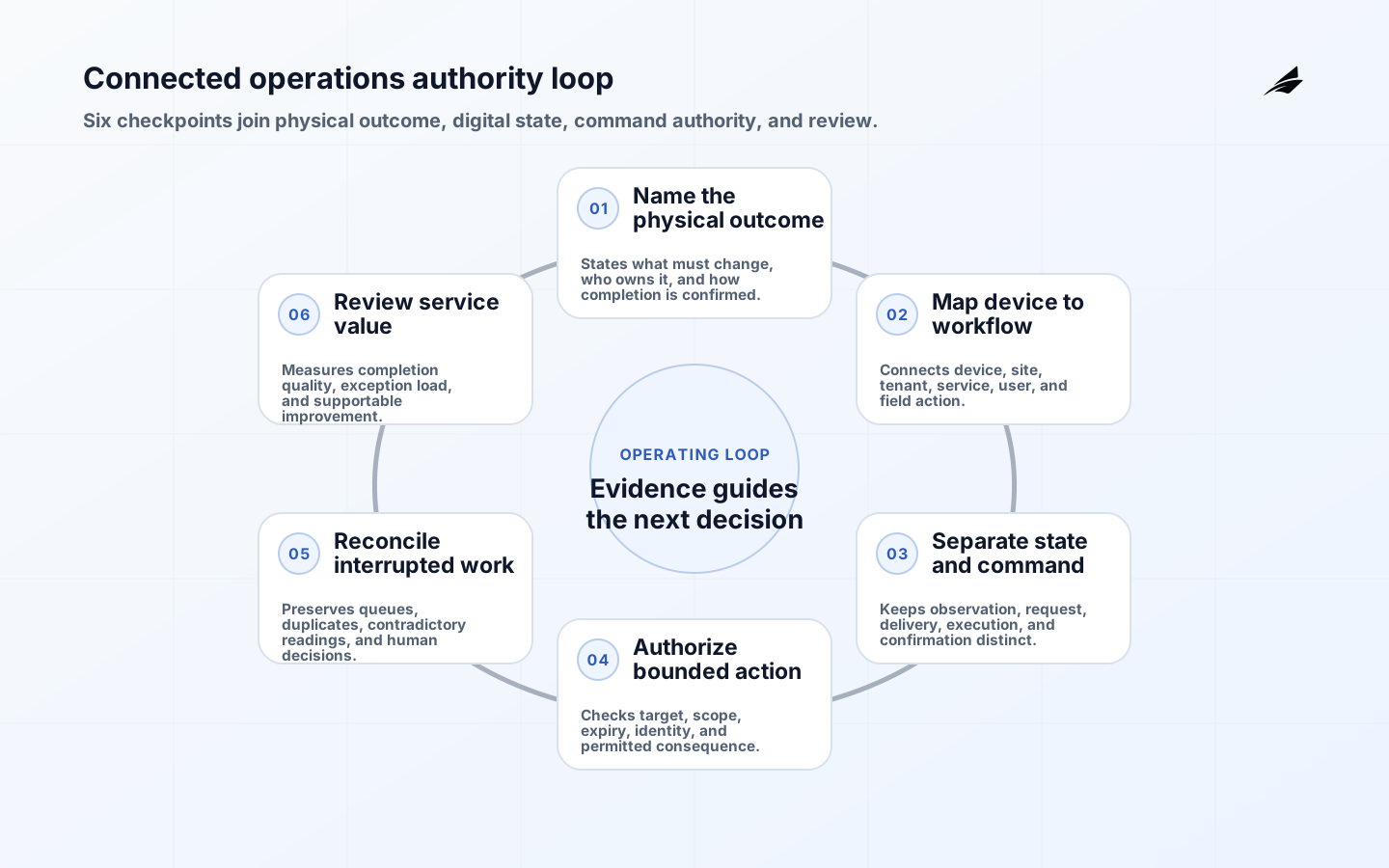
Connected operations turns device observations into work people can understand, authorize, and complete. It is not simply a collection of sensors, a message broker, or a remote-control screen. A useful design connects a physical state to a responsible team, a permitted action, and evidence that the outcome occurred. NIST's IoT device baseline gives a foundation for identification, configuration, data protection, software updates, and state awareness. The operating model decides how those capabilities affect a real workflow such as dispatch, maintenance, quality, or support.
Define the operating outcome first
Name the work that should improve: detect a failed pump, route a technician, hold a shipment, or confirm a remote configuration. Name the owner and condition that changes the decision. Map the path from device to gateway, broker, service, user interface, and field action. A device message has no operational value if nobody can tell whether it is current, trustworthy, or actionable.
Use a concrete scenario to expose hidden assumptions. A warehouse temperature alert may require recent reading, known sensor identity, location, threshold version, customer impact rule, and an authorized person. If one is missing, the workflow may show a red tile while the real action remains unclear. Define the successful outcome and safe degraded state before selecting platforms.
Set boundaries across physical and digital systems
Connected operations crosses teams with different definitions of ownership. The device team may own firmware, network team connectivity, platform team ingestion, and operations the decision. Write seams as contracts: who may send, transform, acknowledge, command, correct, or retire a record. The MQTT 5.0 standard can inform message behavior, but it cannot decide whether a retained value is safe for a business action.
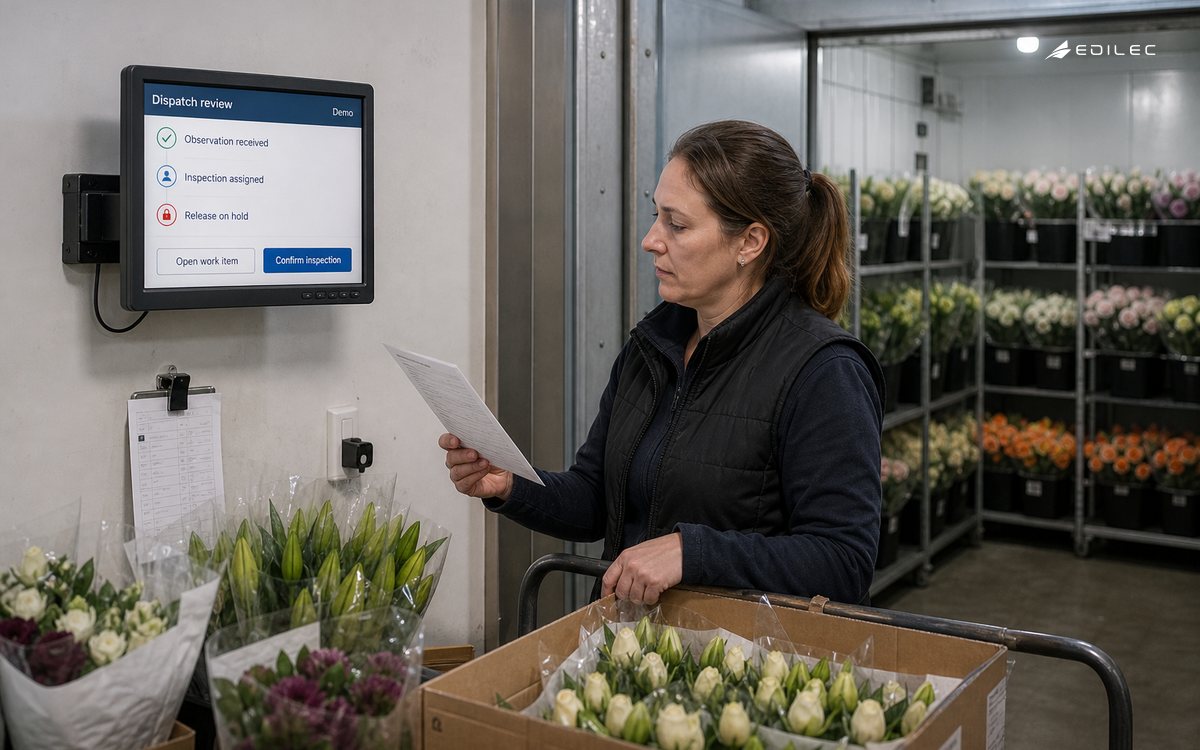
Separate observation from command. A service may know a valve reported open without being authorized to close it. A user may request a command that is accepted by the API but not completed by the device. Preserve request, delivery, execution, and confirmation as different states. This protects operators from assuming that a queued action is a finished physical result.
| Contract area | Decision | Example evidence |
|---|---|---|
| Observation | Meaning, unit, cadence, quality, timestamp | Versioned payload and tests |
| Command | Target, action, authorization, expiry, confirmation | Request and execution records |
| Identity | Device, site, tenant, user, workload mapping | Effective-dated ownership map |
| Recovery | Buffering, retry, reconciliation, manual handoff | Runbook and rehearsal |
Design the connected path for ordinary and degraded work
Architecture should make the normal path, identity, buffering, retries, and failure behavior visible. Put limits around message size, queue age, replay, and command retries. NIST's OT guidance emphasizes that availability and safety constraints shape security decisions; the same logic applies to an IoT operation that must remain safe when cloud access is lost.
Keep device, site, and service identities distinct. A device ID tells which asset spoke; a site or tenant tells where the result belongs; a user or workload identity tells who may act. Record mappings with an effective date so reassignment does not rewrite history. Use the IoT telemetry guide, device identity guide, and offline sync guide when a workflow depends on measurement, authorization, and intermittent networks.
Make data and command contracts explicit
A data contract specifies identifier, unit, range, quality, timestamp meaning, calibration or configuration version, and expected cadence. A command contract specifies target, operation, authorization, expiry, idempotency, delivery state, and confirmation. Put versions in the message or envelope and reject incompatible changes at a visible boundary. This makes a schema change a managed event instead of a parser surprise.
Do not let the UI infer business meaning from a raw number. A value of 0 can mean zero, missing, reset, or device default. Require explicit quality and preserve the source event. When transforming a message, retain source ID, received time, rule version, and transformation reason. The result can then be explained to an operator or customer without reconstructing the pipeline.
Pilot one workflow end to end
Choose a workflow with a clear owner and measurable delay or error today. Include enrollment, normal messages, missed messages, duplicates, a rejected command, reboot, and human handoff. Run it with real operators and limited authority. The first pilot should prove that the system can stop safely, preserve work, and recover without broad access.
Measure completion quality rather than device count. Track time from observation to decision, command to confirmation, stale-state rate, manual exceptions, and cases where an operator lacked context. If the workflow creates more tickets than it removes, refine the boundary or action design. Scale only after unhappy paths are understood.
| Situation | System behavior | Operator action |
|---|---|---|
| Fresh reading | Show value with source and quality | Use within defined decision |
| Delayed reading | Show age and degraded state | Confirm context before acting |
| Rejected command | Preserve reason; do not retry blindly | Correct authority or configuration |
| Reconnection | Reconcile buffered events and pending work | Approve or close each exception |
Use signals that support operational review
Review heartbeat freshness, message acceptance, queue age, duplicate rate, command confirmation, exception backlog, and acknowledgement. Pair each with an owner and response. A high ingestion count can coexist with stale device data; a low error rate can hide commands that never reached an actuator. OpenTelemetry's documentation helps combine traces, metrics, and logs for services, while device evidence needs identity and quality fields.
Make status words stable across dashboard, alert, API, and support conversation. Define healthy, delayed, stale, blocked, rejected, and unknown. Review status changes against field reality. If the system says a command completed while a local controller shows no change, the response is reconciliation and containment, not a quiet status correction.
Design recovery and human handoffs
Connected operations need an explicit human route for network loss, device replacement, credential expiry, and contradictory readings. Preserve the work item and context, then route it to a person with authority. A technician should not need unrestricted production access to see last confirmed state, pending commands, or reason for a hold. A supervisor should approve exceptions with reason and expiry.
Reconciliation should be explicit. When a site reconnects, compare buffered events, commands, and current state; do not replay every operation blindly. Idempotency keys, command expiry, and review queues limit old requests causing new physical action. Keep evidence of what was received, applied, rejected, or unknown so the final record is honest.
Keep ownership visible as the system grows
Document product, device, site, service, security, and support owners. Review vendor access, replacement, firmware, threshold, and tenant moves. The connected operations checklist and device identity guide help when responsibilities cross a platform boundary.
Governance can be a short cadence: review incidents and exceptions, retire unused identities, test a failure path, and approve material contract changes. Keep evidence to answer who changed a threshold, which devices were affected, and whether the physical outcome was verified. This keeps the service adaptable without making every change a committee exercise.
A connected-operations field scenario
Use a work-item model that keeps the physical event, digital task, and human decision connected. A message can create a task without authorizing a command; a technician can close a task without proving a device changed state. Store those transitions separately and expose the current state with its last confirmed evidence. This gives operations a reliable place to resume work after a handoff or outage.
A connected workflow should have a deliberate boundary for automation. Automate classification, enrichment, and routing when the consequences are bounded; require a human gate where the action changes safety, customer entitlement, or physical state. Make the gate specific: name the evidence a reviewer sees, the authority they hold, and the expiry of their decision. A generic approval button does not make an unsafe action accountable.
Site context deserves its own lifecycle. Devices move, areas are renamed, customers change, and maintenance zones are temporarily isolated. Preserve historical site assignments with effective dates rather than rewriting old events. When an alert is routed, use the assignment that was active when the observation occurred and show any current reassignment separately. That keeps field records and customer explanations aligned.
Connected operations benefits from a clear exception taxonomy. Separate stale data, bad data, missing device, policy denial, command timeout, physical mismatch, and human review. Each category should have a route, target response time, and closure evidence. Otherwise every exception becomes a generic ticket and the team loses the ability to improve the part of the system that is creating the work.
Use a small command budget for early releases. Limit actions by device, site, time window, rate, and cumulative effect. Require idempotency and show whether a command was requested, delivered, executed, or confirmed. This makes a remote action reversible in practice and prevents a retrying service from turning a temporary link problem into repeated physical changes.
Review connected operations with field staff after real exceptions, not only in architecture meetings. Ask which context was missing, which status was misleading, and which handoff created delay. Feed those findings into contracts, alerts, and runbooks. The service improves when operational knowledge becomes a visible design input rather than remaining in a technician's memory.
Key connected-operations takeaways
- Define the physical or customer outcome before choosing the platform.
- Separate observation, request, delivery, execution, and confirmation.
- Give each identity and boundary an owner and effective date.
- Make degraded behavior visible and safe for people in the workflow.
- Scale only after recovery and reconciliation are rehearsed.
Frequently asked connected-operations questions
Is connected operations the same as IoT monitoring?
Monitoring observes conditions. Connected operations uses conditions to drive accountable work, decisions, and sometimes commands. It must define authority, timing, handoffs, and recovery in addition to collecting telemetry.
Should every connected system support remote commands?
No. A read-only design may be safer and more valuable for a first release. Add commands only when target identity, authorization, expiry, idempotency, physical safeguards, and confirmation are explicit and tested.
Conclusion: connected operations in practice
Connected operations works when the physical signal, digital record, human decision, and recovery path agree. Keep contracts explicit, identities scoped, and degraded states visible so the service remains useful when the network, device, or operator path is imperfect.