Data Lineage Controls for Traceable Analytics
Data lineage explains how a team can make data lineage dependable before the work becomes difficult to reverse. Data lineage uses a decision with a named owner, bounded action, visible state, and inspectable evidence.
Define the data lineage decision
Data lineage is ready for a controlled release when the team can state what is authoritative, which context permits action, what must be retained, and how an exception reaches a responsible person. Data lineage uses a provisional state when evidence is incomplete; Data lineage never turns an unanswered question into a silent default.
Data Lineage Controls for Traceable Analytics
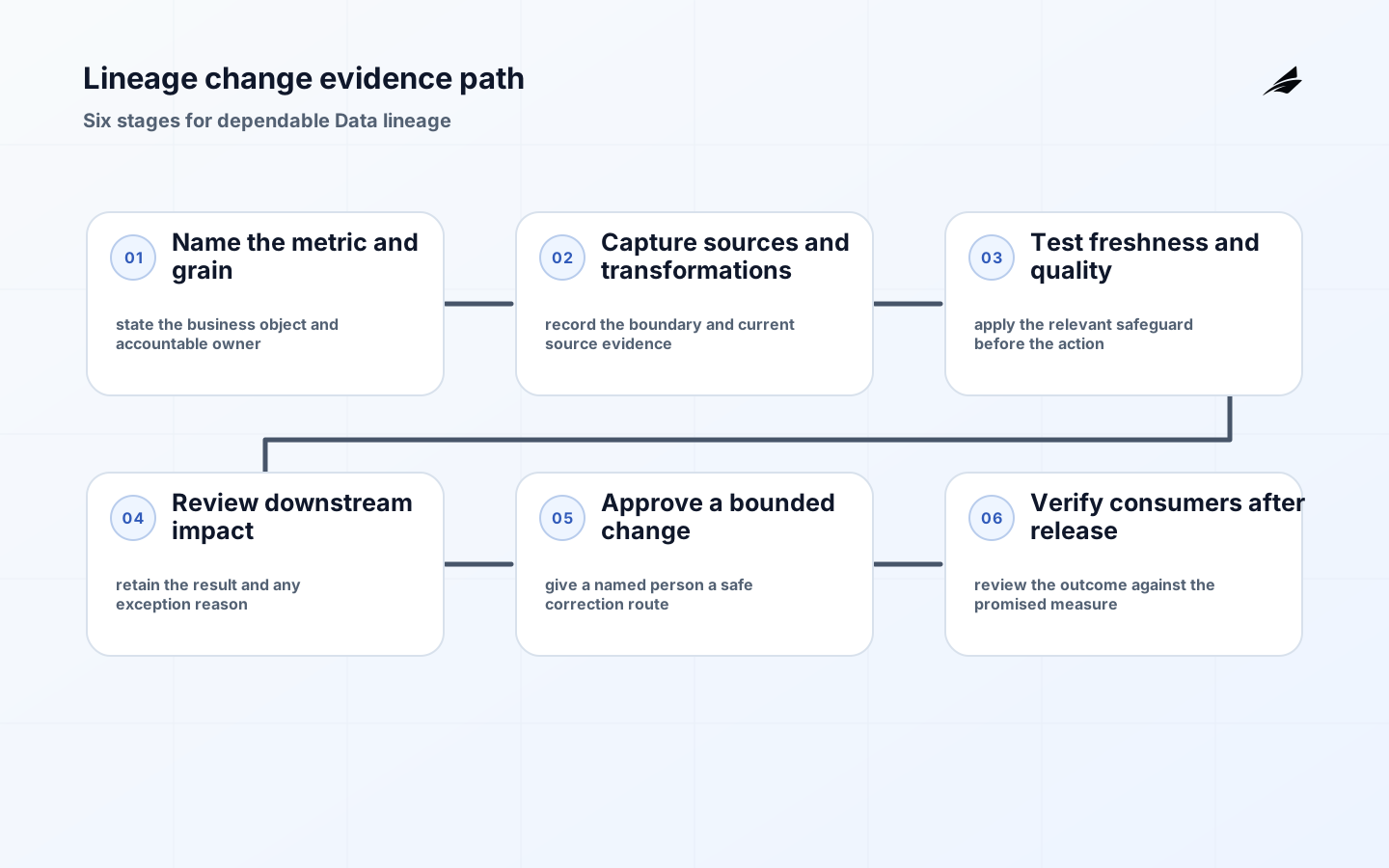
- For data lineage, frame one consequential business object and one accountable owner.
- For data lineage, capture metric provenance at the boundary where a request becomes an approved operational action.
- For data lineage, test the source-to-decision trace route with missing, late, duplicate, denied, and corrected inputs.
- For data lineage, review downstream impact before a change reaches a reader, customer, employee, supplier, or device.
- For data lineage, approve a bounded correction with a named resolver, deadline, and retained reason.
- For data lineage, verify the released result against the promised measure and record what remains uncertain.
Controls and evidence for Data lineage
Treat lineage controls as a chain of evidence rather than a label attached after a report is published. Register each source and dataset with an accountable owner, business definition, update expectation, access boundary, and stable identifier. Record the transformations, jobs, or activities that create a derived value, together with run time, status, input versions, and the resulting dataset. OpenLineage facets can carry operational metadata about runs and datasets, while the W3C PROV model provides useful vocabulary for connecting entities, activities, and agents. A control is incomplete when it shows only a graph: operators also need the failed check, affected consumers, approved disposition, and recovery reference. Preserve prior lineage when a definition or source changes, and make the effective time of the new interpretation explicit so a reviewer can distinguish a corrected result from a rewritten history.
| Decision point | Evidence to retain | Owner response |
|---|---|---|
| Normal case | The input, rule, actor, timestamp, and outcome for a reported metric. | Confirm the result and publish its status. |
| Exception | The failed check, affected scope, safe options, deadline, and disposition. | Route the case to the data product steward without overwriting history. |
| Change | The previous behavior, new definition, approval, effective time, and rollback point. | Reconcile the affected records before expanding scope. |
Test Data lineage before rollout
- For data lineage, trace one case from intake through the final decision and observable outcome.
- For data lineage, replay a normal case and an exception case while preserving metric provenance and the responsible actor.
- For data lineage, ask an operator outside the build team to explain the source-to-decision trace route without private context.
- For data lineage, measure completion quality, exception age, recovery time, and evidence completeness by owner.
- For data lineage, check that a correction reaches every affected consumer without rewriting the original event.
- For data lineage, record the next review date, escalation route, and condition for safely expanding scope.
Before rollout, exercise lineage with representative normal and exceptional runs rather than inspecting only a successful graph. Trace a metric from its declared source through each transformation to the decision or report that consumes it, and verify that the recorded owner can explain the path without private build-team knowledge. Include missing, late, duplicate, corrected, and access-denied inputs; test whether the system marks uncertainty, limits downstream use, and preserves the original event. Replay a correction or backfill and compare the new lineage with the prior version, including affected consumers and effective time. Where dbt sources are used, compare declared source metadata and freshness expectations with the observed run record. Have an independent operator review the evidence and record unresolved gaps, escalation route, and the condition for expanding the release.
Implementation notes for Data lineage
Implementation starts with identifiers that survive ordinary pipeline work. Give each dataset, job run, source version, and published metric a stable reference, and record the relationships among them as events occur rather than reconstructing them from a dashboard later. An OpenLineage event can describe the run, its inputs and outputs, and relevant facets; W3C PROV terms help distinguish the data entity, the activity that changed it, and the responsible agent. Capture schema or definition versions, event time, processing time, status, and the owner who can resolve a failure. Keep lineage emission separate from business-result publication so a failed metadata write cannot silently change the data outcome. Store enough context to link a derived metric to its source declaration and transformation, while respecting access controls for sensitive fields. The resulting record should support both operational triage and a later audit without exposing unnecessary payload data.
Treat a lineage change as an operating change whenever a source, schema, transformation, metric definition, or consumer contract moves. First identify the affected entities and decisions, then record the previous behavior, proposed definition, approver, effective time, and rollback reference. A correction should create a new event or version that points back to the original record; it should not overwrite the evidence that explained an earlier report. For backfills, distinguish historical reconstruction from a current-state correction and identify which consumers must be recomputed or notified. Re-run source, transformation, and downstream checks before widening the change, and retain the result of each review with the responsible owner. When a dependency is late or unavailable, publish a provisional state with an explicit expiry or escalation path. This keeps recovery bounded while allowing operators to see exactly which result is authoritative for each period.
Make lineage useful after launch by reviewing both evidence quality and the work it enables. Track whether important datasets and metrics have an owner, source reference, transformation path, freshness state, and usable correction route; also review exception age, recovery time, and completeness of decision records. Sample traces across normal releases, delayed inputs, schema changes, and corrected results so a dashboard cannot hide a broken relationship. The accountable operator should be able to explain why a value was published, which consumers relied on it, and what would happen if its source were withdrawn. Use the NIST interoperability vocabulary as a prompt to clarify shared definitions and boundaries, while keeping local controls explicit. A review should end with a bounded decision: continue, constrain, revise, or retire the lineage flow, with the changed owner, evidence gap, and next review date recorded.
| Operational question | Evidence to retain | Owner response |
|---|---|---|
| What proves data lineage is ready? | For data lineage, a dated metric provenance decision record connects the input, rule, actor, result, and review. | Confirm the evidence before widening scope. |
| What happens when data lineage is uncertain? | For data lineage, the system marks the state, limits the action, names the resolver, and preserves prior context. | Route the exception without erasing history. |
| How is data lineage corrected? | For data lineage, the correction names the changed fact, affected readers, approval, effective time, and verification result. | Reconcile consumers and close the case. |
| Which measure protects data lineage? | For data lineage, track completion quality, exception age, recovery time, and evidence completeness by owner. | Review the trend with the accountable operator. |
| What should be rehearsed for data lineage? | For data lineage, test normal completion, missing data, duplicate input, denied access, delayed dependency, and reversal. | Record the scenario outcome and remaining risk. |
| When may data lineage expand? | For data lineage, expand only after representative normal and exceptional cases pass with a usable correction route. | Approve the next bounded use explicitly. |
Retain lineage evidence at handoff
A lineage implementation is not complete when a graph first renders. The handoff should preserve the dataset identifier, producing job and version, source snapshot or event range, transformation revision, quality result, publication time, and the owner who accepted the output. Keep the evidence queryable from the business metric back to the source record, including manual corrections and backfills. When a definition changes, record which historical periods were recalculated and which remain under the prior rule. This evidence lets analysts explain a disputed number without reconstructing the pipeline from logs, and it gives engineers a bounded starting point when freshness, completeness, or authorization fails.
Key takeaways for Data lineage
For data lineage, keep the owner, authoritative state, permitted action, evidence boundary, and recovery route visible. For data lineage, pause the normal path when proof is missing and show how a corrected result reaches each affected reader.
Data lineage FAQ
For data lineage, what should a team settle first? Data lineage teams should start with the accountable owner, authoritative state, permitted action, evidence boundary, and recovery route. For data lineage, ask which operator can pause the normal path, what proof they need, and how correction reaches each affected reader.
A dependable Data lineage operating rule
For data lineage, keep the first release narrow, measurable, and owned. For data lineage, a result earns its next use only when it can be explained, challenged, corrected, and reviewed by the right person.
For data lineage, consult these official references for the operating choices in this guide: OpenLineage facet specification; W3C PROV overview; dbt documentation: sources; NIST Big Data Interoperability Framework: Volume 1 Definitions. data lineage related guide 1; data lineage related guide 2; data lineage related guide 3