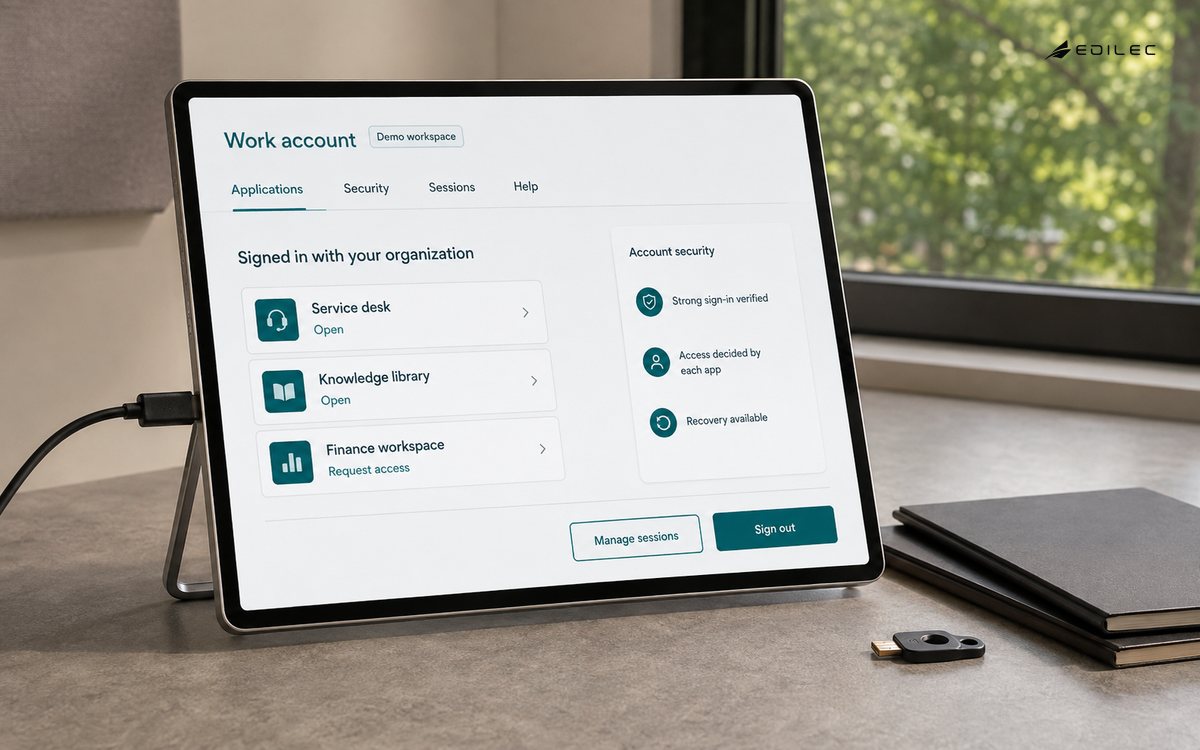
SSO meaning for companies matters to IT managers coordinating access across several teams and applications. In practical terms, it is a federated authentication arrangement where a user signs in with a trusted identity provider and can access participating applications without maintaining a separate password for each one. That definition is more useful than a product label because it points to decisions a team can test: what the boundary is, what information is trusted, which failure conditions are acceptable, and who responds when the normal path breaks. The related concerns of identity provider, federated authentication, access lifecycle management should be designed as part of the operating model, not appended after an initial launch.
What SSO meaning for companies means
SSO meaning for companies should be explained in the language of responsibilities and observable behaviour. SSO centralises authentication, not every authorisation decision. The identity provider establishes who the person is and may provide group or attribute claims. Each application still needs to decide what that person can see or do, how it handles inactive accounts, and what happens when the identity service is unavailable. A useful definition therefore includes the information that crosses the boundary, the actors allowed to change it, the evidence retained, and the conditions in which the system refuses to proceed. That gives practitioners a way to challenge vague requirements before they become fragile implementation assumptions.
Architecture decisions to make first
The architecture is not a diagram of components alone. It is the set of contracts that lets IT managers coordinating access across several teams and applications operate the capability repeatedly. Make the following decisions explicit before choosing a platform feature or writing an integration. Each one affects the likely failure mode, the test plan, and the people who will need evidence later.
| Decision | What to define |
|---|---|
| Identity authority | Choose the directory or identity provider that owns workforce identity and lifecycle events. |
| Protocol and claims | Use a supported federation protocol and request only claims an application needs. |
| Application authorization | Map identity to local roles and resource rules without granting broad access by default. |
| Recovery and continuity | Design administrator recovery, break-glass controls, logout, and identity-provider outage behaviour. |
Implementation path
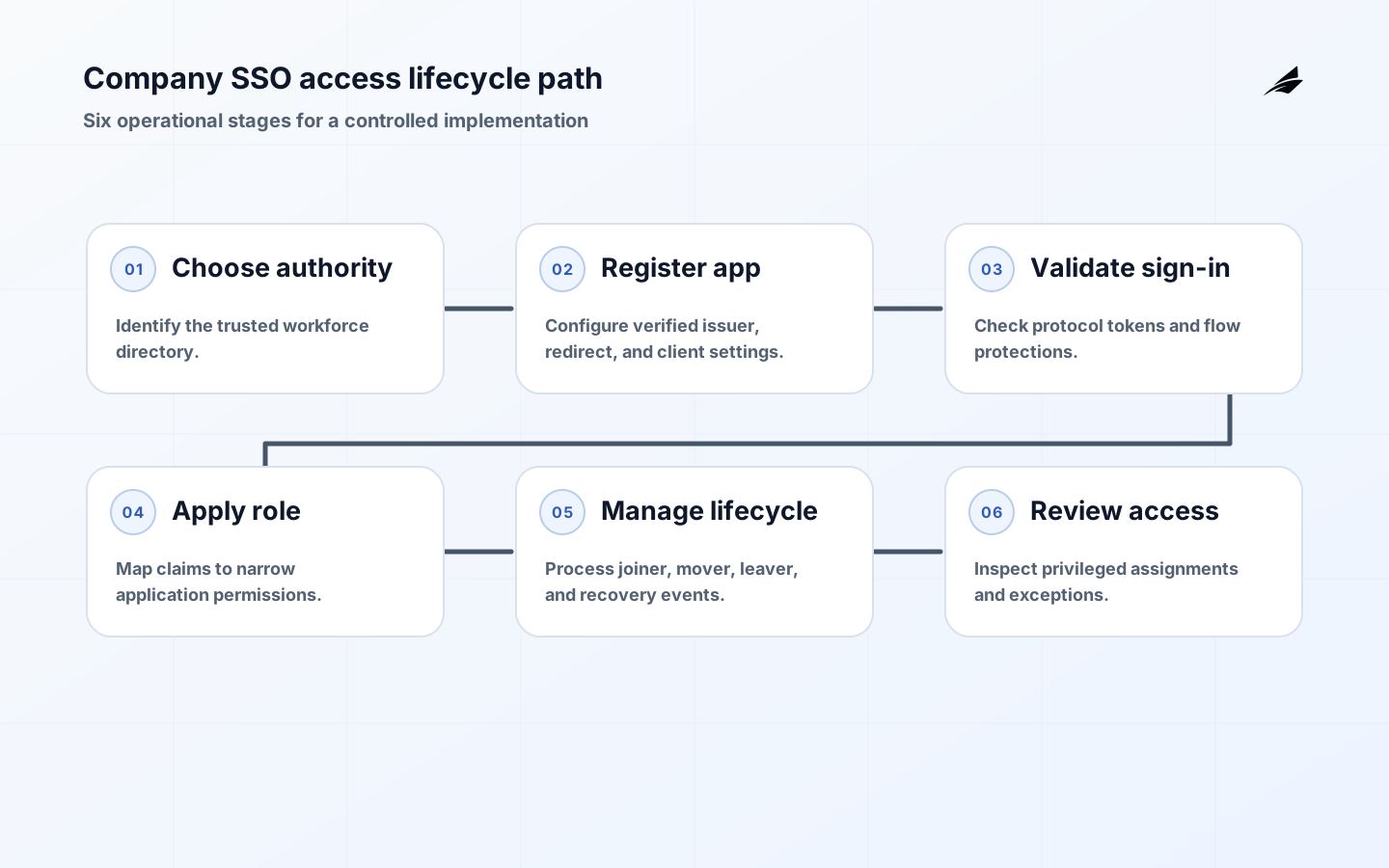
- Inventory applications, user populations, data sensitivity, and existing authentication paths.
- Define joiner, mover, and leaver events that must change access.
- Register applications with exact redirect URIs, validated issuers, and narrow client permissions.
- Validate issuer, audience, signature, expiry, and nonce or state as applicable to the protocol.
- Use least-privilege group and role mappings, with periodic review of high-risk access.
- Test deprovisioning, recovery, logout, and identity-provider outage before broad rollout.
Build a thin, inspectable path first. It should include the unpleasant cases as well as the demonstration case: a missing identifier, a delayed message, an expired credential, a rejected record, or an unavailable dependency. Give that path named inputs and outputs, a clear retry or escalation rule, and a way to prove what happened. This is where identity provider becomes operational rather than aspirational.
Risks and controls
The phrase “one login” can hide dangerous shortcuts. Never treat a decoded identity token as trustworthy until the application validates the issuer, intended audience, signature, expiry, and relevant flow protections. Avoid using email address alone as the immutable account key because addresses can change or be reassigned. Provisioning and deprovisioning must be tested as business processes, not assumed from a directory sync.
| Operating signal | What it shows |
|---|---|
| Application federation coverage | Participating applications with a reviewed supported integration. |
| Deprovisioning latency | Time from identity lifecycle event to loss of access in each application. |
| Authentication failure rate | Failures by cause, including configuration and user-recovery paths. |
| Privileged access review completion | Timely review of administrator and break-glass assignments. |
Review and measurement
Measurement should tell the team whether SSO meaning for companies is still meeting its contract, not merely whether infrastructure is running. Review the signals in the table with the owner who can change the workflow. Look at trends, samples of failures, and the gap between detected and resolved issues. When a metric changes, follow the evidence back to the contract, implementation version, and real user or device behaviour before declaring a fix.
- Set a service objective for the consequence that matters, not only a technical average.
- Sample successful and failed cases to verify that federated authentication is understandable.
- Make a named owner responsible for triaging exceptions and publishing the resolution.
- Review access, configuration, and retention choices whenever the process or fleet changes.
- Use controlled tests to rehearse recovery before an incident requires improvisation.
Operational scenario
A company rolls out a new case-management tool for employees and external contractors. Employees sign in through the workforce identity provider, while contractors use a separate approved identity population. Both may reach the same application but should not automatically receive the same roles, data scope, or recovery process. The application needs its own explicit mapping and deprovisioning checks. This is closely connected to RBAC meaning in software: federation answers who authenticated; authorisation answers what that identity may do now.
Evidence and testing
Keep a per-application integration record containing issuer, client identifier, redirect locations, requested claims, group or role mappings, owners, supported protocol flow, and tested recovery behaviour. Test an account removal at the identity source and verify that every relying application loses access within the stated window. Record exceptions, such as service accounts or emergency administrators, with an owner and expiry. These records are more valuable than a diagram alone when a team needs to diagnose a claim mismatch or an offboarding gap.
Design review questions
At design review, verify that login hints and email addresses are not being used as proof of identity without protocol validation. Confirm that the application rejects tokens intended for another audience and that a revoked or inactive user cannot continue through a stale local session beyond the documented limit. Consider operational dependency too: who can access the identity provider during an outage, who can approve break-glass use, and how the organisation learns that an emergency path was used.
Practical operations
Roll out SSO application by application with a measured migration plan. Start with a low-risk group, compare expected and actual claims, test first-login account linking, and keep a documented recovery route while adoption grows. Do not silently merge accounts only because email text matches; use a deliberate mapping and review collisions. Include administrators, contractors, and service accounts in the plan because they often follow different lifecycle rules. The end state should reduce unmanaged credentials while preserving a clear explanation of where each application gets identity and permissions.
Limits and tradeoffs
Central authentication creates a dependency that must be operated thoughtfully. Plan for identity-provider degradation, certificate rotation, metadata updates, and changes in directory group membership. A short, bounded local session may preserve a safe read-only function during an outage, whereas a high-risk approval should fail closed. The right continuity choice depends on the action and its consequences, so document it at the application boundary instead of making it an accidental browser-session behaviour.
- Name the accountable owner before adding another integration or policy.
- Keep a representative failure test beside the normal acceptance test.
- Record the version of the contract, configuration, or rule in use.
- Use evidence from real operations to improve the next release.
- Make temporary exceptions visible, approved, and time-bounded.
- Review the boundary whenever the business process or fleet changes.
Adoption and change management
Acquisitions, contractor onboarding, application migration, and incidents at the identity provider are the moments when a seemingly simple sign-in design is tested. Prepare for them with a small change record that names the proposed change, contract or policy version, expected operational effect, affected owners, test evidence, rollout window, and reversal decision. Give users and support teams a plain-language explanation of the behaviour that will change, especially where a new denial, warning, or data-quality status can be mistaken for a defect. Monitor the first production cases closely and compare them with the pre-change baseline. When an exception appears, decide whether it is a valid new requirement, a training issue, a data defect, or a control that must remain firm. This practice keeps SSO meaning for companies connected to the people who operate it. It also prevents a series of urgent local fixes from becoming an undocumented alternate system. Retire obsolete rules and integrations deliberately, preserve the evidence needed for a later review, and update runbooks so the next team member inherits a working explanation rather than a collection of historical assumptions.
Key takeaways
- SSO meaning for companies is a contract between technical components, people, and operations.
- Define boundaries and ownership before optimising a tool or interface.
- Treat federated authentication as a first-class output, with evidence for failure and recovery.
- Make exceptional conditions testable and visible to an accountable owner.
- Revisit the contract as customers, devices, data, or regulations change.
Frequently asked questions
Is SSO the same as a password manager?
No. A password manager stores and fills distinct credentials. Single sign-on delegates authentication to a central identity provider using a federation protocol. An organisation may use both, especially while applications that cannot federate remain in service.
Does SSO eliminate the need for MFA?
No. SSO is a route for authentication; multi-factor authentication adds assurance to that authentication. Centralising MFA at the identity provider often improves consistency, but privileged or high-risk actions can require additional controls.
Conclusion
SSO is valuable when it makes identity lifecycle safer and easier to operate across applications. Treat it as an identity architecture: validate federation messages, maintain local authorisation boundaries, and rehearse the recovery paths that teams will need under pressure.