Engineering Procurement Software for Enterprise Systems
Engineering procurement software is a distributed state machine with a financial side effect. A request can be submitted twice, approved under a stale policy, acknowledged by one system while rejected by another, or retried after the commitment already exists. The engineering goal is not merely a faster form; it is a contract that keeps identity, authority, idempotency, reconciliation, and recovery explicit. This playbook pairs implementation details with the enterprise procurement guide, the founder guide, and the document routing architecture guide.
Model the financial consequence

Define the command that changes money or supplier obligation, then model every state before it. Request creation, policy evaluation, approval, order creation, supplier acknowledgement, receipt, invoice match, and cancellation are not interchangeable. Keep the business state separate from transport state so a message retry cannot masquerade as a completed purchase.
Write invariants such as “one approved request produces at most one order for a given commitment key” and “a revoked approval cannot authorize a new release.” The NIST Cybersecurity Framework 2.0 PDF can help frame outcomes and responsibility, while the implementation must enforce the invariant at the state boundary.
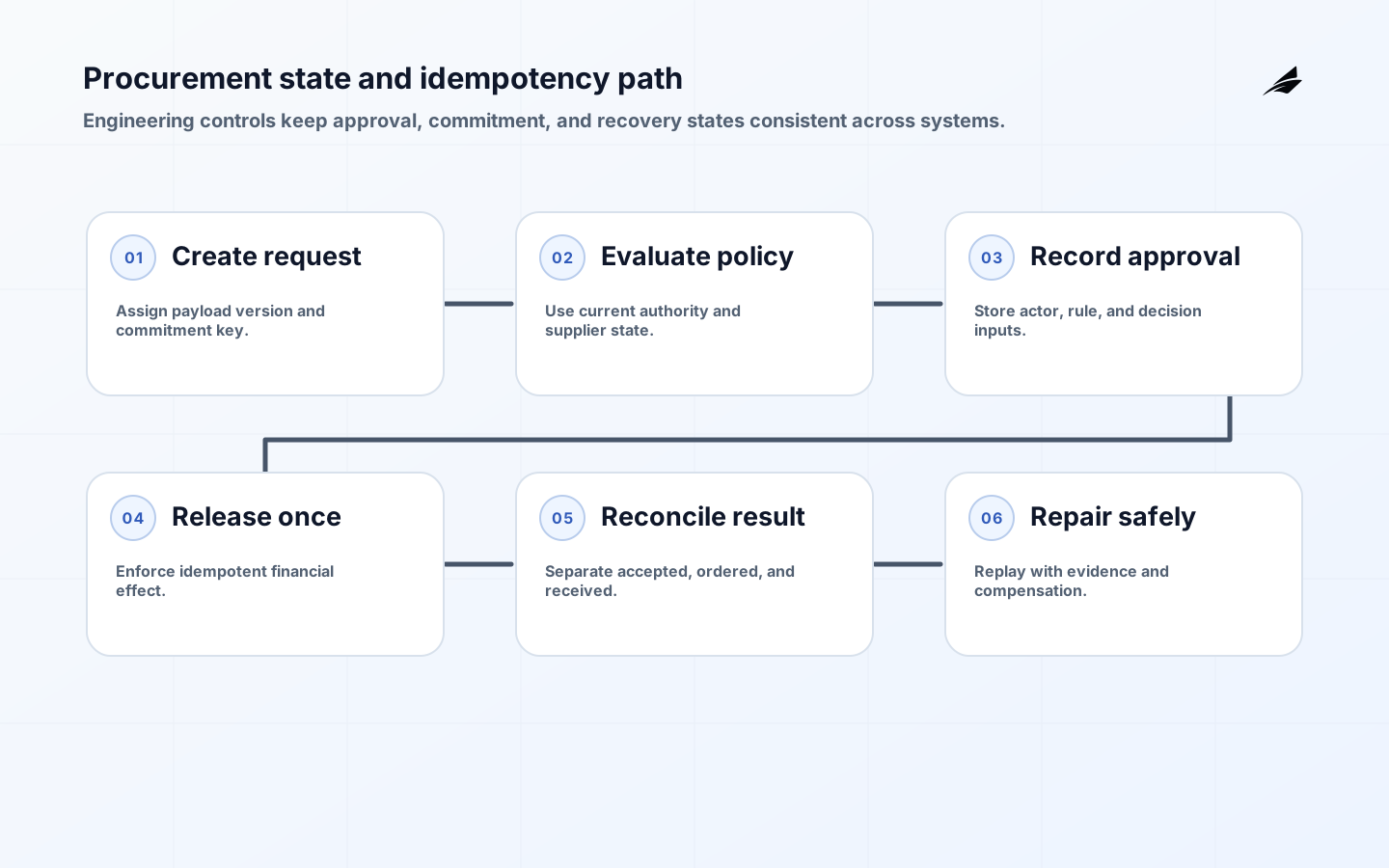
Give every request a durable identity
Use a request ID, commitment key, supplier ID, policy version, and actor identity. Make idempotency keys deterministic for a business action and store their result long enough to cover realistic retries and reconciliation. Do not derive identity from a mutable description or UI session.
Version the payload when fields affect policy or downstream mapping. Preserve the original request and each correction; an updated amount should not silently rewrite the approval evidence. Test duplicate create, duplicate approve, and duplicate release calls with the same key and with conflicting payloads.
Enforce policy where effects happen
A front-end check improves user feedback but cannot be the final authority. Re-evaluate policy at the release boundary using current supplier, budget, authority, and request state. Record the inputs and policy version that produced the result. The NIST SP 800-63 Digital Identity Guidelines are relevant when a service must distinguish authentication from the authority to approve a consequential action.
Keep rule evaluation deterministic enough to replay. If a policy decision depends on mutable external data, snapshot the relevant value or record its effective time. A later reviewer should be able to tell whether a changed budget, role, or supplier status caused the release to stop.
Use contracts across procurement systems
Define schemas for request, supplier, approval, order, acknowledgement, receipt, invoice, and cancellation. Make optional and required fields explicit, declare enum meanings, and state whether consumers tolerate new values. The ERP, supplier portal, identity provider, and finance ledger should share correlation context.
Do not use a generic “success” field when the downstream system distinguishes accepted, created, submitted, rejected, and reconciled. Contract tests should cover missing identifiers, old policy versions, currency precision, timezone, and a downstream response that arrives twice.
Make retries and compensation safe
A timeout after order creation is the classic failure. Query by commitment key before creating again, or use an idempotent downstream operation if available. When a later step fails, choose whether to retry, compensate, or hold for a person. Compensation is not deletion: it may create a cancellation, reversal, or supplier communication that needs its own authority.
The NIST Secure Software Development Framework is a useful source for verification and secure development practices, but teams still need workflow-specific fault tests. Exercise network partitions, worker restarts, message duplication, partial writes, and a supplier API that returns an ambiguous response.
Protect dependencies and build evidence
Record dependency versions, configuration, policy artifacts, and software component evidence for releases that can affect purchasing. The CISA Software Bill of Materials reference is useful for understanding why component visibility matters, especially when a workflow handles supplier and payment data. Keep secrets out of logs and restrict administrative replay tools.
An audit event should include request reference, action, actor or service identity, rule version, decision, timestamp, downstream reference, and correction link. Avoid logging full contracts or bank details into a broadly accessible event stream. Evidence is strongest when it is both complete enough to reconstruct the action and narrow enough to protect sensitive material.
Test the operating path, not only APIs
Use contract, component, integration, and scenario tests. Scenarios should include stale approval, changed amount, revoked user, duplicate event, delayed supplier response, invoice mismatch, cancellation after receipt, and a repair that is retried. Seed realistic state transitions and assert the final business effect, not just HTTP status.
Run a failure drill with an operator who has limited production access. The operator should be able to find the affected request, see the safe options, and escalate without editing tables directly. Keep replay and repair permissions separate from ordinary support access.
Release with reversible authority
Use feature flags or bounded routing to introduce a new policy or downstream connector. Compare decisions and reconciliation results before switching the authoritative path. Define how to stop new releases, drain in-flight work, and restore the prior policy or connector.
A rollback plan must mention financial records, supplier communications, and open approvals. Code rollback alone may leave an order or invoice in the new world. Keep the release record with the policy and schema changes so finance and engineering share the same version history.
Measure state quality after launch
Monitor duplicate-key conflicts, approval-to-order latency, ambiguous acknowledgements, reconciliation gaps, correction age, and manual database intervention. Segment by supplier, connector, policy, and currency. A low error count can coexist with a serious blind spot if a system reports “accepted” too early.
Review an ordinary request and an interrupted request each cycle. The system is improving when fewer cases need private repair and when the remaining exceptions arrive with enough context for a safe decision. Use the NIST Cybersecurity Framework 2.0 PDF as a governance prompt, not as a substitute for local evidence.
| State | Invariant | Evidence |
|---|---|---|
| Requested | Request identity and payload are stable | Request ID and payload version |
| Approved | Authority and policy inputs are recorded | Actor, rule version, timestamp |
| Committed | One business effect per commitment key | Order reference and idempotency result |
| Reconciled | Downstream outcome matches the request | Acknowledgement, invoice, correction |
Key takeaways
- Model the financial effect and invariants before designing screens.
- Use durable identity, idempotency, versioned contracts, and replayable evidence.
- Re-check authority and policy at the effect boundary.
- Test ambiguous downstream responses and operator repair.
- Roll out with a plan for open requests, supplier messages, and financial reconciliation.
| Scenario | Expected behavior | Proof |
|---|---|---|
| Duplicate release | No second order is created | Stable key and original result |
| Stale approval | Release stops or requires reapproval | Policy version comparison |
| Ambiguous timeout | Operator sees safe next step | Query or hold state |
| Invoice mismatch | Reconciliation exception owns the case | Linked order and invoice evidence |
Frequently asked questions
Where should idempotency be enforced? At every boundary that can repeat a consequential business action, with a durable business key and a stored result or safe lookup path.
Is an API success response enough to mark an order complete? No. It may only mean the downstream service accepted the message. Track creation, acknowledgement, receipt, invoice match, and correction as separate business states.
What belongs in a procurement audit event? The request and commitment references, acting identity, policy and payload versions, decision, timestamps, downstream reference, and correction link, while excluding unnecessary sensitive document content.
Use reconciliation as a standing capability. Compare approved amount with order amount, order with receipt, receipt with invoice, and invoice with payment. Detect missing or contradictory links before a month-end close. Segment mismatches by connector and policy version. A reconciliation queue with owners and deadlines is safer than an exception report that no team has agreed to work.
Operational tooling should expose safe actions rather than raw database power. Let support find a request, inspect the last trusted state, query by commitment key, and choose a reviewed retry, hold, compensation, or escalation. Restrict bulk repair and require a reason. NIST's Secure Software Development Framework provides a baseline for integrating secure practices into the software lifecycle. Keep release and repair evidence linked so operators can explain what changed, why it was authorized, and how the system recovered.
Contract evolution matters when finance, suppliers, and ERP systems move at different speeds. Add fields compatibly, tolerate unknown values where safe, and make a new state visible only after every consumer has a meaning for it. Record currency precision, effective time, and source system. A schema that validates successfully can still change the commercial interpretation if the unit or status semantics are vague.
Engineering teams should treat procurement state as business data, not a side effect of transport. Keep immutable request and approval evidence, then derive operational states from explicit events or transactions. If a downstream connector cannot provide an idempotent operation, put a lookup-and-reconcile step around it and make the ambiguity visible. The repair path should have its own command, permission, audit event, and tests.
A connector should expose the business reference it used, not only its own message ID. This lets reconciliation find an order when a supplier system changes its identifier or returns a response after a retry. Keep the mapping immutable and include it in repair tooling. An engineer should never need to infer commercial identity from a timestamp or a free-text description.
Conclusion
Procurement engineering is successful when a repeated message cannot create a repeated financial effect and an operator can repair a disputed state safely. Model the invariants, test ambiguous responses, and release with reconciliation and rollback in view.