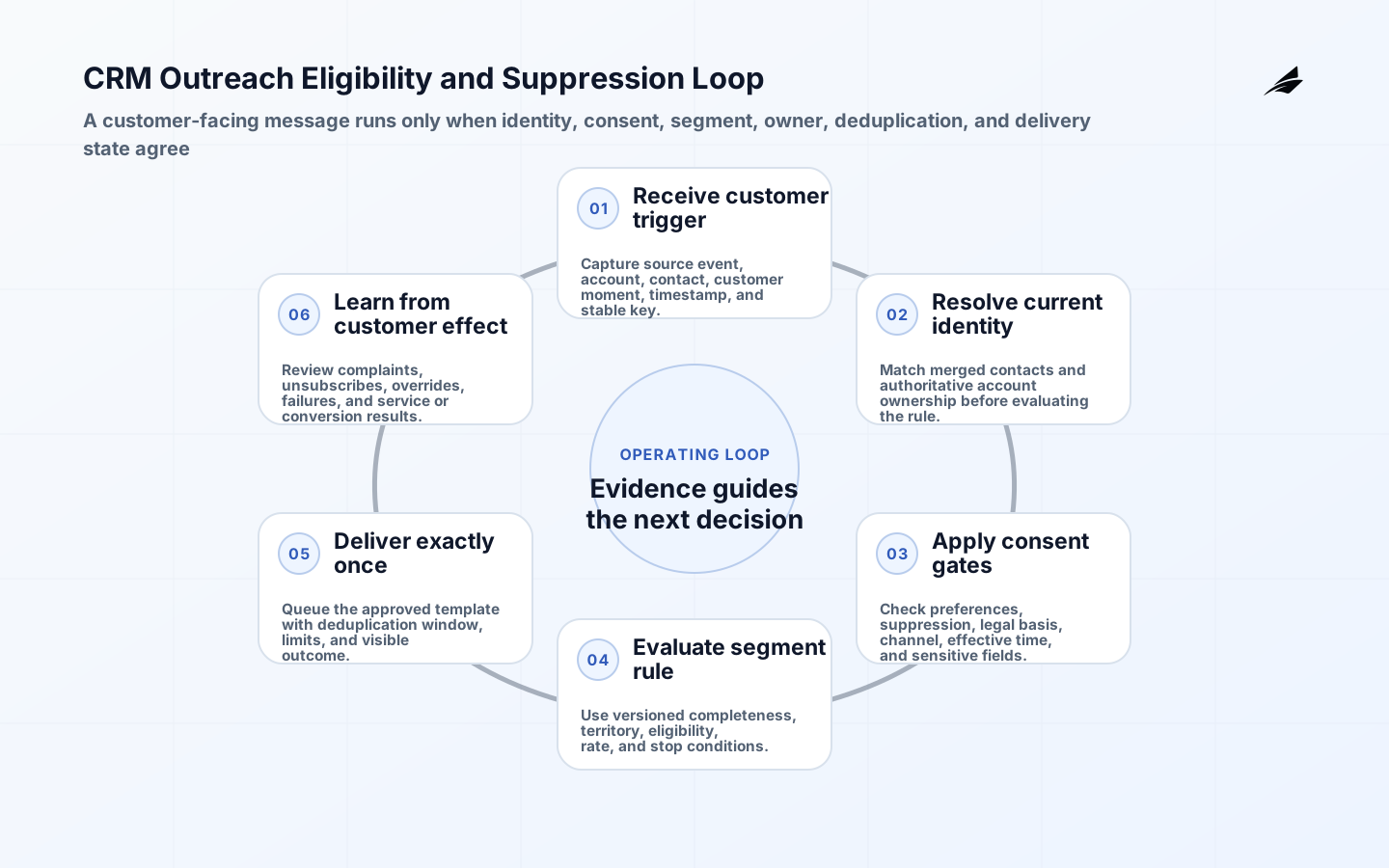
CRM automation is productive when it removes routine coordination without inventing customer facts or taking decisions away from the people accountable for them. It becomes risky when an automation changes lifecycle stage, sends an external message, or assigns an account based on a record that is incomplete, stale, or not eligible for the action. The essential pre-build decision is what the automation is allowed to infer and what must remain a human review.
Set the decision boundary for CRM automation
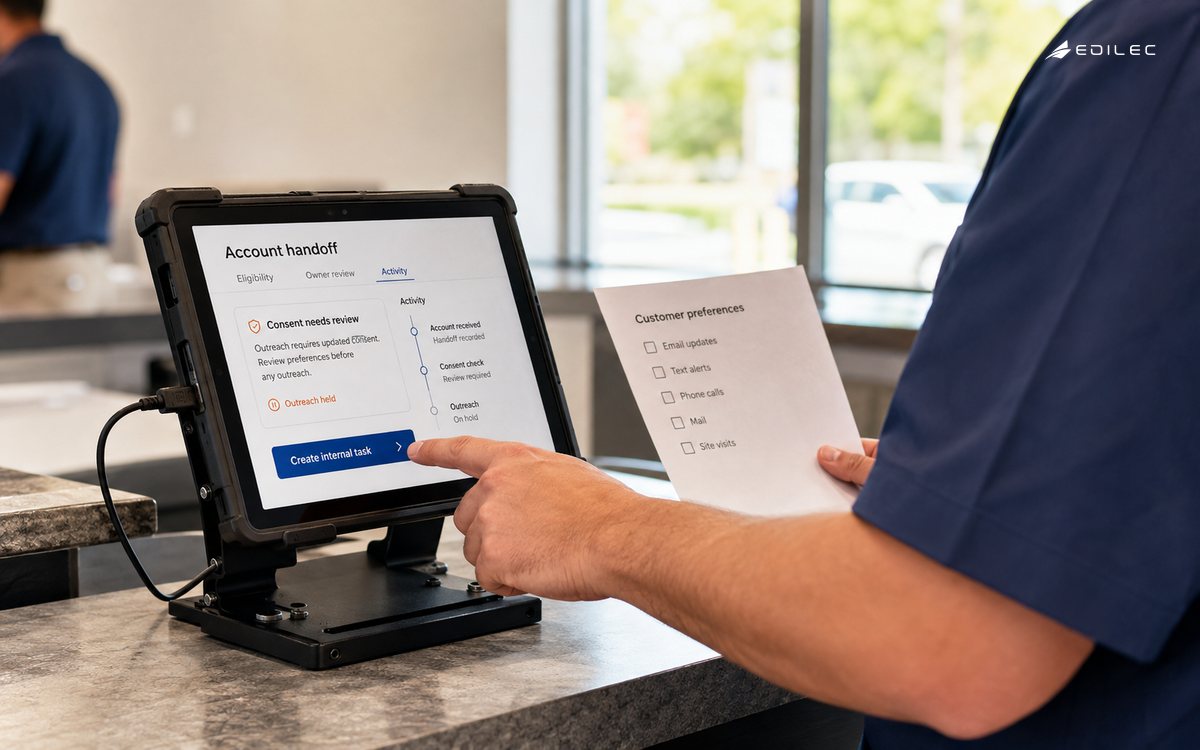
Start with a narrow customer moment: lead routing, renewal risk follow-up, consent update, or account handoff. State the trigger, eligibility rules, data freshness requirement, recipient, owner, and stop conditions. A lead-created event may be enough to create an internal task, while external outreach may require consent, suppression checks, and a reviewable message template.
| Design concern | Decision to make | Evidence to retain |
|---|---|---|
| Trigger | Lead event, renewal date, consent update, or service signal | Source ID, timestamp, and customer scope |
| Eligibility | Completeness, consent, segment, and owner rules | Rule version and exclusion reason |
| Action | Task, assignment, message, or record update | Idempotency key and accountable owner |
| Outcome | Delivered, completed, failed, suppressed, or reviewed | Visible CRM activity and follow-up path |
Keep records that explain the outcome
The automation needs stable account and contact identifiers, consent and preference evidence where relevant, lifecycle history, trigger source, rule version, and action outcome. Keep the original triggering fact even when a workflow updates a derived score or stage. Without that lineage, a sales or service team cannot explain why a customer received a message or why an account was reassigned.
Design CRM automation as an accountable flow
Separate event ingestion, eligibility evaluation, action execution, and customer-facing delivery. Use a queue when an action can fail or require a rate limit, and make the action idempotent so repeated events do not send duplicate messages. Publish the outcome back to the CRM as a dated activity or state change, not merely as a technical log hidden from the operating team.
| Operating stage | Control to design | Signal to review |
|---|---|---|
| Data intake | Identity and preference validation | Missing data and stale-record rate |
| Decision rule | Versioned eligibility and routing | Override and false-positive review |
| Action delivery | Queue, limits, and retry behavior | Duplicate suppression and delivery failure |
| Customer review | Complaint, unsubscribe, and owner feedback | Segment impact and rule correction backlog |
Put authority and evidence into the controls
Use role-based access for rules, segments, message templates, and bulk actions. Require review for high-impact changes such as territory reassignment, sensitive attribute use, or an external campaign activation. Design opt-out, suppression, and legal hold conditions as first-class gates, not optional branches. An audit trail should identify the rule version and actor behind every consequential automated action.
For CRM automation, NIST's Cybersecurity Framework provides a useful structure for protecting customer-related actions and responding when automation behaves unexpectedly. SP 800-53, SP 800-34, and SP 800-92 underscore permission boundaries, recovery paths, and action histories.
Release with exceptions in view
Shadow-run the rule against live-like data before it acts. Let account owners inspect proposed routing or outreach, then compare expected and actual eligibility. Release by segment or region with a kill switch and a clear owner for customer-impacting mistakes. Test duplicate triggers, missing consent, a merged contact, and a staff member who changes roles during an active workflow.
Measure operating reliability, not activity alone
Measure action volume, eligibility rejection, duplicate suppression, delivery failure, owner override, customer complaint, and conversion or service outcomes by segment. Do not optimize open rates or task completion in isolation. A campaign that performs well while creating inaccurate lifecycle data or unnecessary outreach is borrowing value from the future.
Pre-build decision register
- For CRM automation, confirm customer moments suitable for autonomous action; write the rule, named owner, effective time, audit evidence, failure signal, and recovery action into the build decision record before release.
- For CRM automation, test customer moments suitable for autonomous action with normal, delayed, corrected, and failed inputs; retain the result so the operating team can explain and safely repeat the decision.
- For CRM automation, confirm completeness criteria before a rule may run; write the rule, named owner, effective time, audit evidence, failure signal, and recovery action into the build decision record before release.
- For CRM automation, test completeness criteria before a rule may run with normal, delayed, corrected, and failed inputs; retain the result so the operating team can explain and safely repeat the decision.
- For CRM automation, confirm consent and suppression checks for outreach; write the rule, named owner, effective time, audit evidence, failure signal, and recovery action into the build decision record before release.
- For CRM automation, test consent and suppression checks for outreach with normal, delayed, corrected, and failed inputs; retain the result so the operating team can explain and safely repeat the decision.
- For CRM automation, confirm stable identity keys across merged contacts; write the rule, named owner, effective time, audit evidence, failure signal, and recovery action into the build decision record before release.
- For CRM automation, test stable identity keys across merged contacts with normal, delayed, corrected, and failed inputs; retain the result so the operating team can explain and safely repeat the decision.
- For CRM automation, confirm eligibility rules for territories and segments; write the rule, named owner, effective time, audit evidence, failure signal, and recovery action into the build decision record before release.
- For CRM automation, test eligibility rules for territories and segments with normal, delayed, corrected, and failed inputs; retain the result so the operating team can explain and safely repeat the decision.
- For CRM automation, confirm idempotency windows for duplicate triggers; write the rule, named owner, effective time, audit evidence, failure signal, and recovery action into the build decision record before release.
- For CRM automation, test idempotency windows for duplicate triggers with normal, delayed, corrected, and failed inputs; retain the result so the operating team can explain and safely repeat the decision.
- For CRM automation, confirm message-template approval and change history; write the rule, named owner, effective time, audit evidence, failure signal, and recovery action into the build decision record before release.
- For CRM automation, test message-template approval and change history with normal, delayed, corrected, and failed inputs; retain the result so the operating team can explain and safely repeat the decision.
- For CRM automation, confirm rate limits by channel and audience; write the rule, named owner, effective time, audit evidence, failure signal, and recovery action into the build decision record before release.
- For CRM automation, test rate limits by channel and audience with normal, delayed, corrected, and failed inputs; retain the result so the operating team can explain and safely repeat the decision.
- For CRM automation, confirm human review for high-impact account changes; write the rule, named owner, effective time, audit evidence, failure signal, and recovery action into the build decision record before release.
- For CRM automation, test human review for high-impact account changes with normal, delayed, corrected, and failed inputs; retain the result so the operating team can explain and safely repeat the decision.
- For CRM automation, confirm kill-switch ownership for customer-facing workflows; write the rule, named owner, effective time, audit evidence, failure signal, and recovery action into the build decision record before release.
- For CRM automation, test kill-switch ownership for customer-facing workflows with normal, delayed, corrected, and failed inputs; retain the result so the operating team can explain and safely repeat the decision.
- For CRM automation, confirm visible activity records for every action; write the rule, named owner, effective time, audit evidence, failure signal, and recovery action into the build decision record before release.
- For CRM automation, test visible activity records for every action with normal, delayed, corrected, and failed inputs; retain the result so the operating team can explain and safely repeat the decision.
- For CRM automation, confirm customer and owner feedback used to correct rules; write the rule, named owner, effective time, audit evidence, failure signal, and recovery action into the build decision record before release.
- For CRM automation, test customer and owner feedback used to correct rules with normal, delayed, corrected, and failed inputs; retain the result so the operating team can explain and safely repeat the decision.
Key takeaways for CRM automation
- Automate a clearly bounded customer moment and state the stop conditions upfront.
- Keep trigger facts, eligibility decisions, and action outcomes visible to the operating team.
- Make consent, suppression, and role changes explicit gates for customer-facing actions.
- Use shadow runs and owner review before a rule can change customer experience.
Frequently asked questions
What should be automated first in a CRM?
A repetitive, low-risk decision with clear data and a measurable owner outcome, such as assignment of a complete inbound request.
How can duplicate outreach be prevented?
Use stable event keys, deduplication windows, channel rules, and an action history that the eligibility check reads.
When is human approval necessary?
Require it for high-impact actions, uncertain data, sensitive attributes, exceptions to customer preferences, and material rule changes.
Conclusion
A dependable CRM automation implementation is a system of explicit choices: what is authoritative, who can decide, which state is real, how an exception is recovered, and how the team verifies the result. Build the smallest flow that proves those choices with real evidence, then extend it deliberately. Related reading: CRM automation in production, master data management, case management.