Procurement Controls for Enterprise Systems: A Practical Guide
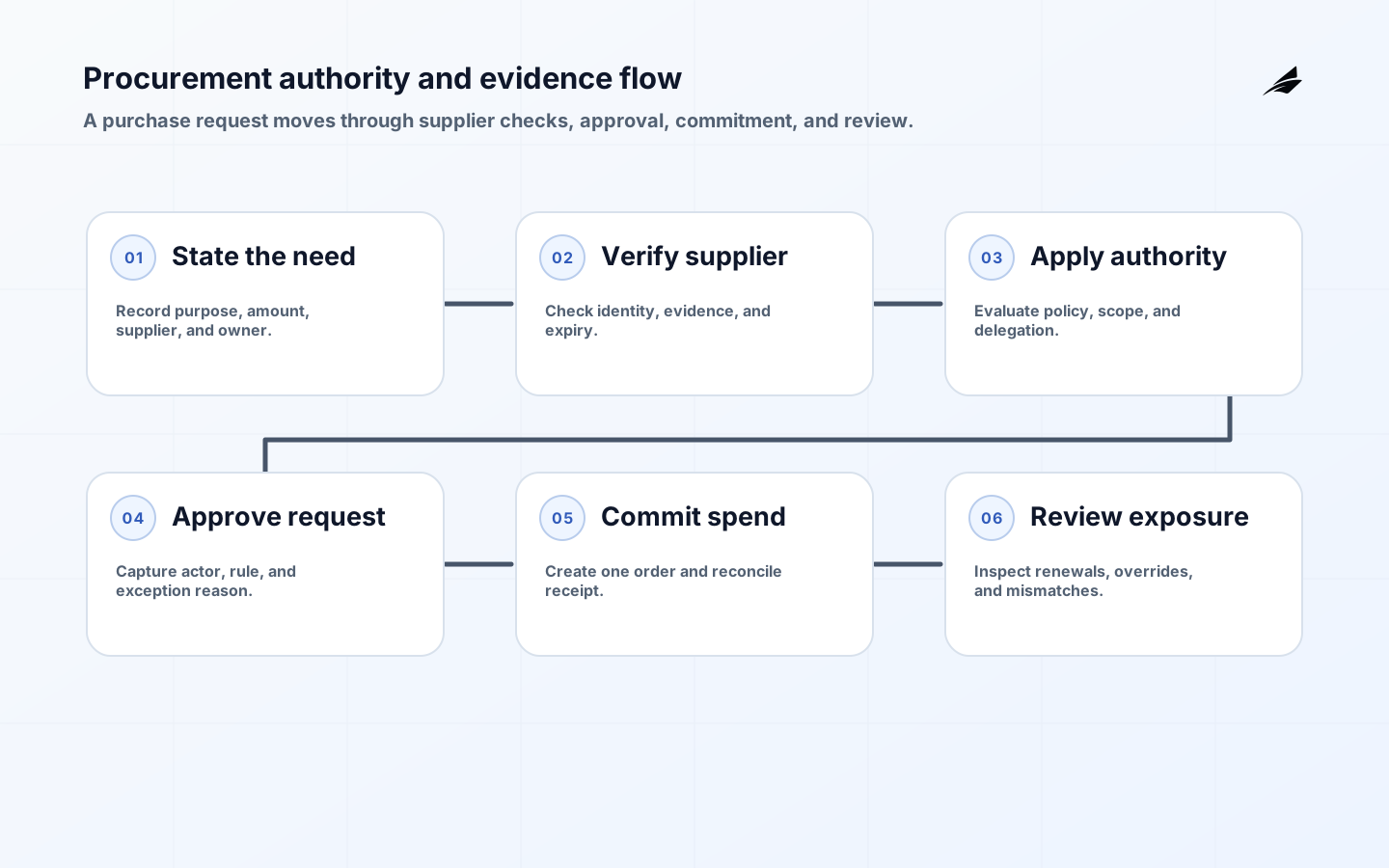
Enterprise procurement controls begin with a clear commitment boundary, not a larger form. Enterprise procurement software earns trust at the moment a request becomes a commitment. The workflow must show who requested the spend, which supplier record was checked, which rule applies, who may approve, and what can still be changed. A polished requisition screen cannot answer those questions by itself. This guide uses a purchase request as the running case and separates policy, identity, supplier evidence, approval, integration, and review. The document routing guide, inventory systems guide, and connected operations guide offer related patterns for governed work.
Name the commitment boundary

Define the business event the workflow controls: a request for approval, a supplier onboarding decision, a purchase order release, or a contract change. These events have different exposure and should not share one vague status. Name the requester, budget owner, buyer, approver, and downstream system. State what “approved” permits and what it does not permit; approval of a supplier is not approval of an unlimited purchase.
A compact boundary statement also clarifies when the system must stop. Missing tax information, an expired supplier document, a split purchase, or a changed bank account should create a visible hold with an owner. The NIST Cybersecurity Framework 2.0 PDF is a useful governance reference for tying process outcomes to responsibility and risk, but the thresholds still belong to local policy.
Build a supplier record that can be challenged
Supplier identity, legal name, payment details, tax status, insurance, sanctions screening, and service scope should have owners and effective dates. Avoid treating a supplier profile as a single mutable row when different evidence expires on different schedules. Keep the source and verification event beside each important attribute. A buyer should be able to tell whether a document is current, pending review, or superseded without opening a private email thread.
Supplier duplication is a control problem as well as a data problem. Use stable identifiers and a review queue for possible matches. If the workflow cannot resolve a match automatically, route it to procurement operations with the evidence that triggered the ambiguity. Do not let a rushed request silently create a second payment destination.
Separate identity from approval authority
A login proves that an account authenticated; it does not establish that the person may approve this spend. Map roles to scope, amount, category, entity, and delegation period. Require a fresh or stronger authentication step when policy treats the action as consequential. The NIST SP 800-63 Digital Identity Guidelines supplies a vocabulary for identity assurance that is more precise than “the user is trusted.”
Make separation of duties observable. The requester should not be able to approve their own request merely because both actions are available in the same interface. Record the acting identity, delegated authority, policy version, and timestamp. When a manager changes teams or leaves, revoke the approval path promptly and test that queued requests do not retain stale authority.
Encode purchasing policy as reviewable rules
Rules should name the inputs they use: spend amount, category, cost center, supplier status, currency, contract coverage, and urgency reason. Keep the rule outcome separate from the interface label. “Fast track” should still say what evidence is required and who owns the exception. Version rules and expose the effective date so a later reviewer can explain why a request followed one path rather than another.
Avoid hidden thresholds scattered through workflow code and spreadsheet macros. Store the decision result with the rule identifier and inputs used. If policy changes, replay a sample of open requests and decide whether they remain under the old rule or are re-evaluated. That decision is part of governance, not an implementation detail.
Protect the moment a purchase becomes real
The purchase order or contract commitment is the consequence boundary. Require a final check that supplier identity, approved amount, currency, delivery terms, and approval scope match the outgoing document. Use an idempotency key so a timeout does not create duplicate commitments. Treat an acknowledgement from the ERP or supplier as different from successful delivery of the business outcome.
The ISO 20400 Sustainable procurement reference is helpful when teams consider supplier selection and lifecycle decisions beyond price. It does not replace financial controls. Keep commercial evaluation, risk evidence, and release authority distinct enough that one missing document cannot be hidden by a successful API response.
Handle exceptions without bypassing controls
Procurement work often fails under deadline pressure: a supplier is not yet verified, an approver is unavailable, a budget is moved, or a purchase order is rejected downstream. Define safe alternatives, expiration times, and escalation authority before launch. A manual override should capture who granted it, why it was necessary, what evidence was missing, and when the normal path must be restored.
Do not send every problem to a generic support queue. Classify a missing supplier fact, policy ambiguity, authentication failure, integration timeout, and suspected fraud separately. Each class needs a different owner and response. A clear hold status protects the buyer from guessing and gives finance a defensible record of why a commitment paused.
Integrate with durable acknowledgements
Connect the request system, supplier master, contract repository, identity provider, budget ledger, and ERP through contracts that define identifiers, states, retries, and correction behavior. Preserve the original request reference across messages. A “received” response should not be displayed as “ordered.” Track downstream acknowledgement and reconciliation as separate states, and make the person responsible for resolving a mismatch visible.
Test duplicate messages, out-of-order updates, revoked approval, currency changes, and a partial ERP outage. Log the decision context without copying every sensitive document into every system. CISA Secure by Design supports the idea that misuse resistance and secure defaults belong in the workflow itself, especially where a rushed path could create financial harm.
Pilot a category with real authority
Choose a category with repeatable policy and a manageable supplier set, then run the workflow with buyers, budget owners, finance, and an administrator. Compare the old and new paths on time to approve, unresolved holds, duplicate supplier candidates, correction effort, and downstream reconciliation. Have a reviewer inspect a successful order and a blocked one.
Acceptance requires more than a green status. A buyer must know what to do next, a finance reviewer must reproduce the decision, and an administrator must revoke or correct authority without database surgery. Keep the pilot small enough to stop if the evidence shows that the workflow is increasing hidden manual work.
Review spend controls after launch
Operate procurement software with a cadence tied to supplier, policy, and financial change. Sample approvals by category and authority, inspect overrides, reconcile orders to invoices, and review dormant delegations. Segment metrics by business unit and request type so a healthy average does not hide a risky route. Record each material control change and test its effect on open work.
The NIST Cybersecurity Framework 2.0 PDF can structure a governance conversation, but the useful artifact is local: a decision log that links policy, identity, evidence, action, and correction. Retire controls only when their risk has moved elsewhere and the new owner has accepted the evidence burden.
| Boundary | Required evidence | Owner to name |
|---|---|---|
| Supplier onboarding | Identity, due diligence, expiry, payment change history | Supplier operations |
| Purchase request | Requester, category, amount, budget, urgency | Budget owner |
| Approval | Policy version, authority scope, acting identity, timestamp | Approver |
| Commitment | Final terms, downstream acknowledgement, idempotency key | Buyer and finance |
Key takeaways
- Define the exact commitment a procurement workflow controls.
- Keep supplier facts, identity assurance, and approval authority separate.
- Record policy version and acting authority with every consequential decision.
- Make overrides expire and retain their reason and evidence.
- Reconcile the approved request with the downstream commitment and invoice.
| Signal | What it may indicate | First investigation |
|---|---|---|
| Override rate | Policy does not fit work or authority is weak | Sample reasons and expiry handling |
| Supplier duplicates | Master data matching is unreliable | Compare identifiers and payment evidence |
| Approval age | Missing owner, unavailable authority, or unclear rule | Inspect queue state and delegation |
| Order mismatch | ERP acknowledgement or correction failure | Reconcile request, order, and invoice |
Frequently asked questions
Does procurement software replace procurement policy? No. It can make policy repeatable and visible, but owners still set thresholds, supplier requirements, delegation, and exception authority.
Should the requester ever approve a purchase? Only where local policy explicitly permits it for a defined low-risk case. For consequential spend, use separation of duties and record any delegation or exception.
What is the most important procurement integration test? Test the transition from approved request to downstream commitment with duplicate, delayed, rejected, and revoked-authority messages. A successful API call alone is not enough.
A useful operating review samples both speed and restraint. Look at a purchase that moved cleanly, one that waited for evidence, one that was overridden, and one that did not reconcile downstream. Ask whether the status shown to the buyer matched the financial state. That review often reveals missing delegation expiry, weak supplier matching, or a renewal owner who exists on paper but cannot act. Fix the control that created the repeated exception.
Procurement data should support a reviewer who was not present when the request was made. Store the supplier reference, budget context, approval scope, final terms, downstream identifier, and any correction in a connected history. Keep sensitive documents behind their original access rules instead of copying them into every workflow event. When a supplier disputes an order, the team should be able to distinguish a policy decision from a transmission failure and a commercial correction.
Conclusion
Enterprise procurement software should make authority and commitment easier to inspect, not merely easier to submit. Tie supplier evidence, approval scope, downstream acknowledgement, and correction to one record, then review the exceptions that reveal where policy needs to change.