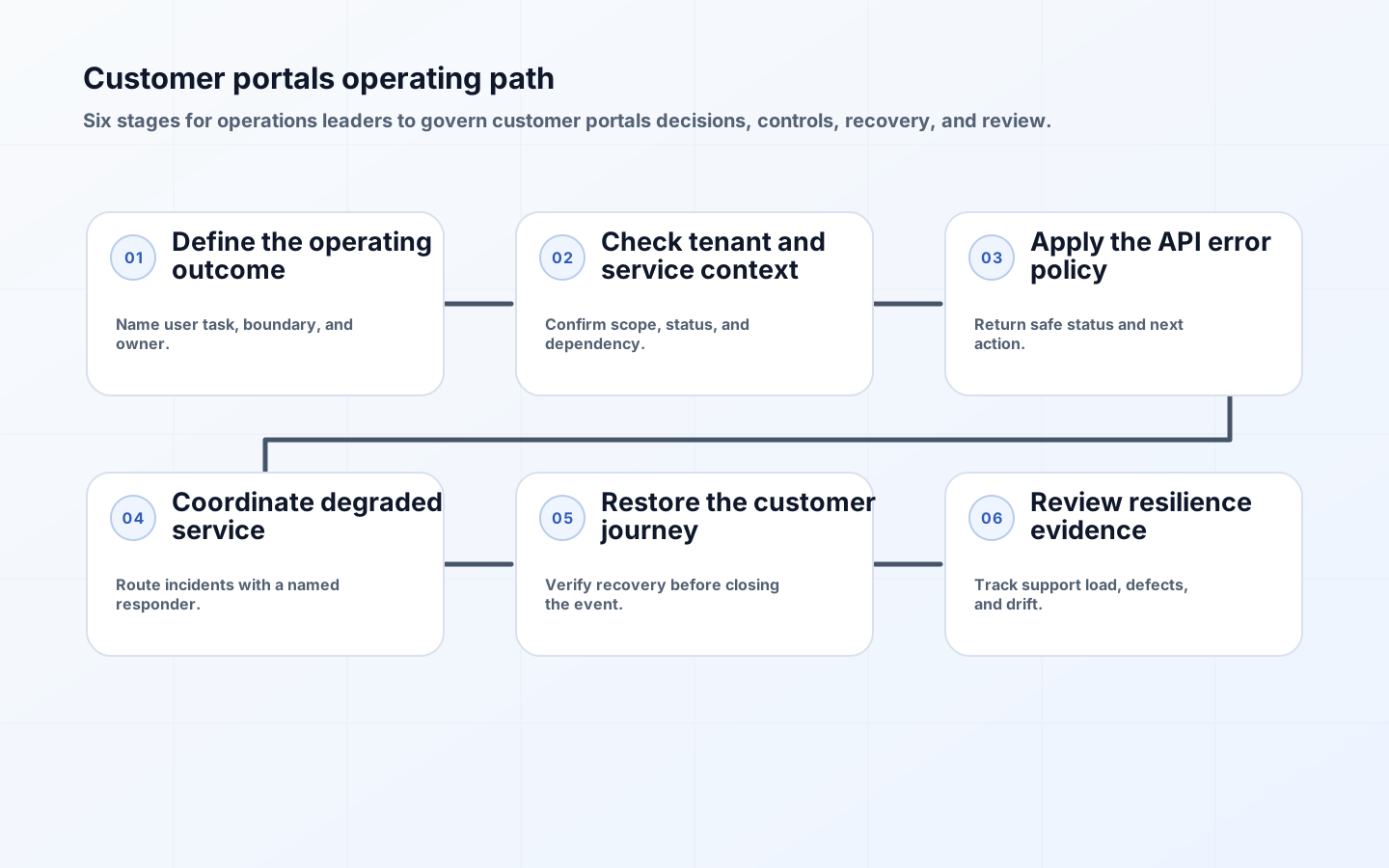
A customer portal incident is not only a front-end outage. It may expose stale data, cross a tenant boundary, accept an action without recording it, or leave a customer unsure whether a request succeeded. The response plan therefore needs two objectives: contain unsafe behaviour and preserve a minimum trustworthy service. OWASP API Security guidance informs the boundary controls, while RFC 9457 provides a consistent way for APIs to communicate failures.
Define the incident boundary before the portal fails
Map each critical portal journey to its authoritative system, tenant identifier, permitted actors, downstream dependencies, and customer-visible result. A profile update, invoice download, support request, approval, and payment initiation do not share the same consequence. Assign an incident class and maximum tolerable interruption to each journey so responders know what may remain available and what must be stopped.
Record the normal operating baseline before an incident: request volume, successful completion rate, authorization failures, stale-data age, dependency latency, support contacts, and reconciliation backlog. The runbook should identify the dashboard or query for each signal, its owner, and the threshold that changes the response. Without a known baseline, a team cannot distinguish a real incident from normal variation or verify recovery.
Keep the general portal design in the service-owner guide. This runbook focuses on the operating question after a failure signal appears: which journeys are unsafe, which records may be stale or incomplete, who can declare degraded mode, how customers are informed, and what evidence is required before normal processing resumes.
| Decision area | Question to answer | Evidence to keep |
|---|---|---|
| Outcome | What should improve? | Named journey, baseline, acceptance condition. |
| Boundary | What is included? | Scope map and dependency owners. |
| Authority | Who may act? | Role, escalation route, expiry. |
| Recovery | What happens when it fails? | Runbook and decision record. |
Use an incident model that separates safety from availability
Classify the failure along four axes: tenant scope, data integrity, action integrity, and dependency health. A portal can be visually available while returning another tenant's record or accepting a request that never reaches the system of record. Treat those as safety incidents even when uptime is high. Conversely, a planned read-only mode may reduce availability while protecting data and preventing ambiguous writes.
Give the incident commander one timeline that joins deployment changes, authentication events, authorization decisions, API errors, dependency state, customer reports, and support actions. Preserve correlation identifiers without placing secrets or unnecessary personal data in logs. When scope is uncertain, default to the smaller safe capability and expand only after tenant isolation and record correctness have been demonstrated.
Design degraded mode as a controlled product state
Degraded mode should be enforced at the API and workflow boundary, not only hidden in the interface. Define which reads may use cached data, which writes must be queued, which actions are disabled, and how every unavailable action is explained. Continue authorization checks even when a dependency is failing. WCAG 2.2 remains relevant during incidents: status and recovery instructions must still be perceivable, operable, and understandable.
Avoid silent retries for consequential actions. Assign every queued or uncertain request an idempotency key, visible status, expiry, and reconciliation owner. Tell the customer whether the action was rejected, accepted for later processing, or left in an unknown state. An unknown state should block a duplicate high-consequence submission until the system can determine the original result.
- Identify affected tenants and journeys without exposing one tenant's evidence to another.
- Freeze unsafe writes while keeping verified low-risk functions available.
- Give queued and uncertain actions an explicit status and reconciliation owner.
- Keep emergency access narrow, time-bound, logged, and reviewed.
- Communicate impact, workaround, next update, and recovery criteria consistently.
Recover in stages and reconcile every uncertain action
Use a staged recovery: validate dependencies, restore read paths, test low-risk writes with an internal cohort, reconcile held requests, then widen access. For each stage, define the owner, evidence, abort condition, and customer effect. Rollback is not enough when a request reached an external system; those actions need comparison against the system of record and a documented compensation route.
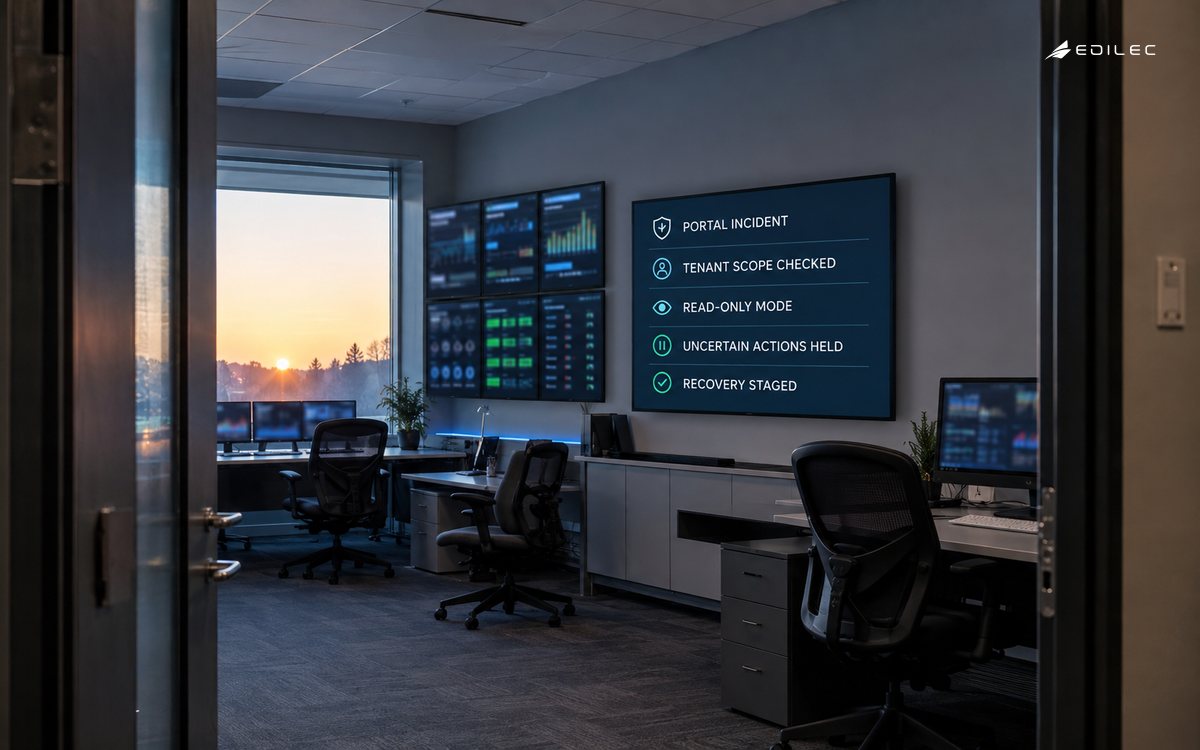
Exercise the runbook against one realistic failure at a time: identity-provider outage, authorization regression, stale system-of-record data, partial write failure, dependency timeout, or suspected tenant crossover. Include engineering, support, security, and the service owner. Record where the exercise relied on memory, an unavailable person, or an undocumented query; those are recovery defects even when the software behaves correctly.
| Stage | Minimum output | Decision gate |
|---|---|---|
| Discover | Boundary, owner, baseline, dependencies. | Problem is specific enough to test. |
| Design | State model, controls, permissions, measurement. | Consequence has a safeguard. |
| Pilot | Small cohort with recovery path. | Observed behaviour supports next step. |
| Operate | Runbook, alert owner, support route. | Capability survives turnover. |
| Improve | Outcome trend and exception review. | Next change has evidence. |
Measure containment, reconciliation and customer recovery
Measure time to detect, time to contain unsafe behaviour, time to establish tenant scope, time to communicate, reconciliation backlog, incorrect or duplicate actions, and time to restore each journey. Separate technical recovery from customer recovery: a healthy API does not mean customers understand the result of requests made during the incident.
Maintain an incident evidence package with the affected versions, detection signal, scope decision, timeline, customer notices, policy changes, queued-action inventory, reconciliation results, recovery approvals, and follow-up owners. Store references to protected evidence rather than copying sensitive records into a broadly accessible document.
The post-incident review should distinguish the initiating fault from the conditions that widened impact. Ask why the unsafe path remained available, why scope was difficult to determine, why communication lagged, and why reconciliation required manual discovery. Convert those answers into tested controls, clearer ownership, or smaller failure domains rather than a generic instruction to be more careful.
Customer portal incident runbook checklist
- Map critical journeys, owners, dependencies, tenant boundaries, and stop conditions.
- Define read-only, queued-write, and unavailable states at the enforcement layer.
- Prepare customer and support messages for denied, delayed, and uncertain actions.
- Rehearse staged recovery and reconcile every action whose result was uncertain.
Treat the portal as a service boundary rather than a screen collection, with degraded service in scope. Each journey needs a clear customer outcome, tenant context, identity assurance, authorization decision, accessible interaction, and support route, with degraded service in scope. Show users what happened when a request is denied, delayed, or partially completed, and give operators enough context to correct it without exposing another tenant, with degraded service in scope. During rollout, test keyboard and assistive-technology use alongside normal and degraded network conditions, with degraded service in scope. Record the policy version, affected object, actor, and communication whenever a consequential state changes A portal earns trust when its normal path is simple and its exceptional path is understandable, owned, and recoverable, with degraded service in scope. Review stale permissions, unused fields, and silent integrations regularly so convenience does not accumulate hidden risk, with degraded service in scope.
Review the runbook after material architecture, identity, policy, support, or dependency changes. A runbook that references an obsolete dashboard, former owner, or removed feature is worse than an acknowledged gap because responders will trust it under pressure.
Customer portal incident response FAQ
What is the first artifact for portal incident response? Create a journey inventory that names the authoritative system, tenant boundary, permitted actions, dependencies, stop condition, degraded behaviour, and recovery owner.
Should every portal failure trigger a full shutdown? No. Disable the unsafe journey or action while preserving capabilities whose data, authorization, and dependencies remain trustworthy.
When is normal service restored? Restore a journey only after its dependency health, authorization, data freshness, queued actions, customer communication, and rollback path meet the documented recovery gate.
For this customer portals operating boundary, define the minimum evidence before the first release, with degraded service in scope. The team should be able to identify the initiating actor, the affected object, the policy or version in force, the transition requested, and the result returned, with degraded service in scope. When any of those fields is missing, the system should preserve the incomplete state and route it for review, with degraded service in scope. This practice makes this service useful during a dispute because the team can distinguish a bad decision from a missing record and fix the right layer, with degraded service in scope.
Plan the support experience alongside the technical workflow. A person who encounters a denied action, stale status, conflicting record, or delayed signal needs a clear explanation and a safe next step, with degraded service in scope. For this customer portals service, write the user message, escalation route, expected response time, and evidence a support colleague should collect, with degraded service in scope. Good customer portals support design reduces repeated manual work and prevents well-meaning staff from bypassing the control that protects the system, with degraded service in scope.
Test the customer portals boundary with deliberately awkward cases before calling the pilot successful, with degraded service in scope. Use duplicate submissions, stale permissions, missing fields, clock skew, partial outages, retries, handoff during an incident, and a request that should be rejected, with degraded service in scope. Record not only whether the customer portals system failed, but whether the person who received the failure knew what to do, with degraded service in scope. This customer portals service is production-ready when the exception is understandable, owned, and recoverable, with degraded service in scope.
Keep change management proportional to the consequence. A low-risk label change may need a peer review; a permission model, master record, purchasing rule, ticket priority, telemetry schema, or certificate lifecycle needs compatibility analysis and a communication plan, with degraded service in scope. For this customer portals service, publish the effective date, affected users, migration or training need, and rollback or compensation route, with degraded service in scope. This prevents operational surprise from being mistaken for user resistance, with degraded service in scope.
Finally, retire customer portals material that no longer earns its place. Remove unused fields, expired exceptions, duplicate queues, obsolete mappings, stale credentials, and dashboards that no one uses to make a decision, with degraded service in scope. Review the cost of retaining every customer portals integration and manual workaround A smaller system with current ownership and visible evidence is easier to secure and more trustworthy than a larger system whose history nobody can explain, with degraded service in scope.
A useful customer portals review question is what the team would do if the primary system were unavailable for one business cycle, with degraded service in scope. Identify the minimum safe operating state, the information that must remain current, the person who can declare degraded mode, and the point at which normal service may resume, with degraded service in scope. For customer portals, this exercise exposes hidden coupling between policy, data, identity, communication, and support It also gives leaders a realistic basis for funding resilience because the gap is described as a decision and recovery problem, not as an abstract request for more infrastructure, with degraded service in scope.
Conclusion: recover the customer outcome, not only the interface
Security and accessibility remain part of recovery. Preserve least privilege, minimise exposed data, log sensitive actions, and keep incident messages accessible on constrained devices and connections. The NIST contingency-planning guide offers a useful structure for impact analysis, recovery strategies, testing, and plan maintenance; adapt it to the portal's actual journeys and ownership.
Ownership for customer portals must survive turnover. Name a service owner, steward, technical maintainer, support queue, and decision authority, with degraded service in scope. Set review dates for permissions, mappings, schemas, certificates, and exceptions, with degraded service in scope. The runbook should explain the first safe action, escalation boundary, and evidence to attach during handoff, with degraded service as the scope.
The durable test is whether responders can explain what happened, contain the unsafe path, preserve a trustworthy customer option, reconcile uncertain actions, and prove that restoration is safe. If any step depends on guesswork, reduce the journey's failure domain and rehearse again.
A resilient customer portal is not one that never enters degraded mode. It is one that fails visibly, protects tenant and transaction integrity, gives customers a clear next step, and returns to normal through evidence-based gates.