Master data management engineering turns contested entity data into dependable contracts for operational systems. The hard parts are identity, authority, time and correction: deciding whether two records describe the same thing, which source governs each attribute, when a value applies and how consumers learn that a previous value was wrong. A central database without those decisions is consolidation, not trusted master data.
Begin with Edilec's system of record design guide and practical MDM guide. The CRM automation architecture guide shows why downstream workflows need stable customer and account meaning. These notes focus on implementable data and service behavior.
Key takeaways
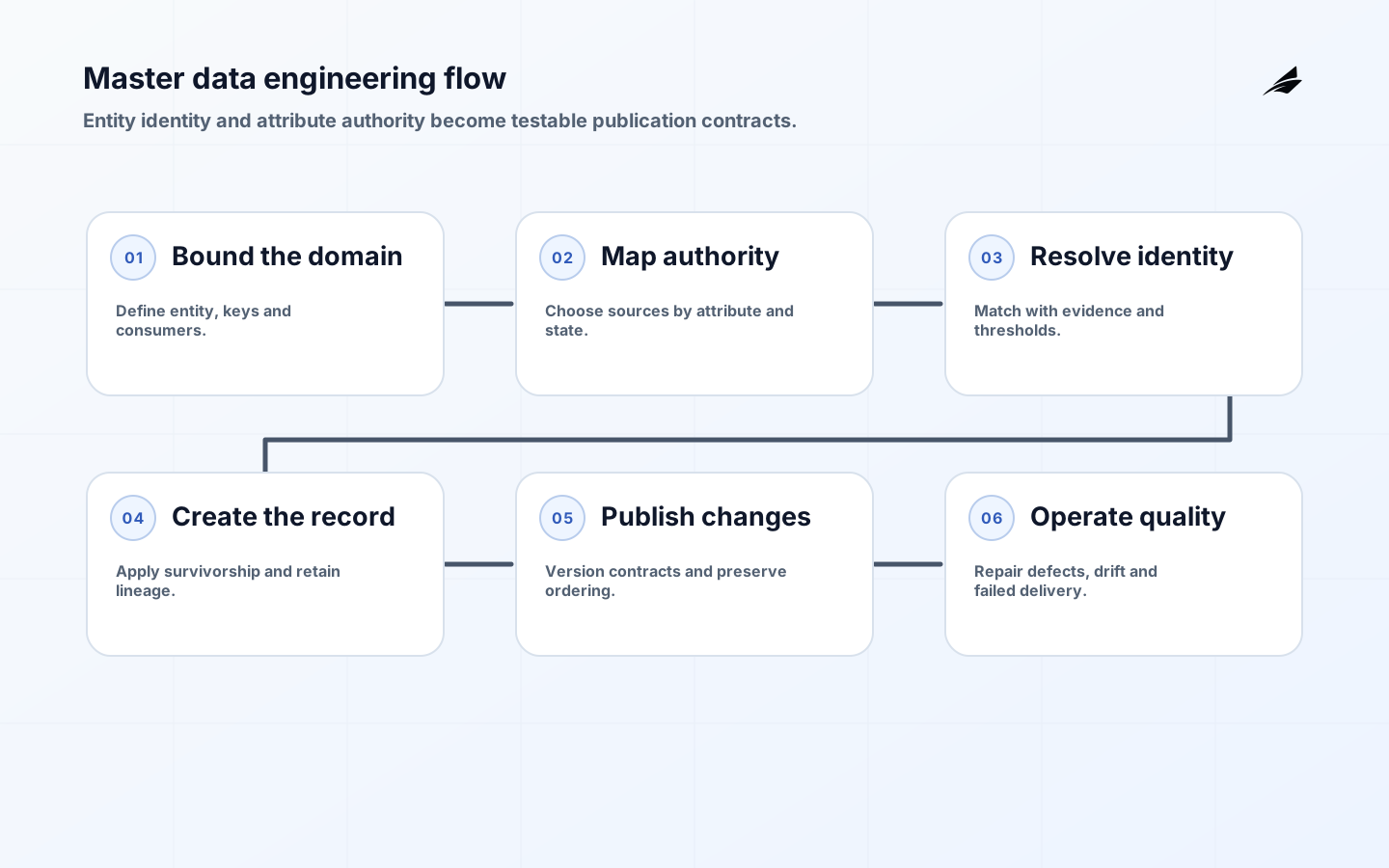
- Bound one entity domain and consumer decision before designing a golden record.
- Assign source authority by attribute, lifecycle state and effective time.
- Treat matching as an evidence-bearing decision with review thresholds.
- Publish versioned changes, lineage and correction semantics to consumers.
- Operate stewardship queues and quality objectives like production services.
Bound the entity domain and identifiers
Define what the entity represents and does not represent. A customer may be a legal party, billing account, household, user or relationship; collapsing these concepts produces dangerous merges. Specify lifecycle states and stable internal identifiers. Preserve source identifiers as cross-references. Never recycle master identifiers after deletion or closure.
List consumers and decisions: order fulfillment, sanctions screening, catalog publication, support routing or reporting. Mark critical attributes and required freshness. GS1's system architecture describes how identification keys connect master data to recurring business documents, a useful example of why stable identity and shared meaning matter across organizational boundaries.
| Design artifact | Contents | Test | Owner |
|---|---|---|---|
| Domain model | Entity, relationships and lifecycle | Ambiguous real examples | Domain owner |
| Identifier policy | Creation, cross-reference and retirement | Collision and replay cases | Platform owner |
| Attribute catalog | Meaning, type, authority and time | Source conflicts | Data owner |
| Consumer contract | Fields, events and quality promise | Compatibility tests | Service owner |
| Stewardship policy | Queues, authority and evidence | Disputed merge scenario | Stewardship lead |
Set authority at attribute and state level
Build a source matrix for each critical attribute. Record authoritative source, eligible alternates, validation, freshness, effective date and override authority. Authority can change by lifecycle: a supplier portal may propose banking data, but verification controls may own the approved value. Distinguish source priority from recency; the newest value is not automatically correct.
Model history explicitly with effective and recorded times where decisions need them. Keep raw source value, normalized value, provenance and transformation rule. Deletion, restriction and legal hold require domain-specific semantics. The NIST Privacy Framework helps teams evaluate privacy risk created by linking personal data across systems; MDM increases both usefulness and potential impact.
Engineer entity matching as a controlled decision
Normalize names, addresses, identifiers and contact data without destroying original evidence. Generate candidate pairs using blocking rules, then score features such as exact identifiers, address similarity and relationship context. Use separate thresholds for auto-match, steward review and no-match. Evaluate false merges and missed matches by meaningful population because their costs differ.

Prevent transitive surprises: if A resembles B and B resembles C, it does not follow that all three are one entity. Store pair evidence, rule or model version, decision, reviewer and time. Support unmerge with deterministic recalculation of downstream memberships and survivor values. High-consequence domains may prohibit automated merges regardless of score.
| Match outcome | Required evidence | System action | Control |
|---|---|---|---|
| Strong deterministic match | Verified shared identifier | Link automatically | Uniqueness and source validation |
| Strong probabilistic match | Several consistent attributes | Auto-link only in approved tier | Sample and drift review |
| Ambiguous | Conflicting or sparse evidence | Steward queue | Independent source access |
| No match | Insufficient similarity | Create new entity | Duplicate monitoring |
| Confirmed false merge | Correction evidence | Unmerge and notify | Impact reconciliation |
Create a golden record without hiding uncertainty
Survivorship chooses a usable value; it does not prove universal truth. Apply rules by attribute: verified source, valid status, effective date, quality and explicit stewardship. Keep alternative values and conflict indicators when useful. A consumer may need to know that an address is disputed or that a classification is pending review.
Validate semantics, not only syntax. Product dimensions may need measurement standards; party data may need jurisdiction-specific address rules. GS1's Global Data Model demonstrates harmonized product attributes for exchange. Use external standards where the domain has them, but keep local extensions governed and distinguish required, optional and conditionally applicable fields.
Publish master data as a versioned service
Offer snapshots for bootstrap and ordered change events for maintenance. Define schema versions, event identity, entity version, effective time, deletion or merge semantics and replay. Make delivery at least once with idempotent consumers, or define stronger guarantees precisely. A merge event should tell consumers survivor and retired identifiers; an unmerge needs equally explicit handling.
Track consumer registration, version, lag and failed delivery. Provide a reconciliation endpoint or dataset so consumers can compare state. Avoid allowing every consumer to query the hub synchronously for every transaction; that creates a critical dependency without clear availability design. Publish quality metadata only when consumers know how to use it.
Protect the hub and stewardship path
The MDM platform can expose a rich map of people, organizations, products and relationships. Apply least privilege by domain and function, separate stewardship from platform administration, protect bulk export and log sensitive access. The NIST Cybersecurity Framework provides a lifecycle for governing, protecting, detecting, responding and recovering around this high-value service.
Mask or synthesize non-production data. Secure matching features, review notes and audit history, not only golden fields. Validate inbound services and rate-limit abusive search. Rehearse recovery with identifier, lineage and event ordering intact. A restore that reissues old changes or loses merge history can corrupt every consumer.
Operate quality and stewardship
Monitor completeness and validity for critical attributes, duplicate candidates, false-merge reports, source freshness, steward backlog, publication lag, consumer failure and correction time. Define service objectives by business consequence. ISO's data-quality management process model provides a current process reference for improving data-quality management capability; use it as a framework, then tie measures to local decisions.
Treat source-system defects separately from hub defects. Send actionable feedback to source owners and verify repair. Sample auto-matches and survivorship changes. Review rules after acquisitions, product launches and regional expansion. Capacity-plan both computation and human queues; a matching release that floods stewards is an operational regression.
Worked example: supplier master consolidation
A group consolidates suppliers from three ERP systems. The domain distinguishes legal party, remit-to location and purchasing relationship. Existing ERP vendor numbers remain source identifiers; a new immutable supplier-party ID becomes the cross-system key. The first consumer is spend reporting, while payment execution remains in local ERPs until banking controls are redesigned.
Tax registration is a strong matching feature only within the right jurisdiction and legal-party context. Names and addresses generate candidates but do not auto-merge alone. Shared bank accounts trigger protected review rather than stronger match confidence because they may indicate a payment agent or fraud. Steward decisions retain source documents and the matching-rule version.
Attribute authority differs: procurement owns category and relationship status, verified onboarding owns approved tax and banking attributes, and local ERP owns operational payment blocks. The golden view displays conflicts and pending verification. Survivorship never replaces a blocked payment status with a more recent unverified source value.
Publication sends party creation, relationship, merge and correction events with entity versions. Consumers process them idempotently and can download a current snapshot. When two suppliers are falsely merged, the unmerge procedure restores identifiers, recomputes survivor fields, republishes affected entities and gives finance a list of reports and controls requiring reconciliation.
Operations track candidate volume, confirmed duplicate rate, false-merge reports, banking-review age, source freshness and consumer lag. The team does not claim payment savings until a later controlled consumer adopts the service. It can still demonstrate earlier value through reduced duplicate analysis and a traceable supplier view, keeping benefits aligned with actual scope.
The engineering acceptance record includes domain-model version, identifier policy, source-authority matrix, match evaluation by supplier type, steward capacity, publication contract, recovery point and consumer reconciliation results. Privacy and security review the richer combined view and export paths. Domain owners approve meanings and override rights; platform staff do not silently decide them through configuration.
Before changing thresholds, engineers replay labeled historical pairs and a recent production sample, estimate steward load and inspect false merges separately from missed duplicates. The candidate runs in shadow mode long enough to expose source and regional shifts. Release proceeds only with an unmerge drill and a list of consumers able to process correction events.
MDM engineering checklist
- Entity meaning, identifiers, lifecycle and consumers are approved.
- Critical attributes have authority, validation, history and override rules.
- Matching thresholds are evaluated with false-merge and missed-match costs.
- Survivorship retains lineage, alternatives and correction evidence.
- Publication contracts define versions, ordering, merge and replay.
- Stewardship, quality, security and recovery objectives are monitored.
Frequently asked questions
Is the golden record always the system of record?
No. It can be a governed composite while source applications remain authoritative for particular attributes or transactions. Document authority precisely.
Should matching use machine learning?
Only when it improves evaluated outcomes and decisions remain explainable enough for the domain. Deterministic identifiers and rules should still be used where they are stronger.
Do consumers need every MDM event?
No. Publish domain contracts and let consumers subscribe to relevant changes. They still need bootstrap and reconciliation paths to recover from missed delivery.
Conclusion
Master data management engineering makes shared identity and authority testable. Bound the domain, preserve evidence, control matching, publish explicit change semantics and operate correction as a service. The golden record earns trust through lineage and recoverability, not through its name. Engineer merge, unmerge, replay and consumer reconciliation before scale, because those paths determine whether an inevitable correction remains contained across every dependent system and reporting boundary.