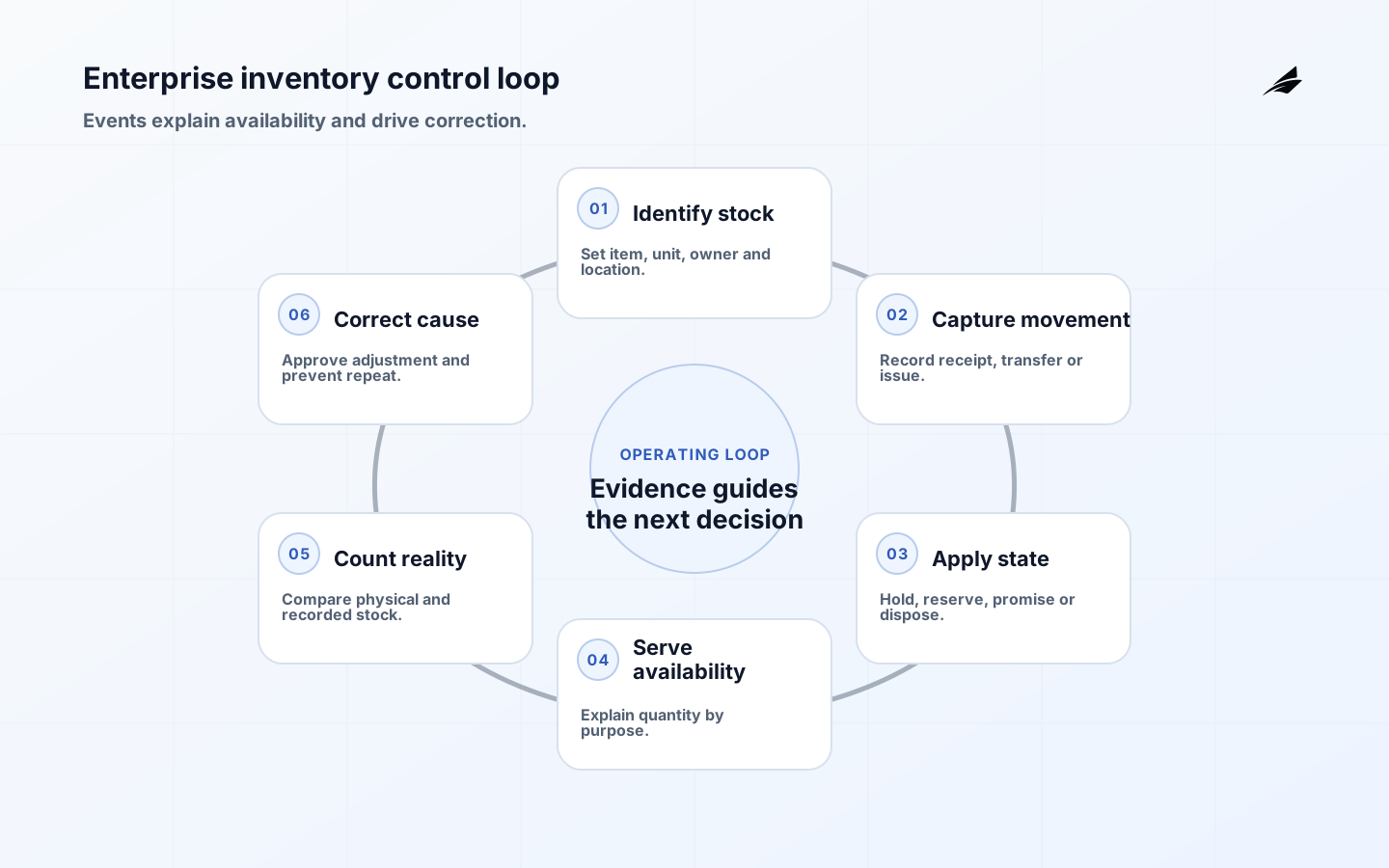
Enterprise inventory systems must answer a deceptively simple question: what quantity of a specific item is available, where, for which promise, at this moment? The answer depends on identity, units, location hierarchy, movement events, reservations, holds, returns, adjustments and timing. A single quantity-on-hand field cannot explain those states or repair them after a missed scan. Strong systems preserve a movement ledger and derive balances that can be reconciled to physical counts and financial records. GS1’s EPCIS standard provides a common language for visibility events across organizations. It emphasizes what happened, when, where, why and to which objects rather than treating inventory as an isolated database number.
Define the inventory promise before selecting software
Start with the smallest population where inventory systems change a meaningful outcome. Write lifecycle states in plain language and identify who may create, approve, amend, cancel, investigate, or close each state. Capture stable references, source authority, and effective time at the moment a decision is made. Ask what a newcomer would need to explain a completed case without unrestricted access or a private spreadsheet. That question reveals the minimum evidence the workflow must retain.
| Decision | Working rule | Evidence to retain |
|---|---|---|
| Boundary | State the inventory systems outcome and exclusions. | Examples, lifecycle states, and success condition. |
| Authority | Name business, technical, and exception owners. | Role, delegation, and escalation route. |
| Identity and time | Keep durable references and effective dates. | Source reference, policy version, and change history. |
| Exception | Route ambiguity visibly rather than silently bypassing it. | Queue, reason, resolver, and disposition. |
Model stock states, movements, and allocation rules
Use durable movement references for receipt, transfer, reservation, pick, return, adjustment, and count; do not overwrite balances without an explanation. Keep movement ledger, availability calculation, allocation policy, and channel publication distinguishable.
Test stock received into quarantine, a web reservation, a cycle-count discrepancy, an in-transit transfer, and a cancelled order. The model should show promiseable quantity, expiry, corrective movement, and channel update timing.
| Failure mode | Design response | Review signal |
|---|---|---|
| Incomplete input | Reject or hold records with an explainable reason. | Required-field and validation-failure trend. |
| Duplicate action | Use stable keys, idempotent handling, and reconciliation. | Duplicate rejection and replay volume. |
| Ownership gap | Escalate to a named decision-maker with context. | Aged queue and transfer count. |
| Late correction | Link the compensating action to the original record. | Correction cycle time and recurrence. |
Use evidence and controls deliberately
For inventory systems, use NIST Cybersecurity Framework guidance to name governance and recovery responsibility, and use the NIST Privacy Framework to evaluate data purpose and exposure. Apply OWASP ASVS to sensitive actions, authorization, and audit evidence. Google's monitoring guidance is useful for separating a signal that needs action from diagnostic context that helps someone understand a failure. These references inform design choices; they do not replace the policy and evidence appropriate to the organisation.
- State the inventory systems decision in language CTOs can test.
- Keep source, state, timing, policy, and correction rationale together.
- Limit service identities and recovery permissions to the action required.
- Test normal work alongside retries, corrections, unavailable dependencies, and disputed outcomes.
- Reconcile intended work to the final result before treating expansion as success.
Reconcile physical and digital positions
Run inventory systems as an observable service. Give normal and exceptional work a clear state, durable reference, accountable owner, and a defined point where the final result is verified. Exercise unavailable dependencies, late messages, disputed results, and correction paths during rollout. Before expanding to another team, channel, or region, sample completed cases and inspect whether the evidence supports a safe recovery. Connect this work to a related enterprise systems guide so the workflow remains part of the wider operating model.
Make the human interface carry the operational context. A user should see what happened, what evidence is missing, who owns the next decision, and what action is permitted in the current state. Support teams need a constrained view that keeps sensitive data and privileged actions out of routine handling. When policy changes, update the interface, integration contract, runbook, training material, and exception queue together. Otherwise a locally sensible but obsolete workaround becomes the actual process. For inventory systems, tailor that context to the person at the point of action: a steward needs provenance, a responder needs current impact, and a reviewer needs policy evidence. Design the view around the decision rather than a generic record form, then test whether someone can complete the permitted action without resorting to an untracked message or spreadsheet.
Measure availability, accuracy, and exception age
Track stock-record accuracy by product and location, reservation expiry, negative-availability attempts, aged movement exceptions, adjustment causes, publishing delay, and count-to-ledger variance. Review the measures with people who create, approve, operate, support, and consume the result. When a measure worsens, trace it to a rule, source, integration, interface, or ownership decision rather than merely asking staff to work faster.
| Signal | Question it answers | Action when it worsens |
|---|---|---|
| Aged exceptions | Where has normal processing failed to produce a final result? | Assign a resolver, classify the cause, and prevent blind replay. |
| Manual overrides | Which rule, input, or ownership boundary is failing? | Review the decision trail and repair the upstream cause. |
| Reconciled outcomes | Did expected work produce the intended result? | Pause expansion until material differences are understood. |
Build a controlled first release
Build the first release around one consequential inventory systems decision and a deliberately limited population. Bring the business owner, technical owner, operator, and support path into the same review so they can agree what a correct result looks like. The scope should be small enough to inspect completed cases, but real enough to exercise actual handoffs, source data, and dependencies. This is where assumptions become testable operating rules.
Write acceptance checks that retain stable identifiers, source evidence, effective time, policy version, and the final business outcome. Confirm that the workflow produces the intended effect once and that a person can explain why it happened. Use examples from current operations, including incomplete input and a changed circumstance. A concrete case gives engineering and operations a common reference when implementation details begin to hide the underlying decision. In inventory systems, acceptance evidence should connect the initiating fact to the resulting operational state, including the version of any rule or contract used. That makes a completed test meaningful to both the delivery team and the person who will later resolve an exception.
Exercise the exception path before expanding inventory systems. Decide what may retry, what must pause, who can correct a result, and how recovery is verified. Corrections should be bounded by an identifiable record and connected to the original action; broad replay or direct editing is rarely an adequate response to a consequential problem. A rehearsed recovery route makes the normal path safer because staff do not need to invent authority during pressure.
Hold a recurring evidence review that samples completed work as well as unresolved items. Look for missing context, unnecessary overrides, repeated upstream defects, or handoffs that leave a customer or colleague without a clear next step. Turn the finding into an owned improvement to policy, interface, source quality, contract, or support guidance. Metrics identify where to look; representative cases reveal what must change. For inventory systems, make the review population deliberate: choose an ordinary completed case, a delayed or rejected case, and a correction from the same period. Trace each item from the initiating evidence through every handoff to its final result. Ask whether the stated owner could act with the available context, whether a downstream consumer received the right state, and whether a customer, employee, supplier, or colleague would receive an intelligible explanation. Record a specific improvement and return to the same measure in the next review; otherwise a meeting can describe a known weakness without changing it.
As inventory systems grows, keep operational change close to the work. Version meaningful rules and contracts, notify affected owners, test a representative population, and retain a rollback or compensating option. Expansion is justified when the current scope can reconcile expected work, explain exceptions, and recover predictably. Adding volume before those behaviours are proven creates more activity without creating more control.
Build availability from events and explicit states
Define item, lot or serial identity; stocking and fulfillment locations; units; ownership; condition; and event types before integrating channels. A receipt should reference a purchase order; a transfer needs dispatch and receipt states; a reservation should expire or convert; a return remains unavailable until disposition. The ERP integration guide covers financial handoffs, the procurement software guide covers inbound commitments, and the enterprise reporting guide explains shared measure definitions.
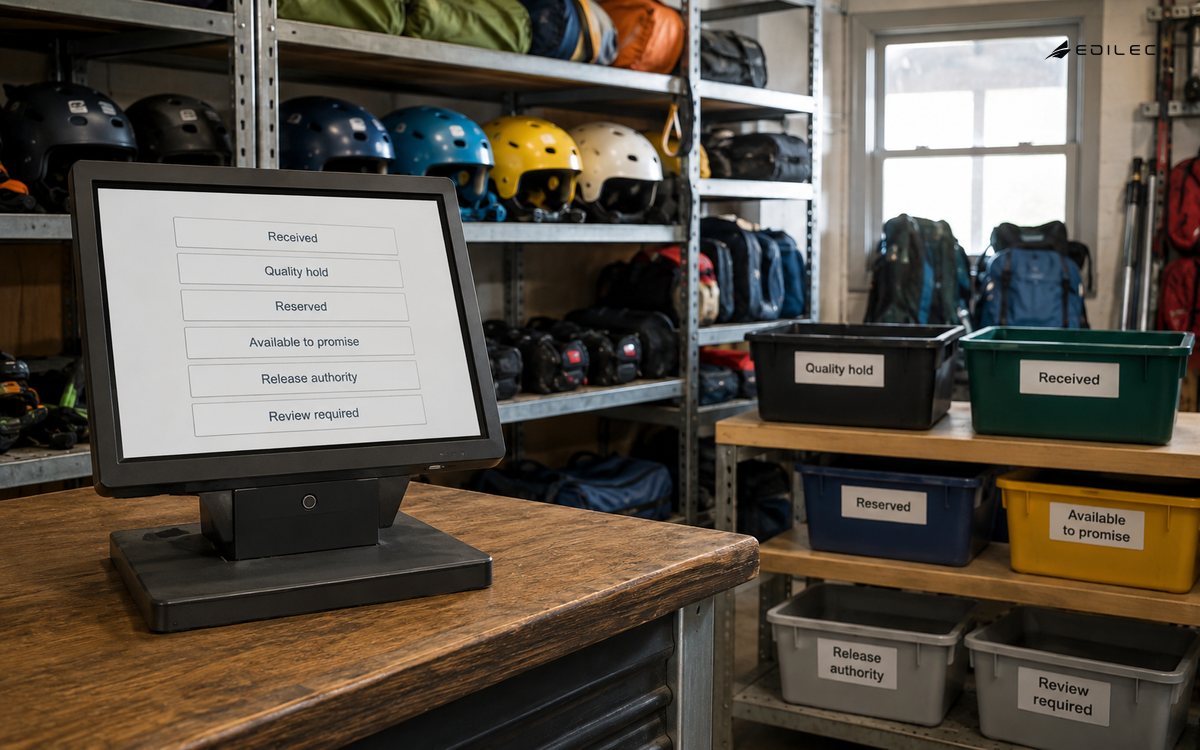
If a warehouse receives 100 units, quality holds 8, orders reserve 30 and a picker finds 3 damaged, physical on-hand may be 97 while available-to-promise is 59. A useful service shows that arithmetic and its source events. It should not overwrite 97 with 59 or let channels invent different meanings. The GS1 EPCIS implementation guideline illustrates capture and query patterns. Use immutable event references, idempotent ingestion and controlled adjustments so late or duplicated messages can be reconciled.
| Inventory state | Physical on-hand? | Available-to-promise? | Control |
|---|---|---|---|
| Received and accepted | Yes | Yes | Receipt matched to source |
| Quality hold | Yes | No | Reason and release authority |
| Reserved | Yes | No | Order link and expiry |
| In transfer | Policy-dependent | No until destination receipt | Paired dispatch and receipt |
| Damaged | Until adjusted | No | Count, disposition and approval |
| Returned | After receipt | Only after disposition | Return reference and inspection |
Key takeaways
- Anchor inventory systems in a consequential decision rather than a platform ambition.
- Make state, authority, timing, and evidence visible where people act.
- Design correction, retry, and reconciliation before scaling automation.
- Use recurring exceptions to improve upstream quality and policy.
- Judge success by reliable outcomes for the people affected.
Frequently asked questions
What is the first practical step for inventory systems?
Is real-time inventory always necessary? Only when the customer promise requires it; reliable reconciled batches can be safer for less time-sensitive decisions.
How should teams handle exceptions?
Who approves stock adjustments? Set authority by reason and materiality, with stronger review for high-value, write-off, or policy-exception adjustments.
Conclusion
An enterprise inventory system is dependable when every balance can be explained by movements, states and controlled corrections. Standardize identity and units, preserve event history, separate physical stock from promiseable stock and reconcile continuously. Technology leaders should judge the platform by its behavior during late events, duplicate scans, partial transfers and physical differences, not by its ideal-path dashboard. Inventory accuracy is an operating discipline made visible by software.