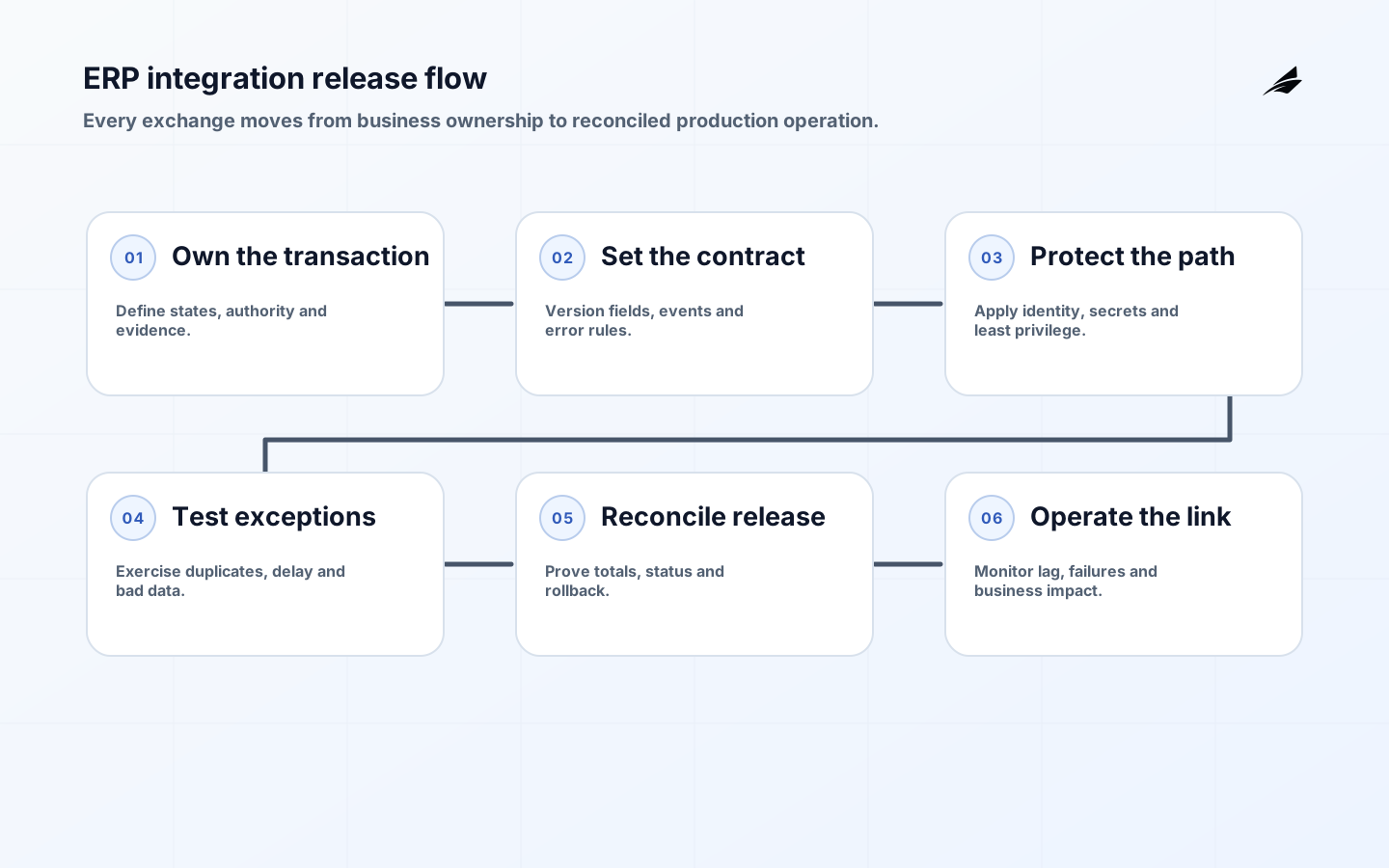
An ERP integration is reliable when both sides agree what a business transaction means, can prove what happened, and can recover without silently duplicating or losing work. This ERP integration checklist covers the decisions that matter from discovery through production. It applies to APIs, events, files and middleware because transport is only one layer of the operating contract.
Use Edilec's ERP integration first-principles guide to clarify core concepts, the engineering guide to ERP integration for implementation choices, and the production ERP integration guide for ongoing operations. This checklist is the acceptance path connecting them.
Key takeaways
- Define the business transaction, authority and system of record before choosing middleware.
- Version schemas and behavior, including errors, retries, ordering and effective dates.
- Make duplicate delivery safe and reconciliation a designed capability.
- Test business exceptions and partial failure, not only valid sample payloads.
- Cut over in observable slices with rollback and accountable production ownership.
1. Define the transaction and ownership boundary
Name the initiating event, business outcome, ERP object, downstream consumers and accountable owner. Draw the states a transaction can occupy: created, validated, approved, posted, rejected, reversed and closed, for example. Decide which system is authoritative for each state and attribute. Avoid the phrase bidirectional synchronization until the team can explain conflict authority and timing for every field.
Record volume, peaks, latency tolerance, operating hours, historical load and retention. Separate commands from facts: a request to create an invoice is not evidence that the invoice was posted. Assign a stable correlation key that survives retries and crosses every participating system. Define what operators and auditors must be able to reconstruct months later.
| Checklist area | Decision to record | Evidence | Owner |
|---|---|---|---|
| Business scope | Trigger, outcome and excluded cases | Approved process and state map | Process owner |
| Authority | System and role authoritative by field | Source matrix and access model | Data owner |
| Service objective | Volume, latency and recovery target | Measured baseline and capacity test | Service owner |
| Evidence | Correlation, history and retention | Searchable transaction trail | Control owner |
2. Specify the interface contract
Describe fields, types, units, currencies, time zones, enumerations, null meaning and identifier rules. Include examples for valid, invalid and boundary cases. For HTTP APIs, the authoritative OpenAPI Specification provides a machine-readable description format, but a schema alone does not define business behavior. Document authentication, authorization, pagination, rate limits, concurrency, timeouts and status semantics too.

Choose a compatibility policy. Additive fields may be safe for tolerant consumers; changed meaning is not. Publish deprecation dates and consumer inventories. For events, define partitioning and ordering scope. For files, define naming, completion markers, checksums, duplicate handling and late arrival. For every mode, specify an idempotency key and the response to a replay after success, rejection or uncertain timeout.
3. Protect identities, secrets and data
Give each integration workload its own identity and minimum permissions. Separate read, create, approve, post and reverse capabilities. Store secrets in a managed facility, rotate them without synchronized downtime and prevent them from entering payload logs. Validate sender, destination and message integrity. Encrypt transport and apply appropriate protection to queues, files, backups and support exports.
Threat-model the whole delivery path, including middleware administrators, support consoles and non-production copies. The NIST Cybersecurity Framework helps connect governance, protection, detection, response and recovery, while the OWASP ASVS supplies testable application-control requirements. Apply the NIST Secure Software Development Framework to integration code, build pipelines and third-party connectors.
4. Engineer exceptions and reconciliation
Classify errors as retryable, correctable, permanently rejected or operationally unknown. Bound retries with backoff and a terminal queue; infinite retries turn one bad record into congestion. Preserve the original payload, validated transformation, error code, attempt history and responsible queue without exposing sensitive values broadly. A corrected replay must retain lineage to the first attempt.
Reconciliation compares business truth, not just message counts. Match transaction keys, amounts, currency, status and relevant dates between source and ERP. Explain legitimate timing differences and assign unmatched items. Run control totals by batch or period, and make reversal explicit rather than editing history. Finance-facing flows may require approval separation and evidence that a posted document balances.
| Failure case | Expected behavior | Test evidence | Operational signal |
|---|---|---|---|
| Duplicate delivery | Return prior result or ignore safely | Same key sent before and after timeout | Duplicate count |
| ERP unavailable | Queue or fail without losing state | Extended outage and recovery test | Oldest pending age |
| Bad reference data | Reject with actionable reason | Missing vendor, account or tax code | Correctable backlog |
| Partial downstream success | Expose state and compensate deliberately | Failure after one committed step | Unreconciled transaction |
| Out-of-order event | Hold, reject or process by defined policy | Reordered event sequence | Ordering exception |
5. Test the business lifecycle
Test contract conformance, transformation, permissions, idempotency, throughput, back pressure, restart, time-zone boundaries, precision and maximum field sizes. Use production-like reference data that has been safely synthesized or protected. Include upgrades on both sides. A green happy-path test says little about the integration that will face stale master data and month-end peaks.
Run user acceptance around business evidence. A buyer should trace a purchase order through approval and posting; an accountant should reconcile amounts; a support analyst should diagnose a rejection without database access. Confirm that alerts lead to a named action. Google SRE's monitoring guidance distinguishes symptoms from causes and is a useful reminder to monitor user-visible transaction health, not merely connector processes.
6. Cut over and operate safely
Choose migration sequencing, freeze windows, initial load, delta capture and source-of-truth switch. Rehearse with measured duration and realistic data. Define go/no-go checks for control totals, queue age, permissions and support readiness. Roll back by a pre-agreed point; do not improvise reverse synchronization after both systems have accepted new transactions.
After release, monitor successful business completions, rejection rate by reason, queue age, end-to-end latency, reconciliation breaks and manual correction effort. Keep runbooks for credential expiry, schema drift, ERP maintenance, replay and data correction. Assign service ownership across organizational boundaries and review whether vendor changes or new consumers alter the contract.
Worked example: posting approved supplier invoices
An accounts-payable service sends approved invoices to the ERP. The workflow owns approval evidence; the ERP owns document numbering and posting status. The contract uses a stable invoice-attempt identifier plus supplier and invoice business keys. It defines amounts in minor currency units, tax lines, accounting period, attachments, approval references and the status returned when posting succeeds.
Before submission, deterministic validation checks supplier status, purchase-order balance, currency, tax code and approval authority. The integration identity may create a parked document but cannot approve a supplier or release payment. The ERP response distinguishes accepted, correctable rejection, duplicate and temporary unavailability. A timeout is treated as unknown until the service queries by idempotency key.
A correctable tax-code rejection enters a finance-owned queue with the source invoice, transformed payload and validation error. When a clerk corrects reference data and replays the item, the new attempt keeps lineage to the original. A supplier blocked for suspected fraud cannot be corrected through this queue; that case follows a protected investigation path.
Cutover runs one legal entity and one invoice type in parallel with the prior process. The team reconciles count, net, tax, gross, currency and posting status daily. It measures acceptance, oldest pending item, duplicate handling, correction effort and period-close readiness. The go/no-go decision requires zero unexplained financial difference, tested credential rotation and a rehearsed rollback before the next entity moves.
This scenario also tests ownership. Integration engineers fix delivery and transformation defects; finance resolves accounting exceptions; procurement owns supplier records; security investigates suspicious access; the service owner arbitrates priorities. Without that split, every rejection becomes an engineering ticket and the interface appears unreliable even when it correctly protected the ledger.
The acceptance memo records observed peak throughput, maximum queue age, posting and reconciliation totals, unresolved exclusions, connector and ERP versions, credential-rotation result and named support contacts. Finance signs the business evidence, engineering signs failure recovery, security signs access, and the service owner accepts residual risk. This prevents a successful demonstration from being mistaken for production acceptance and gives later change reviews a concrete baseline.
After go-live, weekly review separates interface defects from valid business rejections. The team trends duplicate attempts, unknown outcomes, old correctable items and manual postings outside the integration. Any workaround that bypasses correlation or reconciliation becomes a tracked risk with an expiry date rather than an undocumented permanent process.
ERP integration readiness checklist
- Transaction states, field authority and approval rights are signed off.
- Contract includes versions, errors, retries, ordering and idempotency.
- Workload identity, secrets, network paths and audit access are tested.
- Exception queues have owners, aging targets and correction procedures.
- Reconciliation proves status and values across the business boundary.
- Cutover, rollback, observability and support have been rehearsed.
Frequently asked questions
Is an API always better than a file integration?
No. APIs suit interactive or smaller exchanges; files can be dependable for controlled batches. Choose from business latency, volume, replay, vendor capability and operating evidence, then engineer the chosen mode completely.
Does middleware remove the need for contracts?
No. Middleware can route, transform and observe messages, but the producer and consumer still need shared definitions, compatibility rules and business ownership. Otherwise the platform only centralizes ambiguity.
How often should ERP integrations reconcile?
Set cadence by consequence and timing. High-value posting may need near-real-time checks plus period totals; lower-risk reference data may reconcile daily. Every break needs an owner and aging target.
Conclusion
A useful ERP integration checklist follows the transaction from authority to evidence. Define meaning, specify behavior, constrain access, make replay safe, reconcile business state and rehearse cutover. Those controls let teams change systems without turning ordinary exceptions into financial or operational uncertainty. Keep the checklist with the service and repeat its critical tests whenever the ERP, connector, schema or business authority changes.