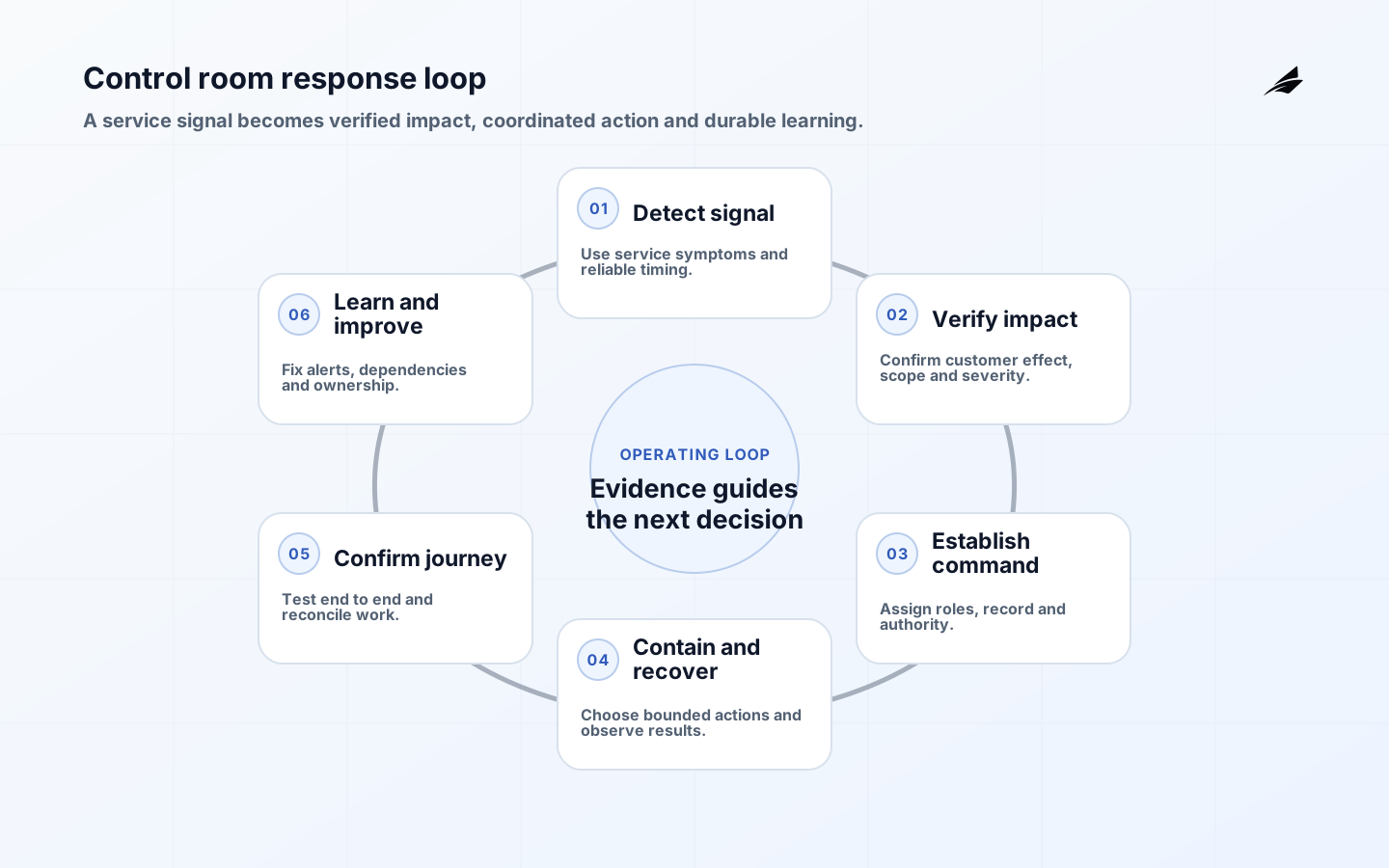
Operations control rooms are an operating discipline for service-state detection and coordinated recovery. It becomes valuable when a team can explain the record, decision, or state that a person must trust, then show who owns it and what happens when it is wrong. The work usually spans customer journeys, outcome signals, incident roles, decisions, and recovery checks. The first useful scope is not “improve the platform”; it is a known service condition that requires a business and technical response. That framing gives engineering, operations, and business owners something concrete to test. It also makes the companion ticketing workflows checklist for reliable digital operations relevant: a system may store a fact, but it does not automatically own every use or correction of that fact.
Edilec’s system of record guide helps establish authoritative state, the ticketing workflow checklist covers assignment, and the CRM automation guide offers lessons for controlled handoffs.
Define service states before selecting a dashboard
Select a user journey and write the service-state vocabulary responders will use during pressure. State which observations establish normal operation, degraded performance, outage, recovery in progress, and unknown condition. For every transition, identify the declaring role, evidence source, effective timestamp, and next required check. A component dashboard turning green should not automatically mean the business journey has recovered. Test the vocabulary against partial failures, stale telemetry, contradictory supplier updates, queued work after mitigation, and noisy alerts. If two operators interpret the same facts differently, resolve the definition before adding panels. The room should preserve enough state and decision history for an incoming responder to understand the situation through approved access rather than private notes.
| Decision | Working rule | Evidence to retain |
|---|---|---|
| Journey scope | Name the customer or operational result under coordinated observation | Included entry and exit points, service owner, and impact threshold |
| State language | Define the observable difference between degraded, unavailable, recovering, and unknown | Queries, freshness requirements, examples, and declaration authority |
| Response command | Assign incident lead, technical leads, communications, and business decision owner | On-call schedule, delegation, severity rules, and escalation contacts |
| End condition | Specify technical restoration, journey verification, backlog reconciliation, and stability window | Test results, remaining work, closure decision, and follow-up ownership |
Build signals around user-facing outcomes
Route each signal to the role capable of changing the outcome. The service owner defines journey health and accepts residual business risk. The incident commander coordinates pace and priorities. Technical leads diagnose and propose bounded mitigations, while communications and support translate the declared state for affected people. Security, privacy, finance, or legal owners join when the facts cross their decision boundary. Keep proposal, approval, execution, and observed result distinct in the incident record. Privileged access should be temporary and limited to the action required; an all-powerful shared administrator account makes response faster only by sacrificing attribution, safety, and later understanding.
- Connect every primary signal to a named journey, material threshold, responder, and expected first action.
- Separate confirmed observations, working hypotheses, proposed mitigations, approvals, execution, and measured results.
- Use expiring incident roles and constrained service permissions rather than permanent broad recovery access.
- Give customer support and communications the declared state and cadence without exposing restricted diagnostics.
- Verify the end-to-end outcome and reconcile residual work before lowering severity or closing the record.
Give an incident response a shared working record
Use one incident timeline as the spine of coordination. Capture when impact was observed, who declared the state, current affected journeys, telemetry and change references, assigned roles, significant hypotheses, decisions, executed actions, and the result expected from each action. Attach links to protected diagnostic evidence instead of pasting secrets or personal records into the shared log. Mark corrections rather than rewriting earlier entries, and distinguish automated updates from human declarations. This structure lets a new shift reconstruct cause and authority without manually correlating several exports. It also keeps an emergency mitigation from becoming undocumented permanent configuration because its owner, scope, and removal condition remain visible.
| Failure pattern | Control | Signal to review |
|---|---|---|
| Competing incident threads | Correlate alerts and tickets under one stable incident identifier | Duplicates merged, owners notified, and active timeline designated |
| Contradictory evidence | Display freshness and provenance and declare impact unknown when proof is weak | Disputed facts, validating owner, and next verification time |
| Risky mitigation | Require the authorized decision role, bounded scope, and reversal plan | Approver, action target, execution identity, expected signal, and result |
| Apparent technical recovery | Keep the incident active until the user journey and queued work are checked | Synthetic or sampled journey, backlog disposition, observation window, and closure decision |
Design the room for decisions, not surveillance
Build the first room around a service that already has an owner, an on-call path, a measurable user journey, and a reversible mitigation. Connect only the alerts, release history, dependency state, runbooks, customer-safe status, and diagnostic links required for its most credible incidents. Implement role-specific views and verify that privileged actions are unavailable from general displays. Run tabletop and live simulations covering false alarm, regional degradation, dependency outage, harmful change, failed rollback, and missing telemetry. The release is ready when participants can establish impact, command, communicate, act within authority, and prove recovery from the same shared record without inventing side channels.
Verify recovery and turn incidents into improvement
Turn incident evidence into a maintenance queue for the operating model. Review whether the first material signal was timely, paging identified the correct owner, the commander obtained useful context, a safe mitigation was available, and journey recovery was demonstrated. Measure alert actionability, acknowledgement, time to a consequential decision, containment, communication punctuality, backlog clearance, and completed follow-ups. Segment patterns by journey, service, dependency, region, release type, and severity. Frequent manual data gathering may justify better integration; repeated authority disputes need policy and rehearsal; recurring rollback trouble points to release engineering. Assign the improvement to the owner able to change the underlying condition and verify its effect in a later exercise or event.
Review the operating design before expansion
Test the playbook with ambiguous scenarios rather than rehearsed happy paths. Slow an external payment service while internal health checks stay green; publish an incomplete supplier update; trigger a release correlation that later proves incidental. Include on-call engineering, incident command, the service owner, support, communications, security, and any business approver for the proposed mitigation. Ask each participant to act using only their normal view and permission. Observe how the group establishes user impact, distinguishes fact from theory, obtains authority, and decides the next update. Record disagreements about state, severity, or closure as defects in definitions and roles, then resolve them before expanding coverage.
Define the incident record schema and its data boundary. Retain the declared service state, impact statement, shared clock, command assignments, material evidence references, decisions, mitigation scope, communications, recovery checks, and follow-up commitments. Include timestamps and authorship so later reviewers can understand what was known at each point. Keep credentials, unrestricted traces, raw personal details, and irrelevant chat outside the general record; link to access-controlled systems when investigators legitimately need them. Apply retention according to operational, contractual, legal, privacy, and learning needs. A concise structured history is more useful than an indiscriminate archive because responders can find the facts that govern correction and accountability.
Predefine safe response envelopes for common hazards. Automated retries need rate, idempotency, and stop conditions; queue replay needs population reconciliation; configuration rollback needs an approved target and health checks; traffic restriction needs a customer-impact limit and expiry. When the signal is uncertain, prefer a containment that is narrow and observable over a broad irreversible change. Track incomplete transactions or requests by stable identifier so repair can address specific work rather than rerun an entire period. Any compensating action should reference the failed operation, record why normal processing was unsuitable, and produce a verifiable final state. These boundaries let responders act quickly without assuming emergency pressure grants unlimited authority.
Shape the primary interface around the next incident decision. Put journey state, material impact, severity, command roles, current containment, major uncertainty, pending approval, and next communication time first. Keep detailed metrics, traces, logs, and topology within drill paths for authorized responders. Label hypotheses and stale data clearly; use text and timestamps as well as color. Embed current runbook actions and escalation contacts where they are needed. Train teams with realistic exercises, then update the screen, alerts, permissions, runbooks, support language, and role guidance together whenever the response model changes. Otherwise the interface can preserve an obsolete playbook long after policy owners believe it retired.
Use explicit adoption gates. The initial service should demonstrate actionable paging, timely command assignment, bounded mitigation, consistent support and executive updates, end-to-end recovery proof, and owned follow-up in both exercises and actual events. Define pause conditions such as rising unowned alerts, frequent broad privilege use, unresolved data exposure, or closure without journey verification. Before onboarding a new region or service, confirm its owner, state definitions, dependencies, impact thresholds, actions, and communication route. Leadership can then distinguish healthy coverage growth from a central dashboard that merely accumulates signals faster than people can govern them.
Use evidence and controls deliberately
Use public frameworks to challenge the playbook from several angles. The NIST Cybersecurity Framework supports explicit governance, incident response, and restoration ownership. When screens or traces contain personal information, the NIST Privacy Framework helps teams examine purpose, access, and data handling. Google SRE monitoring guidance explains why pages should prompt action while deeper diagnostics remain available for investigation. The OWASP Application Security Verification Standard informs authorization and verification of control-room interfaces and privileged actions. Translate those references into the organization's service definitions, risk thresholds, permissions, records, and exercises rather than treating a framework name as proof of operational readiness.
Run the first fifteen minutes as a script
Example: rising checkout latency
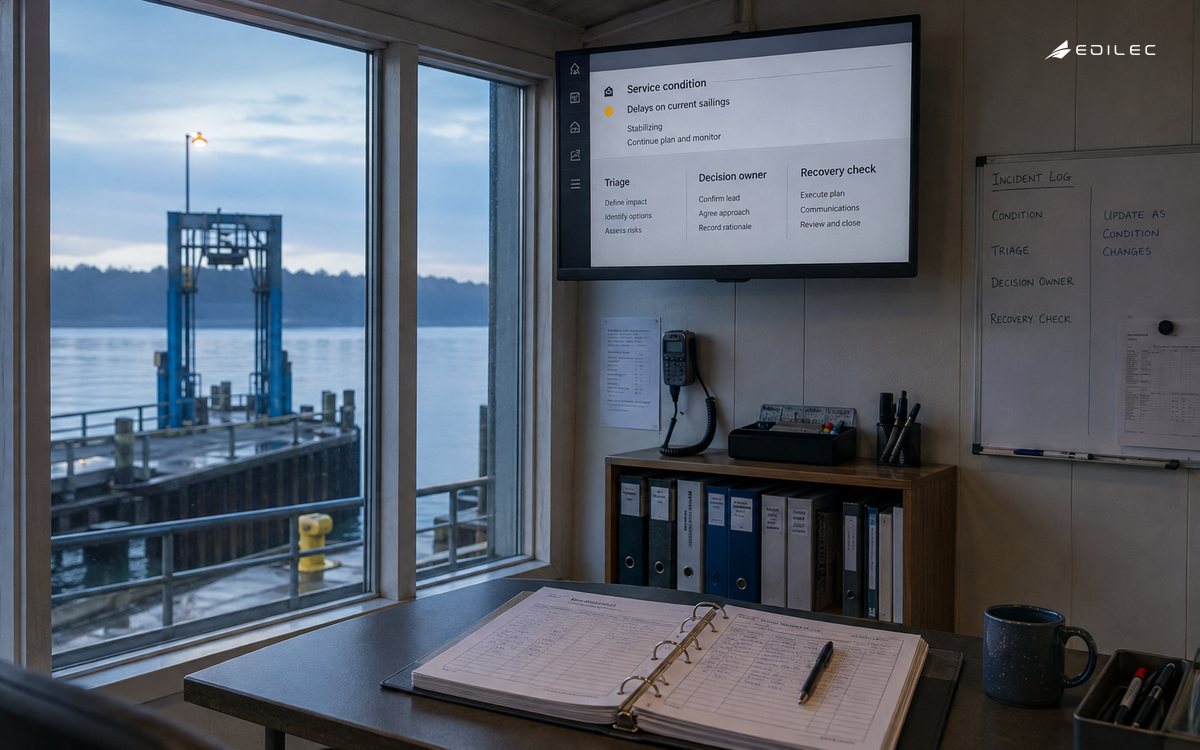
A journey alert shows latency above its objective in one region. The duty lead validates real customer impact, opens an incident record, assigns a commander, and records first known impact and time. A technical lead checks changes and dependencies while communications prepares a factual update. If impact crosses the agreed threshold, severity changes and more responders join. Every major action records who decided, supporting evidence, and the result that should confirm success.
Make uncertainty visible. “Provider suspected” differs from “provider failure confirmed”; “rollback started” differs from “customer recovery verified.” Use owners and timestamps rather than color alone. After mitigation, confirm the full journey, reconcile queued or duplicated transactions, and observe for a stability window. Close only after follow-up owners accept deadlines. Review alert usefulness, handoff delay, change evidence, communication, recovery, and recurring dependencies, then improve the operating design.
Key takeaways
- Begin with one user journey, a shared state vocabulary, and response roles tied to material decisions.
- Maintain a timestamped incident timeline that distinguishes facts, hypotheses, approvals, actions, and results.
- Bound rollback, replay, retry, traffic control, and privileged access before responders need them.
- Confirm customer recovery and reconcile residual work instead of closing on component health alone.
- Feed exercises and incident patterns into owned improvements to signals, platforms, suppliers, and authority.
Frequently asked questions
What belongs on the primary view?
Show journey health, impact, severity, active owner, containment, decision deadlines, and next update. Keep diagnostics one step away.
Who declares an incident resolved?
The commander coordinates closure against technical and business recovery criteria with the service owner. Green graphs alone are insufficient.
Does a control room need a physical room?
No. It needs shared, timely situational awareness and defined response roles. A disciplined digital workspace can work well for distributed teams.
What belongs on the primary view?
Show critical service state, material impact, active ownership, and the next decision. Detailed telemetry should be available for investigation rather than competing for attention.
Conclusion
An operations control room succeeds when a weak signal becomes a coordinated, evidence-based response without losing customer context. Script the first minutes, assign authority, distinguish hypotheses from facts, verify recovery, and turn learning into owned change.