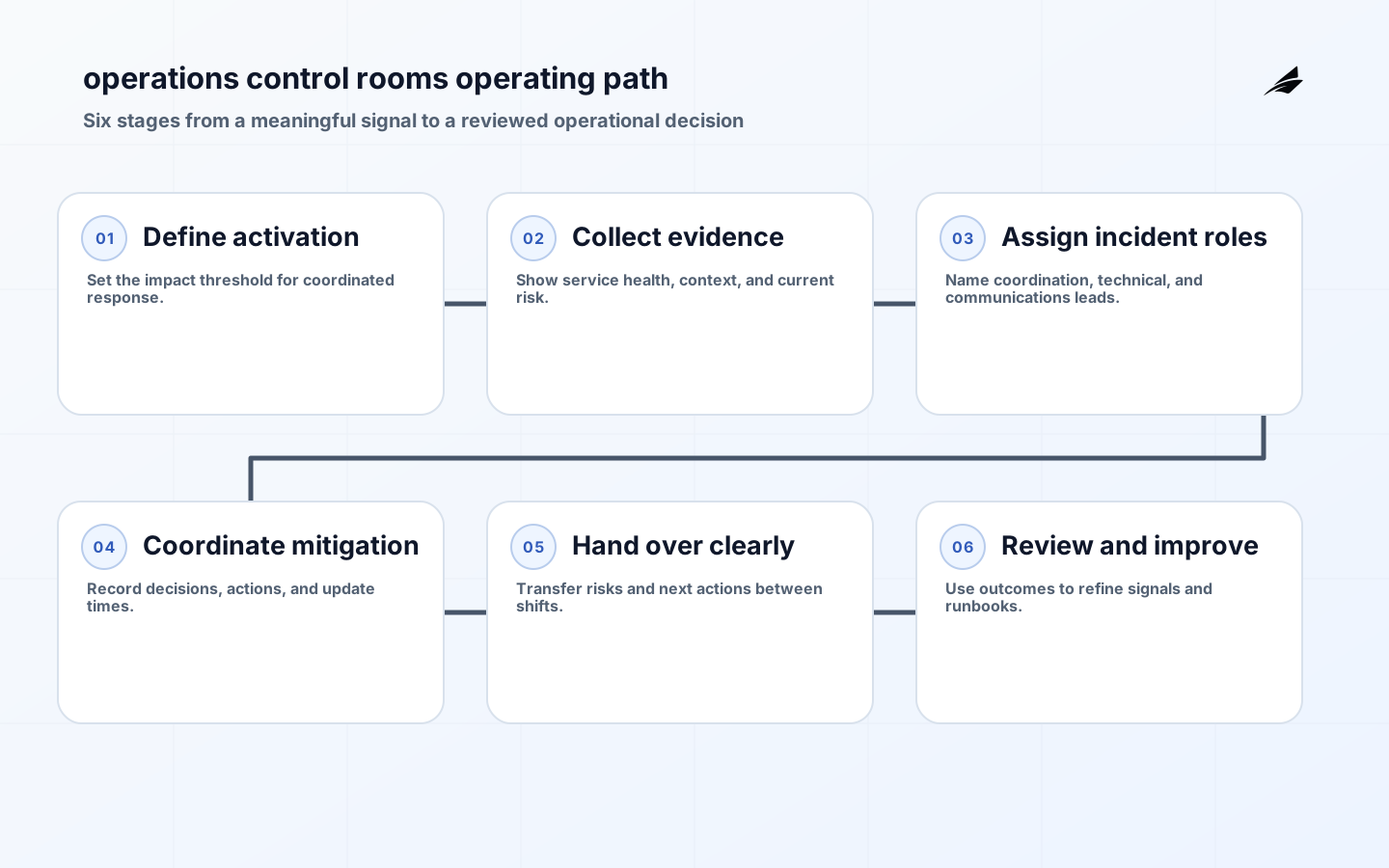
Operations control rooms are valuable when they shorten the distance between a meaningful signal and an accountable decision. A room full of screens does not create operational control; it can just as easily create noise and spectators. Whether the team meets in a physical space or a digital incident channel, it needs a shared view of service objectives, current impact, ownership, and the next decision that will reduce uncertainty.
Build operations control rooms around an accountable operating model
Define the operating scope before selecting displays. A platform control room may cover customer-facing availability, deployment risk, and security events; a logistics room may cover fulfillment, capacity, and disruption. For each scope, state which events warrant active coordination, who declares an incident, which systems provide evidence, and when responsibility returns to ordinary teams. Do not turn every alert into a control-room event. Teams planning adjacent work should also consider this ticketing workflows guide, because shared records and handoffs often determine whether an apparently local improvement survives production use.
Define the records and states that make operations control rooms explainable
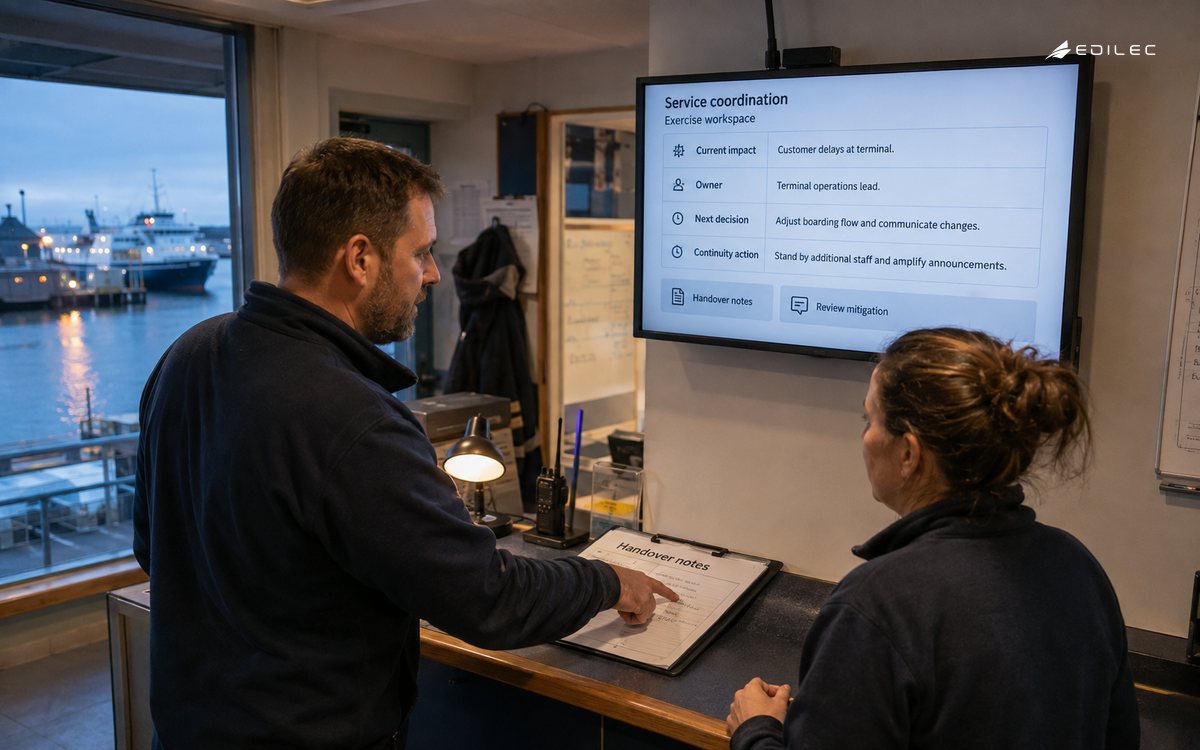
Build the view around decisions rather than data sources. A responder needs to know what changed, which customers or services are affected, which mitigation is active, and when the next update is due. Combine leading indicators such as error budget burn, queue growth, or capacity headroom with lagging indicators such as completed orders or resolved incidents. Make the evidence drillable: a red status without a path to logs, traces, or business context invites speculation.
| Decision | Practical definition | Why it matters |
|---|---|---|
| Activation | Customer impact or defined operational risk threshold | Avoids treating every alert as an incident |
| Primary view | Service outcome, current impact, owner, next decision | Keeps coordination grounded |
| Escalation | Change freeze, supplier call, continuity action | Makes authority clear under pressure |
| Handover | Current mitigation, risks, next update, decision log | Prevents loss of context between shifts |
Set ownership and controls before automating the happy path
During a material incident, assign an incident lead to coordinate, a technical lead to direct investigation, and a communications owner to maintain a factual update cadence. The incident lead should not be the only person who can approve a rollback or a customer message. Establish decision thresholds in advance, including when to freeze changes, invoke a supplier, or activate continuity procedures. Record major decisions and the evidence that supported them. The related ERP integration guide is a useful comparison when the design includes cross-team rules, because both practices depend on knowing whose decision controls the next state.
- Choose one service journey and define the impact that merits coordinated response.
- Assign incident, technical, and communications roles with named backups.
- Map each displayed signal to a decision, owner, and source of truth.
- Set thresholds for change freezes, escalations, and continuity actions.
- Run a rehearsal with stale data and an explicit shift handover.
- Review incidents for missing evidence, delayed decisions, and recurring conditions.
Deliver operations control rooms in slices and make exceptions visible
Begin with one service journey and one scenario that has caused real disruption. Define three to five signals that reveal customer impact, instrument the handoffs, and rehearse the response with the people who will be on call. Add dashboard panels only when someone can name the decision they support. Test stale telemetry, contradictory signals, a loss of access to the primary observability tool, and a long-running incident that requires shift handover.
Use operating signals that lead to an action
Measure detection quality, time to acknowledge, time to mitigation, recurrence, handover completeness, and the number of decisions delayed by missing evidence. Do not use a single time-to-resolve number to judge every incident; a rapid but unsafe rollback can hide risk, while a longer investigation may prevent recurrence. Review whether service-level indicators reflected actual customer impact and whether alert thresholds created meaningful attention.
| Control area | Signal to review | Accountable role |
|---|---|---|
| Detection | Signal-to-incident relevance and false-positive rate | Observability owner |
| Coordination | Acknowledgement and update cadence | Incident lead |
| Mitigation | Time to safe containment or rollback | Technical lead |
| Learning | Corrective-action completion and recurrence | Service owner |
Common operations control rooms failure modes and practical responses
Operations control rooms have their own failure patterns. A configured tool can still fail because a key record is ambiguous, authority is missing, or an integration hides a rejected change. Treat each repeated exception as a case with evidence, a named owner, and a specific decision about whether policy, data, process, or code must change. That approach preserves operational learning without normalizing a workaround as part of the system.
Use a decision workshop before expanding scope
A useful decision workshop for operations control rooms starts with a concrete operating case rather than a platform diagram. Put the people who create the record, apply the policy, consume the result, and repair failures in the same discussion. Ask them to trace the first design choice: activation. The team should agree on customer impact or defined operational risk threshold and why it matters: avoids treating every alert as an incident. Then repeat the exercise for primary view. Disagreement is useful evidence; it often reveals that two teams have been using the same term for different business conditions.
Turn the workshop into a short operational rehearsal. First, choose one service journey and define the impact that merits coordinated response. Next, assign incident, technical, and communications roles with named backups. Then test whether the team can map each displayed signal to a decision, owner, and source of truth. Do this with a representative, non-sensitive record and an ordinary time constraint. A review that only describes the ideal path will miss the handoff, authorization, or missing-data condition that causes the real escalation. The purpose is to make ownership and evidence usable before more users depend on the workflow.
The exception path deserves equal design attention. Use the next steps as a practical test: set thresholds for change freezes, escalations, and continuity actions. Also, run a rehearsal with stale data and an explicit shift handover. Finally, review incidents for missing evidence, delayed decisions, and recurring conditions. Record the decision with the relevant source evidence and avoid repairing a symptom in a private message. When an exception returns, compare it with the earlier case; recurrence is a signal to change the input rule, policy, mapping, or service boundary rather than simply closing another ticket.
As scope grows, preserve the second set of design choices. For escalation, the operating definition is change freeze, supplier call, continuity action; this matters because it makes authority clear under pressure. For handover, use current mitigation, risks, next update, decision log so the team can prevent loss of context between shifts. These details are where a pilot becomes a service other teams can rely on. They also give reviewers a stable way to distinguish a legitimate exception from an undocumented bypass.
Review evidence on a regular cadence with the people able to change the system. Look at detection through signal-to-incident relevance and false-positive rate, owned by observability owner. Pair that with coordination: acknowledgement and update cadence. The goal is not a perfect dashboard. It is a short list of decisions: which failure needs an immediate repair, which trend needs a policy change, and which measurement no longer represents the operating outcome the team cares about.
Use a written acceptance test for the next release of operations control rooms. The test should show that a normal record completes, an invalid record is stopped with a useful reason, and a corrected record can continue without creating a second outcome. It should also prove the policy behind activation remains visible to the person reviewing the result. These tests create shared confidence between the business owner and the delivery team, especially when a change crosses an integration boundary.
Keep the review practical by sampling a recent case and asking the questions users actually ask: Does an operations control room need a physical room? Which metrics belong on the main display? How often should the team run exercises? Then compare the answers with the current evidence in the system. The control view should help the responsible team inspect mitigation through time to safe containment or rollback, and decide whether the next improvement belongs in policy, data, product behavior, or operations. This small discipline prevents a growing system from accumulating unexplained exceptions.
Key operations control rooms takeaways
- A control room should organize decisions and evidence, not decorate a wall with metrics.
- Roles and escalation thresholds are most valuable when agreed before a stressful event.
- Rehearsals reveal blind spots that a dashboard review cannot.
Frequently asked questions about operations control rooms
Does an operations control room need a physical room?
No. A shared digital workspace can work well when it has reliable communication, a common incident record, decision-ready views, and clear ownership. Physical proximity is less important than a practiced coordination model.
Which metrics belong on the main display?
Use metrics that answer a time-sensitive decision: customer impact, service health, queue or capacity risk, and mitigation progress. Keep detailed diagnostic data available through drill-down rather than placing every telemetry stream on the primary view.
How often should the team run exercises?
Run enough exercises to keep roles, access, and escalation paths familiar, especially after material architecture or staffing changes. Vary scenarios so the team practices ambiguity, tool loss, and handover as well as straightforward outages.
Conclusion
An operations control room is a disciplined coordination practice, not a dashboard project. Give it a narrow mandate, decision-ready evidence, clear roles, and a learning loop after material events. When the room helps a team make fewer unsupported decisions and restore the right service outcome faster, it has earned its place in operations.