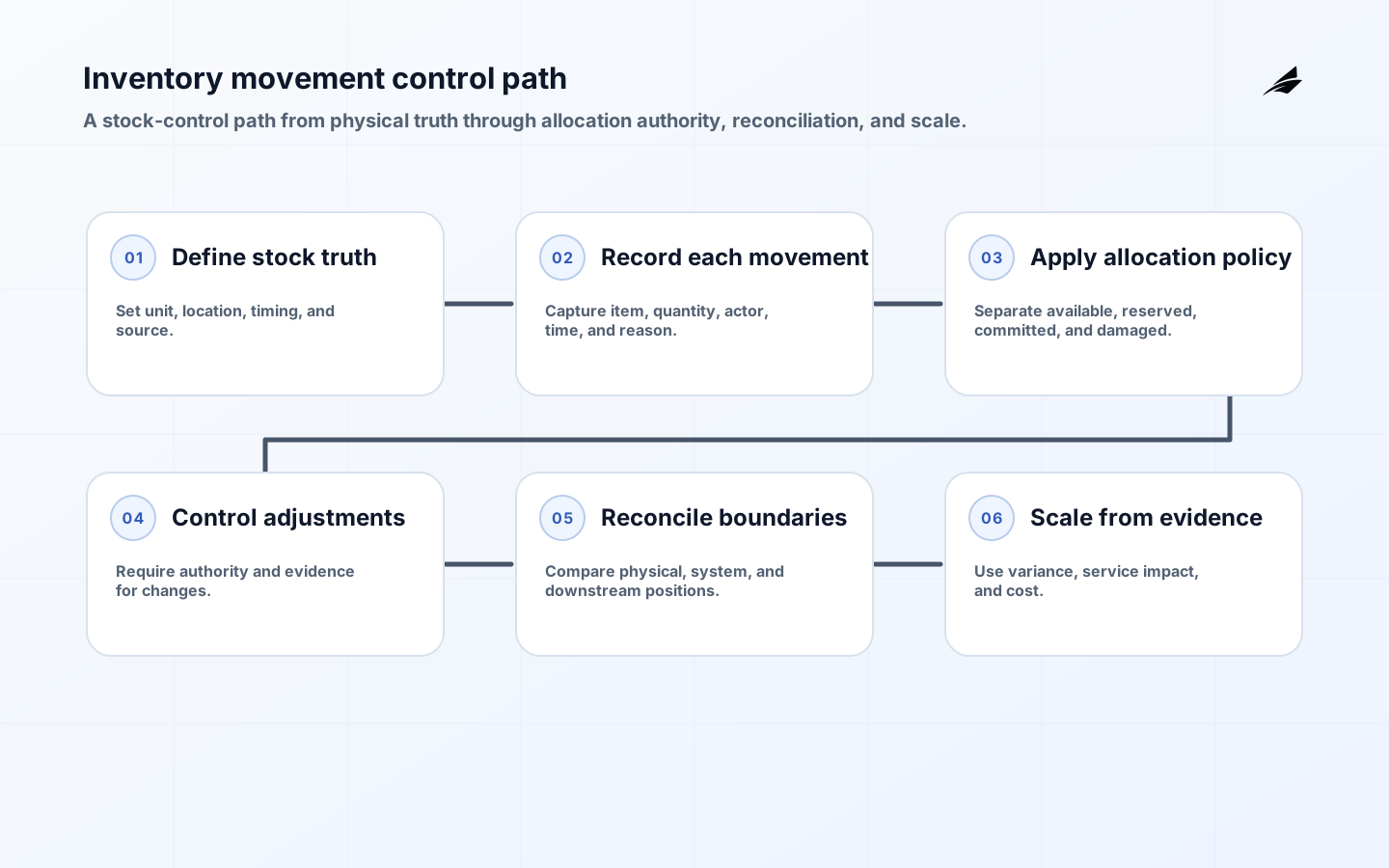
Inventory systems make a promise about what can be sold, reserved, picked, transferred, counted, or reordered. That promise affects customer expectations, cash, procurement, warehouse labor, and financial reporting. Scaling the system is therefore not only a question of database capacity or scanner count. It asks whether the organization can preserve an understandable stock position across locations, channels, returns, damaged goods, in-transit inventory, and late or duplicate movement messages. The most expensive failures often arise from unclear semantics: one team thinks an item is available when another considers it reserved, or a stock adjustment fixes a count without recording the cause. A practical inventory system makes the business meaning of each movement and balance inspectable.
Define the inventory truth
Start with the units and states that the business actually needs: on hand, allocated, available to promise, picked, shipped, received, quarantined, damaged, returned, and in transit may each have a different operational meaning. Define the item identity, unit of measure, location hierarchy, lot or serial requirement, ownership, valuation relationship, and time policy. Decide which system creates each movement and which service calculates availability for each customer channel. The inventory systems guide offers useful context for separating a physical count from a commercial availability promise. Do not hide a business policy inside a report formula or warehouse worker workaround.

| Stock concept | Question | Example evidence |
|---|---|---|
| On hand | What is physically or custody-held? | Receipt, count, or transfer record. |
| Allocated | What is committed to another demand? | Order or work reservation. |
| Available | What may be promised now? | Policy calculation and timestamp. |
| Adjustment | Why did the balance change outside a normal movement? | Reason code and approver. |
Capture movements with durable identity
Treat stock as a result of movements, not a number that can be edited without context. A receipt, pick, shipment, transfer, return, count variance, and adjustment should carry a unique reference, item, quantity, unit, location, time, source, actor or device where appropriate, and related business document. Ensure retry behavior is idempotent so a scanner resend does not decrement stock again. Keep a reversal or correction linked to the original movement rather than overwriting it. This makes investigation possible when a customer sees availability that the warehouse cannot fulfill. The principles used in ERP integration are directly relevant to event identity, acknowledgement, and reconciliation across systems.
- Use consistent item and location identifiers across sales, warehouse, and finance boundaries.
- Record both event time and processing time for delayed scans or imports.
- Make unit-of-measure conversion explicit and test it with representative products.
- Use reason codes and authority rules for inventory adjustments.
- Retain links from a movement to the order, transfer, count, or return that caused it.
Control allocation and exceptions
Allocation is where an apparent stock number becomes a customer commitment. Establish prioritization rules for channels, customer classes, safety stock, backorders, substitutions, and partial fulfillment. When availability is uncertain, choose a conservative promise or a visible review state rather than selling the same unit twice. Exception paths need owners for negative inventory, late transfer confirmation, damaged stock, count discrepancy, and item-master change. The NIST Cybersecurity Framework provides a helpful framework for linking governance, detection, response, and recovery around these operational conditions. A system that notices negative inventory but has no resolver has not controlled the risk.
| Exception | Likely cause | First response |
|---|---|---|
| Negative available stock | Duplicate allocation or delayed movement. | Pause unsafe promise and reconcile references. |
| Count variance | Loss, damage, timing, or process error. | Verify physical evidence and authorized adjustment. |
| Transfer not received | Carrier, receiving, or message issue. | Compare dispatch, transport, and receipt states. |
| Oversell risk | Concurrent channel demand. | Apply reservation policy and review allocation. |
Secure adjustments and master data
Inventory adjustments can affect customer commitments, valuation, supplier claims, and performance reporting. Limit who can perform or approve them, require a reason and evidence proportionate to the impact, and preserve the prior balance and linked movement. Protect item, supplier, and employee information in interfaces and exports. The OWASP Application Security Verification Standard is relevant for authorization, input validation, audit logging, and safe error handling. Access rules should distinguish ordinary scanning from bulk correction, master-data maintenance, and valuation-related actions. Review temporary or emergency permissions once the urgent work is complete.
Understand the cost of complexity
Create a decision record for each major inventory capability: why it exists, which stock states and users it affects, the source of truth, the control owner, and the test used before rollout. This record is valuable when a later warehouse, channel, or finance change challenges an earlier assumption. It also reveals redundant custom behavior that can be retired before the next scaling phase adds another layer of exceptions and support burden.
Include physical process capacity in the scale decision. A new scanner workflow, bin structure, replenishment rule, or count cadence changes how warehouse colleagues receive, move, and verify goods. Observe the task time, exception rate, label reliability, and training burden alongside system throughput. A technically fast interface that creates confusing physical work can increase inventory variance rather than reduce it. The best scaling plan keeps system design and floor reality in the same review.
Inventory-system cost is broader than licenses, devices, and implementation effort. Include process design, item and location data cleanup, integration development, label and scanner operation, training, cycle counts, support, exception handling, security review, and the cost of an incorrect promise. Complexity rises with warehouses, sales channels, units of measure, lot or serial tracking, kits, returns, ownership models, and regulatory requirements. A feature is worthwhile when it prevents a material failure or reduces recurring work with evidence, not simply because a larger competitor uses it. Start by measuring the operational cost of the current ambiguity before buying a more elaborate capability.
Choose scaling increments that preserve learning. Adding one fulfillment location may expose location-master, transfer, and receiving rules that were invisible in a single-site operation. Adding a marketplace may introduce reservation timing and cancellation behavior that differs from direct sales. Introduce the new dimension with a clear scope, test cases, reconciliations, support coverage, and observation window. Resist making several major changes at once, because a stock discrepancy then becomes difficult to attribute. A staged rollout gives warehouse, customer-service, finance, and engineering teams evidence about which assumptions held.
Capacity planning should account for operational bursts as well as averages. Seasonal promotions, stock counts, carrier cutoffs, returns peaks, and product launches can create a concentrated stream of updates and exceptions. Test how the system behaves when movement processing is delayed, a location is offline, or a channel cannot receive the latest availability. Define safe degraded behavior, such as temporarily reducing a promise, pausing a sync, or routing an order for review. That preparation is often cheaper than trying to recover credibility after customers have been promised inventory that no longer exists.
Reconcile and scale deliberately
Reconcile movement populations and balances across the warehouse, inventory service, sales channel, and financial system. Use cycle counts and targeted investigations, but also monitor movement-processing delay, reconciliation break age, adjustment rate by reason, reservation expiry, stockout promise failures, and stale availability timestamps. Google SRE monitoring guidance helps separate alerts that demand immediate intervention from trend evidence that informs capacity or process design. Scale one dimension at a time when possible, such as another location, channel, or volume band, and run a defined observation period before making the next commitment. The billing operations checklist also illustrates why population reconciliation matters whenever operational events create financial consequences.
Use adjacent operations guidance only after stock truth and adjustment authority are explicit; this guide stays centred on inventory evidence, control, and scaling.
Define the stock position the operation trusts
An inventory review should define the promise behind each stock state. On-hand describes custody; available-to-promise also depends on reservations, holds, safety stock, and timing. Write the unit, location, effective time, and authoritative movement stream beside the balance. The GS1 Global Product Classification can provide shared product categories, while local policy still decides which items may be promised or substituted.
Record movement with identity and timing
A movement record needs a stable item and location identity, quantity and unit, event time, processing time, actor, and reason. Use the GS1 EPC Tag Data Standard when designing identifiers and tags, and use the GS1 EPCIS Standard to reason about event capture and exchange. A correction should append evidence rather than silently editing the balance, so a warehouse lead can reconcile physical work with the system history.
Apply allocation rules at the commitment point
Scale inventory in observable increments. Reconcile receipts, picks, transfers, returns, reservations, and financial postings before adding another site or channel. Review variance age, adjustment reasons, reservation expiry, stockout promises, and processing delay with the owner who can change the operation. The NIST Cybersecurity Framework 2.0 is a useful control lens for protecting adjustment authority and recovering after a material data or access failure.
- Name the inventory systems decision, owner, timing, evidence, and unacceptable failure.
- Distinguish current, provisional, blocked, corrected, and recovered states.
- Test normal, late, duplicate, denied, partial, and recovery outcomes before expansion.
- Keep source, identity, policy, version, and authority close to consequential actions.
- Review one real exception with operators and record the correction.
Key takeaways
- Define stock states and availability as business policies, not ambiguous labels.
- Capture durable, idempotent movement events rather than relying on editable balances.
- Make allocation and exception rules explicit before customer commitments are created.
- Protect adjustments, master data, and bulk actions with appropriate authority and audit evidence.
- Reconcile across operational and financial boundaries before scaling locations, channels, or volume.
Frequently asked questions
What is the difference between on-hand and available inventory?
On-hand inventory is what is physically or custody-held according to the defined record. Available inventory is the portion the business can promise after applying reservations, holds, safety stock, timing, and allocation policies. They should not be used interchangeably.
When does inventory need a new system?
Consider a new system when the required movement volume, locations, traceability, allocation rules, or integration reliability exceed what current tools can control and reconcile. First confirm that the operating definitions and ownership rules are clear; replacing software does not resolve ambiguous stock policy.
Reconciliation should be scheduled around the business consequence, not only the system clock. A high-value or constrained item may need same-day review, while a low-risk variance can wait for a cycle-count cadence. Record the threshold and the person who can change it.
Conclusion
An inventory system scales when its promises remain explainable as the network becomes more complex. Preserve the meaning and history of every movement, control the actions that change availability, and let reconciliation evidence determine where the next expansion is safe.