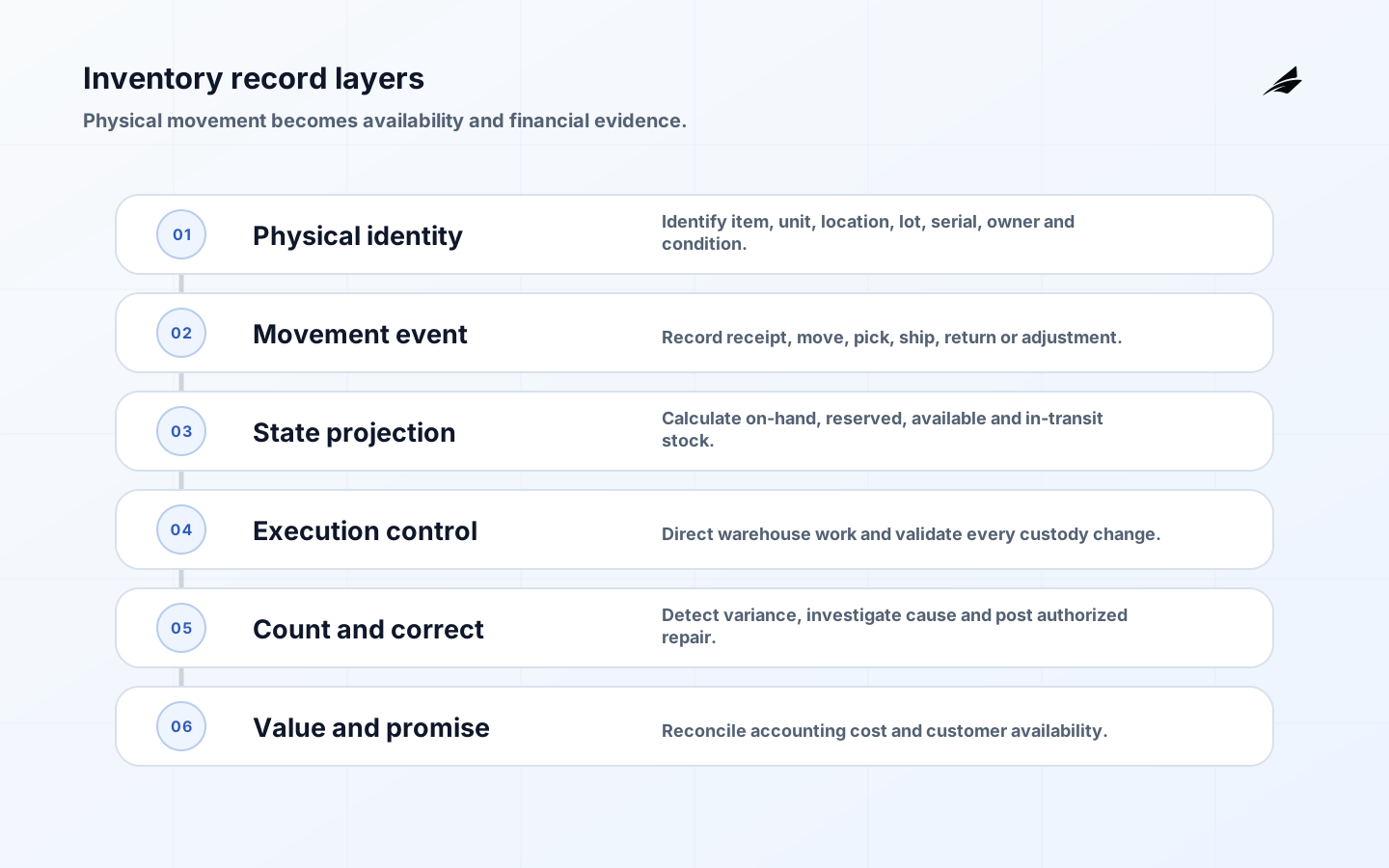
Inventory systems answer a deceptively simple question: what stock do we have, where is it, what condition is it in and how much is available for the next promise? The reliable answer is not a periodically edited quantity. It is the current result of identifiable products, locations, receipts, moves, reservations, picks, shipments, production, returns, adjustments and counts, each recorded with time and authority.
The right system depends on operational complexity. A small distributor may need purchasing, on-hand balances and barcode counts. A multi-site manufacturer may need lots, serials, units of measure, quality status, work-in-process and traceability across partners. Choosing by feature count misses the central test: can the record explain a physical item and recover when physical and digital reality diverge?
Edilec's inventory cost and scaling guide, CTO guide to inventory systems, and inventory production operations guide extend the commercial, architectural and operating decisions covered here.
Key takeaways
- Treat inventory as a movement ledger plus current projections, not a freely editable number.
- Define item, location, lot, serial, owner, condition and unit identities before integrating systems.
- Separate on-hand, reserved, available, expected and financially valued inventory.
- Use counts to detect process failure and investigate causes, not merely post adjustments.
- Select ERP, WMS or specialized tools according to operational authority and transaction volume.
Understand the core inventory record
Every stock position has dimensions. At minimum, it combines item and location; regulated, perishable or high-value operations may add lot, serial, expiry, quality status, owner and handling unit. Quantity also needs a unit of measure and conversion rule. Ten cases are not ten each unless a governed conversion says so. Master-data errors can create stock that is mathematically valid but operationally unusable.
Record movements as immutable business events with a reference, source, actor, timestamp and reason. Corrections should reverse or supersede prior events rather than erasing evidence. GS1's EPCIS standard expresses visibility through what, when, where, why and how, a useful frame even when a company does not implement EPCIS directly. Current balances can then be recalculated or reconciled from traceable events.
| Quantity concept | Plain-language meaning | Typical calculation | Common mistake |
|---|---|---|---|
| On hand | Physically recorded in a controlled location | Receipts plus moves in minus moves out | Including expected purchase orders |
| Reserved | Allocated to a demand or work order | Open allocations not yet consumed | Assuming reservation equals physical pick |
| Available | Eligible for a new promise | On hand minus reservations and holds | Ignoring quality or expiry status |
| In transit | Left one authority but not accepted by another | Open transfer shipments | Counting at both locations |
| Expected | Planned to arrive or complete | Open supply with confidence and date | Presenting planned quantity as owned stock |
| Valued | Quantity carrying an accounting cost | Approved method by inventory class | Using operational estimate as ledger value |
Compare ERP, WMS and specialized inventory tools
ERP inventory commonly connects purchasing, sales, production and finance, making it a strong authority for enterprise stock and valuation. A warehouse management system focuses on execution inside a facility: receiving, put-away, replenishment, waves, picking, packing and labor. Point-of-sale systems capture retail sales; manufacturing execution systems track material consumption and production state; specialized traceability platforms exchange events across organizations.
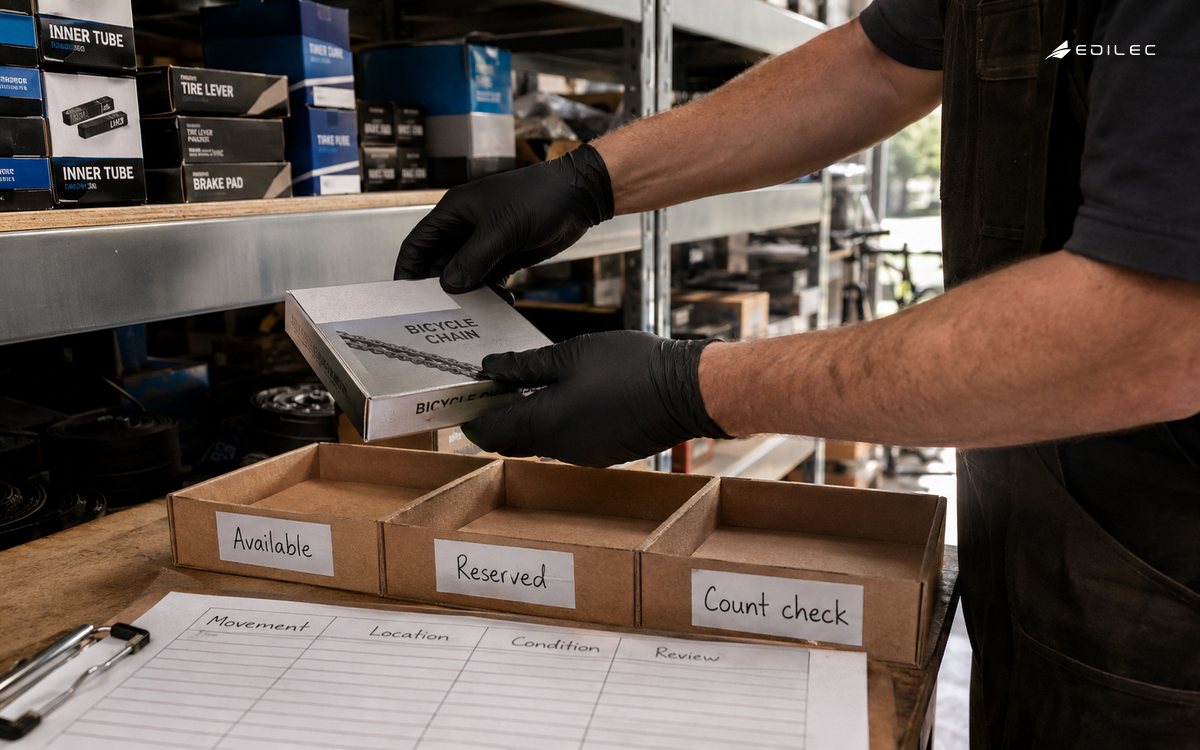
These systems may coexist, but authority must be explicit. A WMS can direct bin-level movement while ERP owns the financial posting. The integration should state when custody transfers, which transaction changes enterprise on-hand and how rejected messages are reconciled. Avoid two systems independently creating the same adjustment. The GS1 standards repository can help teams identify shared identifiers and event vocabularies where trading-partner interoperability matters.
Control every stock movement
Receiving begins with expected supply but must capture what actually arrived: item, quantity, unit, location, condition and, when required, lot or serial. Overages, shortages and damage need disposition rules. Internal moves should confirm both source and destination. Picking and shipping must distinguish allocation, physical pick, packing and dispatch; collapsing them makes it impossible to locate stock during an interrupted order.
Use scanning where it reduces ambiguity, but do not treat a barcode as proof of the whole event. Validate that the scanned identity is expected in the location, unit and process. Require reason codes and appropriate authority for adjustments, scrap and status changes. Monitor negative stock, backdated transactions and manual overrides because they often reveal late recording, interface failure or incentives that favor speed over accuracy.
Make cycle counting a learning system
Cycle counting samples inventory throughout the year so discrepancies surface close to the process that caused them. Frequency can reflect value, movement rate, historical variance, regulatory importance and operational risk. Oracle describes cycle counts as a way to align physical on-hand with system on-hand, while Microsoft's inventory counting guidance shows how policies, journals and item locks affect execution.
A count should be independent where risk warrants it: hide the expected quantity, record the counter and time, and require recount or approval above tolerance. Investigate variance before adjusting. Was a receipt posted to the wrong unit, a pick confirmed late, a product stored in the neighboring bin, or a damaged item left in available status? Trend causes by location, shift, item and transaction type. Repeated adjustment without process repair simply resets the symptom.
| Decision factor | Basic inventory module | Warehouse management system | Specialized traceability platform |
|---|---|---|---|
| Best fit | Low-complexity purchasing and stock | High-volume facility execution | Cross-party or regulated event history |
| Location detail | Site or simple bins | Bins, zones, tasks and handling units | Events across organizations and facilities |
| Execution control | Manual or simple transactions | Directed put-away, replenishment and picking | Capture and query standards, not full warehouse work |
| Integration burden | Lower when embedded in ERP | Requires precise ERP ownership contract | Requires partner identity and vocabulary governance |
| Primary risk | Outgrown controls and manual work | Complex configuration and synchronization | Coverage gaps if operational systems do not emit events |
Keep operational quantity and accounting value aligned
Operations needs exact physical state; finance needs recognized cost. Link them without pretending they are identical. IAS 2 addresses inventory cost, expense recognition, write-downs and cost formulas under IFRS. The applicable accounting policy must come from qualified finance owners. Systems should preserve the quantity events and valuation layers needed to explain postings and period-end reconciliation.
Design a bridge from receipt and production events to inventory and cost-of-sales entries. Control backdating after a period close, currency and landed-cost updates, write-downs, consignment and intercompany transfers. A warehouse correction may change quantity without the same accounting treatment as a purchase-price variance. Reconcile subledger quantity and value to the general ledger with explainable differences, not a forced balancing entry.
Example: a transfer that disappears between sites
Warehouse A ships 40 serialized devices to Warehouse B. At dispatch, A records each serial leaving available stock and creates an in-transit position tied to the transfer. B receives 39 acceptable devices and one damaged device two days later. Its receipt references the same transfer, places 39 in available stock and one in quarantine. The transfer remains open until all serials have an accepted disposition.
A weak design subtracts 40 from A and adds 40 to B in one synchronous update, hiding custody and damage. A robust system can answer where every serial was during transit, who accepted it, why one is unavailable and whether finance needs a loss or claim. That evidence also supports recall and service work later.
Inventory system implementation checklist
- Define item, location, unit, lot, serial, owner and condition identifiers.
- Map each physical step to one authoritative digital event.
- Separate on-hand, reserved, available, expected and in-transit views.
- Set adjustment, backdating and negative-stock authority.
- Design acknowledged, idempotent integrations between ERP, WMS and channels.
- Create count policies and variance investigations by risk class.
- Reconcile quantity, status and accounting value at defined intervals.
- Test offline scanning, duplicate messages, partial receipts, returns and recalls.
Connect inventory records to customer promises
Available-to-promise logic should state which locations, conditions and future supply can support an order, how reservations expire and what safety stock protects. Do not expose raw on-hand quantity as customer availability. A unit in quarantine, a transfer without confirmed receipt or a purchase order with uncertain arrival may be real inventory information without being safe to promise. Preserve the calculation version used when the order was accepted.
Measure promise quality through fill rate, cancellations, substitutions, late allocation and inventory held by expired reservations. Segment by item, location and channel. When channels compete for stock, publish allocation policy and authority rather than letting integration timing decide the winner. During data degradation, reduce promise horizons or switch to conservative availability instead of continuing to sell from a stale projection. This makes inventory accuracy a customer-service control, not only a warehouse metric.
Inventory systems FAQ
Can an ERP replace a warehouse management system?
Sometimes. Simple operations may be served well by ERP inventory. Directed tasks, dense bin control, waves, automation and high transaction volume can justify a WMS. Decide from workflows and service requirements, not company size alone.
Does real-time inventory mean every screen updates instantly?
It means the freshness and consistency are defined for the promise being made. A customer checkout may need seconds; financial consolidation may use controlled batches. Show timestamps and degraded states rather than implying impossible immediacy.
What is a good inventory accuracy percentage?
There is no universal target. Define accuracy at the dimensions that matter, such as item-location-lot, and weight errors by operational and financial impact. A high aggregate percentage can hide shortages in critical items.
Conclusion
Inventory systems create trusted stock by connecting physical identity, movement authority, current projections, counts and financial reconciliation. Choose tools according to the work they must control, make system boundaries explicit and investigate every meaningful variance. When the event history remains explainable, availability promises and accounting records can both stand on firmer ground.